Try it on your own data
Every report in this article is in the free plan. One snippet for web and apps, up to 10 sites.
Start freeTrial-to-paid conversion looks simple, but extensions, early upgrades and trial types change the answer. This guide shows how to calculate it by trial-start cohort and why activation inside the trial is the number that moves it.
What you will learn
- Calculate by trial-start cohort, after every trial has ended
- Never mix card-required and no-card trials in one rate
- Activation during the trial is the leading number to improve
The formula
Free trial conversion rate = trials that became paying customers ÷ trials started, for one trial-start cohort, counted after the trial has ended plus a short grace period.
The cohort part matters. "Customers this month ÷ trials this month" mixes trials that started last month with trials that have not ended yet, the same problem as in lead conversion rate. Pick a cohort (trials started in a given week or month), wait until every trial in it has ended, then count.
Edge cases to decide once
The table lists the cases that change the number most, with a sensible default for each. Whatever you choose, write it down so the rate means the same thing every month.
| Case | Question | Sensible default |
|---|---|---|
| Early upgrade | Upgraded before the trial ended? | Converted, in its start cohort |
| Trial extension | Trial extended by sales or support? | Same cohort, counted after the extended end |
| Grace period | Paid a few days after the trial ended? | Count payments within 7 days of trial end |
| Repeat trials | Same person or company started twice? | Count the first trial only |
| Refund in first days | Paid, then refunded immediately? | Not converted |
| Card-required vs no card | Both trial types running? | Report each separately |
Write the definitions down and keep them stable.
Trial types change the meaning
A trial that asks for a card up front and bills automatically at the end converts a much higher share of trials, because people who start it have already decided to pay unless they cancel. A no-card trial converts a lower share of trials but usually brings in many more of them. Compare the two on customers per visitor or per sign-up, not on trial conversion alone, and never mix both types in one rate.
Activation inside the trial
The trial conversion rate is a lagging number: by the time you see it, the trial is over. The leading number is activation, the share of trialists who reach the action that shows they got value (for example, installing the tracking code and seeing the first report).
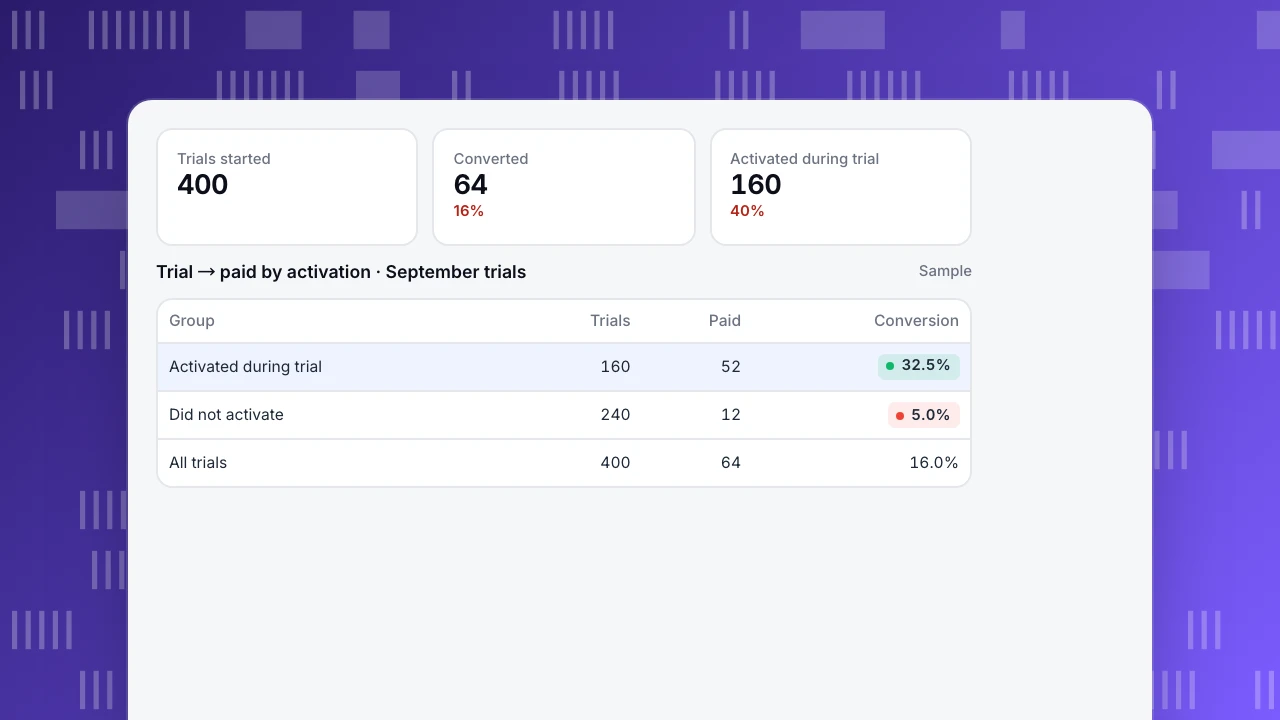
In the example, 400 trials started in a month and 64 converted, 16%. Split by activation, the picture is clearer: 160 activated trialists converted at 32.5%, while 240 who never activated converted at 5%. Raising activation from 40% to 50% of trials would add more customers than any change to the pricing page. Treat this as association, though: people who activate may have been more serious to begin with, so confirm with a before-and-after comparison when you change onboarding. Activation behaves like a validated micro conversion.
Trials started
400
Converted
64
16%
Activated during trial
160
40%
Trial → paid by activation · September trials
Sample| Group | Trials | Paid | Conversion |
|---|---|---|---|
| Activated during trial | 160 | 52 | 32.5% |
| Did not activate | 240 | 12 | 5.0% |
| All trials | 400 | 64 | 16.0% |
How to raise it
- Define activation for your product and measure time to reach it.
- Remove setup steps between sign-up and first value.
- Reach out to non-activated trialists in the first days, while they still care.
- Match trial length to time to value. If most activation happens in three days, a 30-day trial delays the decision.
- Ask at the right moment. Prompt to upgrade after a success, not only on the last day.
Free trial conversion in TapCub
The B2B / SaaS industry pack installs trial_started (with plan), onboarding_complete, feature_used and subscription_started (with plan and mrr, best sent from the server), together with a trial conversion metric, a trial-to-paid funnel and a SaaS growth dashboard (B2B / SaaS pack). A funnel with person identity and a window up to 180 days gives the cohort rate directly; set the window to the trial length plus grace period (funnels). Add the activation event as a middle step to see the split above. More in SaaS metrics, startup metrics and cohort.
FAQ
How do you calculate free trial conversion rate?
Paying customers from a trial-start cohort ÷ trials started in that cohort, counted after every trial in the cohort has ended.
What is a good free trial conversion rate?
It depends heavily on whether a card is required, the price and the audience. Compare your own cohorts over time and split by trial type.
Should early upgrades count as conversions?
Yes, count them in the cohort where the trial started.
How long should a free trial be?
Long enough for most users to reach activation, and no longer. Measure time to activation and set the trial a little beyond it.
What is the difference between trial conversion and activation?
Activation is reaching value during the trial. Trial conversion is paying after it. Activation comes first and predicts conversion.
See also: Freemium model.
Was this article helpful?
We use your answers to fix and expand this page.
Couldn’t send. Please try again in a minute.
Thanks for the feedback. We’ll use it to improve this page.You’ve already sent feedback on this page. Thanks.

Product Adoption Consultant
Explores customer onboarding, live conversations, and self-service, turning common usage questions into practical guidance and improvements.