Try it on your own data
Every report in this article is in the free plan. One snippet for web and apps, up to 10 sites.
Start freeFreemium trades a low conversion rate for a much larger audience. Whether that trade pays depends on how the free plan is limited and when users meet the upgrade. This guide compares freemium with trials, shows how to design free-plan limits, and walks through a test where the obvious win disappeared six months later.
What you will learn
- Freemium converts a few percent of signups; trials convert more
- Pick free-plan limits that grow with the value a user gets
- Let new users reach the aha moment without paying
- Prompt upgrades when users succeed, not when they are stuck
- Judge changes on retained paid customers, not conversion alone
What is the freemium model?
The freemium model is a pricing strategy where a product's basic version is free with no time limit and customers pay to unlock more usage, features, seats or support. The word combines "free" and "premium." Dropbox, Slack, Zoom, Spotify, Canva and Notion grew this way: millions of people use the free plan, and a small share pays.
Freemium works when the free plan is genuinely useful, costs little to serve, and the paid plan solves a need that grows as the user gets more value: more storage, more history, more people, more control.
Freemium vs free trial vs reverse trial
| Model | How it works | Typical free-to-paid conversion | Best for |
|---|---|---|---|
| Freemium | Free plan with limits, no end date | Low (a few percent of signups) | Large markets, low cost to serve, viral or team products |
| Free trial (opt-in) | Full product for 7–30 days, no card | Medium | Products whose value shows quickly |
| Free trial (opt-out) | Trial requires a card, bills unless cancelled | High, but fewer signups | High-intent buyers |
| Reverse trial | Starts on the paid plan, drops to free after the trial | Between trial and freemium | Showing premium value while keeping a free base |
| Open core | Open-source core, paid hosted or enterprise features | Low | Developer tools |
Lenny Rachitsky's survey of product-led companies put good self-serve freemium conversion at about 3–5% of free signups, against 8–12% for opt-in free trials. The free base is bigger in freemium, so revenue can still be higher.
| Model | Typical conversion |
|---|---|
| Freemium | ≈ 3–5% of signups |
| Free trial, no card | ≈ 8–12% |
| Free trial, card required | Higher, fewer signups |
| Reverse trial | Between the two |
Benchmarks from Lenny Rachitsky’s survey of product-led companies.
Advantages and disadvantages
Advantages
- Low barrier to adoption: no credit card, no sales call.
- Word of mouth and network effects: free users invite others, share files, embed widgets.
- Long consideration windows: a user who is not ready to pay today can stay until they are.
- A large audience for learning: usage data, feedback and upgrade experiments.
Disadvantages
- Cost to serve free users: hosting, support, abuse prevention.
- Low conversion rate by design: most users never pay.
- Risk of a free plan that is "too good": users never hit a reason to upgrade.
- Harder to change later: taking away free features angers users.
How to design a free plan
Pick limits that grow with value, so the users who get the most from the product are the ones who hit them:
| Limit type | Example | Works when |
|---|---|---|
| Usage | 10,000 events a month, 2 GB storage | Usage tracks value |
| Features | Advanced reports, integrations, SSO | Some features matter only to serious users |
| Seats | Up to 3 collaborators | Value grows with team size |
| History | 30 or 180 days of data | Long-term analysis is a paid need |
| Branding | "Made with" badge on free plan | Free users' output is seen by others |
| Support | Community only on free | Paid users need guarantees |
Rules of thumb: the free plan should let a new user reach the "aha" moment without paying; the upgrade trigger should appear when the user is succeeding, not when they are stuck; and the limit should be visible before it is hit.
Worked example: tightening the free plan
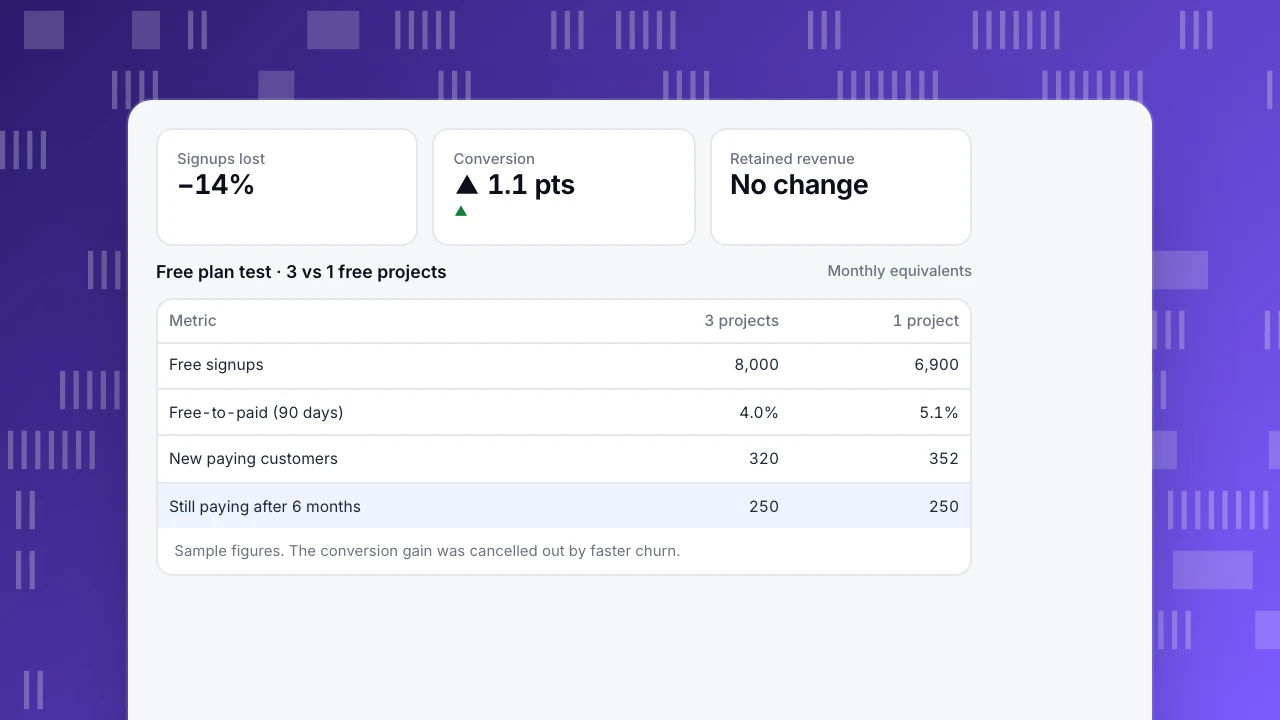
A collaboration tool tested moving from 3 free projects to 1 free project for new signups over 60 days, with a 50/50 split (sample figures, monthly equivalents):
| Metric | 3 free projects (control) | 1 free project (test) | Change |
|---|---|---|---|
| New free signups | 8,000 | 6,900 | −14% |
| Activation (first shared project) | 46% | 43% | −3 pts |
| Free-to-paid within 90 days | 4.0% | 5.1% | +1.1 pts |
| New paying customers | 320 | 352 | +10% |
| Paid customers still paying after 6 months | 78% | 71% | −7 pts |
| Paying customers left after 6 months | 250 | 250 | 0% |
On first read, the test won: 10% more paying customers. Six months later the gain was gone: the extra customers were people pushed to pay before they were sure, and they churned faster. Fewer free signups also meant fewer invitations to new users. The team kept 3 free projects and instead added an upgrade prompt when a project reached 5 collaborators, the point where paid features (permissions, admin controls) actually mattered. That lifted conversion to 4.6% without hurting signups.
The lesson: judge freemium changes on retained paid customers and on signups lost, not on conversion rate alone.
Signups lost
−14%
Conversion
▲ 1.1 pts
▲
Retained revenue
No change
Free plan test · 3 vs 1 free projects
Monthly equivalents| Metric | 3 projects | 1 project |
|---|---|---|
| Free signups | 8,000 | 6,900 |
| Free-to-paid (90 days) | 4.0% | 5.1% |
| New paying customers | 320 | 352 |
| Still paying after 6 months | 250 | 250 |
Sample figures. The conversion gain was cancelled out by faster churn.
Freemium metrics to track
- Free-to-paid conversion by signup cohort, within 30, 90 and 180 days.
- Activation rate of free users: share reaching the aha moment.
- Time to upgrade and the action that preceded it.
- Cost per free user per month (hosting, support).
- Paid retention and net revenue retention by the plan the customer started on.
- Viral coefficient: new signups generated per existing user through invites and sharing.
Measuring a freemium funnel in TapCub
Send signup, an activation event and purchase (or your own upgrade event) and identify users so the free and paid stages join the same person (Identify users). All-platform analytics › Business › AARRR growth maps signup, activation, payment and share events to the AARRR stages; a funnel from signup to activation to upgrade shows where free users stop (Build a funnel); cohort retention compares customers who upgraded early and late. Related reading: Free trial conversion rate, Product-led growth metrics and SaaS marketing.
See also: Value metric.
Sources
- Lenny Rachitsky, What is a good free-to-paid conversion rate? (Lenny's Newsletter).
Was this article helpful?
We use your answers to fix and expand this page.
Couldn’t send. Please try again in a minute.
Thanks for the feedback. We’ll use it to improve this page.You’ve already sent feedback on this page. Thanks.

Data Engineer
Writes about event design, data quality, and collection workflows, with verifiable implementation methods for reliable analytics.