Try it on your own data
Every report in this article is in the free plan. One snippet for web and apps, up to 10 sites.
Start freeA product engineer is measured by whether users adopt what they ship, not by tickets closed. This guide explains how the role compares with software engineers and product managers, what the work looks like day to day, the skills it needs, and a worked example of one feature from support tickets to full rollout.
What you will learn
- Product engineers own a feature area end to end, including metrics
- They decide what to build, not only how
- Instrument and define success metrics before release
- Release gradually behind flags and read the data
- The role suits small and mid-size product companies most
What is a product engineer?
A product engineer is a software engineer who owns product outcomes, not just code. They take a user problem from idea to shipped feature: talk to users or read support tickets, shape the solution with design, build across the stack, release it gradually, and check in the data whether it worked. The role grew out of small product-led companies where there are few product managers per engineer and engineers are expected to make product decisions themselves.
The title is still used loosely. At some companies "product engineer" simply means a full-stack engineer on a product team; at others it is a distinct role with explicit ownership of a feature area's metrics. The common thread is product judgment: deciding what to build, not only how.
Product engineer vs software engineer vs product manager
| Product engineer | Software engineer (platform or backend) | Product manager | |
|---|---|---|---|
| Main question | Did this solve the user's problem? | Is this system correct, fast and reliable? | What should we build next, and why? |
| Owns | A feature area end to end, including its metrics | Services, infrastructure, technical quality | Roadmap, prioritization, stakeholders |
| Writes code | Yes, most of the time, across the stack | Yes, often deep in one layer | Rarely |
| Talks to users | Regularly | Occasionally | Constantly |
| Success measure | Adoption, retention, conversion of what they shipped | Uptime, latency, defect rate, delivery | Business outcomes of the roadmap |
In teams with product engineers, product managers tend to focus on strategy and cross-team work, while day-to-day feature decisions move to the engineers.
| Product engineer | Software engineer | |
|---|---|---|
| Main question | Did it solve the problem? | Is the system reliable? |
| Owns | Feature area and its metrics | Services and technical quality |
| Success | Adoption and retention | Uptime, latency, delivery |
Product managers focus on strategy and roadmap.
What does a product engineer do day to day?
- Find and frame problems. Read support conversations, watch session recordings, join customer calls, look at where users drop off.
- Scope the smallest useful version. Cut a feature down to what can ship in days and still answer whether users want it.
- Build across the stack. Front end, API, database changes, and the analytics events needed to measure it.
- Instrument before release. Add events to the tracking plan, define the success metric and a guardrail metric before the code ships.
- Release gradually. Behind a feature flag, to internal users, then a percentage of customers.
- Read the results. Adoption, funnel completion, retention of users who tried it, error rates, support volume.
- Iterate or remove. Improve what works, delete what nobody uses.
Skills a product engineer needs
- Full-stack development: comfortable in a front-end framework, a back-end language, SQL and deployment.
- Product sense: understanding users' jobs, prioritizing by impact, saying no.
- Analytics literacy: writing event specs, building funnels and retention charts, querying data, knowing when a difference is noise.
- Experimentation: feature flags, A/B tests, reading results without p-hacking.
- Design sensibility: working directly from rough sketches; good-enough UI without waiting for pixel-perfect specs.
- Communication: writing short proposals, explaining trade-offs, sharing results with the team.
Worked example: one feature, end to end
A product engineer on a B2B SaaS team noticed in support tickets that customers kept asking how to export a report to CSV. The existing export lived three menus deep. Over three weeks (sample figures):
| Stage | What happened | Data |
|---|---|---|
| Problem check | Counted tickets and searched session recordings | 46 tickets in 30 days; 8% of report viewers opened the old export menu |
| Tracking plan | Added report_export_clicked and report_export_completed with format and row_count properties | Success metric: weekly export users; guardrail: export error rate |
| Internal release | Shipped an "Export" button on the report header to the team | 2 bugs found with files over 100,000 rows |
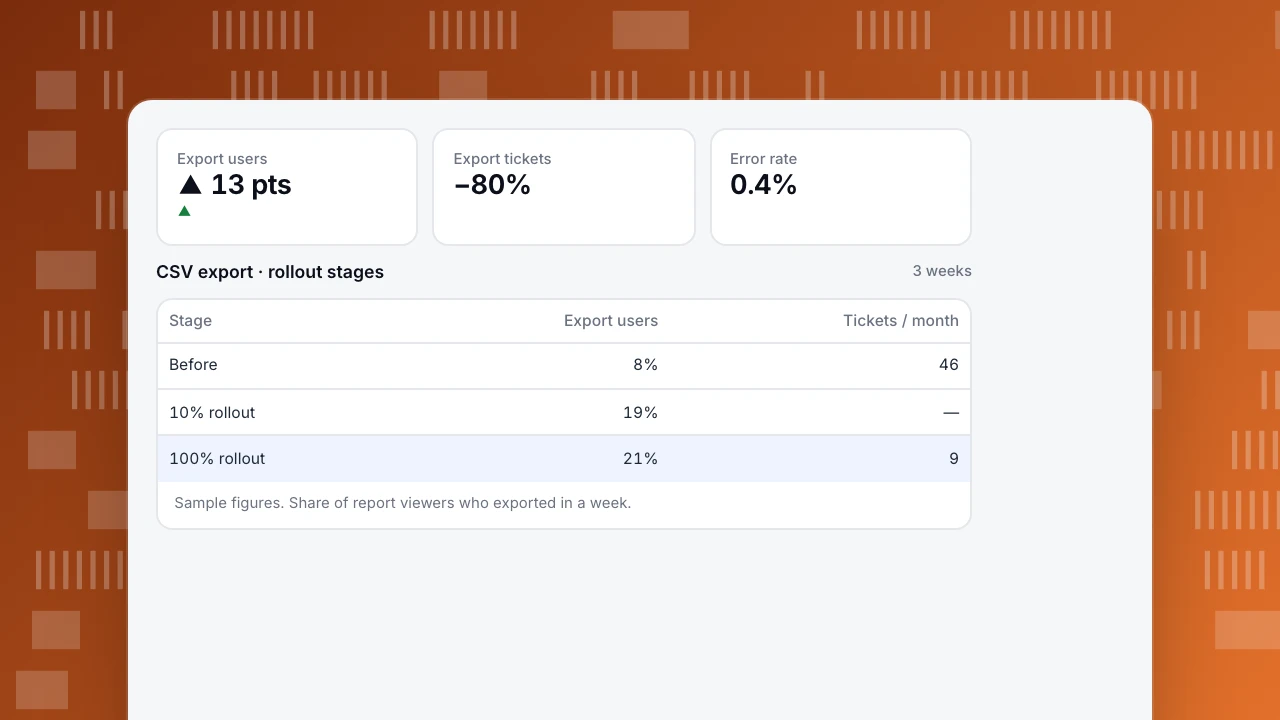
| 10% rollout | Feature flag on for 10% of accounts | Export users 8% → 19% of report viewers; error rate 0.4% |
| 100% rollout | Enabled for everyone; old menu kept for two weeks | Export users 21%; export-related tickets 46 → 9 a month |
The engineer also checked one thing a pure delivery metric would miss: accounts that exported at least once in their first month retained at 88% after 90 days, against 81% for those that did not. That is correlation, not proof of cause, but it was enough to move export into the onboarding checklist as a next experiment.
Export users
▲ 13 pts
▲
Export tickets
−80%
Error rate
0.4%
CSV export · rollout stages
3 weeks| Stage | Export users | Tickets / month |
|---|---|---|
| Before | 8% | 46 |
| 10% rollout | 19% | — |
| 100% rollout | 21% | 9 |
Sample figures. Share of report viewers who exported in a week.
Is product engineer a good career?
For engineers who enjoy talking to users and care about whether their work is used, yes. The role builds both engineering depth and product skills, and is a common path into engineering leadership, founding roles or product management. It suits small and mid-size product companies most; very large organizations often split the same work between more specialized roles.
Tools product engineers use
- Product analytics for events, funnels, retention and paths.
- Session replay and heatmaps to see how a feature is actually used.
- Feature flags and experiments to release gradually and measure impact.
- Error tracking and performance monitoring to catch regressions.
- SQL or a notebook for questions the dashboards do not answer.
Product engineering with TapCub
TapCub covers the measurement half of the job: plan events in a tracking plan (Track custom events), review unplanned events before they pollute reports (Event inbox), measure completion with funnels (Build a funnel), watch how a new feature is used with heatmaps (Create a heatmap), catch front-end errors after a release (Find JavaScript errors) and query raw events in SQL when needed (Query data with SQL). Related reading: Feature adoption and What does a product analyst do?.
See also: Dogfooding.
Sources
- Gergely Orosz, The product-minded software engineer (The Pragmatic Engineer).
Was this article helpful?
We use your answers to fix and expand this page.
Couldn’t send. Please try again in a minute.
Thanks for the feedback. We’ll use it to improve this page.You’ve already sent feedback on this page. Thanks.

Product Analyst
Focuses on event analysis, conversion funnels, and retention, using clear metric definitions and structured analysis to explain product performance.