Try it on your own data
Every report in this article is in the free plan. One snippet for web and apps, up to 10 sites.
Start freeConverting website visitors into customers means matching each visitor’s intent to the right next step, removing friction and following up with those who are not ready. This guide maps intent to next steps, lists ten tactics, and shows a B2B site where answering integration and migration questions on the pricing page added about six customers a month.
What you will learn
- Match the next step to visitor intent
- Show price, total cost and proof near the decision
- Offer a lower-commitment step for researchers
- Answer objections in the moment with chat or FAQ
- Follow up with visitors who leave
How do you convert website visitors into customers?
You convert website visitors into customers by matching each visitor's intent with the right next step, removing what stops them from taking it, and following up with the ones who are not ready yet. Most visitors do not buy on their first visit: they research, compare and come back. Conversion is the result of a path, not of one page.
In practice that means three things: know who arrives and why (channel, landing page, intent), make the decision easy (clear offer, price, proof, a simple form or checkout), and stay in touch (email, retargeting, chat, saved carts) with those who leave.
Visitor intent decides the next step
| Visitor type | Typical source | What they need | Right next step |
|---|---|---|---|
| Researching a problem | Blog, guides, organic search | Answers and trust | Newsletter, download, related guide |
| Comparing solutions | Comparison and "best" queries, reviews | Differences, proof, price | Demo video, pricing page, case study |
| Ready to buy | Brand search, pricing page, ads with offers | Fast, safe purchase | Short checkout, trial, booking |
| Returning customer | Email, direct | Reorder, upgrade, support | Account area, recommendations |
Sending every visitor straight to "Buy now" ignores the first two groups, who are usually the majority.
| Signal | What it suggests |
|---|---|
| High exit on pricing | Unanswered objections or unclear plans |
| Many chat questions on one page | Missing information on that page |
| Cart abandonment at shipping | Hidden costs |
| Low trial-to-paid | Onboarding, not acquisition |
Fix the step that loses the most value first.
10 ways to turn visitors into customers
- Match landing pages to the ad or query. The promise that brought someone in should be visible above the fold.
- State the offer clearly. What it is, who it is for, what it costs, and what happens after clicking.
- Show price and total cost early. Hidden costs are a leading reason for abandonment.
- Add proof near the decision. Specific reviews, customer logos, numbers and guarantees placed next to the call to action.
- Shorten forms and checkout. Ask only what you need now; allow guest checkout.
- Offer a lower-commitment step. Free trial, sample, demo, calculator or download for visitors who are not ready to buy.
- Answer questions in the moment. Live chat or a visible FAQ on pricing, product and checkout pages.
- Follow up with leavers. Abandoned cart emails, retargeting and nurture sequences for leads.
- Make it fast and mobile-friendly. Speed and tap-friendly layouts affect every step.
- Measure and iterate. Track the path from first visit to customer and fix the step that loses the most value.
Worked example: a B2B software site
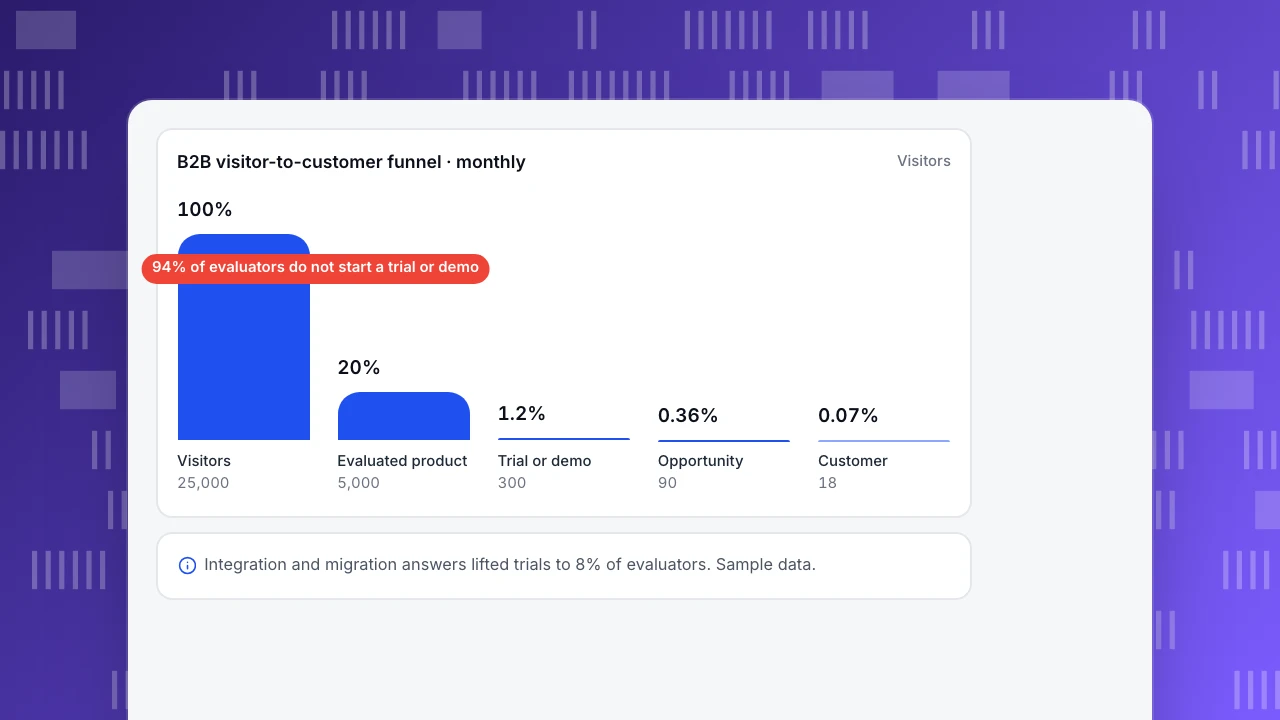
A B2B software company (sample data) gets 25,000 visitors a month and closes 18 new customers. Average first-year contract value: €4,800.
| Step | Monthly | Rate |
|---|---|---|
| Visitors | 25,000 | — |
| Visited pricing or product pages | 5,000 | 20% |
| Started a free trial or booked a demo | 300 | 6% of evaluators |
| Qualified opportunity | 90 | 30% |
| Customer | 18 | 20% |
Chat transcripts showed evaluators asking whether the product integrated with their CRM and how data migration worked; neither was answered on the pricing page. The team added an integrations section and a migration FAQ, and enabled a proactive chat invitation on pricing after 30 seconds. Trial and demo starts rose from 6% to 8% of evaluators (400 a month). At the same downstream rates that is about 24 customers a month: roughly €29,000 more first-year revenue every month.
B2B visitor-to-customer funnel · monthly
VisitorsVisitors
25,000
Evaluated product
5,000
Trial or demo
300
Opportunity
90
Customer
18
Common mistakes
- One call to action for every visitor. Researchers need something smaller than "Buy now".
- Optimizing only the last step. Most losses happen earlier, on landing and product pages.
- No follow-up. Visitors who leave without converting are often your best future customers.
- Ignoring support conversations. They reveal objections no analytics report shows.
- Judging by last click only. Content that starts journeys gets undervalued.
Converting visitors with TapCub
- Paths and funnels: see how visitors move from landing pages to goals with conversion paths and funnels, split by channel and device.
- Attribution: first-touch and last-touch views show which channels start and finish journeys; see attribution.
- Live chat: proactive invitations on pricing and checkout pages, conversations linked to visitor pages, and chat vs no-chat conversion in chat reports.
- Friction: heatmaps, rage clicks, form tracking and session replay (off by default).
- Goals and revenue: goals for trials, demos and purchases, with revenue where you send it.
Related: lead conversion rate, landing page conversion rate, does live chat increase conversions?
FAQ
What percentage of website visitors become customers? It varies widely by business model. Ecommerce stores often convert 1–3% of sessions into orders; B2B sites convert a much smaller share of visitors into customers, with leads and trials in between.
How do I convert visitors who are not ready to buy? Offer a lower-commitment step, such as a guide, newsletter, trial or demo, and follow up with relevant content.
Does live chat help convert website visitors? It can, especially on high-intent pages where visitors have specific questions. Measure the conversion rate of visitors who chatted versus those who did not, with enough volume to trust the comparison.
What is the fastest way to improve conversions? Fix what blocks visitors who already want to convert: broken forms, hidden costs, slow pages and unanswered questions on pricing and checkout pages.
Sources
- Baymard Institute. Reasons for cart abandonment.
- Nielsen Norman Group. The 3 Cs of building trust on websites.
Was this article helpful?
We use your answers to fix and expand this page.
Couldn’t send. Please try again in a minute.
Thanks for the feedback. We’ll use it to improve this page.You’ve already sent feedback on this page. Thanks.

Growth Strategist
Explores acquisition channels, activation, and conversion experiments, turning data insights into actionable growth hypotheses and evaluation methods.