Try it on your own data
Every report in this article is in the free plan. One snippet for web and apps, up to 10 sites.
Start freeVisitors who chat convert several times more often than those who do not, but that gap is not the effect of chat. This guide explains why the headline comparison overstates it, how to measure live chat's real effect on your own site, and where chat tends to help.
What you will learn
- Chatters convert more partly because they already intended to buy
- A time-split test of chat or invites gives a far more honest lift
- Chat helps most where one question blocks a decision, and only if replies are fast
The short answer
Often yes, but by less than the headline numbers suggest, and not on every page. Visitors who chat almost always convert at a higher rate than those who do not. The question is how much of that difference chat caused, and how much comes from the fact that people who open a chat were already more likely to buy.
You can find published figures for live chat lift, often without a method or sample behind them. Treat them as a reason to test, not as an estimate for your site.
Why the headline comparison overstates it
Comparing "visitors who chatted" with "visitors who did not" mixes two effects:
- Chat helps: an answer removes a doubt about shipping, pricing or fit, and the visitor buys.
- Selection: people who start a chat are on the pricing or checkout page, have a specific question and intend to buy. They would convert more often even without chat.
Only the first is the effect of chat. The second makes any naive comparison look better than it is. Segmenting helps a little (compare chatters and non-chatters on the same pages), but the clean answer comes from a test where the only difference between two groups is whether chat was offered. See customer segmentation analysis on cause vs selection.
Measure it on your site
Two steps, with numbers from the example:
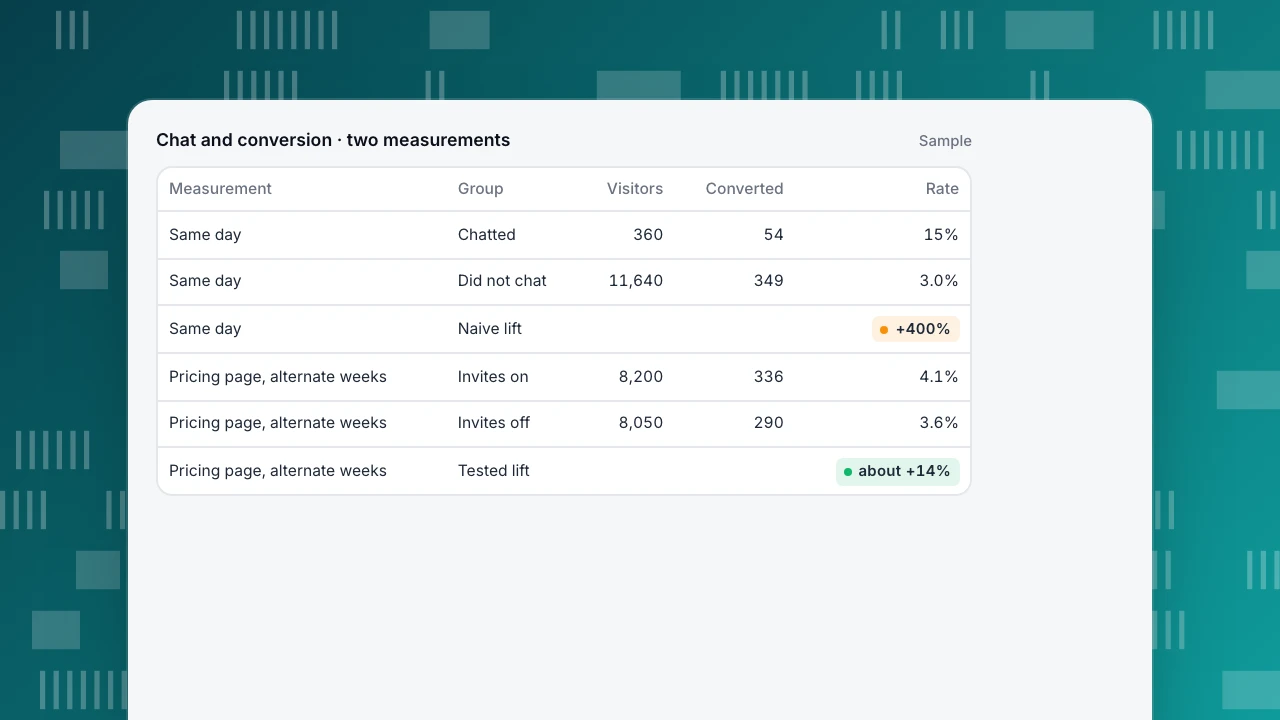
- Same-day comparison. Of 12,000 visitors in a day, 360 chatted and 54 of them reached a goal: 15%. Of the 11,640 who did not chat, 349 reached a goal: 3.0%. The naive lift is 15% ÷ 3.0% − 1 = +400%.
- Time-split test of invites. Proactive invites on the pricing page were switched on for alternate weeks over two months. Pricing-page visitors converted at 4.1% in invite weeks and 3.6% in the other weeks: a lift of about +14%.
The second figure is much smaller, and much closer to what chat is actually worth on that page. It is also the one to use when deciding how many agents to staff. Keep everything else the same between the weeks, and check that traffic sources are similar.
Chat and conversion · two measurements
Sample| Measurement | Group | Visitors | Converted | Rate |
|---|---|---|---|---|
| Same day | Chatted | 360 | 54 | 15% |
| Same day | Did not chat | 11,640 | 349 | 3.0% |
| Same day | Naive lift | +400% | ||
| Pricing page, alternate weeks | Invites on | 8,200 | 336 | 4.1% |
| Pricing page, alternate weeks | Invites off | 8,050 | 290 | 3.6% |
| Pricing page, alternate weeks | Tested lift | about +14% |
Methods compared
The table compares the three ways to measure chat's effect, from quickest to most reliable. Whichever you use, you need conversions tracked as goals first (see conversion tracking), and enough chats for the rates to mean something: a few dozen chatters a day is a minimum.
| Method | How | What it tells you | Watch out for |
|---|---|---|---|
| Chatted vs did not chat | Compare goal rates on the same day | Upper bound on chat's effect | Selection: chatters already intended to buy |
| Same pages only | Compare chatters and non-chatters on pricing or checkout | Smaller, fairer gap | Still self-selected |
| Time-split test | Switch chat or invites on and off by week | Closest to the real effect | Seasonality; keep traffic mix similar |
Track conversions as goals before measuring.
Where chat tends to help
Chat helps most where a specific question blocks a decision:
- Pricing and plan pages (which plan, what is included).
- Checkout and shipping steps (delivery time, returns, payment).
- High-value or configurable products.
- Sign-up pages for B2B products (security, integrations).
It helps least on content pages where visitors are not ready to decide, and it can hurt when invites interrupt reading. Fast first replies matter: a chat started and left unanswered is worse than no chat (see first response time). For timing and wording of invites, see proactive chat invites.
Measuring chat conversion in TapCub
TapCub's chat and analytics share one visitor ID, so the Conversion attribution report can join chats to goals. It compares visitors that day, visitors who chatted (started a conversation and sent at least one message) and those who reached a goal after chatting. The chatted rate is chatters who reached a goal; the no-chat rate is the same for visitors who did not chat; relative lift is the chatted rate divided by the no-chat rate, minus 1. Hot pages show where chats started, and when fewer than 30 visitors chatted the report warns that the sample is too small (chat vs no-chat conversion).
The join works within one day; on the strict privacy preset the visitor ID rotates daily, so a purchase on a later day is not linked. Proactive invites show after a visitor stays on a matching page for the seconds you set, and the rule list records impressions, open rate and reply rate (proactive invites), which makes a time-split test easy to run. More in proactive invites and conversion rate.
FAQ
Does live chat increase conversions?
Often, on pages where a question blocks a decision. The real lift is usually much smaller than the gap between chatters and non-chatters, so test it on your own site.
Why do visitors who chat convert so much more?
Partly because chat helps and partly because people who start a chat already intend to buy. A simple comparison cannot separate the two.
How do I measure the effect of live chat?
Track conversions as goals, compare chatters with non-chatters on the same pages, then switch chat or invites on and off over alternating periods and compare.
How many chats do I need to measure conversion?
Enough that the rate is stable: a few dozen chatters per period at least. TapCub warns below 30.
Can live chat reduce conversions?
Yes, if invites interrupt people who are reading, or if chats go unanswered. Measure both conversion and reply time.
See also: Convert visitors into customers, Customer experience metrics.
See also: What is live chat? How it works, metrics and staffing.
Was this article helpful?
We use your answers to fix and expand this page.
Couldn’t send. Please try again in a minute.
Thanks for the feedback. We’ll use it to improve this page.You’ve already sent feedback on this page. Thanks.

Product Analyst
Focuses on event analysis, conversion funnels, and retention, using clear metric definitions and structured analysis to explain product performance.