Try it on your own data
Every report in this article is in the free plan. One snippet for web and apps, up to 10 sites.
Start freeDirect traffic is meant to be people typing your address, but it is also where every visit with a lost source ends up. This guide shows what falls into direct, how to read its landing pages to tell real direct from untagged email, apps and stripped referrers, and the fix for each cause.
What you will learn
- Direct is the default bucket for visits with no referrer, UTM tags or click ID
- Deep landing pages with many direct entries usually mean a lost source
- Tag every link you control, keep click IDs, and never filter direct out
What direct traffic means
Direct traffic is the channel an analytics tool uses when a visit arrives with no referrer, no UTM tags and no ad click ID. The name suggests someone typed your address or used a bookmark, and some of it is exactly that. But direct is also the default bucket: any visit whose source was lost along the way lands there too.
That is why a large or rising direct share is worth investigating. It usually means part of your marketing is being credited to nothing. Google's own help page for GA4 lists missing traffic information, typed URLs or offline documents, and ad blockers among the reasons for (direct) / (none) (Google Analytics Help).
What ends up in direct
The common causes fall into a few groups, listed in the table with the signal that gives each away.
- Links that do not pass a referrer. Email clients, chat apps, PDFs, desktop and mobile apps often open links without a referring page. Links with
rel="noreferrer"deliberately send none (MDN). - Referrers trimmed or dropped by policy. The default browser policy,
strict-origin-when-cross-origin, sends only the origin to other sites and nothing when going from HTTPS to HTTP (MDN Referrer-Policy). A site that setsno-referrersends nothing at all. - Untagged campaigns. Paid social, newsletters and partner links without UTM tags or click IDs.
- Real direct visits. Typed URLs, bookmarks, autocomplete in the address bar, returning customers.
| Cause | Signal in the report | Fix |
|---|---|---|
| Untagged newsletter | Direct spike on send day; campaign page as landing | UTM tags on every link |
| Chat apps and dark social | Blog posts and product pages as direct landing | Share links with UTM; accept some loss |
| Apps, PDFs, QR codes | Deep pages, often with odd query strings | UTM tags in each link |
| Referrer policy no-referrer | Visits from your other sites missing as referrers | Use strict-origin-when-cross-origin |
| HTTPS to HTTP | Referrals from old HTTP sites missing | Serve every page over HTTPS |
| Real direct | Home and login as landing; returning visitors | Treat as brand and retention signal |
Filter to the direct channel and open landing pages to see which cause applies.
Read the landing pages inside direct
The quickest diagnosis is to filter the report to the direct channel and look at landing pages. Real direct visits mostly start on the home page or on pages people bookmark, such as the login page. When deep pages show up with lots of direct entries, such as a single blog post, a pricing page with a query string, or a campaign landing page, those visits almost certainly came from a link whose source was lost.
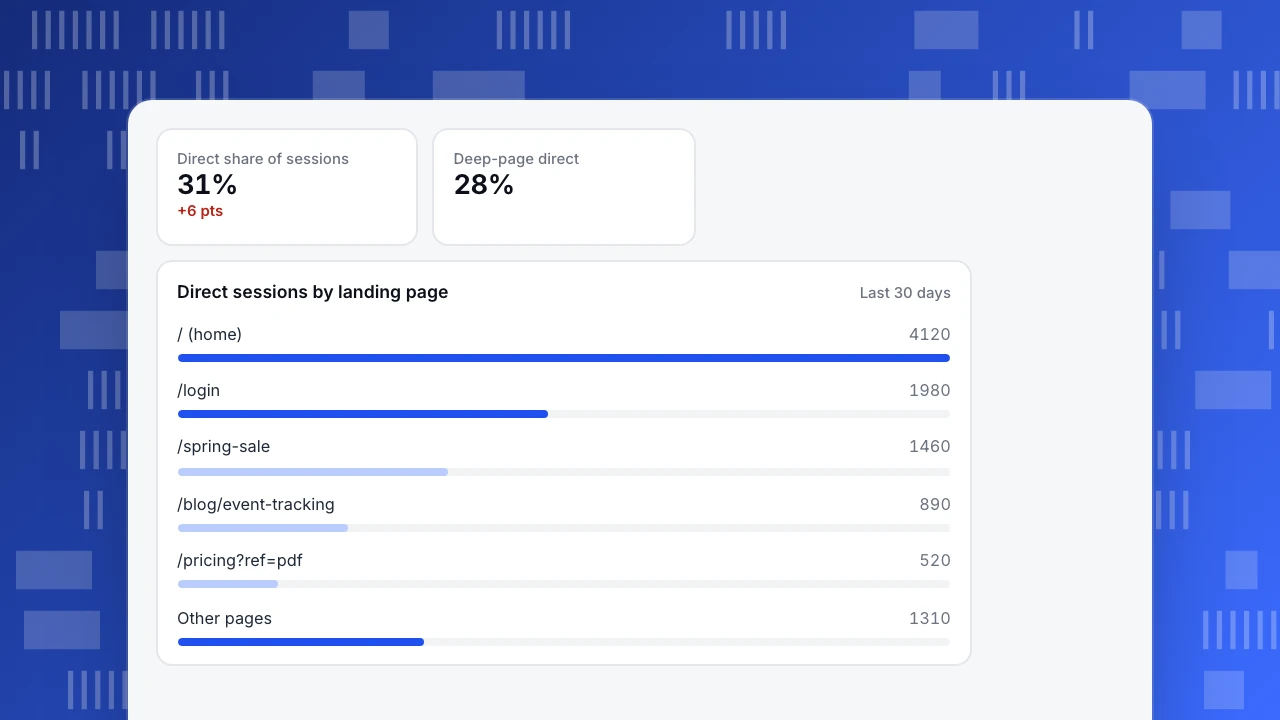
In the example, the home page and login are plausible direct. The spring sale page has no reason to be typed in: it was sent in a newsletter without UTM tags. The blog post was shared in chat apps. Together they are more than a third of the "direct" sessions.
Also compare direct with the timing of your sends. A spike in direct on the morning a newsletter goes out is the newsletter.
Direct share of sessions
31%
+6 pts
Deep-page direct
28%
Direct sessions by landing page
Last 30 daysHow to shrink direct traffic
- Tag every link you control. Newsletters, social posts, QR codes, partner links, app links and PDFs all get UTM tags. A shared naming rule matters more than the exact values; the UTM builder keeps them consistent. See UTM parameters.
- Keep ad click IDs. Auto-tagging adds click IDs such as
gclid; make sure redirects and URL rewrites do not strip them. See click ID. - Check your own referrer policy. If your other sites (docs, app, help centre) set
no-referrer, visits between them arrive as direct.strict-origin-when-cross-originstill passes the origin. - Serve every page over HTTPS so referrers are not dropped on the way to your site.
- Do not filter direct out. Excluding it hides real customers and makes conversion rates look better than they are.
When direct is real
Some direct traffic is a good sign. Brand recognition shows up as people typing your domain; returning customers and logged-in users come straight back. If direct grows while landing pages are mostly home and login, and sign-ups from direct convert like returning visitors, that is real direct. Treat it as a brand and retention signal rather than an acquisition channel.
Direct traffic in TapCub
TapCub groups visits by channel from UTM tags, the referring host and click IDs. A visit with no source at all is direct. A hop from your own site is internal, and with no external source it falls through to direct, so an in-site click is never counted as acquisition. Rules you add for the site win over the defaults (sources).
Click the direct row on the channels tab to filter every other report to direct, then open the entry pages tab under Pages to see landing pages. The channel table includes conversions, so you can compare how direct converts with other channels. For channel-level goals and targets, see marketing KPIs and acquisition metrics.
FAQ
What is direct traffic?
Visits that arrive with no referrer, no UTM tags and no click ID. It includes typed URLs and bookmarks, plus any visit whose source was lost.
Why is my direct traffic so high?
Usually untagged links from email, chat apps, PDFs or apps, referrers dropped by policy or on HTTPS to HTTP, and campaigns without UTM tags. Look at the landing pages inside direct to see which.
Is direct traffic good or bad?
Neither by itself. Direct to the home page and login is often brand and returning users; direct to deep campaign pages is usually lost attribution.
How do I reduce direct traffic?
Tag every link you control with UTM, keep ad click IDs through redirects, use HTTPS, and do not set no-referrer between your own sites.
Does dark social count as direct?
Yes. Links shared in chat apps and private messages usually arrive with no referrer and land in direct.
Was this article helpful?
We use your answers to fix and expand this page.
Couldn’t send. Please try again in a minute.
Thanks for the feedback. We’ll use it to improve this page.You’ve already sent feedback on this page. Thanks.

Product Experience Specialist
Explores usability, user journeys, and feature adoption through practical examples of onboarding and everyday product use.