Try it on your own data
Every report in this article is in the free plan. One snippet for web and apps, up to 10 sites.
Start freeMonthly unique visitors are the distinct visitors who came at least once in a month. This guide shows why adding up daily or weekly visitors overstates the figure, how four counting methods change it, and how to report it so it can be checked.
What you will learn
- Take monthly uniques from one monthly query; summing days counts people repeatedly
- With a daily salt, a "monthly" figure is visitor-days, not unique visitors
- Quote the number with its counting method, exclusions and time zone
What the metric means
Monthly unique visitors (MUV, also "monthly uniques") is the number of distinct visitors who came to a site at least once during a calendar month or a 30-day window. A person who visits on 12 different days counts once.
Two things make the number harder than it sounds. First, analytics never sees people: it sees browsers, devices or logins, so "unique visitor" really means "unique identifier". Second, deduplication across days needs an identifier that lasts across days, and not every counting method has one.
Why you cannot add up the days
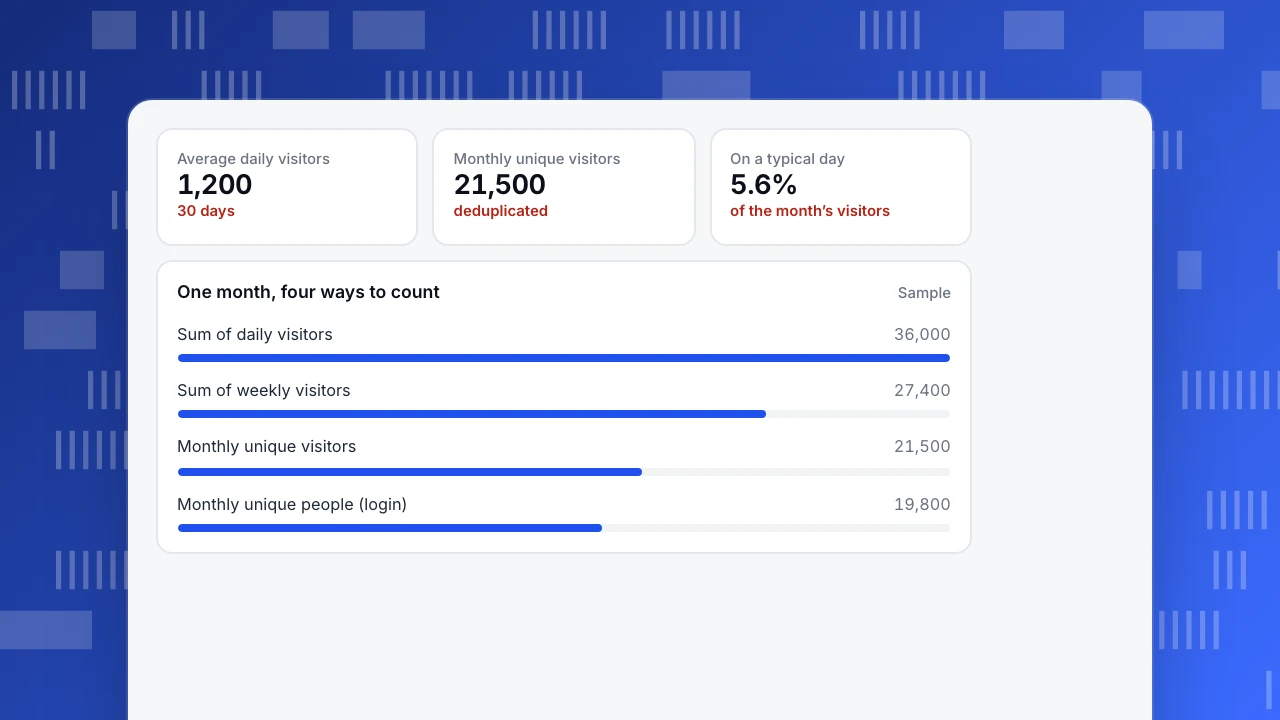
Suppose a site averages 1,200 unique visitors a day. Over 30 days the daily figures add up to 36,000. But many of those are the same people on different days: regular readers, customers checking an order, a colleague who has the site bookmarked. Deduplicated over the month, the sample site has 21,500 monthly unique visitors.
The ratio says something too: 1,200 ÷ 21,500 ≈ 5.6% of the month's visitors come on a typical day. A site with loyal daily readers has a much higher ratio than one that lives on one-off search visits.
The same applies to weeks. Four weekly figures added together overstate the month, because people who came in two different weeks are counted twice. Always take the monthly figure from the tool's own monthly query.
How the counting method changes the number
The table compares four ways of identifying visitors and what the monthly number means under each.
The important case is cookieless counting with a daily salt. Each day the visitor identifier is rebuilt with a new secret, so the same browser on Monday and Tuesday looks like two visitors. That is good for privacy and still exact within a day, but the "monthly" figure becomes the number of visitor-days: close to the 36,000 sum, not the 21,500.
In TapCub, the balanced privacy preset (the default) keeps a site-level salt, so a returning browser on the same network is recognised across days and monthly visitors are deduplicated. The strict preset rotates the salt daily and does not report returning visitors across days; quote a monthly figure under strict as visitor-days. When people log in, user mode prefers the person ID, which merges one person's phone and laptop and usually lowers the count again: 19,800 in the sample.
| How visitors are identified | What a monthly figure means | Watch out for |
|---|---|---|
| First-party cookie or storage | Unique browsers over the month | Cleared storage, private windows, several devices |
| Cookieless, kept salt | Unique browser and network over the month | Same person on a new network counts again |
| Cookieless, daily salt | Visitor-days: close to the sum of daily visitors | Not a unique count across days |
| Login ID | Unique signed-in people across devices | Only covers people who sign in |
State the method next to any monthly figure you share.
A worked example: one month, four numbers
The same month, counted four ways:
- Sum of daily visitors: 36,000. Not a unique count; do not quote it as one.
- Sum of weekly visitors: 27,400. Still double-counts.
- Monthly unique visitors (visitor mode): 21,500. The number to quote, with its definition.
- Monthly unique people (user mode): 19,800. Lower, because 1,700 people used more than one device and logged in on both.
Which one is "right" depends on the question. For audience size in a sponsor deck, the deduplicated monthly visitors with a note on bots and method. For "how many customers used the site", the user-mode figure for signed-in people.
Average daily visitors
1,200
30 days
Monthly unique visitors
21,500
deduplicated
On a typical day
5.6%
of the month’s visitors
One month, four ways to count
SampleHow to report monthly uniques
- Say how they were counted: cookie, cookieless with a kept or daily salt, or login.
- Say what was excluded: bots and AI crawlers, internal traffic, test environments.
- Give a calendar month and the time zone, so the figure can be checked.
- Do not compare tools on this number. Different identifiers and bot filters can put two tools 10–30% apart on the same site; see why visitor numbers never match.
- Pair it with engagement: sessions per visitor, or the share who came back, say more about the audience than its size alone.
FAQ
How do you calculate monthly unique visitors?
Count distinct visitor identifiers that recorded at least one visit in the month. Do it with one query over the whole month; adding up days or weeks counts returning visitors several times.
What is the difference between unique visitors and pageviews?
A pageview is every page load; a unique visitor is a distinct visitor, counted once in the period. 21,500 monthly uniques can produce 90,000 pageviews.
Are monthly unique visitors the same as monthly active users?
Similar idea, different subject. Monthly active users usually means signed-in users who did something in a product. Monthly unique visitors counts anonymous visitors to a website.
Why did my monthly unique visitors drop after changing privacy settings?
If you moved to stricter consent, fewer visitors may be counted at all; if you moved to a daily-salt mode, monthly figures become visitor-days and usually rise. Annotate the change and do not compare across it.
Related: how to check website traffic and unique visitors.
Was this article helpful?
We use your answers to fix and expand this page.
Couldn’t send. Please try again in a minute.
Thanks for the feedback. We’ll use it to improve this page.You’ve already sent feedback on this page. Thanks.

Data Analyst
Explores traffic sources, conversion funnels, and retention, using clear metric definitions and concrete examples to explain what the numbers mean.