Try it on your own data
Every report in this article is in the free plan. One snippet for web and apps, up to 10 sites.
Start freeSaaS lead generation means attracting people who might need your software and turning them into trial accounts or contacts your team can convert. More leads rarely fix flat revenue; better qualification does. Defining qualified leads by what trial users do in the product predicts payment far better than form fills. In the 100-trial example below, behavior separates 37.5% from 3.3%.
What you will learn
- Channels differ less in lead volume than in how well their leads predict payment; judge each by the share of trials that become product-qualified
- Write the PQL rule in one sentence: fit + key action + time window + recency, with the key action chosen from your own trial history
- In the sample, PQLs paid at 37.5% vs 3.3%, while a form-based MQL flag only separated 20% from 15%
Which channels generate SaaS leads, and what quality signal does each give?
SaaS lead generation is the work of attracting people who might need your software and turning them into contacts or trial accounts your team can convert. Every guide lists channels; what matters more is that each channel produces leads of a different quality, and each gives you a different early signal of that quality.
The six channels most B2B SaaS companies rely on:
- Content and SEO — articles, guides and comparison pages that answer problems your product solves. Leads arrive through signups or downloads after reading. The quality signal is which page they read before signing up: a reader of a how-to for your exact use case is a different lead from a reader of a general industry roundup.
- Paid search and paid social — ads on problem and category keywords. Fast and scalable, but intent varies widely by keyword. The signal is the search term and the landing page; analyse the spend per activated trial, not per signup.
- Product-led: free trial or freemium — people sign up and use the product before talking to anyone. The signal is the strongest of all: what they actually do in the product.
- Partners and integrations — marketplace listings, integration directories, agencies and resellers. Usually small volume with high fit, because the partner has already filtered for need.
- Live chat on high-intent pages — visitors on pricing or comparison pages ask questions in real time. The signal is the question itself. The full playbook is in live chat lead generation.
- Outbound — cold email and social outreach to a target list. You control who you contact, but nothing about intent until they reply. In the US, commercial email is subject to the CAN-SPAM Rule, which requires a working opt-out that costs the recipient nothing (§316.5).
The table below compares the channels on how leads arrive, the quality signal each offers, and what to measure. The point to take from it: channels differ less in how many leads they produce than in how well those leads predict a paying customer.
| Channel | How leads arrive | Quality signal | Measure |
|---|---|---|---|
| Content and SEO | Signup or download after reading | Which page they read before signing up | Trials and PQLs by entry page |
| Paid search and social | Click on an ad, then signup | Search term and landing page | PQLs per dollar, not trials per dollar |
| Free trial or freemium | Self-serve signup and product use | Key actions completed in the product | PQL rate and trial-to-paid rate |
| Partners and integrations | Referral or marketplace listing | Partner fit and integration used | PQL rate by partner, over a quarter |
| Live chat | Question on a high-intent page | The question asked and pages viewed | Leads captured and their paid rate |
| Outbound | Reply to cold email or outreach | Reply and meeting booked | Meetings that become trials or deals |
Small channels swing month to month; read PQL rates over a quarter before moving budget.
Why don't more leads mean more customers?
The classic SaaS complaint is "lead volume doubled and revenue did not move." It usually happens because the definition of a good lead rests on what people say on a form rather than what they do in the product.
A marketing qualified lead (MQL) is typically defined by fit and engagement signals collected by marketing: company size, job title, pages visited, content downloaded. The definition and the criteria are in marketing qualified lead. Those signals are cheap to collect and easy to inflate: a gated ebook can triple MQL volume overnight without adding a single serious buyer.
A product-qualified lead (PQL) is a trial or freemium user who has done something in the product that strongly predicts paying, such as connecting their data, inviting a colleague or reaching a usage threshold. The definition is in product-qualified lead.
The thesis of this article is simple: for a SaaS product with a trial or free plan, defining qualified leads by product behavior predicts payment far better than form fills do. Quality beats quantity, and behavior is the best measure of quality you have. Forms still help with fit — a solo freelancer is unlikely to buy an enterprise plan — but they say little about whether the product has proved its value to this account. The worked example below puts numbers on the difference.
How do you define a PQL with behavior rules?
A usable PQL rule has four parts. Write it down in one sentence so marketing, product and sales use the same definition:
- Fit — a minimum profile, if it matters for your pricing. Example: a work email domain, or a team of at least 3 seats.
- Key action — the product behavior that predicts payment. Example: connected a data source and invited at least one teammate.
- Time window — how soon after signup the action must happen. Example: within the first 7 days of the trial.
- Recency — the account is still active. Example: used the product in the last 3 days.
Put together: "A PQL is a trial account on a work domain that connected a data source and invited a teammate within 7 days of signup, and was active in the last 3 days."
How do you choose the key action? Do not guess, and do not pick the action the product team is proudest of. Take your last few hundred trials, list 5–10 candidate actions, and for each compare the paid rate of accounts that did it with accounts that did not. Keep the one or two actions with the largest gap that enough accounts actually reach. An action that predicts payment perfectly but only 2% of trials reach is too rare to drive a sales motion; an action that 90% reach separates nothing.
Two cautions. The relationship is correlation, not proof: accounts that were already serious are also the ones that connect data. That is fine for prioritising follow-up, which is all a PQL is for. And rules decay — after a pricing or onboarding change, recheck the gap every quarter.
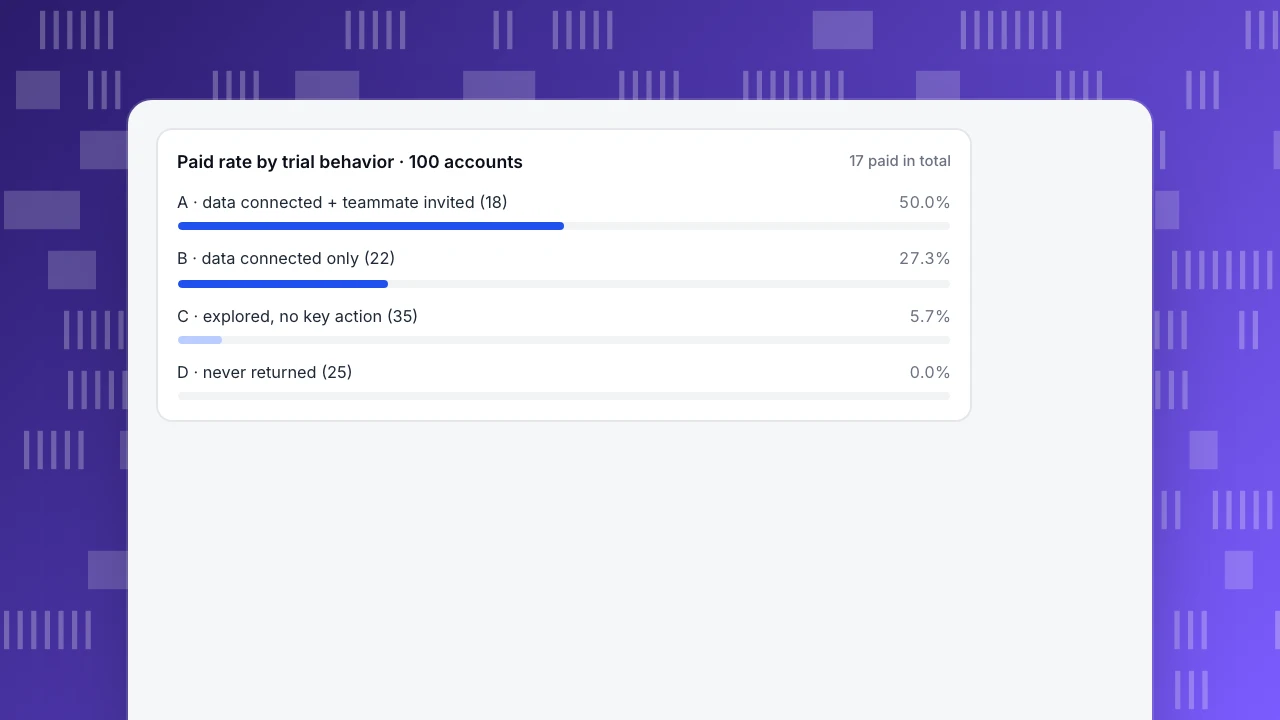
Worked example: 100 trial accounts grouped by behavior
Sample data: 100 trial accounts that started in the same month, all with 14-day trials, followed until 30 days after trial end. 17 became paying customers, a 17% trial-to-paid rate.
Group them by what they did in the first 7 days:
| Group | Behavior in first 7 days | Accounts | Paid | Paid rate |
|---|---|---|---|---|
| A | Connected a data source and invited a teammate | 18 | 9 | 50.0% |
| B | Connected a data source, no invite | 22 | 6 | 27.3% |
| C | Logged in and explored, no key action | 35 | 2 | 5.7% |
| D | Never returned after day 1 | 25 | 0 | 0.0% |
| Total | 100 | 17 | 17.0% |
Define PQL as groups A and B together, accounts that connected a data source: 40 accounts, 15 paid, a paid rate of 15 ÷ 40 = 37.5%. The other 60 accounts produced 2 customers: 2 ÷ 60 = 3.3%. A PQL in this sample is 37.5 ÷ 3.33 = 11.25 times as likely to pay as a non-PQL.
Now the form-based definition on the same 100 accounts. Suppose 40 accounts reported a company size of 50 or more on the signup form and are flagged as MQLs. 8 of them paid: 8 ÷ 40 = 20%. Of the other 60, 9 paid: 9 ÷ 60 = 15%. The form signal makes an account 20 ÷ 15 = 1.33 times as likely to pay — better than nothing, but barely.
Make it concrete with sales capacity. Your one sales rep can work 40 accounts a month. Give them the 40 PQLs and the list contains 15 of the 17 eventual customers, 88% of them. Give them the 40 MQLs and it contains 8 of 17, 47%. Same number of calls, almost twice the paying customers on the list.
Behavior also tells you what to do with the rest. Group C — active but stuck — is a product and onboarding problem: an email or in-app nudge toward connecting data will do more than a sales call. Group D never came back; a single check-in is enough.
Paid rate by trial behavior · 100 accounts
17 paid in totalHow should you hand PQLs to sales?
A PQL list is only useful if someone acts on it quickly and with context. Three rules make the handoff work.
Pass the behavior, not just the name. The rep should see what the account did: which data source, how many teammates, which features, when they were last active. "You connected your CRM and invited two colleagues — want help setting up the dashboard your team will share?" is a far better opening than a generic demo offer.
Decide who gets a human. Not every PQL needs a call. Self-serve buyers on low-priced plans often prefer to convert alone; reserve sales time for accounts above a seat or plan threshold, and let the rest receive in-product help.
Move fast. Response speed matters for every kind of online lead. In a 2011 Harvard Business Review study, Oldroyd, McElheran and Elkington reported that contacting a web lead within an hour made it nearly 7 times as likely to be qualified as waiting even one hour longer. That study covered web leads in general, not trials, but a trial user who just hit the key action is at peak attention; reaching them within one business day is a realistic target for small teams.
Record what happens next — contacted, meeting, paid, lost — in your CRM, and track the stage rates. How to measure lead-to-customer conversion is in lead conversion rate, and how to follow leads from source to close is in lead tracking.
How do you judge channels by lead quality instead of volume?
Once you have a PQL definition, judge every channel by the share of its trials that become PQLs, not by signup count. Same 100 trial accounts, split by acquisition channel:
| Channel | Trials | PQLs | PQL rate | Paid | Paid rate |
|---|---|---|---|---|---|
| Content and SEO | 40 | 18 | 45.0% | 7 | 17.5% |
| Paid search | 35 | 10 | 28.6% | 4 | 11.4% |
| Partners | 10 | 6 | 60.0% | 3 | 30.0% |
| Live chat | 15 | 6 | 40.0% | 3 | 20.0% |
| Total | 100 | 40 | 40.0% | 17 | 17.0% |
Judged by volume, paid search is the second-largest channel with 35 trials. Judged by quality, it has the lowest PQL rate (28.6%) and the lowest paid rate (11.4%). Partners bring only 10 trials, but 60% become PQLs. That does not mean "cut paid search": it may still be profitable at its cost per trial. It means the next dollar of budget, and the next hour of partner work, should be weighed on PQLs per dollar rather than trials per dollar. Small samples like the partner row move a lot from month to month, so read them over a quarter before you act.
How to pair lead counts with quality and cost metrics across the whole funnel is covered in lead generation metrics; how lead generation fits a wider plan is in SaaS growth strategy.
What are the most common SaaS lead generation mistakes?
- Optimising for MQL volume. Gated content and broad ads raise the count while the paid rate falls. Report MQLs and PQLs next to customers, never alone.
- Choosing the key action by opinion. Use your own trial history: compare paid rates for accounts that did and did not take each candidate action.
- Treating every PQL the same. Route by plan size: humans for accounts that justify a call, in-product help for the rest.
- Ignoring stuck trials. Active users who never reach the key action are an onboarding problem, not a sales problem.
- Judging channels on signups. A channel with many trials and few PQLs can look like your best channel until you check what happened next.
- Never revisiting the rule. Onboarding and pricing changes shift which actions predict payment. Recheck quarterly.
How to find product-qualified leads in TapCub
TapCub does not run ads, is not a CRM and does no lead scoring. What it does is give you the behavior data to write and check a PQL rule like the one in the worked example:
- Identify trial users. Call
tapcub.loginwhen someone signs up or logs in. From then on, each person appears in All-platform analytics › Users › People with a day-by-day timeline of what they did, on web, app or mini-program. - Group people into accounts. After login, call
tapcub.group('company', id, {...})so everyone on the same trial rolls up together. All-platform analytics › Users › Accounts shows members, 30-day active accounts and a 0–100 health score (40 points for the share of members active in the last 30 days, 30 for the share of active days, 30 for being seen in the last 7 days, 15 if in the last 30). Anonymous visitors do not join accounts. - Save the PQL rule as a segment. In All-platform analytics › Users › Segments & tags, build a rule segment with conditions such as "did
data_source_connected", "didteammate_invited" and first seen within the trial window. Rule segments refresh daily or on demand and keep a 30-day trend of how many people are in them. - Check that the rule predicts payment. In All-platform analytics › Behavior › Behavior analysis, bring the segment into a funnel from signup to payment and compare it with everyone else, as in the 37.5% versus 3.3% comparison above.
- Add context to chat leads. If you run live chat, visitors who are logged in arrive in Live chat › Inbox already identified, with their source and recent browsing in the side panel, so the agent can see whether a trial user who asks about pricing has already connected data. The follow-up itself, and any scoring, belong in your CRM.
FAQ
How do SaaS companies generate leads?
Most combine inbound content and SEO, paid search and social, a free trial or freemium plan, partner and integration listings, live chat on high-intent pages, and some outbound outreach. The mix matters less than how leads are qualified: for products with a trial, qualifying by in-product behavior identifies future customers far better than form fields, so channels should be judged on qualified leads per dollar, not raw signups.
What is the difference between an MQL and a PQL?
An MQL is qualified by marketing signals such as company size, job title and content downloads. A PQL is qualified by product behavior during a trial or free plan, such as connecting data or inviting teammates. In the sample of 100 trials above, PQLs paid at 37.5% versus 3.3% for the rest, while the form-based MQL flag only separated 20% from 15%.
What is a good trial-to-paid conversion rate for SaaS?
There is no reliable universal number; it varies with price, trial length, whether a card is required and how qualified the traffic is. Use your own baseline and segment it. The more useful comparison is the paid rate of accounts that reached your key action versus those that did not — that gap shows where onboarding and sales effort will pay off.
Should SaaS lead generation focus on inbound or outbound?
Inbound and product-led channels usually produce better-qualified leads because people arrive with a problem; outbound gives you control over which companies you reach. Many B2B teams use inbound and trials for volume and outbound for a short list of target accounts. Whichever you use, measure each by the share of leads that reach your qualification rule and then pay.
How many leads should a SaaS company generate?
Work backwards from revenue rather than picking a lead target. Divide the number of new customers you need by your qualified-to-paid rate, then by the share of leads that become qualified. With the sample rates above (37.5% of PQLs pay, 40% of trials become PQLs), 30 new customers need 80 PQLs and about 200 trials.
See also: SaaS Sales Funnel: Put the Trial in the Middle and Read Each Stage.
See also: B2B Lead Generation: Judge Channels by Won Deals, Not Lead Count.
Sources
- Oldroyd, McElheran & Elkington. The Short Life of Online Sales Leads. Harvard Business Review, March 2011 — lead response time and qualification. Verified 2026-11-15.
- eCFR. 16 CFR Part 316 — CAN-SPAM Rule — §316.5 opt-out requirements for commercial email. Verified 2026-11-15.
Was this article helpful?
We use your answers to fix and expand this page.
Couldn’t send. Please try again in a minute.
Thanks for the feedback. We’ll use it to improve this page.You’ve already sent feedback on this page. Thanks.

Product Experience Specialist
Explores usability, user journeys, and feature adoption through practical examples of onboarding and everyday product use.