Try it on your own data
Every report in this article is in the free plan. One snippet for web and apps, up to 10 sites.
Start freeB2B lead generation works when you judge leads by quality, not count: a good lead fits your best customers and shows intent, and only tracing each lead from its source to a closed deal tells you which channels are worth the money. This guide defines fit and intent, compares channels, and works through a recomputed example where the cheapest lead turns out to be the most expensive deal.
What you will learn
- A good B2B lead scores on fit (who they are) and intent (what they did); volume tells you neither
- Store the channel, campaign, landing page, first-contact date and creating action on every lead from the first moment
- Compare channels by cost per won deal and won per 100 leads; cost per lead can reverse the ranking
What is B2B lead generation, and what makes a lead good?
B2B lead generation is the work of attracting people at other companies and capturing their contact details with their interest in what you sell. The word "lead" hides a wide range, from someone who downloaded a checklist to someone who asked for a quote. A lead is good when it scores on two separate things:
- Fit: does the company look like your best customers (size, industry, role, region)?
- Intent: did the person do something that signals a buying need (visited pricing, asked for a demo, replied to a sales email)?
Volume tells you neither. A thousand leads with poor fit and no intent produce a sales team that learns to ignore the list. This guide follows each lead from its source to a closed deal, because only that path shows which sources are worth the money. The deeper metric definitions are in lead generation metrics and the hand-off between marketing and sales is in MQL vs SQL. For the software-specific version, see SaaS lead generation.
| Signal | Fit or intent | Example | Where it comes from |
|---|---|---|---|
| Company size, industry, region | Fit | 50 to 500 staff, healthcare, Europe | Form field or enrichment |
| Job role | Fit | Operations manager | Form field |
| Pricing or demo page visit | Intent | Viewed /pricing twice in a week | Website behaviour |
| Direct request | Intent | "Book a demo" form | Form submission |
| Reply to a sales message | Intent | Answered with a question | Sales or chat tool |
Which channels bring B2B leads, and what do they usually deliver?
Channels differ less in how many leads they produce than in what those leads are worth. Use this table to set expectations, then check them against your own numbers:
| Channel | Typical lead | Usual quality pattern | What to track |
|---|---|---|---|
| Webinar | Attendee who registered | Mixed: some research, some job seekers | Registered vs attended vs later SQL |
| Gated guide or ebook | Downloader | High volume, low intent | Leads that reach pricing or demo within 30 days |
| Website demo request | Person asking to talk | Low volume, high intent | Request-to-meeting rate |
| Outbound email or calls | Person who replied | Depends on list fit | Reply, then meeting, then SQL |
| Live chat on pricing pages | Visitor with a question | High intent, small numbers | Chats that become meetings |
| Referral | Introduced contact | Usually high fit | Source recorded at first contact |
The quality patterns in the table are rules of thumb to test, not measured figures; your own data may differ. The pattern is general: the easiest leads to get (a gated download) are rarely the ones most likely to buy, and the hardest to get (a person asking for a demo) usually are. That is why raw lead count is the wrong objective.
| Channel | Typical lead | What to track |
|---|---|---|
| Webinar | Registered attendee | Registered vs attended vs later SQL |
| Gated guide | Downloader, high volume, low intent | Reach pricing or demo within 30 days |
| Website demo request | Person asking to talk | Request-to-meeting rate |
| Outbound email or calls | Person who replied | Reply, then meeting, then SQL |
| Live chat on pricing pages | Visitor with a question | Chats that become meetings |
| Referral | Introduced contact | Source recorded at first contact |
These quality patterns are rules of thumb to test, not measured figures.
How do you trace a lead from source to close?
Define four stages and store the source with the lead from the first moment, because a lead whose source is "unknown" cannot be learned from:
- Lead: a contact who gave details and some interest.
- Marketing qualified lead (MQL): meets your fit rule and shows enough intent.
- Sales qualified lead (SQL): a salesperson has talked to them and agrees there is a real need and a budget path.
- Won: a signed deal.
Store these five fields on every lead record: the channel, the campaign or UTM campaign, the landing page, the date of first contact and the form or action that created it. Pass them from the website into your customer-management system when the form is submitted; if the fields are lost, you will be guessing in every later review.
How do you write a simple fit-and-intent rule?
Write the MQL rule down in one line so marketing and sales argue about the same thing. A starter version, with sample points to adjust:
- Fit points (max 7): company size 50 to 500 staff = 2; target industry = 2; decision-maker or influencer role = 2; region you serve = 1.
- Intent points: pricing page visit = 2; reply to a sales message = 3; demo request = 5.
- Rule: MQL = fit of at least 4 and intent of at least 2.
A downloader at a 20-person company in an industry you do not serve scores fit 0 and stays a lead. A demo request from a 200-person target-industry company scores fit 4 and intent 5 and goes straight to sales. Review the rule each quarter against which MQLs became SQLs, and change one number at a time. This rule lives in your customer-management or marketing tool; TapCub does not score leads.
What does it look like when you compare channels by quality? A worked example
Sample data for one quarter. Average first-year contract value is $12,000.
| A: Webinar | B: Ebook download | C: Website demo requests | |
|---|---|---|---|
| Spend | $4,000 | $4,500 | $1,800 |
| Leads | 400 | 900 | 120 |
| Cost per lead | $10 | $5 | $15 |
| MQL (share of leads) | 48 (12%) | 45 (5%) | 72 (60%) |
| SQL (share of MQL) | 12 (25%) | 9 (20%) | 36 (50%) |
| Won (share of SQL) | 3 (25%) | 2 (22%) | 9 (25%) |
| Won per 100 leads | 0.75 | 0.22 | 7.5 |
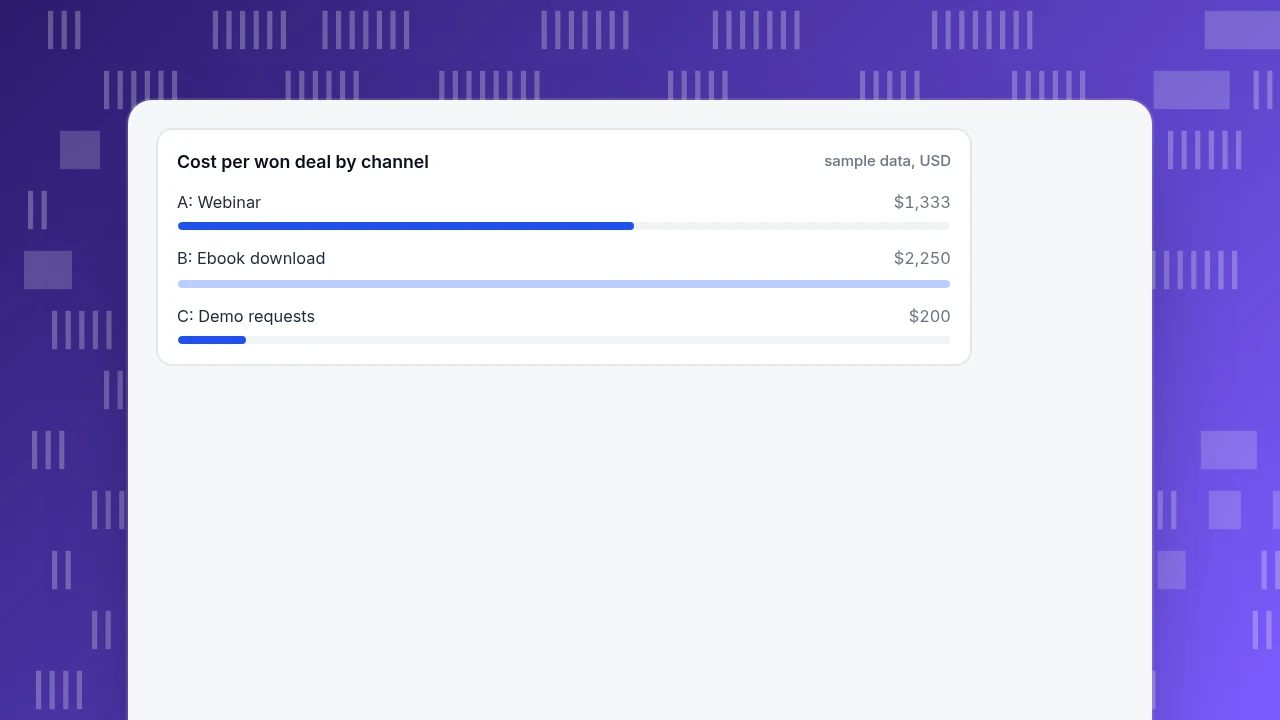
| Cost per won deal | $4,000 ÷ 3 = $1,333 | $4,500 ÷ 2 = $2,250 | $1,800 ÷ 9 = $200 |
| First-year contract value | 3 × $12,000 = $36,000 | $24,000 | $108,000 |
Channel B generated 900 of the 1,420 leads (63%) and only 2 of the 14 wins (14%). On cost per lead it looks best at $5; on cost per won deal it is the most expensive at $2,250. Channel C is the smallest in leads (8%) yet brought 9 of the 14 wins (64%). A report that stops at "cost per lead" would tell you to buy more of B.
Be careful with the small numbers: 14 wins in total means one deal moves a channel's share by a lot, so run it for at least two quarters before moving large budgets. The gap between B and C is large enough to act on cheaply, for instance by moving a slice of B's budget to a test of C, but not large enough to cancel B.
Cost per won deal by channel
sample data, USDWhat should you check about the rules for B2B outreach?
A business address is still a person's data, and outreach rules differ by country and by whether the recipient is a company or an individual such as a sole trader. In the United Kingdom the Information Commissioner's Office explains that rules differ between corporate subscribers and individual subscribers, and that data protection law can still apply to business contacts. In the United States the CAN-SPAM provisions in 15 U.S.C. § 7704 cover commercial email, business-to-business included: no deceptive headers or subject lines, a valid postal address and a working opt-out. In both cases: say who you are, give an easy opt-out and keep a record of where each contact came from. This is general information, not legal advice; check the rules that apply to your markets.
What are the common B2B lead generation mistakes?
- Optimising for cost per lead. It rewards the channels with the weakest intent.
- Losing the source. Leads that arrive without a channel or campaign cannot be traced to a win.
- One "MQL" definition for every channel. A webinar attendee and a demo request are different things.
- Treating gated downloads as sales leads. Many of those people are researching, not buying.
- Judging channels on too few wins. With a handful of deals, luck dominates.
- No feedback from sales. Without SQL and won data, marketing cannot adjust its fit rule.
- Ignoring multi-person buying. Several people from one company may touch different channels; count the account, not only the contact.
How to trace B2B leads in TapCub
Take the three channels above. TapCub measures what happens on your website and in chat up to the moment a lead is created; it does not store contacts, score leads or track deals, so MQL, SQL and won stay in your customer-management system. The part TapCub covers is the source side:
- See which sources bring the visits that matter. In Web analytics › Sources, read visitors by channel, source and UTM parameters; tag each campaign (
utm_campaign=webinar-q3,ebook-q3) so the same names appear in your form records. - Count the intent actions on the site. In Web analytics › Goals, create goals for the demo-request confirmation and for pricing-page visits; read the goal rate per source. This is where channel C's 7.5 wins per 100 leads would start to show up as a high demo-request rate.
- Compare attribution models. In All-platform analytics › Behavior › Behavior analysis, choose first, last, linear, position and time-decay together; each model gets a column, so a channel that only assists is visible. The lookback window defaults to 30 days.
- Tell the account from the person. Where your product has logins, call
tapcub.group('company', 'acme', {...})after login, and see account counts, members and the health score in All-platform analytics › Users › Accounts. Anonymous visitors do not appear there, and the account view is not a person-level view. - Use chat as an intent signal. Chat visitors arrive with their source, current page and recent browsing; Live chat › Reports › Conversion attribution compares chatters with non-chatters. That gap is a raw one, since chatters are already interested.
- Know the boundary. TapCub does not score leads, store CRM records or track sales stages. Join its source data to your CRM using the UTM campaign names.
FAQ
What is B2B lead generation?
It is the process of attracting people at other companies and capturing their contact details and interest, so sales can follow up. Good B2B lead generation is judged on fit and intent, not on how many contacts it collects.
What is the best way to generate B2B leads?
It depends on your market, but the pattern is consistent: high-intent channels such as demo requests and referrals convert best per lead, while high-volume channels such as gated downloads convert worst. Compare channels by cost per won deal, not cost per lead.
How do you measure the quality of a B2B lead?
Score fit (company size, industry, role) and intent (pricing visits, direct requests, replies), then track what share of leads from each source reach MQL, SQL and won. Quality shows up as won deals per 100 leads, as in the example above.
What is a good B2B lead conversion rate?
There is no universal figure; it varies by market, price and sales cycle. Track your own stage-by-stage rates by channel and use them as the baseline for improvement rather than comparing with another company's average.
How many leads do you need to close a deal?
Work backwards from your own funnel: in the sample, channel C needed about 13 leads per won deal (120 ÷ 9) and channel B about 450 (900 ÷ 2). The right number is the one your own stage rates give you.
See also: How to Find B2B Leads Without Buying a List: 7 Sources Compared.
Sources
- Information Commissioner's Office. Business-to-business marketing. How electronic marketing rules treat corporate and individual subscribers.
- U.S. Code. 15 U.S.C. § 7704, Other provisions of the CAN-SPAM Act. Requirements for commercial email.
Was this article helpful?
We use your answers to fix and expand this page.
Couldn’t send. Please try again in a minute.
Thanks for the feedback. We’ll use it to improve this page.You’ve already sent feedback on this page. Thanks.

Product Adoption Consultant
Explores customer onboarding, live conversations, and self-service, turning common usage questions into practical guidance and improvements.