Try it on your own data
Every report in this article is in the free plan. One snippet for web and apps, up to 10 sites.
Start freeTo find B2B leads, put your offer where buyers already look, capture who they are and track which source produced deals. Skip bought lists: they carry no intent and US law has no business-email exception. In the sample month, seven sources cost $11,250 for 412 leads and 17 deals, but the cheapest lead was not the cheapest deal.
What you will learn
- Compare sources on cost per won deal: outbound email was cheapest per lead ($13.33) but partner referrals were cheapest per deal ($333.33)
- The FTC states CAN-SPAM makes no exception for business email, with penalties up to $53,088 per email
- Write one qualified-lead rule (fit plus intent) and apply it to every source before comparing costs
The short answer: pick sources you can measure and skip bought lists
You find B2B leads by putting your offer where buyers already look, then tracking which source produced conversations that became deals. A lead here means a person or company that gave you a way to contact them or asked a question. A qualified lead is one that fits your target customer and showed intent, for example by asking for a demo or pricing. A bought list gives you neither: it is contact details with no sign of interest, and in some cases it is a legal risk, covered below.
Gartner's research found that buyers spend only about 17% of their purchase-consideration time meeting with potential suppliers (its 2020 release), and with several suppliers in play each gets a small share. Most of the buying journey happens before anyone talks to you, so sources that work are the ones where you are found, read or recommended before a sales conversation starts.
This guide compares seven sources side by side, then calculates the cost per lead and, more usefully, the cost per won deal for each on sample numbers. B2B lead generation covers how to judge channels by deals won in depth; lead tracking covers how to record where each lead came from. Here the focus is where to look and what each source costs.
Seven sources compared
| Source | How leads arrive | What it costs | Watch for |
|---|---|---|---|
| Organic content (search) | Readers find a guide, then book a demo or sign up | Writing time, months before results | Slow start; the value shows in deals, not in traffic |
| Outbound email | You write to named people at target companies | A sending tool and research and writing time | Legal rules; low reply rates are normal |
| LinkedIn outreach | Connection requests and messages to named roles | A seat or tool and hours | Same legal rules apply to messages that advertise |
| Paid search | Searchers click an ad on a buying keyword | Ad spend per click | Cost per click rises with competition; track per keyword |
| Partner referrals | A partner introduces you to a customer | Partner fees or time | Few leads, but they are usually already trusted |
| Webinars and events | Attendees register, you follow up | Hosting or booth cost, plus time | Many registrants are researching, not buying |
| Pricing-page chat | A visitor asks a question while evaluating | Agent time and the chat tool | Only reaches people already on your site |
Each source has a different job. Outbound reaches people who were not looking; organic content, paid search and chat reach people who are. Partners reach people who trust someone else first. A sensible mix has at least one source from each group, so you are not dependent on a single way of being found.
| Group | Sources | Reaches |
|---|---|---|
| People who were not looking | Outbound email, LinkedIn outreach | Named people at target companies |
| People who are looking | Organic content, paid search, pricing-page chat | Buyers researching or already on your site |
| People who trust someone else first | Partner referrals | Customers introduced by a partner |
| People gathered in one place | Webinars and events | Registrants, many still researching |
A sensible mix uses at least one source from each group so you are not dependent on a single way of being found.
Worked example: cost per lead is not cost per deal
Sample data: one month, seven sources. "Spend" includes tool costs and your own time at $50 an hour. A "lead" is any contact captured; "qualified" fits the target customer and showed intent; "won" is a signed deal.
| Source | Spend | Leads | Qualified | Won | Cost per lead | Cost per qualified | Cost per won deal |
|---|---|---|---|---|---|---|---|
| Organic content | $2,000 | 60 | 18 | 3 | $33.33 | $111.11 | $666.67 |
| Outbound email | $1,200 | 90 | 12 | 2 | $13.33 | $100.00 | $600.00 |
| LinkedIn outreach | $850 | 40 | 10 | 2 | $21.25 | $85.00 | $425.00 |
| Paid search | $3,000 | 75 | 20 | 3 | $40.00 | $150.00 | $1,000.00 |
| Partner referrals | $1,000 | 12 | 8 | 3 | $83.33 | $125.00 | $333.33 |
| Webinars | $2,500 | 110 | 15 | 2 | $22.73 | $166.67 | $1,250.00 |
| Pricing-page chat | $700 | 25 | 12 | 2 | $28.00 | $58.33 | $350.00 |
| Total | $11,250 | 412 | 95 | 17 | $27.31 | $118.42 | $661.76 |
Check the totals: 2,000 + 1,200 + 850 + 3,000 + 1,000 + 2,500 + 700 = 11,250; 60 + 90 + 40 + 75 + 12 + 110 + 25 = 412; 18 + 12 + 10 + 20 + 8 + 15 + 12 = 95; 3 + 2 + 2 + 3 + 3 + 2 + 2 = 17. $11,250 ÷ 412 = $27.31; ÷ 95 = $118.42; ÷ 17 = $661.76.
Two things stand out:
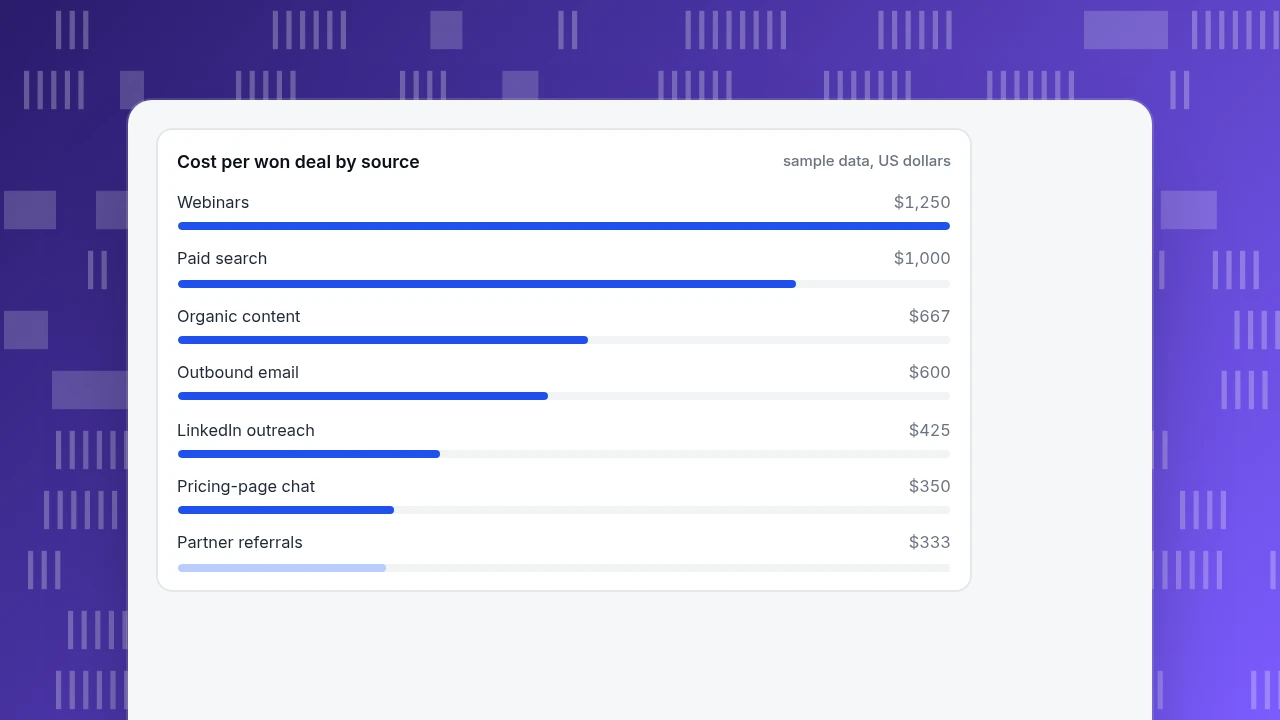
- The cheapest lead is not the cheapest deal. Outbound email has the lowest cost per lead ($13.33), but only 13.3% of its leads qualify (12 of 90), and it costs $600 per won deal. Partner referrals have the highest cost per lead ($83.33) yet the lowest cost per won deal ($333.33), because 66.7% of their leads qualify (8 of 12) and 37.5% of those close (3 of 8).
- Volume can mislead. Webinars produced the most leads (110) and the highest cost per won deal ($1,250). Only 13.6% of leads qualified and 13.3% of qualified leads closed.
Decision rule: rank sources by cost per won deal, then check how few deals the figure rests on. Two or three deals per source is too few to be sure, so treat the ranking as a reason to test, not a final verdict. A sensible move is to shift about 20% of the budget from the highest-cost source to the lowest-cost one, and re-measure after eight weeks.
Cost per won deal by source
sample data, US dollarsWhy bought lists are the wrong shortcut
A purchased list is attractive because it is instant, but it fails on three counts.
It has no intent. People on a list did not ask to hear from you, so the qualified share is usually far below your own sources. Count it as outbound and measure it the same way: if cost per won deal is not competitive, stop.
US law applies to business email. The FTC states that its CAN-SPAM rules make no exception for business-to-business email. Each separate email in violation can carry penalties of up to $53,088. The rules include accurate header and subject lines, identifying the message as an advertisement, a valid postal address, a clear opt-out and honouring opt-outs within 10 business days. You also remain responsible for companies you hire to send email.
Other countries differ. In the UK, the Information Commissioner's Office says the electronic-marketing rules do not require consent to email corporate subscribers (companies and similar bodies), but sole traders and some partnerships are treated as individuals who generally need to consent, and where an address identifies a person (name@company.com) data protection law applies, including an absolute right to object to direct marketing. If you are unsure which type a recipient is, the ICO says to treat them as an individual. This article is not legal advice; check the rules in each country you email.
The practical alternative is to build the list yourself from named accounts that fit your target customer, email them with relevant, honest messages and keep a suppression list.
What makes a lead qualified
Without a written definition, every source looks productive. Write the rule as two tests:
- Fit. Company size, industry and role match your target customer.
- Intent. The person did something that buyers do: asked for a demo or a quote, visited the pricing page more than once, or asked a buying question in chat.
Sample rule: "qualified = fits the target customer AND (asked for a demo OR asked about price OR visited pricing twice within 14 days)". Apply the same rule to every source or the cost-per-qualified column is meaningless. Review rejected leads each month; if more than a quarter of them turn out to be real buyers, the rule is too strict.
A monthly routine for finding and measuring leads
- Tag every link you control. Add UTM parameters (source, medium, campaign) to links in emails, messages, partner pages and ads, so the visit is credited to the right source.
- Capture the source on every lead. Record it in your CRM or sheet at the moment of capture, not afterwards.
- Log the outcome. For each lead mark qualified, won or lost, and the date.
- Build the table above once a month. Spend, leads, qualified, won, and the three cost columns.
- Move budget in small steps. Shift about 20% from the weakest source by cost per won deal to the strongest, and compare after eight weeks.
- Re-check the definition quarterly. Review whether the qualified rule still predicts deals.
In TapCub: measuring which sources bring leads
Take the sample's pricing-page chat and organic content rows and ask what TapCub can show.
- See which sources bring visitors. Open Web analytics › Sources. The Channels, Referrers and UTM tabs show visitors, sessions, bounce and duration per row, and the channel table also shows conversions. Search terms and AI sources are separate tabs.
- Define the lead as a goal. In Web analytics › Goals, make an event or page, such as the demo-request thank-you page, a goal. A form submit can be recorded when the form tracking attribute is on; TapCub records only the form's id, name and action, not what was typed. The goal shows conversions for each source.
- Know who the lead is. After sign-in or form submit, call
tapcub.loginso the person appears in All-platform analytics › Users › People with a day-by-day behaviour timeline. For accounts,tapcub.group('company', 'acme', {...})rolls people up by company. - Capture leads in chat. The chat widget has no pre-chat form. Ask for the email inside the conversation, or use offline messages when nobody is online. Each conversation arrives with the visitor's source, current page and last 2 days of browsing, and Live chat › Reports › Conversion attribution compares goal conversion for visitors who chatted with those who did not.
- Compare spend. Import spend in All-platform analytics › Business › Channel ROI to put it beside conversions by channel, then compute cost per lead yourself: spend ÷ goal conversions.
TapCub is not a CRM. It does not score leads, send email or track deals through to a signed contract; record won deals in your sales system and match them back to the source.
FAQ
How do you find B2B leads?
Put your offer where buyers already look and track the source: organic content, outbound email to named accounts, partner referrals, paid search, webinars and chat on your pricing page. In the sample month, the seven sources produced 412 leads, 95 qualified and 17 won deals for $11,250.
How do you find B2B leads without buying a list?
Build your own list of accounts that fit your target customer, write relevant messages, and rely on sources where buyers come to you, such as search content and referrals. The FTC says its email rules apply to business email too, so include an opt-out and a postal address.
Which B2B lead source is the cheapest?
Cheapest per lead and cheapest per deal can be different sources. In the sample, outbound email was cheapest per lead at $13.33 but partner referrals were cheapest per won deal at $333.33. Compare on cost per won deal, once you have enough deals to trust it.
What is a qualified lead?
A lead that both fits your target customer and showed intent, for example asking for a demo or visiting the pricing page twice in 14 days. Write the rule down and apply it the same way to every source.
Is it legal to cold email businesses?
In the US, the FTC says CAN-SPAM makes no exception for business email, so messages need accurate headers, an opt-out and a postal address. In the UK, corporate subscribers do not need to consent but individuals and sole traders generally do. This is not legal advice; check each country.
Sources
- Federal Trade Commission. CAN-SPAM Act: A Compliance Guide for Business: no business-to-business exception, eight requirements and penalties of up to $53,088 per email. Checked 2026-11-20.
- UK Information Commissioner's Office. Business-to-business marketing: corporate subscribers, sole traders and opt-outs. Checked 2026-11-20.
- Gartner. Gartner Says 80% of B2B Sales Interactions Between Suppliers and Buyers Will Occur in Digital Channels by 2025, 15 September 2020: buyers spend about 17% of consideration time meeting suppliers. Figure as reported in the release; the page may refuse automated checks.
Was this article helpful?
We use your answers to fix and expand this page.
Couldn’t send. Please try again in a minute.
Thanks for the feedback. We’ll use it to improve this page.You’ve already sent feedback on this page. Thanks.

Product Experience Specialist
Explores usability, user journeys, and feature adoption through practical examples of onboarding and everyday product use.