Try it on your own data
Every report in this article is in the free plan. One snippet for web and apps, up to 10 sites.
Start freeAn MQL is a lead marketing judges ready for sales; an SQL is one sales has accepted as a real opportunity. This guide compares the two, gives a starting lead-scoring model from fit and behaviour, and shows MQL-to-SQL rates by source in a worked example.
What you will learn
- Marketing defines MQLs; sales accepts SQLs; the handoff is where to measure
- Score leads on fit plus behaviour, and require a real intent signal
- Track MQL-to-SQL rate by source to find which MQL rule is wrong
The difference
A marketing qualified lead (MQL) is a lead that marketing has judged worth a salesperson's time, based on who they are and what they have done: the right kind of company, and enough interest, such as a demo request or several visits to pricing.
A sales qualified lead (SQL) is a lead that sales has looked at, usually talked to, and accepted as a real potential deal: there is a need, a budget or a path to one, someone who can decide, and a reasonable timeline.
The line between them is the handoff. Marketing decides what becomes an MQL; sales decides what becomes an SQL. Most friction between the two teams comes from an MQL definition sales does not trust, and the cure is to measure what happens to MQLs after the handoff.
Side by side
The table compares the two on who decides, what the decision is based on and what each stage is measured by.
| MQL | SQL | |
|---|---|---|
| Decided by | Marketing (scoring rules) | Sales (after review or a first call) |
| Based on | Fit and engagement signals | Need, authority, budget, timing |
| Typical trigger | Score over threshold: demo request, pricing visits, content | Accepted after qualification conversation |
| Next step | Handoff to sales, or more nurturing | Opportunity, proposal, deal |
| Measured by | MQL volume, MQL-to-SQL rate by source | SQL-to-won rate, pipeline value |
Both definitions should be written down and agreed by both teams.
How leads become MQLs: a simple scoring model
Lead scoring adds points for fit (is this the kind of customer we sell to?) and behaviour (are they showing buying intent?), and turns a lead into an MQL above a threshold. A starting model for a B2B software company:
- Fit: company size in your target range (+20), target industry (+10), job role that buys or influences (+15), free email domain (−10).
- Behaviour: demo or contact request (+40), pricing page visited twice or more in 14 days (+15), docs or integration pages viewed (+10), webinar attended (+10), guide downloaded (+5), no visit in 30 days (−15).
- Threshold: 50 points makes an MQL. A demo request from a target company passes on its own; a guide download alone does not.
The behaviour points come from your analytics, so the visits have to be tied to the lead. In TapCub, calling \tapcub.login\ (or identifying the person when they submit a form) links their earlier anonymous visits to the profile, so pricing and docs visits before the form count. CRM stages such as "SQL accepted" can be sent back as server events so the whole path sits in one place.
A worked example: MQL-to-SQL rate by source
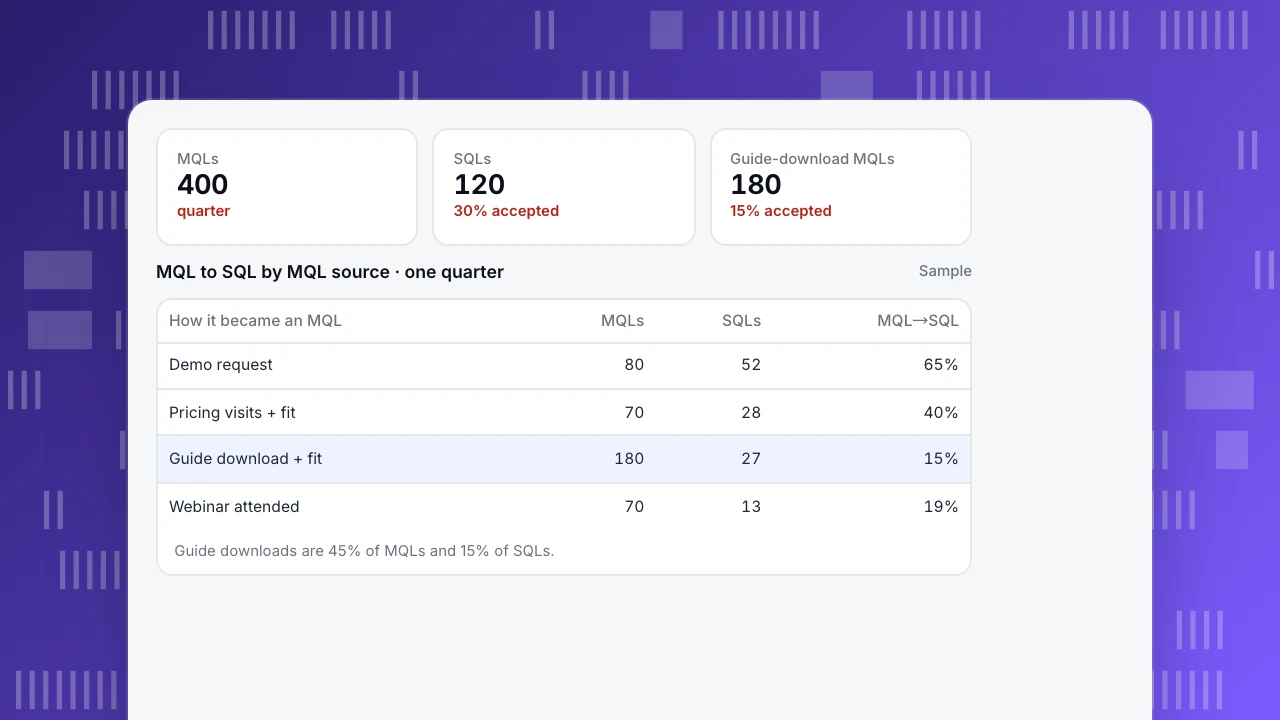
In one quarter, a team creates 400 MQLs and sales accepts 120 as SQLs: a 30% MQL-to-SQL rate. Overall that is fine. Split by how the lead became an MQL, it is not:
- Demo requests: 80 MQLs, 52 SQLs (65%). Strong intent, as expected.
- Repeated pricing visits plus fit: 70 MQLs, 28 SQLs (40%). Good: a behaviour signal that predicts acceptance.
- Guide downloads plus fit: 180 MQLs, 27 SQLs (15%). Nearly half the MQL volume, and most of what sales rejects.
- Webinar attendance: 70 MQLs, 13 SQLs (19%).
The fix is not "send fewer leads"; it is to change the scoring. Guide downloads become a nurture signal worth fewer points, and an MQL from content needs a second intent signal (pricing, docs, a return visit). The next quarter's MQL count drops, the SQL count stays the same, and sales stops ignoring the queue.
MQLs
400
quarter
SQLs
120
30% accepted
Guide-download MQLs
180
15% accepted
MQL to SQL by MQL source · one quarter
Sample| How it became an MQL | MQLs | SQLs | MQL→SQL |
|---|---|---|---|
| Demo request | 80 | 52 | 65% |
| Pricing visits + fit | 70 | 28 | 40% |
| Guide download + fit | 180 | 27 | 15% |
| Webinar attended | 70 | 13 | 19% |
Guide downloads are 45% of MQLs and 15% of SQLs.
Metrics for the handoff
- MQL-to-SQL rate, overall and by source. The main health check of your MQL definition.
- Speed to lead: time from MQL to first sales contact. Interest fades within days; agree a target in hours, not weeks.
- MQL rejection reasons. A short list sales picks from ("not a fit", "no need", "student", "duplicate") tells you what to fix in scoring.
- SQL-to-won rate and revenue by MQL source. The final test: which kinds of MQL turn into customers.
FAQ
What is a good MQL to SQL conversion rate?
It varies with your definition and market; rates in the range of 15% to 40% are commonly reported for B2B. Compare your own rate by source over time: a source far below the others is a scoring problem.
Who decides when an MQL becomes an SQL?
Sales, usually a sales development rep after a first conversation, using agreed criteria such as need, authority, budget and timing. Write the criteria down so the decision is consistent.
What is the difference between an SQL and an opportunity?
An SQL is a lead sales has accepted as worth pursuing. An opportunity is usually created once a deal is being actively worked, with an expected value and close date. Some teams treat them as the same stage.
What is a PQL?
A product qualified lead: someone who has shown buying intent inside the product, such as hitting a plan limit or inviting colleagues during a trial. In self-serve products it often replaces the MQL.
Related: lead tracking, lead conversion rate and product-qualified lead.
Was this article helpful?
We use your answers to fix and expand this page.
Couldn’t send. Please try again in a minute.
Thanks for the feedback. We’ll use it to improve this page.You’ve already sent feedback on this page. Thanks.

Growth Strategist
Explores acquisition channels, activation, and conversion experiments, turning data insights into actionable growth hypotheses and evaluation methods.