Try it on your own data
Every report in this article is in the free plan. One snippet for web and apps, up to 10 sites.
Start freeDirect competitors sell the same kind of product to the same customers; indirect competitors meet the same need with a different kind of product. Most teams watch the first group closely, yet customers who leave often go to the second, or stop doing the job at all. Below: the three types, four questions that find them, and a churn example in numbers.
What you will learn
- Label every competitor as direct, indirect or substitute by the customer's job, not by product category
- Ask people who left where they went; it is the only question that measures a competitor's effect
- In the sample, direct rivals explain 31 of 100 departures; 22 left to do nothing
What counts as direct and indirect competition?
Three kinds of competitor take customers from you, and they are easy to confuse:
- Direct competitors sell the same kind of product to the same customers for the same need. A customer comparing two invoicing apps is choosing between direct competitors.
- Indirect competitors sell a different kind of product that meets the same need. A freelancer can invoice with an app, with an accounting suite's invoice module, or with a template in a word processor; each is a different product doing the same job.
- Substitutes, including doing nothing, perform the same function from a different industry or with no product at all: a spreadsheet, a manual process, a person on the team, or a decision to stop caring about the problem.
The distinction is older than software marketing. Michael Porter's 1979 Harvard Business Review article on competitive forces separates rivalry among existing competitors from the threat of substitute products, and treats them as different forces with different consequences. Clayton Christensen's jobs-to-be-done framing gives the practical test: ask what job the customer is hiring a product to do, and everything else they could hire for that job is a competitor.
The core claim of this guide is simple. Most teams keep a list of direct competitors and watch it closely, but the customers who leave often go somewhere else, and the largest group is frequently the one that does nothing. The worked example below puts numbers on that.
How the three types differ
The table sets the three types side by side. Use it to label each name on your list; the labels decide what you do about it.
Direct competitors usually give themselves away because they appear in the same search results, the same comparison pages and the same sales calls. They compete on price, features and brand, and a win for one is usually a loss for the other. Indirect competitors are harder to spot because they rarely describe themselves in your words; they appear when a customer says "we just use X for that". Their effect builds slowly, because customers drift to a different category rather than switching in one decision. Substitutes are the hardest to see because there is nothing to look up: no website, no pricing page, no sales team.
A name can move between columns over time. A suite that adds an invoicing module is an indirect competitor to a stand-alone invoicing app the day it ships it, and a direct one if it later builds a stand-alone product.
| Type | Definition | How to spot it | Typical response |
|---|---|---|---|
| Direct competitor | Same product, same customer, same need | Shares your search results, comparison pages and sales calls | Compare on checkable differences: price at a volume, setup time, a missing feature |
| Indirect competitor | Different product, same need | Customers say "we use X for that"; suite modules, adjacent tools | Reposition around the job and who outgrows the alternative |
| Substitute | Same function from another industry or by hand | Spreadsheets, manual processes, a person on the team | Shorten the path to the first result: templates, imports, examples |
| Doing nothing | The problem is judged not worth solving | Cancellations with no destination; trials that never start | Show the cost of the problem; run campaigns whose results you can read |
One name can move between rows over time as products add features.
Four questions that find your competitors
A list built from memory or from a market report finds only what is already famous. These four questions find the rest, and each has a place in your own data where the answer can be checked.
- What job does the customer hire us for, in one sentence? Write it without your product category. "Send a correct invoice and get paid" finds more rivals than "invoicing software". Customer interviews and the words in support chats are the source; see customer needs analysis for how to collect them.
- What did they use before us, and what would they do if we disappeared tomorrow? Ask this at signup or in the first conversation. The answers to "before us" show your substitutes; the answers to "if we disappeared" show how strong they are.
- Who shows up where people look for us? Search results for your category words, comparison pages and review sites show direct competitors. Search queries that bring people to you, especially ones that mention other names or "alternative", show who customers compare you with; the difference between branded and non-branded queries is explained in branded vs non-branded keywords.
- Where do the people who leave go? Add one question to your cancellation or exit flow and ask lost deals the same thing. This is the only question that measures a competitor's effect rather than its existence.
If you can answer only one, answer the fourth. The first three tell you who could take customers; the fourth tells you who does.
Worked example: where do 100 churned users go?
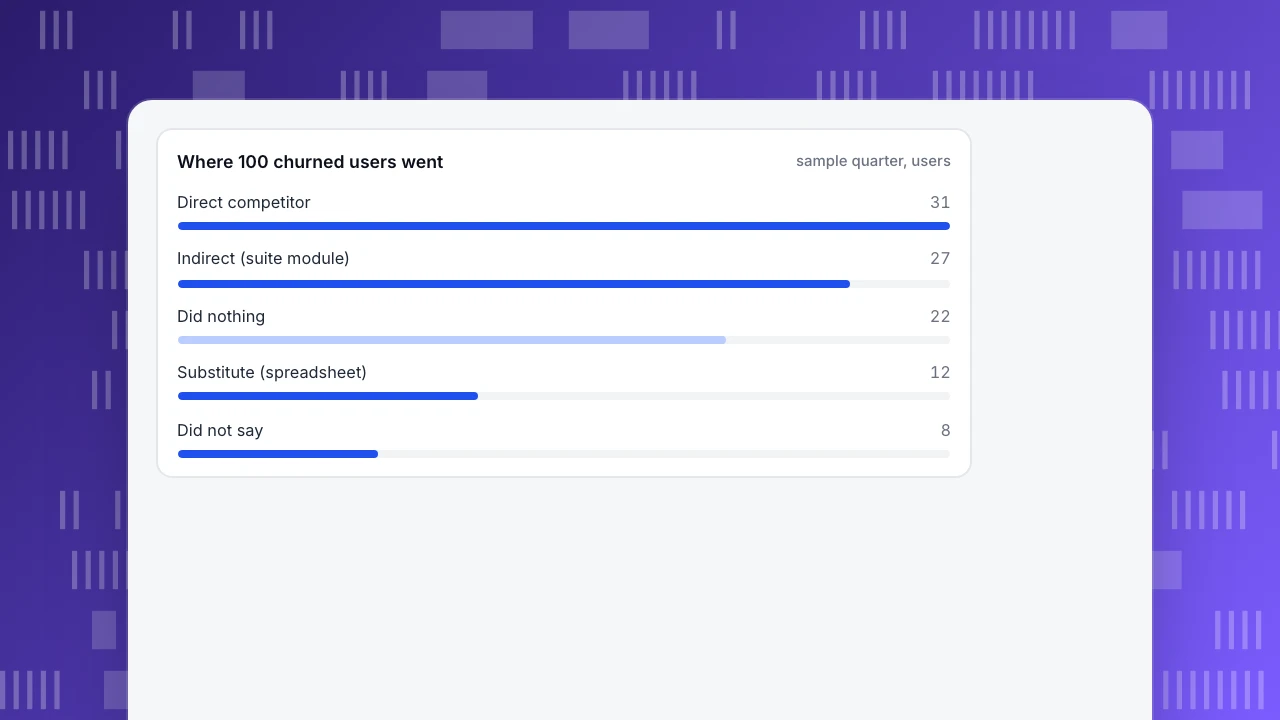
Sample data: a small invoicing product records why users cancelled over one quarter. One hundred users left. Each was asked, in a single free-text question, what they would use next, and the answers were sorted into five groups.
| Where they went | Type | Users | Share of all 100 | Share of the 92 who answered |
|---|---|---|---|---|
| Another stand-alone invoicing app | Direct | 31 | 31% | 33.7% |
| A module in an accounting or all-in-one suite | Indirect | 27 | 27% | 29.3% |
| Spreadsheet or manual process | Substitute | 12 | 12% | 13.0% |
| Nothing: stopped doing the job | No alternative | 22 | 22% | 23.9% |
| Did not say | Unknown | 8 | 8% | not counted |
The arithmetic: 31 + 27 + 12 + 22 + 8 = 100. Of the 92 who answered, 31 went to a direct competitor, which is 31 ÷ 92 = 33.7%. The other 61 (27 + 12 + 22) went somewhere that would never appear on a direct-competitor list, which is 61 ÷ 92 = 66.3%. The largest single group after direct competitors is the 22 who did nothing, and that group cannot be fought with a comparison page: they left because the problem stopped being worth solving with a product.
The decision this supports is concrete. A team tracking only direct competitors is watching one third of its losses. Two thirds are about positioning (why a stand-alone tool rather than the suite's module), about switching cost, and about how fast a new user gets a first result. Eight unknowns also tell you the question is worth asking every quarter, not once.
Where 100 churned users went
sample quarter, usersWhy teams over-watch direct competitors
Three habits keep attention on direct rivals even when the data points elsewhere.
- They are visible. Direct competitors have websites, ad campaigns, pricing pages and press releases, so tracking them is easy and feels like progress. Indirect competitors and substitutes leave no page to monitor.
- They fit a template. A feature-comparison grid works for two similar products and breaks the moment one rival is a spreadsheet.
- Sales hears only the deals that reached a comparison. Prospects who never started a trial because they decided to "keep it in a spreadsheet for now" never appear in the competitor field of the CRM.
The corrective is to give each type its own owner and its own metric, not to ignore direct rivals. A rule of thumb for where to spend time: if the share of departures going to direct competitors is under half of the answered cases, as in the example, put the next quarter's effort into the category-level story (why this kind of product) and first-use experience before the next feature-parity project. If it is over half, parity and price deserve the attention. For how this feeds a wider plan, see product strategy framework.
What to do about each type
- Direct competitor: compare on named, checkable differences (price at a given volume, a feature the other lacks, setup time) and measure the gap, as described in competitor benchmarking. Do not copy their roadmap; match only what lost deals show you are missing.
- Indirect competitor: reposition around the job and the reason a dedicated product does it better. If a suite module wins on convenience, your answer is depth for the people who outgrow the module, not a longer feature list.
- Substitute: shorten the path to the first result. A person comparing your tool with a spreadsheet decides in minutes whether setup is worth it; a template, an import or a prefilled example can decide it.
- Doing nothing: this is a reach and urgency problem. It is addressed by showing the cost of the problem (hours, missed payments) and by campaigns whose results you can read; marketing campaign analysis shows how to judge which messages actually moved people.
Mistakes when mapping competitors
- Treating a large company in a different category as a direct competitor because it is famous. Competitors are defined by the customer's job, not by the other company's size.
- Using one list for every purpose. The competitors you benchmark against (similar products) and the ones that take your customers (anything doing the job) are different lists.
- Asking competitors' customers nothing. Reading competitors' marketing pages shows what they say, not why people pick them.
- Counting only the winners. Lost deals and cancellations carry most of the information; closed-won deals mostly confirm what you already believe.
- Never refreshing the map. Review it once a quarter; categories merge, and a substitute today can be a direct competitor next year.
- Inferring competitor size from your own traffic. Your sources report shows who sends visitors to you, not how big anyone else is.
Mapping competitors with your own data in TapCub
Take the 100 churned users above. TapCub cannot tell you where they went, and it does not scrape competitors' sites or traffic; what it can do is hold the evidence from your side of the relationship in one place.
- See who compares you with whom. Under Web analytics › Sources, the Referrers tab lists the sites that send you visitors, so comparison and review pages that link to you show up by name, and the Search terms tab lists the organic queries recovered from referrers.
- Read full queries where you can. Connect Google Search Console or Bing Webmaster and open Monitoring › Search performance to see queries, clicks and impressions by page. Queries containing "alternative", "vs" or another product's name tell you who customers set next to you. Search data is usually one to three days late.
- Ask the exit question inside the product. Add a Live chat › Chat settings › Proactive invites rule on your cancellation or pricing page so an agent can ask what the visitor will use next; the answer is free text in the conversation. TapCub has no survey tool, so record the answer in your own sheet.
- Compare people who left with people who stayed. In All-platform analytics › Users › Segments & tags, build a segment of identified users who did your cancellation event, then use it as a group in funnel or retention analysis next to active users to see which first-week behavior differs. Anonymous visitors have no profile and do not enter segments.
- Track the share each quarter. The competitor map itself lives in your own sheet; TapCub supplies the traffic, query and behavior evidence that feeds it.
TapCub does not collect competitor data; competitive evidence here comes from your own traffic, search performance and conversations.
FAQ
What is the difference between direct and indirect competition?
Direct competitors offer the same kind of product to the same customers for the same need, so a sale for one is usually a loss for the other. Indirect competitors meet the same need with a different kind of product. The customer's job defines the line: if the customer would see the two as alternatives for that job, they compete.
What is an example of an indirect competitor?
A stand-alone invoicing app and the invoice module inside an accounting suite are indirect competitors: different products, same job. Another is a template in a word processor. In the sample above, 27 of 100 churned users moved to a suite module, more than to any other type except direct competitors.
How do I identify indirect competitors?
Write the customer's job in one sentence without your product category, then list everything people use for it: other categories, suite modules, manual methods. Check the list against your own signals: what customers used before you, which queries bring them to you, and where cancelled users say they went.
Are substitutes the same as indirect competitors?
They overlap but are not identical. A substitute performs the same function from a different industry or with no product at all, such as a spreadsheet or a manual process. Indirect competitors are usually products that look similar from the buyer's side, such as a suite module. Both are worth tracking separately from direct rivals.
Is "doing nothing" really a competitor?
Yes, and often the largest one. If a customer decides the problem is not worth solving, no competitor won; you lost to the status quo. In the sample, 22 of 100 churned users stopped doing the job altogether, the largest group after direct competitors. It is measured only if you ask.
See also: Product Differentiation Examples: 10 Companies and Their Numbers.
Sources
- Michael E. Porter, How Competitive Forces Shape Strategy, Harvard Business Review, March–April 1979.
- Clayton M. Christensen, Taddy Hall, Karen Dillon and David S. Duncan, Know Your Customers' "Jobs to Be Done", Harvard Business Review, September 2016.
- Google Search Console Help, Performance report (Search results).
Was this article helpful?
We use your answers to fix and expand this page.
Couldn’t send. Please try again in a minute.
Thanks for the feedback. We’ll use it to improve this page.You’ve already sent feedback on this page. Thanks.

Product Experience Specialist
Explores usability, user journeys, and feature adoption through practical examples of onboarding and everyday product use.