Try it on your own data
Every report in this article is in the free plan. One snippet for web and apps, up to 10 sites.
Start freeMarketing campaign analysis answers one question: did this campaign produce the outcome it was meant to, at a cost worth paying? Clicks and impressions are only the start. This guide gives a six-step method, the metrics for each step and a sample that compares three campaigns by cost per outcome.
What you will learn
- Write the goal and the outcome metric before launch
- Tag every link with consistent UTM parameters so traffic lands in the right campaign
- Compare campaigns by cost per outcome and quality of visitors, not by clicks
What campaign analysis answers
A campaign analysis checks whether a campaign reached its goal and whether the cost was worth it. It also tells you what to change next time. Do it the same way every time so campaigns can be compared.
Step 1: Set the goal before launch
Write down the one outcome the campaign is for, such as webinar sign-ups or first orders, and the target. Without it, any number can be presented as a success.
Step 2: Tag every link
Add UTM parameters to every link: source, medium and campaign at least. Keep the values consistent (lowercase, one spelling per network). Untagged links land in direct or referral and the campaign looks smaller than it was.
Step 3: Check the traffic arrived
Compare clicks in the ad or email platform with sessions in analytics for the campaign. A gap of a few percent is normal. A large gap points to broken tags, a slow landing page or redirects that drop parameters.
Step 4: Measure the outcomes
The table lists the metrics for each step and where they come from. Count outcomes as conversion goals in analytics so they use the same definition across campaigns.
| Step | Metric | Where it comes from |
|---|---|---|
| Delivery | Impressions, clicks, CTR | Ad or email platform |
| Arrival | Sessions by campaign | Analytics, UTM report |
| Engagement | Engaged sessions, pages per session | Analytics |
| Outcome | Sign-ups, orders, goal completions | Analytics goals |
| Efficiency | Cost per outcome, ROAS | Spend ÷ outcomes; revenue ÷ spend |
Clicks in the ad platform and sessions in analytics will not match exactly.
Step 5: Compare per outcome
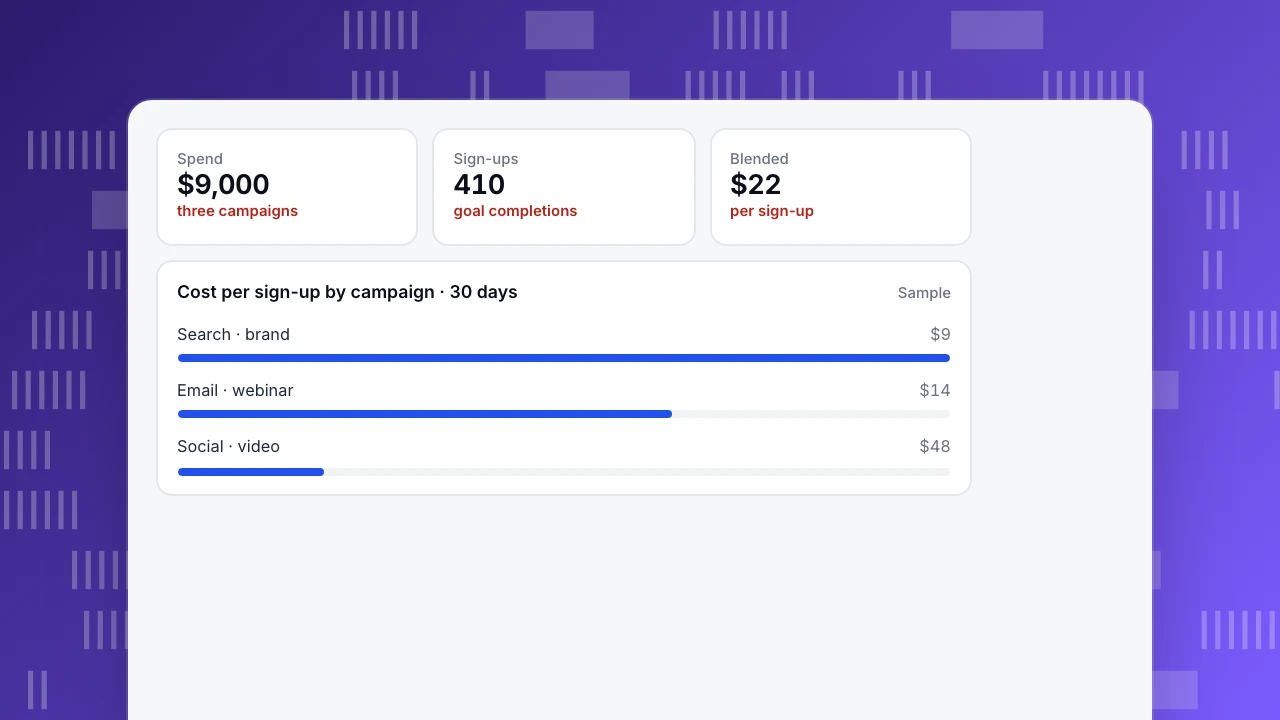
The sample compares three campaigns that spent $9,000 in total and produced 410 sign-ups. The social video campaign had the most clicks, yet its cost per sign-up was $48, against $9 for brand search and $14 for the webinar email.
Two cautions:
- Brand search often captures people who would have come anyway. Its low cost does not mean it created the demand.
- Small numbers swing. A campaign with 12 sign-ups can look twice as good or bad by chance.
Spend
$9,000
three campaigns
Sign-ups
410
goal completions
Blended
$22
per sign-up
Cost per sign-up by campaign · 30 days
SampleStep 6: Decide and record
End each analysis with a decision: scale, change or stop, and a note of why. Over a few quarters, these notes become your playbook.
If a campaign starts journeys that finish later through another channel, look at conversion paths before stopping it.
FAQ
What metrics should I use to analyse a campaign?
Delivery (clicks, CTR), arrival (sessions), engagement, outcomes (goal completions) and efficiency (cost per outcome, ROAS). Lead with the outcome the campaign was for.
Why do ad clicks not match analytics sessions?
People close the page before it loads, blockers stop tracking, and redirects can strip tags. Ad platforms may also count clicks differently.
How long should I wait before analysing a campaign?
Long enough for most outcomes to happen. For quick actions a week is often enough; for purchases with a long decision time, wait for the typical time to convert.
Was this article helpful?
We use your answers to fix and expand this page.
Couldn’t send. Please try again in a minute.
Thanks for the feedback. We’ll use it to improve this page.You’ve already sent feedback on this page. Thanks.

Growth Strategist
Explores acquisition channels, activation, and conversion experiments, turning data insights into actionable growth hypotheses and evaluation methods.