Try it on your own data
Every report in this article is in the free plan. One snippet for web and apps, up to 10 sites.
Start freeA customer needs analysis finds what customers are trying to achieve and what gets in their way, then ranks those needs with evidence. This guide covers the types of needs, the methods for what customers say and what they do, six steps, and an opportunity-score example where support chats and usage data outranked the loudest feature request.
What you will learn
- Combine what customers say with what they do
- Mine existing chats, tickets and search terms first
- Ask about past behavior, not desired features
- Score needs by importance and satisfaction
- Validate top needs against usage data
What is a customer needs analysis?
A customer needs analysis is a structured way to find out what customers are trying to achieve, what gets in their way and what they value, then rank those needs so product, marketing and support decisions are based on evidence rather than assumptions. It draws on what customers say (interviews, surveys, support conversations, reviews) and what they do (usage data, search terms, paths, drop-offs).
The output is a short, prioritized list of needs, each with evidence, the segment it applies to and how well you currently meet it.
Types of customer needs
| Type | What it is | Example (project management software) |
|---|---|---|
| Functional | The job the product must do | Assign tasks and see deadlines across projects |
| Emotional | How customers want to feel | Confident nothing is slipping through the cracks |
| Social | How they want to be seen | Look organized in front of a client |
| Service | Help around the product | Fast answers when an import fails |
| Price and value | What they will pay and why | Pay per active user, not per invited guest |
| Experience | Ease and speed of use | Set up a project in under five minutes |
Functional needs are usually the easiest to find and the least differentiating. Service and experience needs often decide who wins between similar products.
Methods: what customers say vs what they do
| Method | Reveals | Watch out for |
|---|---|---|
| Interviews | Context, motivations, the words customers use | Small samples; people describe ideal behavior |
| Surveys | How common a need is across segments | Leading questions; low response quality |
| Support and chat conversations | Real problems at the moment they happen | Skews toward problems, not delights |
| Reviews and sales notes | Comparison with alternatives, deal breakers | Extreme opinions are overrepresented |
| Site search and search queries | What people look for in their own words | Needs context to interpret |
| Product analytics | Which features are used, where people drop off | Shows what, not why |
The strongest findings show up in both columns: a need people mention in chats and a drop-off in the data at the same step.
| Opportunity score | Meaning |
|---|---|
| Above 10 | Important and badly served: act now |
| 6–10 | Clear opportunity |
| Below 6 | Served well enough or not important |
Opportunity = importance + (importance − satisfaction), on 1–5 or 1–10 scales; the bands here assume 1–10 and scale down for 1–5.
How to do a customer needs analysis in six steps
1. Define the decision and the segments
State what the analysis will inform (a roadmap, a pricing change, a new landing page) and which customer segments matter: new vs established, small vs large accounts, by industry or region.
2. Collect existing evidence first
Before new research, mine what you have: three months of chat transcripts and tickets, site search terms, sales call notes, reviews, cancellation reasons and product usage.
3. Run targeted interviews
Talk to 8–12 customers per segment, including some who churned. Ask about the last time they tried to do the job, what they used, what was hard and what it cost them. Avoid asking which features they want.
4. Code needs and count them
Turn notes and transcripts into need statements ("I need to see which client tasks are overdue without opening every project") and tag each source. Count how often each need appears and in which segments.
5. Measure importance and satisfaction
Use a short survey to rate each top need on importance and on how well your product meets it today (for example 1–5). Needs with high importance and low satisfaction are the opportunities.
6. Validate with behavior and act
Check each top need against usage data: do users try to do this and fail? Then turn the top three into concrete changes with a metric to watch.
Worked example: an opportunity score
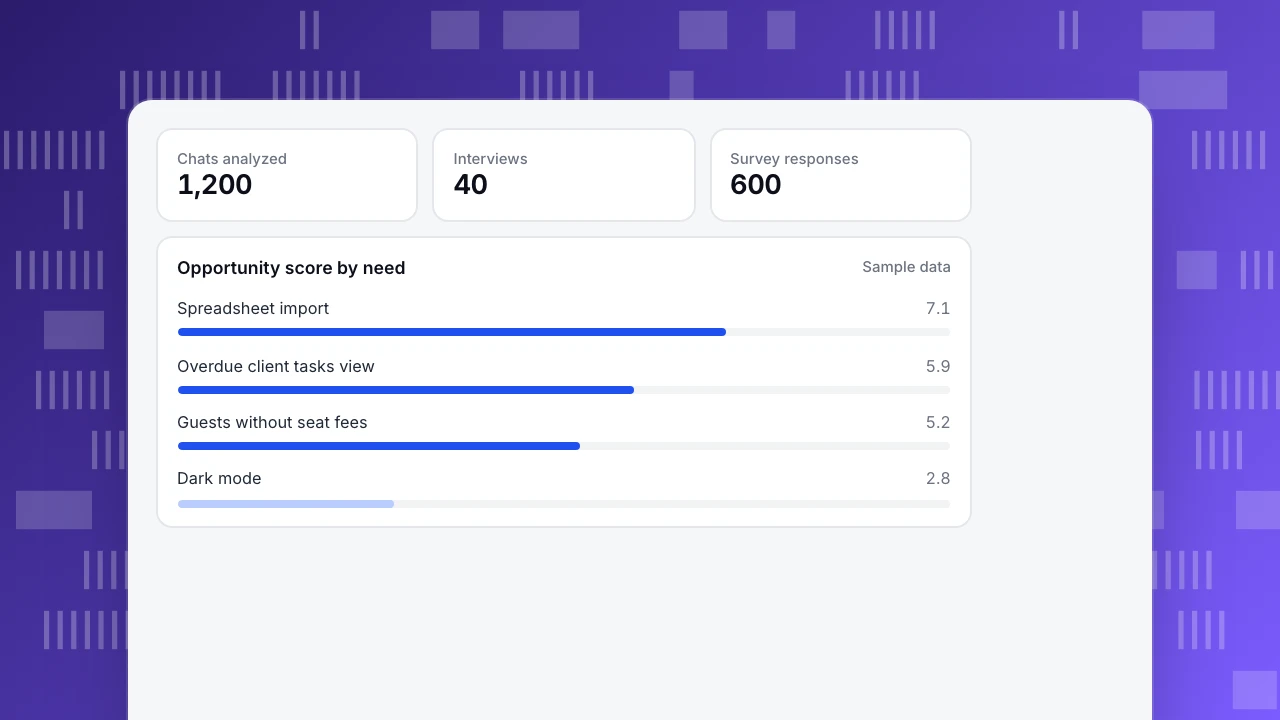
A B2B software company (sample data) analyzed 1,200 chat conversations, 40 interviews and a survey of 600 customers. Importance and satisfaction are averages on a 1–5 scale; opportunity = importance + (importance − satisfaction).
| Need | Mentions in chats | Importance | Satisfaction | Opportunity |
|---|---|---|---|---|
| Import tasks from spreadsheets | 214 | 4.6 | 2.1 | 7.1 |
| See overdue client tasks in one view | 168 | 4.4 | 2.9 | 5.9 |
| Invite guests without paying for seats | 97 | 3.9 | 2.6 | 5.2 |
| Dark mode | 61 | 2.4 | 2.0 | 2.8 |
Product data backed up the first need: 52% of new accounts that started an import from the empty-project screen abandoned it. Building a CSV import came first; dark mode, the loudest request on social media, ranked last.
Chats analyzed
1,200
Interviews
40
Survey responses
600
Opportunity score by need
Sample dataCommon mistakes
- Asking customers to design the solution. Ask about problems and past behavior; design the solution yourself.
- Listening only to the loudest channel. Social posts and big accounts are not representative.
- Skipping churned customers. They explain unmet needs best.
- No link to behavior. A stated need with no sign in usage data deserves a second look.
- Doing it once. Needs shift as markets and products change; refresh the analysis every six to twelve months.
Customer needs analysis with TapCub
- Conversations: live chat transcripts are stored with the visitor's pages, so you can see which page a question came from and search conversations by keyword. See live chat.
- Where needs show up in behavior: funnels, path analysis and feature adoption show which steps and features people try and abandon.
- Segments: compare behavior by user segment, plan, country or acquisition channel.
- Cancellation signals: combine product usage with your cancellation reasons.
TapCub does not run surveys; collect importance and satisfaction ratings with your survey tool and join them by segment.
FAQ
What is the difference between customer needs and customer wants? A need is the underlying problem or goal ("know which tasks are late"). A want is a specific solution a customer asks for ("an overdue tasks email"). Needs are more stable and lead to better solutions.
How many customers should I interview? Usually 8–12 per segment until new interviews stop revealing new needs, then a survey to measure how common each need is.
How is customer needs analysis related to jobs to be done? Jobs to be done is one framework for describing needs as the progress a customer wants to make. A needs analysis can use it to phrase and group needs.
How often should I repeat it? Every six to twelve months, or before major roadmap or pricing decisions.
Sources
- Ulwick, A. W. (2002). Turn customer input into innovation. Harvard Business Review.
- Nielsen Norman Group. User interviews 101.
- Christensen, C. M. et al. (2016). Know your customers' "jobs to be done". Harvard Business Review.
Was this article helpful?
We use your answers to fix and expand this page.
Couldn’t send. Please try again in a minute.
Thanks for the feedback. We’ll use it to improve this page.You’ve already sent feedback on this page. Thanks.

Product Adoption Consultant
Explores customer onboarding, live conversations, and self-service, turning common usage questions into practical guidance and improvements.