Try it on your own data
Every report in this article is in the free plan. One snippet for web and apps, up to 10 sites.
Start freeMost churn prevention advice is a list of good habits: onboard well, listen to customers, offer discounts. The habits are fine; the order is the problem. Customers who leave because a card expired, customers who never got started and customers whose usage slowly faded need completely different fixes. Split your churn first, watch the signals that come before each kind, and put effort where the most customers can be saved.
What you will learn
- Split churn into involuntary, early and late; each needs a different fix
- Act on leading signals (failed payments, no activation, falling usage), not on the cancellation itself
- Estimate saves per intervention, then prove them with a holdout group
Know which churn you are preventing
Churn is not one problem. Before choosing tactics, split last quarter's churned customers by cause and by how long they had been customers.
- Involuntary churn: the customer did not decide to leave; a payment failed (expired card, insufficient funds, bank decline) and was never recovered.
- Early churn: customers who leave in their first weeks or months, usually because they never reached the product's first real value.
- Late churn: established customers whose usage faded, whose champion left, or who found an alternative or lost budget.
The split also tells you whether to look at customer churn or revenue churn: losing ten small accounts and one large one are different problems. For finding the pattern in your data, see customer churn analysis.
Watch the signals that come first
A cancellation is the end of a process that usually started weeks earlier. The useful signals are the ones that leave time to act. The table lists common ones, their typical lead time and the matching action. Two rules make them usable: define each signal precisely enough to count ("fewer than 2 active users in the last 14 days, down from 5+"), and give every signal an owner who acts on it within a set time.
For scoring risk across many signals at once, see customer churn prediction and customer health score.
| Signal | Typical lead time | Action |
|---|---|---|
| Card expiring or payment failed | Days to weeks | Pre-expiry reminder, smart retries, update-card link |
| Not activated by day 7 | Weeks | Onboarding email or call, in-app guidance to first value |
| Active users in an account falling | 1–2 months | Customer success check-in, training for new users |
| Key feature no longer used | 1–2 months | Show what changed, offer help or an alternative workflow |
| Support tickets about the same problem | Weeks | Fix the cause, follow up personally |
| Visits to cancellation or pricing page | Days | Offer a pause or downgrade, ask what is missing |
Lead times are typical for monthly B2B subscriptions; consumer apps move faster.
12 churn prevention strategies
Before and at sign-up
1. Attract the right customers. Churn often starts with a promise the product does not keep. Align ads and sales pitches with what the product actually does well.
2. Get new customers to first value fast. Define the activation moment (first report built, first integration connected), measure the share who reach it in 7 days, and remove steps that stand in the way.
During adoption
3. Onboard the whole account, not one user. In B2B, accounts with several active users churn far less than single-user ones. Prompt invitations and train new members.
4. Drive adoption of sticky features. Compare retained and churned customers to find the features that predict staying, then guide more people to them.
5. Educate continuously. Short guides, webinars and in-product tips when customers reach a new stage, not a one-off welcome series.
While customers are active
6. Monitor health and act early. Combine usage, breadth and recency into a score and review the lowest-scoring accounts weekly.
7. Make support fast and fix root causes. Repeat contacts about the same problem are a churn signal. Track first response and resolution, and send recurring issues to the product team.
8. Reach out proactively. When an account's usage drops, a personal message ("we noticed reports stopped running, can we help?") beats a generic newsletter.
Billing
9. Recover failed payments. Send reminders before cards expire, retry failed charges on a smart schedule, use card-updater services from your payment provider, and send a clear update-card link. Involuntary churn is often the cheapest churn to prevent.
10. Offer flexibility instead of cancellation. Pause, downgrade, annual discounts or a smaller plan keep customers who would otherwise leave entirely.
At cancellation and after
11. Use the cancellation flow to learn and save. Ask for the reason in one question, then respond to it: a fix, a training call, a pause. Track cancellation reasons over time.
12. Win back former customers. When you ship what they asked for, tell them. Some churn is temporary.
A worked example: where to focus
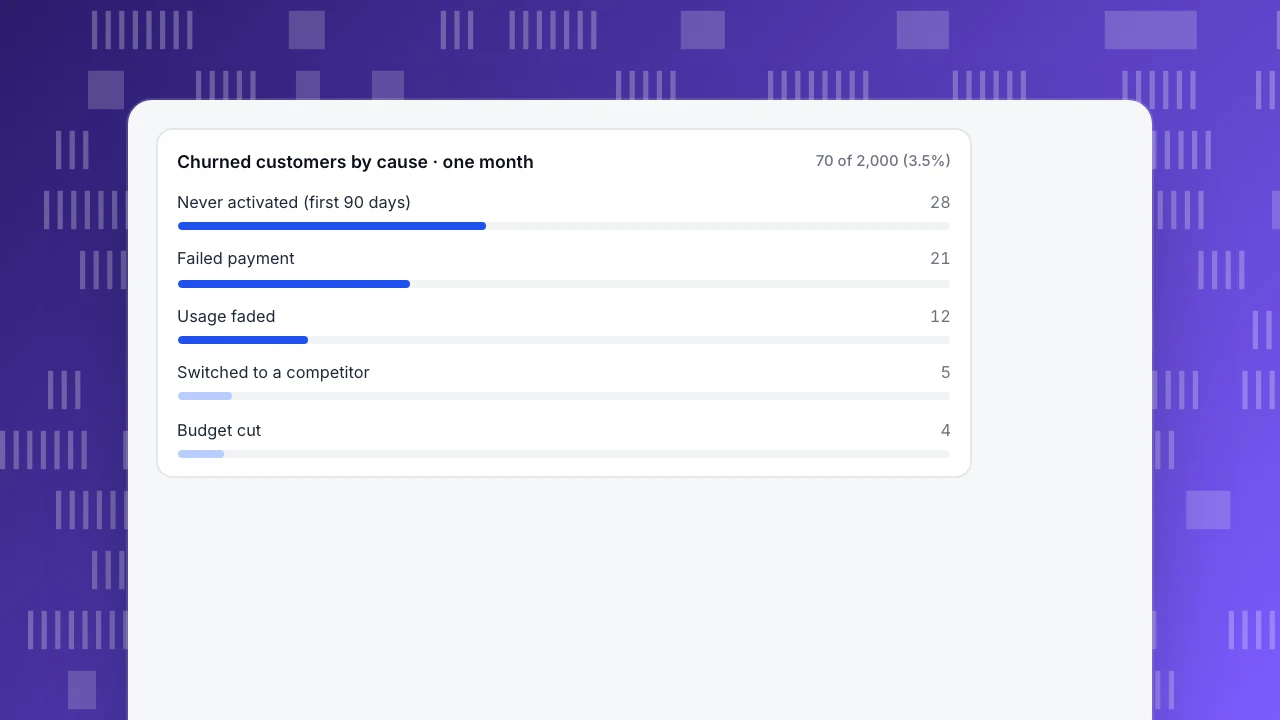
Sample data: a SaaS company with 2,000 customers loses 70 a month (3.5% monthly churn). Split by cause, as in the chart: 28 never activated, 21 had a failed payment, 12 saw usage fade, 5 switched to a competitor and 4 lost budget.
Estimated effect of three interventions (sample assumptions):
| Intervention | Customers in scope | Expected save rate | Saved per month |
|---|---|---|---|
| Pre-expiry reminders and smart retries | 21 failed payments | ~40% | 8 |
| Onboarding fix for the activation step | 28 early churners | ~25% | 7 |
| Health-score outreach to fading accounts | 21 established churners (12 + 5 + 4) | ~15% | 3 |
| Total | 70 | 18 |
If the estimates hold, churn falls from 70 to 52 customers a month, from 3.5% to 2.6%. Notice what is not on the list: a blanket discount. The two largest groups did not leave over price.
Why it is worth it: Reichheld and Sasser's classic study found that small improvements in retention produced large increases in profit, and acquiring a new customer typically costs several times more than keeping one (Gallo, 2014).
Churned customers by cause · one month
70 of 2,000 (3.5%)Measure prevention, not just churn
- Use holdouts. For outreach and save offers, randomly leave 10–20% of at-risk customers untouched. The difference in churn is the effect; without it, you cannot tell saves from customers who would have stayed anyway.
- Track by cohort. Compare the retention curve of customers who joined after an onboarding change with earlier cohorts at the same age.
- Report recovered revenue from failed payments separately; it is often the easiest win to prove.
- Watch for delayed churn. A discount that saves a customer for one month is not a save.
More measurement detail is in retention metrics.
Churn prevention data in TapCub
TapCub does not process payments or send dunning emails; it shows the behaviour that comes before churn.
- Retention and lifecycle in All-platform analytics › Behavior › Behavior analysis: retention curves by cohort, and lifecycle counts of new, returning, resurrecting and dormant users (active in one period, absent in the next). See read the lifecycle report.
- Segments such as "active in the last 30 days but not in the last 14", refreshed daily, as an at-risk list in All-platform analytics › Users › Segments & tags.
- Account health from 0 to 100 for B2B accounts: share of members active in 30 days (40 points), share of active days (30) and recency (30).
- Monitors that alert when a key metric drops beyond its normal range, and live chat to reach customers who are on the site right now.
FAQ
What is churn prevention?
The work of keeping customers from leaving: finding the reasons and early signals of churn and acting on them, from onboarding and support to payment recovery and cancellation flows.
What is the fastest way to reduce churn?
Recover failed payments. Reminders before card expiry, smart retries and an update-card link can save a large share of involuntary churn within weeks, with no change to the product.
How do you identify customers at risk of churning?
Look for falling usage, fewer active users in an account, unused key features, repeated support contacts and visits to the cancellation or pricing page. Combine them into a health score and review the lowest scores weekly.
Do discounts prevent churn?
Sometimes, for customers leaving over price. For customers who never activated or no longer get value, a discount only delays the cancellation.
Sources
- Reichheld, F. F. and Sasser, W. E. (1990). Zero Defections: Quality Comes to Services. Harvard Business Review.
- Gallo, A. (2014). The Value of Keeping the Right Customers. Harvard Business Review.
- Stripe Docs, Revenue recovery.
Was this article helpful?
We use your answers to fix and expand this page.
Couldn’t send. Please try again in a minute.
Thanks for the feedback. We’ll use it to improve this page.You’ve already sent feedback on this page. Thanks.

Product Adoption Consultant
Explores customer onboarding, live conversations, and self-service, turning common usage questions into practical guidance and improvements.