Try it on your own data
Every report in this article is in the free plan. One snippet for web and apps, up to 10 sites.
Start freeA good bounce rate depends on what the page is for. A blog post that answers a question in one page can bounce at 80% and be doing its job; a pricing page at 80% is losing buyers. This guide shows how to judge bounce rate by page type and intent, with a sample, and how to set a target from your own data.
What you will learn
- Never judge bounce rate as one site-wide number; split it by page type and channel
- A high rate is a problem only on pages whose job is to send people onward
- Set targets from your own history per page type, and check time and conversions alongside
What bounce rate measures
Bounce rate is the share of sessions that viewed one page and did nothing else. In TapCub a bounce is a session with one pageview and no custom event, so a visit where someone played a video or clicked a tracked button is not a bounce. Other tools use other rules, which is one reason benchmark numbers from the web rarely compare to yours.
Why one number misleads
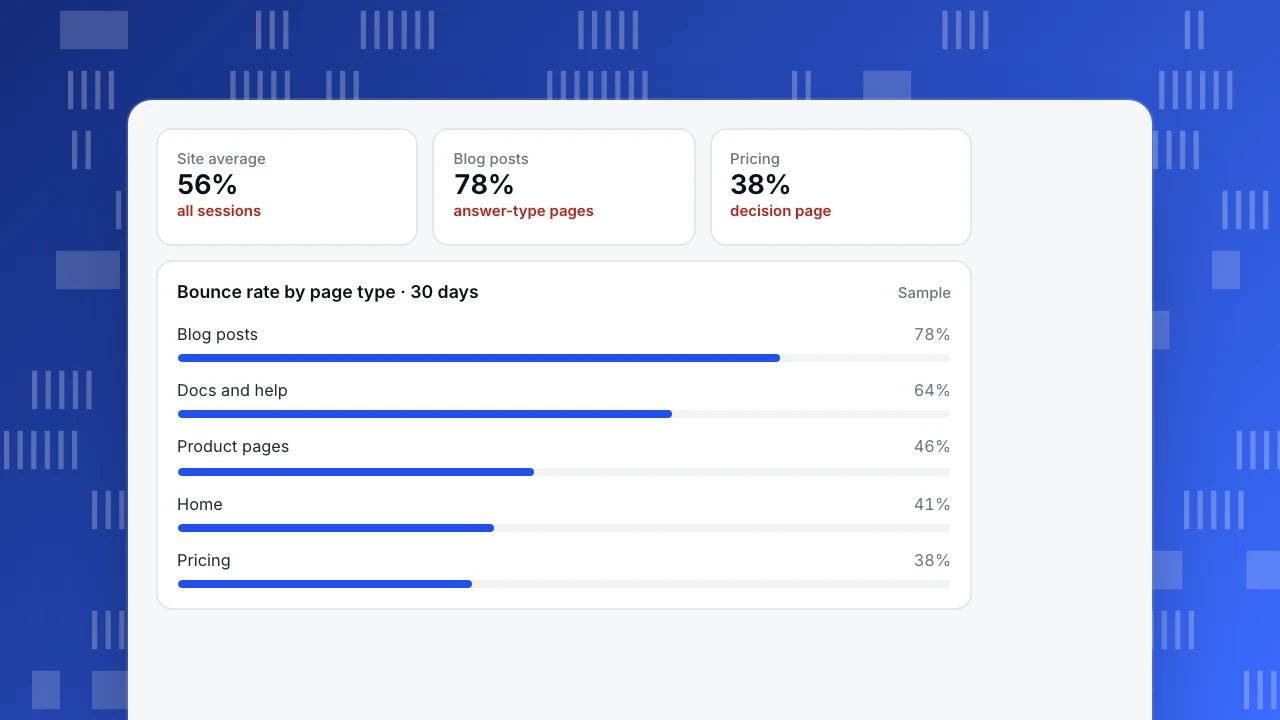
A site-wide bounce rate is an average of very different pages. In the sample below the site average is 56%, but blog posts bounce at 78% and the pricing page at 38%. Publish more articles and the average rises even if every page improved. Publish fewer and it falls without anything getting better.
Bounce rate by page type
The chart splits the sample site by page type. Each group has a different job, so each has a different normal.
Site average
56%
all sessions
Blog posts
78%
answer-type pages
Pricing
38%
decision page
Bounce rate by page type · 30 days
SampleWhen a high bounce rate is a problem
Ask what the page is supposed to do. The table lists the common page types and what a high rate tells you about each.
Then look at two more numbers for the same sessions:
- Time on page. A one-page visit of three minutes on an article is a reader; three seconds is a miss.
- Conversions and next steps. On pages meant to send people onward, bounce goes hand in hand with lost sign-ups or sales.
| Page type | Job of the page | High bounce rate means |
|---|---|---|
| Blog post, glossary | Answer one question | Often fine if time on page is healthy |
| Docs, help article | Solve a problem | Fine if few people contact support afterwards |
| Landing page | Get a click or a form start | A mismatch with the ad or search promise |
| Pricing, product page | Move towards purchase | Lost buyers; check price clarity and load time |
| Home page | Route people onwards | Navigation does not help people find their way |
Judge each page by its job, then compare it with similar pages.
How to set your own target
- Group pages by type with path patterns, such as
/blog/*and/docs/*. - Take the median of the last three months for each group as the baseline.
- Set the target relative to the baseline, for example five points lower on landing pages after a redesign.
- Split by channel. Paid social often bounces more than search; a blended number moves when the mix changes.
- Re-check after tracking changes. Adding a custom event, for example on scroll or video play, lowers bounce rate overnight without any change in behaviour.
Common mistakes
- Comparing your number with a benchmark that uses a different bounce definition.
- Trying to lower the rate on pages that answer a question in one view.
- Reading the rate on pages with only a handful of sessions.
For fixes on pages where bounce really is a problem, see how to reduce bounce rate. The difference from exit rate is in bounce rate vs exit rate.
FAQ
What is a good bounce rate for a website?
There is no single good number. Judge it per page type: answer pages like blog posts can be high without harm, while pages meant to move people onward, such as pricing or landing pages, should be much lower than the site average.
Is a 70% bounce rate bad?
On a blog post with good time on page, not necessarily. On a landing page for a paid campaign, it usually means the page does not match what the ad promised.
Why did my bounce rate suddenly drop?
Often a tracking change: a new custom event, a second copy of the tracking code or a change in how events are counted. Check recent changes before celebrating.
Does bounce rate affect SEO?
Search engines do not use your analytics bounce rate. But a page that fails to satisfy visitors usually also performs poorly in search over time.
Was this article helpful?
We use your answers to fix and expand this page.
Couldn’t send. Please try again in a minute.
Thanks for the feedback. We’ll use it to improve this page.You’ve already sent feedback on this page. Thanks.

Data Analyst
Explores traffic sources, conversion funnels, and retention, using clear metric definitions and concrete examples to explain what the numbers mean.