Try it on your own data
Every report in this article is in the free plan. One snippet for web and apps, up to 10 sites.
Start freeA new domain cannot rank for big keywords in its first year, and it does not need to. This guide shows when a startup should start SEO, how to pick keywords it can win, a month-by-month plan, and a worked year where a few comparison and use-case pages produced most of the signups.
What you will learn
- Start content SEO once a group of customers pays and stays
- In the first six months target KD under 30 with direct product fit
- Alternatives, comparisons and use cases convert far better than guides
- Guides earn the links that help commercial pages rank
- Measure signups by landing page from day one
Why SEO works for startups
SEO for startups means earning search traffic with a small team, a new domain and little budget. Paid channels stop the day you stop paying; a page that ranks keeps bringing visitors for years. For an early-stage company, SEO is one of the few channels whose cost per customer falls over time.
The catch is that it is slow. A new domain usually needs months before pages rank for anything competitive. That is why startups should not copy the SEO playbook of an established company. The goal in the first year is not traffic; it is signups from searches that are close to a buying decision.
When should a startup start SEO?
- Before product-market fit: only the basics. A crawlable site, a clear homepage, a few pages describing the problem you solve. Do not build a content program yet; your positioning will change.
- Once a small group of customers pays and stays: start. You now know who buys, what words they use and what they compare you with. That is the input for keyword research.
- When a competitor's alternative pages or comparison articles keep coming up in sales calls: you are late. Those searches are already deciding deals.
Pick keywords a new domain can win
New domains have little authority, so head terms with high keyword difficulty are out of reach for a while. Start at the bottom of the funnel, where volume is small but intent is high (illustrative figures for an invoicing startup):
| Keyword type | Example | Volume | KD | Intent | When |
|---|---|---|---|---|---|
| Alternatives | "[competitor] alternative" | 1,300 | 18 | Commercial | Months 1–3 |
| Comparisons | "[tool A] vs [tool B]" | 480 | 12 | Commercial | Months 1–3 |
| Use cases | "invoice software for freelancers" | 880 | 24 | Commercial | Months 1–3 |
| Integrations | "invoicing for Stripe" | 210 | 8 | Transactional | Months 3–6 |
| Problem guides | "how to chase a late invoice" | 1,900 | 29 | Informational | Months 3–9 |
| Templates and tools | "invoice template" | 74,000 | 62 | Informational | Later |
| Head term | "invoicing software" | 12,100 | 71 | Commercial | Later |
A simple rule: in the first six months, choose keywords with KD under 30 where your product is a direct answer to the search.
| Keyword type | When |
|---|---|
| Alternatives and comparisons | Months 1–3 |
| Use cases | Months 1–3 |
| Integrations | Months 3–6 |
| Problem guides | Months 3–9 |
| Templates and head terms | Later |
Rule of thumb: KD under 30 for the first six months.
A 12-month SEO plan for a startup
- Month 1, foundations. Server-rendered or static HTML, a sitemap, clean URLs, fast pages (good Core Web Vitals), one H1 and a descriptive title per page, analytics and Search Console connected.
- Months 1–3, money pages. Five to ten alternative, comparison and use-case pages. Each with an honest comparison table, screenshots and a clear call to action.
- Months 2–6, integration and feature pages. One page per integration and key feature, written for the search a user would type.
- Months 3–12, problem content. Two to four guides a month answering the questions customers ask before buying. Use original data or examples where you can.
- Throughout, links from real activity. Launch posts, integration directories, partner pages, founder interviews, podcasts, open data you publish. Skip paid link schemes; they put a new domain at risk.
- Monthly, measure and prune. Track signups by landing page, update pages that slip, merge thin pages that compete for the same keyword.
Worked example: twelve months of startup SEO
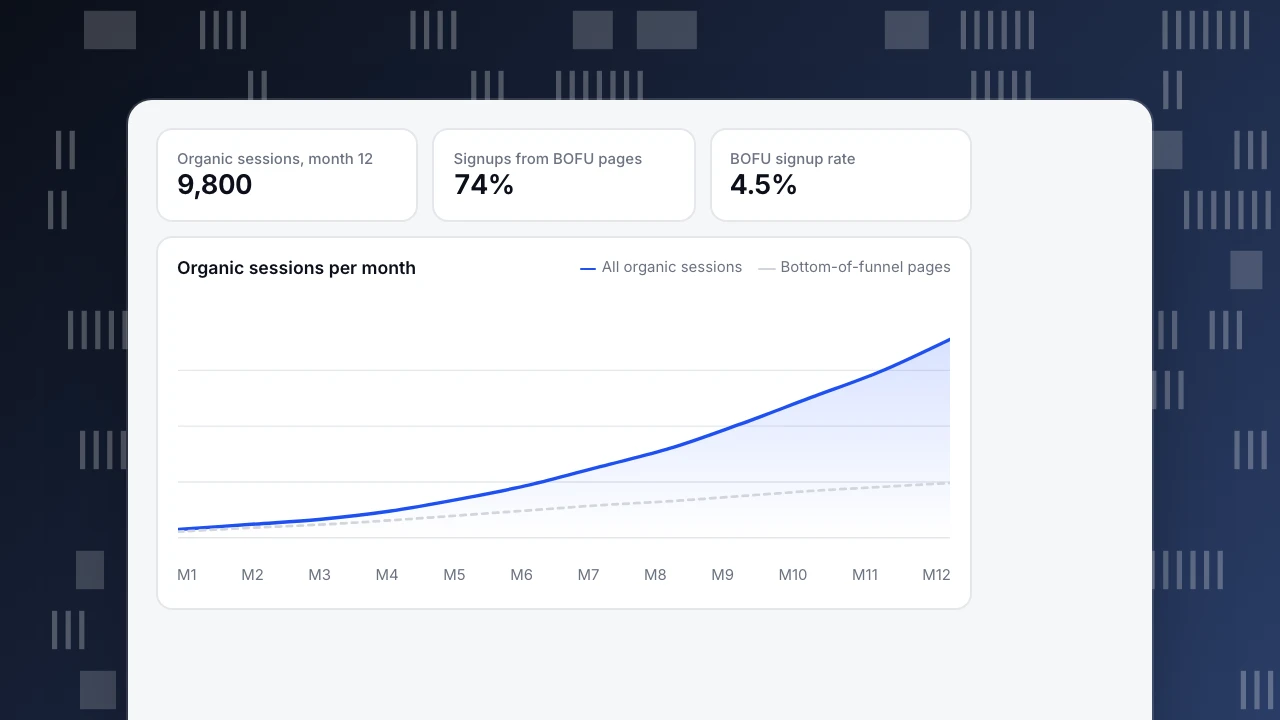
A B2B startup on a new domain followed this plan (sample figures). Organic sessions grew from 400 in month 1 to 9,800 in month 12. The split by page type was the useful part:
| Month 12 | Organic sessions | Share | Signups | Signup rate |
|---|---|---|---|---|
| Bottom-of-funnel pages (alternatives, comparisons, use cases, integrations) | 2,700 | 28% | 122 | 4.5% |
| Guides and blog | 7,100 | 72% | 43 | 0.6% |
| Total | 9,800 | 100% | 165 | 1.7% |
Bottom-of-funnel pages brought 28% of organic traffic and 74% of organic signups. The blog mattered too: it earned most of the backlinks, and those links helped the commercial pages rank. But if the team had started with the blog alone, month 6 would have shown traffic and almost no customers.
Other observations: the first page reached the top 10 in week 7 (a comparison page with KD 12); pages with a comparison table converted 1.8 times better than those without; and two guides that targeted the same query competed with each other until they were merged.
Organic sessions, month 12
9,800
Signups from BOFU pages
74%
BOFU signup rate
4.5%
Organic sessions per month
All organic sessionsBottom-of-funnel pagesCommon SEO mistakes startups make
- Chasing volume. A 20,000-search keyword with KD 70 will not rank for a year; a 300-search comparison keyword can rank in weeks and sell.
- Client-side rendering only. Single-page apps that render content in the browser can be slow to index and invisible to many AI crawlers.
- Writing for the team, not the buyer. Internal product names and jargon nobody searches for.
- Measuring traffic, not signups. Report signups and trials by landing page from day one.
- Publishing and forgetting. Pages decay; refresh numbers, screenshots and comparisons at least twice a year.
- Ignoring AI search. Buyers also ask assistants. Clear answers, tables and original data help you get cited there too.
Measuring startup SEO in TapCub
Connect Google Search Console or Bing Webmaster in Monitoring › Search performance to see clicks, impressions, click-through rate and position by page and query. Web analytics › Pages shows entry pages with sessions and downstream pageviews, and Monitoring › Content decay flags pages whose organic visitors are falling. To count signups by landing page, set up a signup goal (Set up goals) and break it down by entry page. Related reading: Organic traffic, SEO KPIs and JavaScript SEO.
Sources
- Google Search Central, SEO Starter Guide.
- Google Search Central, Creating helpful, reliable, people-first content.
Was this article helpful?
We use your answers to fix and expand this page.
Couldn’t send. Please try again in a minute.
Thanks for the feedback. We’ll use it to improve this page.You’ve already sent feedback on this page. Thanks.

Customer Experience Consultant
Writes about live chat, visitor conversations, and self-service, sharing practical ways to make customer communication clearer and more effective.