Try it on your own data
Every report in this article is in the free plan. One snippet for web and apps, up to 10 sites.
Start freeA good sales pitch says the buyer's problem first, backs it with one checkable piece of evidence, and ends with a single next step. The examples below apply that structure to a cold email, a phone call, an elevator pitch, a website or chat message and a follow-up, and a recomputed split test shows how to tell which version actually works.
What you will learn
- Open with their problem, not your company; features appear only as evidence
- Evidence means a dated, measured, checkable fact, never an adjective
- Ask for one small next step, and test two versions on a random split before rewriting every template
What makes a sales pitch work?
Every pitch below follows the same three moves, in this order:
- Their problem. One sentence that describes the buyer's situation so accurately they think "yes, that's us".
- Your evidence. One fact they can check: a measured result, a named method, a dated number. Not an adjective.
- One next step. A single, small, specific ask, such as "Can I send a two-minute walkthrough?" rather than "Let me know your thoughts".
Product features are not part of the structure. They appear only as evidence for the problem you just named. A pitch that opens with "We are a leading provider of…" has skipped step one.
| Part | The question it answers | What goes wrong |
|---|---|---|
| Problem | Do you understand my situation? | Generic opener that fits any company |
| Evidence | Why should I believe you? | Superlatives with no number or date |
| Next step | What do I do now? | Three asks at once, or none |
The examples use an invented product, a scheduling tool for small dental clinics, so you can see the structure without anyone's real brand. Square brackets mark facts you must fill in from your own data; do not publish a pitch with the brackets left in.
What does a cold email pitch look like?
Example (illustrative):
Subject: Missed appointments at [Clinic name] Hi [Name], Clinics with [number] chairs tell us unconfirmed appointments are where chair time disappears. [Problem: use what you heard in discovery] In a [number]-week pilot with [number] clinics, reminders sent by text cut no-shows from [X%] to [Y%] ([date], [how measured]). [Evidence] Would it help if I sent a two-minute walkthrough of how reminders are set up? [Next step] [Your name], [company], [postal address] · Reply "stop" and I will not write again.
What makes it work: the subject names a problem the reader has, not your company; the evidence is one measured number with a date; there is one question. It is under 90 words. The last line is also a legal requirement in the United States: the CAN-SPAM provisions in 15 U.S.C. § 7704 ban deceptive subject lines and false headers and require a valid physical postal address and a working opt-out in commercial email, and they apply to business-to-business email as well.
How do you open a phone or voicemail pitch?
The first ten seconds decide whether the person stays on the line. Use a short version of the same three moves:
"Hi [Name], it's [your name] from [company]. I'm calling because clinics your size often mention losing chair time to unconfirmed appointments. We cut that by [X] in a [number]-clinic pilot. Do you have two minutes for me to explain how, or should I call back tomorrow?"
The question at the end gives the other person a way out, which is a courtesy and keeps the ask small. For voicemail, drop the question and leave one next step: "I'll send the one-page summary by email today; reply to that if it's useful."
If you call consumers rather than businesses, the Telemarketing Sales Rule (16 CFR Part 310) requires you to promptly say who you are and that the purpose is to sell something. Check which rules apply to your calls before you build a script.
How do you write an elevator or one-line pitch?
An elevator pitch has one job: make the other person ask a follow-up question. Fill in this template, then cut it to one breath:
"We help [who] [do what] so that [measurable result]. Unlike [the usual way], we [one difference]."
"We help small dental clinics fill empty chairs by reminding patients by text, so no-shows drop. Unlike a phone call from the front desk, reminders go out on their own and patients can confirm or rebook in one tap."
Test: say it to someone outside your industry. If they can repeat what you do after hearing it once, it works. If they ask "what does that mean?" about any word, replace the word.
How do you pitch on a website or in live chat?
A website pitch is the first screen of a landing page or the opening message of a proactive chat. Same moves, shorter space:
- Headline = problem: "Stop losing chair time to no-shows."
- Subline = evidence: "Clinics in our pilot cut no-shows from [X%] to [Y%]." with a link to how it was measured.
- Button = next step: "See a 2-minute demo", not "Submit".
In live chat the same pitch becomes a first message, sent only when it is relevant: someone has spent time on the pricing page, so the message says "Questions about pricing? I can compare plans for a clinic your size." For more openers and replies see live chat scripts. The way a pitch ends is a lead conversion step, so measure it as one.
How do you follow up without nagging?
A follow-up pitch adds something new each time. Never send "just checking in". Three follow-ups that earn their place:
| Day | New thing you add | Example line |
|---|---|---|
| 3 | A proof the first email lacked | "I attached the one-page method behind the [X%] to [Y%] result." |
| 7 | A relevant observation about them | "I noticed you now offer Saturday appointments; reminders matter more when the schedule is tighter." |
| 14 | A graceful exit | "I'll stop here. If missed appointments become a priority, this link has the walkthrough." |
Each follow-up keeps one next step. The day-14 exit is part of the pitch: it respects the reader and leaves the door open. Prepare each one from what you learned in a customer needs analysis, so the problem you name is theirs, not a template's.
| Channel | Length | The one next step |
|---|---|---|
| Cold email | 60 to 90 words | Send a two-minute walkthrough |
| Phone opener | 10 to 15 seconds | Two minutes now, or a call back |
| Voicemail | Under 20 seconds | I will email a one-page summary |
| Elevator pitch | 1 to 2 sentences | The listener asks a follow-up |
| Website hero | Headline plus one line | Button: See a 2-minute demo |
| Follow-up | 30 to 50 words | One new proof, one ask |
Stop when problem, evidence and next step are all present; shorter is not automatically better.
How do you tell which pitch works? A worked example
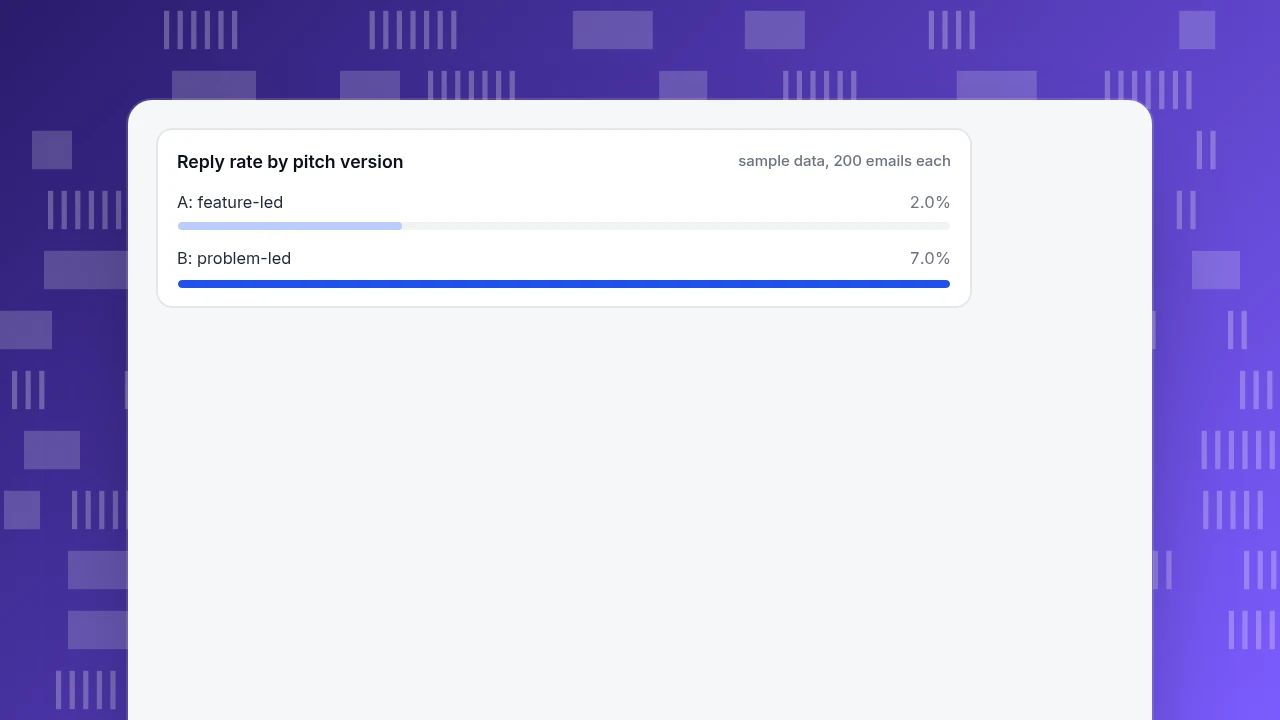
Sample data: you send two versions of the cold email to 200 clinics each, split at random. Version A leads with features ("Our tool offers automated SMS reminders, two-way confirmation and calendar sync"). Version B leads with the problem and the measured result, as in the example above.
| A: feature-led | B: problem-led | |
|---|---|---|
| Emails sent | 200 | 200 |
| Replies | 4 | 14 |
| Reply rate | 4 ÷ 200 = 2.0% | 14 ÷ 200 = 7.0% |
| Difference | 5.0 points (3.5 times) |
Is a gap of 5 points real or luck? A two-proportion z-test on these counts gives z ≈ 2.41, p ≈ 0.016, so a gap this large would happen by chance about 1.6% of the time if the two versions were equal. That is encouraging, but with only 18 replies in total it is a thin base. Ten more replies for A would erase the gap. Before you rewrite every template, send the winner and the loser to another 2,000 each: if the rates held (2.0% and 7.0%), 40 versus 140 replies would give p well below 0.001. See statistical significance for how many sends you need before trusting a gap.
Also decide in advance what the reply rate measures. Replies that say "not interested" count too; the number that matters for revenue is meetings booked, and then deals. Track the pitch through to that stage, not only to the reply.
Reply rate by pitch version
sample data, 200 emails eachWhat are the most common sales pitch mistakes?
- Opening with yourself. "We are a leading provider of…" tells the reader nothing about them.
- Adjectives instead of evidence. "Powerful, flexible, easy" cannot be checked; "no-shows fell from X% to Y% in [number] weeks" can.
- Unsupported claims. A number you cannot back up is a legal and trust risk. Keep the source and date for each one.
- Fake familiarity. "I loved your recent post" followed by a template. If you cannot be specific, skip it.
- Several asks. Demo, call, reply and download in one message means none gets done.
- Treating the pitch as a close. A pitch starts a conversation; the sale happens later.
- Never measuring. Without a reply rate by version, you are guessing which words work.
How to measure your pitch in TapCub
The email example ends with a link to a two-minute walkthrough. Here is how to see what happens after the click. TapCub measures the website side; it does not send email, make calls or manage deals, so the reply counts and the deal pipeline stay in your email and CRM tools.
- Tag each pitch version. Put a UTM campaign on the link, for example
utm_campaign=pitch-aandpitch-b. Under Web analytics › Sources you see visits by campaign. - Define the next step as a goal. In Web analytics › Goals, create a goal for the demo-request or booking confirmation page. The goal rate is the goal's conversions divided by unique visitors, so read it per campaign.
- Find where people drop. In All-platform analytics › Behavior › Behavior analysis, build a funnel from the landing page to the booking confirmation and click the step where most people leave to see who dropped.
- If the pitch also runs as a proactive chat, set it up in Live chat › Chat settings › Proactive invites (page plus seconds on page), then compare chatters with non-chatters in Live chat › Reports › Conversion attribution. That comparison is a raw gap, so treat it as an upper bound.
- Know the boundary. TapCub does not split email traffic for you, score leads or log calls. It tells you what the people who clicked did.
FAQ
What are the 3 parts of a sales pitch?
The problem (their situation, described accurately), the evidence (one checkable fact such as a dated, measured result) and the next step (one small specific ask). Features only appear as evidence for the problem.
What is a good example of a sales pitch?
A good short example is: "Clinics your size often mention losing chair time to unconfirmed appointments. In a pilot, text reminders cut no-shows from X% to Y%. Can I send a two-minute walkthrough?" It names the problem, gives one measured result and asks one question.
How long should a sales pitch be?
Match the channel. A cold email works at 60 to 90 words, a phone opener is about 10 to 15 seconds, an elevator pitch is one or two sentences, and a landing-page hero is a headline plus a sentence. Shorter is not always better: stop when problem, evidence and next step are all there.
How do you write a sales pitch for a product?
Start from what you learned about the buyer, not from the feature list. Write the problem in their words, pick the single strongest proof you can document, state one next step, then cut every word that is not one of those three. Test two versions on a split and compare replies, then meetings.
What is the 3-3-3 rule in sales?
It is a shorthand some sales teams use for structuring an opening, but it is not a standard and teams define it differently, so check how yours does. The structure above (problem, evidence, next step) is the more reliable test.
See also: How to Make a Sales Call Script: Fill-In Template With Timing.
Sources
- U.S. Code. 15 U.S.C. § 7704, Other provisions of the CAN-SPAM Act. Deceptive headers and subject lines, postal address and opt-out in commercial email.
- Electronic Code of Federal Regulations. 16 CFR Part 310, Telemarketing Sales Rule. Disclosures at the start of outbound sales calls.
- Electronic Code of Federal Regulations. 16 CFR Part 255, Guides concerning the use of endorsements and testimonials in advertising. Disclosure of material connections behind testimonials.
Was this article helpful?
We use your answers to fix and expand this page.
Couldn’t send. Please try again in a minute.
Thanks for the feedback. We’ll use it to improve this page.You’ve already sent feedback on this page. Thanks.

Product Experience Specialist
Explores usability, user journeys, and feature adoption through practical examples of onboarding and everyday product use.