Try it on your own data
Every report in this article is in the free plan. One snippet for web and apps, up to 10 sites.
Start freeSaaS product marketing turns each feature into a result the customer wants, then checks the message by activation rather than clicks. In the sample, the landing page with 20% fewer sign-ups produced 73% more activated users, which a sign-up-only view would have missed.
What you will learn
- Write each feature as an outcome, with a measurable proof you will collect
- Judge a message by activated users per visitor over a fixed window
- Define adoption before a launch, so the launch can succeed or fail
What is SaaS product marketing, and how does it differ from SaaS marketing?
SaaS product marketing is the work of deciding who a software product is for, what to say about it and how to launch and grow its use: positioning, messaging, launches, sales and customer enablement, and adoption. It sits between product, marketing and sales. SaaS marketing in general, covered in SaaS marketing, is wider and includes demand generation, content and paid channels.
The distinction is practical, because the two jobs ask different questions:
| Question | Owner | Typical output |
|---|---|---|
| Who is it for, and why us? | Product marketing | Positioning and messaging |
| How do we tell people it exists? | Marketing | Campaigns, content, channels |
| How do we get a new user to value? | Product marketing with product | Onboarding messages, launch plans |
| How do we know the message works? | Both | Activation and conversion by message |
The claim of this article is simple: turn each feature into a result the customer wants, and test the message by activation, not by clicks. A message that gets sign-ups but not activated users is a good ad for the wrong product. For how product-led motions fit in, see product-led growth strategy, and for the wider plan, SaaS go-to-market strategy.
How do you turn features into customer outcomes?
A feature describes what the product does; an outcome describes what changes for the customer. Messaging that stays at the feature level makes buyers do the translation, and most will not. Use a fixed pattern for each feature:
For [who] who [problem], [product] helps them [outcome], proven by [measurable result].
Sample data: a hypothetical invoicing product.
| Feature | Outcome the customer wants | Proof to collect |
|---|---|---|
| Recurring invoices | Stop retyping the same invoice every month | Minutes saved per invoice cycle |
| Payment reminders | Get paid sooner without chasing | Days to payment before and after |
| Multi-currency | Bill overseas clients without a spreadsheet | Share of invoices sent in client currency |
| Reports | Know on Monday who owes what | Time from export to answer |
The "proof" column is what makes the claim safe and believable: it names the number you will measure and show. If you cannot name one, the outcome is a hope. Customer interviews and the jobs-to-be-done idea help with the first column; the main point there is that people hire a product to make progress in their situation, so ask about the situation, not about features.
| Feature | Outcome the customer wants | Proof to collect |
|---|---|---|
| Recurring invoices | Stop retyping the same invoice monthly | Minutes saved per invoice cycle |
| Payment reminders | Get paid sooner without chasing | Days to payment before and after |
| Multi-currency | Bill overseas clients without a spreadsheet | Share of invoices in client currency |
| Reports | Know on Monday who owes what | Time from export to answer |
Sample data for a hypothetical invoicing product.
How do you position the product so a buyer can repeat it?
Positioning has three parts, and a buyer should be able to say them back:
- Segment: the specific kind of customer, such as "freelance agencies with 2 to 10 people", not "businesses".
- Alternative: what they use today, which is often a spreadsheet or doing nothing, not a competitor's name.
- Difference: the one thing you do that the alternative cannot, expressed as an outcome.
A simple test: show the sentence to three people in the segment and ask them to explain it back in their own words. If they describe something else, the positioning is not working, however clear it is to you. Keep the sentence on the homepage, in the sales deck and in the onboarding email, because one message repeated beats three clever ones.
How do you test a message by activation, not clicks?
Activation is the share of new users who reach the first moment of value. A message should be judged by how many activated users it produces per visitor, because sign-ups alone reward vague promises.
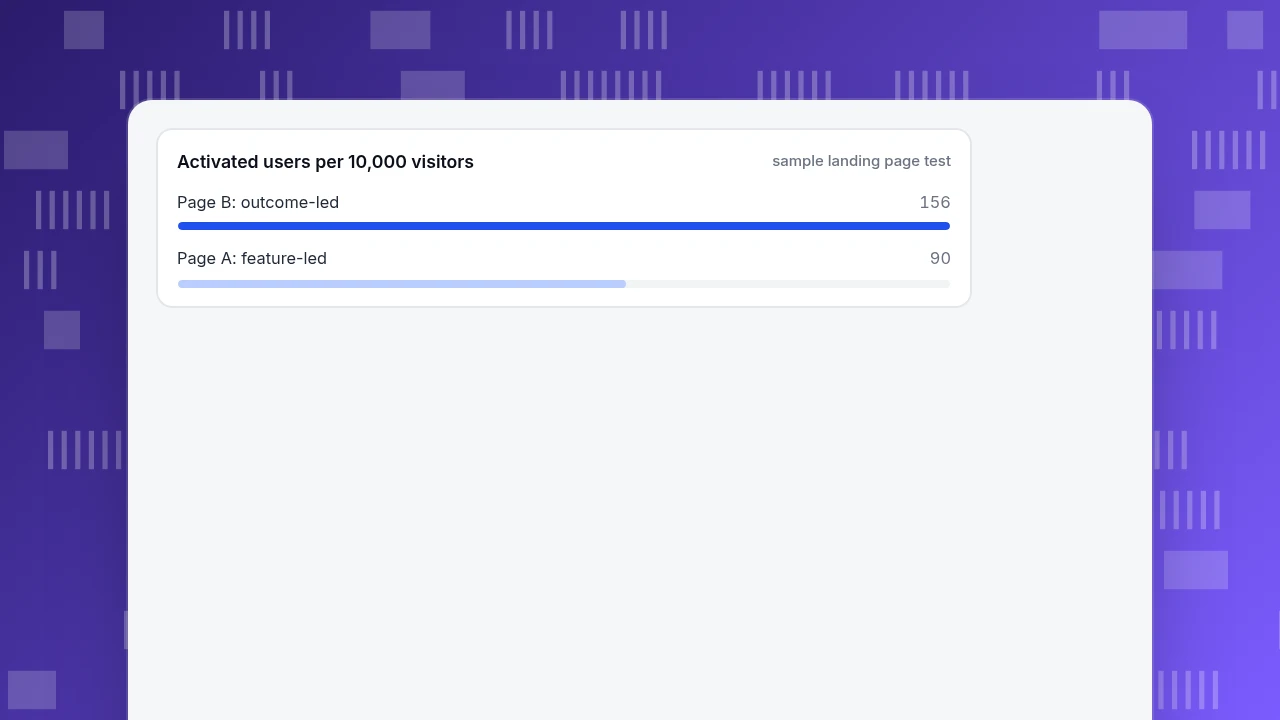
Sample data: two landing pages, 10,000 visitors each, one led by features (A) and one led by outcomes (B).
| Measure | Page A: feature-led | Page B: outcome-led |
|---|---|---|
| Visitors | 10,000 | 10,000 |
| Sign-ups | 300 (3.0%) | 240 (2.4%) |
| Activated users | 90 | 156 |
| Activation rate | 90 ÷ 300 = 30% | 156 ÷ 240 = 65% |
| Activated per visitor | 0.90% | 1.56% |
Page B has 20% fewer sign-ups but 73% more activated users: 156 ÷ 90 − 1 = 73.3%. A sign-up-only view would have picked A. The sign-up gap is also statistically real here (z ≈ 2.6), which means page A is better at generating curiosity and page B is better at attracting the people who will use the product.
Two cautions. If A and B received traffic from different campaigns, the audiences differ and the comparison is not clean; a fair test splits traffic between the pages at random. And measure activation over a fixed window, such as 7 days from sign-up, so that late activators do not flatter the older page. For the definition and variants, see activation rate.
Activated users per 10,000 visitors
sample landing page testHow do you launch a feature and know if it landed?
A launch is complete when people use the feature, not when the announcement ships. Define adoption before you launch: feature adoption = users who used the feature in the last 30 days ÷ active users in that period.
Sample data: a new feature, two months after launch, 8,000 active users, 1,200 of whom used it. Adoption = 1,200 ÷ 8,000 = 15%. The target was 25%, which is 0.25 × 8,000 = 2,000 users, so the gap is 800 users.
Then look at where the gap is. Use a short checklist:
- Awareness: did active users see the announcement or the in-product prompt?
- Findability: can a user find the feature without being told where it is?
- First use: does the first use succeed, or does it end in an error or an empty screen?
- Repeat use: do users who tried it once return to it?
Each stage has its own fix, and message changes help only for the first. Launch messages that explain the outcome ("send invoices in the client's currency") give users a reason to try; launch messages that list the feature give them nothing to do.
Which channels does product marketing use at each stage?
Product marketing rarely owns channels, but it supplies the message to all of them. A simple map keeps the message consistent:
| Stage | Job | Message focus | Metric |
|---|---|---|---|
| Acquire | Reach the right segment | The problem, in their words | Visits from the segment, sign-up rate |
| Activate | Get to first value | The first outcome, with a clear next step | Activation rate within 7 days |
| Retain | Keep using it | New ways to get more outcomes | Retention by week, feature adoption |
| Expand | Add seats or plans | Results already achieved | Upgrades, seats added |
If a stage has no metric, nobody will notice when its message fails. Write the message for the stage first and choose the channel second: a retention email that repeats the acquisition headline wastes the one chance to show the customer a new outcome.
How do you start in five steps?
- Pick one segment and write the positioning sentence.
- List three features and turn each into outcome and proof using the pattern above.
- Write two versions of the landing message, one outcome-led, and send each a comparable audience.
- Measure activated users per visitor over a fixed window.
- Keep the winner and move the learning into onboarding emails and the launch plan.
Common mistakes in SaaS product marketing
- Selling features. "Custom reports" gives the buyer homework; "know on Monday who owes what" gives them a reason.
- Judging by sign-ups. In the example, the page with fewer sign-ups produced 73% more activated users.
- Positioning for everyone. A segment you cannot describe in five words is not a segment.
- Announcing without defining adoption. A launch with no target cannot succeed or fail.
- Comparing different audiences. Two pages fed by different campaigns do not test the message.
- Treating the message as finished. The best sentence changes as the product and the segment do.
How do you measure product marketing in TapCub?
Take the two landing pages above. TapCub measures what happens after the click; it does not write the message, run an A/B split or send email. Here is how the test would be read.
- Tag each page's traffic. Give each campaign its own
utm_campaignorutm_content, then read them in Web analytics › Sources › UTM. If both pages receive traffic from one source, tag by page so the audiences can be compared. - Count sign-ups. Create a goal on the sign-up event in Web analytics › Goals; the conversion count appears per channel and campaign.
- Define activation. In All-platform analytics › Business › AARRR growth, map the activation event ("first invoice sent", for the sample product). Activation counts new users who do it in the period or within 7 days after it ends.
- See the drop. Use a funnel from sign-up to activation in All-platform analytics › Behavior › Behavior analysis, and check retention there as well.
- Count feature adoption. Save the feature's event as a metric in All-platform analytics › Behavior › Metrics & SQL, or use a segment of the people who did it, and compare with active users.
A B2B / SaaS industry pack in All-platform analytics › Business › Industry packs installs sign-up, onboarding, trial and subscription events, goals, funnels and dashboards to start from. TapCub does not split traffic between pages, so a clean A/B test needs a separate tool; with separate campaigns, treat the result as a comparison, not a proof.
FAQ
What is SaaS product marketing?
SaaS product marketing decides who a software product is for, what to say about it and how to launch it and grow its use. It covers positioning, messaging, launches, enablement and adoption, and sits between product, marketing and sales.
What is the difference between SaaS marketing and SaaS product marketing?
SaaS marketing is the wider job of generating demand through content, paid channels and campaigns. Product marketing supplies the positioning and messaging those channels use, and owns launches and adoption. One finds the audience; the other decides what to tell it.
How do you market a SaaS product?
Pick a segment, write one positioning sentence, turn each feature into an outcome with a measurable proof, and test the message by activated users per visitor. Then use the winning message across the site, onboarding emails and launches.
What metrics matter for SaaS product marketing?
Activation rate within a fixed window, activated users per visitor for each message, feature adoption after launches, and retention by week. Sign-ups and clicks are inputs; the test is whether people reach value.
How do you test SaaS messaging?
Send comparable audiences to two versions, ideally by splitting traffic at random, and compare activated users per visitor over a fixed window such as 7 days. In the sample, the outcome-led page had 20% fewer sign-ups but 73% more activated users.
See also: B2B SaaS Marketing Strategy: A Stage-by-Stage Plan with Funnel Targets.
Sources
- Clayton M. Christensen, Taddy Hall, Karen Dillon & David S. Duncan. Know Your Customers' "Jobs to Be Done". Harvard Business Review, 2016 — customers hire products to make progress in a situation. Verified 2026-11-19.
- Wikipedia. Product marketing — the scope of product marketing and how it relates to marketing and product management. Verified 2026-11-19.
- Wikipedia. Software as a service — definition of the delivery model. Verified 2026-11-19.
Was this article helpful?
We use your answers to fix and expand this page.
Couldn’t send. Please try again in a minute.
Thanks for the feedback. We’ll use it to improve this page.You’ve already sent feedback on this page. Thanks.

Product Experience Specialist
Explores usability, user journeys, and feature adoption through practical examples of onboarding and everyday product use.