Try it on your own data
Every report in this article is in the free plan. One snippet for web and apps, up to 10 sites.
Start freeOmnichannel engagement means interacting with the same customer across channels such as your website, app and live chat so that each interaction continues from the last. The number of channels is not the point; the connection is. Measure it by how many people you can recognise across channels and how often customers must repeat themselves. Below: multichannel vs omnichannel, three metrics and a worked example.
What you will learn
- Omnichannel is about shared identity and context between channels, not the number of channels
- Track the linked-identity rate and the repeat-question rate; report unique people, not summed channel counts
- A higher conversion rate for multi-channel people is a pattern, not proof that a second channel caused it
What does omnichannel engagement mean?
Omnichannel engagement means interacting with the same customer across several channels, such as your website, app and live chat, in a way that each interaction continues from the last one instead of starting again. The test is simple: if a customer asked about a delivery date on your site this morning, the agent in chat this afternoon should already know what they asked and which page they were on.
Researchers describe the underlying shift as moving from multi-channel to omni-channel management: Verhoef, Kannan and Inman (2015) write about managing channels and touchpoints together so that the customer experience across channels is optimised, rather than each channel on its own. Wikipedia's summary of the term makes the same point from the customer's side, seamless experiences within and between contact channels.
Notice what the definition does not require: a long list of channels. A business with a website and a chat widget that share one customer record is more omnichannel than a business with seven channels that each keep their own list. That is the argument of this article: the thing to build and measure is the connection between channels, meaning identity and context, not the number of channels. Cross-channel measurement is covered in omnichannel analytics; this article focuses on the engagement itself, what to measure and how to connect the pieces.
Multichannel vs omnichannel: where is the line?
The two terms are often used as if they were synonyms. The practical difference is whether channels share data.
| Multichannel | Omnichannel | |
|---|---|---|
| Channels | Several, each managed on its own | Several, managed as one experience |
| Customer record | One per channel | One per person across channels |
| What the customer repeats | Their question, order number, history | Little or nothing |
| Who owns the number | Each channel owner owns their own metric | A shared view of the journey |
| How you count customers | Sum of channel counts (inflated) | Unique people |
| Typical failure | "Please tell us your email again" | A wrong match that mixes two people |
Two points on the table. First, omnichannel is not "more multichannel". You can add a fifth channel and become less omnichannel if it adds a fifth separate record. Second, the last row matters: connecting identities has a failure mode too, a wrong merge that shows one person another person's history, and that is a privacy problem rather than only an accuracy problem. Section "How to connect identity" covers the rules that reduce it.
Where does digital engagement fit?
Digital engagement is the narrower term: the interactions a person has with you through digital touchpoints (site visits, app sessions, chat, email opens, in-product actions) and how much of it there is. It is a measure of activity. Omnichannel engagement adds the requirement that those digital touchpoints, and offline ones where you have them, are connected for each person.
A short test shows the difference. Suppose a customer had 12 digital interactions in a month: 7 on the website, 4 in the app, 1 in chat. Digital engagement counts 12. Omnichannel engagement asks a further question: in the chat on day 20, did the agent see the 7 + 4 earlier interactions? If yes, the interactions are connected; if not, you have 12 interactions and no omnichannel engagement. The metrics in the next section measure exactly that gap.
Which three metrics show whether it is working?
Counting channels or messages does not tell you whether engagement is joined up. Three measures do, and each can be computed from data most teams already have.
1. Linked-identity rate. The share of people active in more than one channel who are recognised as the same person: people linked across channels ÷ people who were active in two or more channels. It tells you how much of your multichannel activity you can actually see as one journey. A low rate means customers move between channels, but your data treats them as strangers.
2. Repeat-question rate. The share of contacts where the customer had to give information they had already given in another channel. Sample 100 or 200 recent chat or support contacts and count how many started with a question whose answer was already on file (email, order number, the page they were on). It is a manual measure, and that is fine: it is the one that matches what customers complain about.
3. Cross-channel conversion, read with care. The conversion rate of people active in two or more channels compared with people active in one. This is the metric that gets quoted in marketing decks, and it is the easiest to misread. People who use two channels are usually more engaged to begin with, so a higher conversion rate for them does not show that adding the second channel caused the difference. Use it to see where the engaged customers are, and use a before and after comparison or a holdout to test whether a change helped. For the broader question of journeys, see customer journey analytics.
A fourth number is worth watching alongside them: the unique-people count, compared with the sum of channel counts. It is a quick check on how much your headline audience is overstated before linking.
| Metric | How to compute it | What it needs |
|---|---|---|
| Linked-identity rate | People recognised across channels ÷ people active in 2+ channels | A stable id such as a login id shared by channels |
| Repeat-question rate | Contacts where the customer re-gave known information ÷ contacts sampled | A manual sample of 100–200 recent contacts |
| Cross-channel conversion | Conversion of 2+ channel people vs 1-channel people | Unique people and a goal; read as a pattern, not a cause |
Also compare unique people with the sum of channel counts.
A worked example: one store, three channels
Sample data: an online store looks at one month of activity in its website, its app and its live chat.
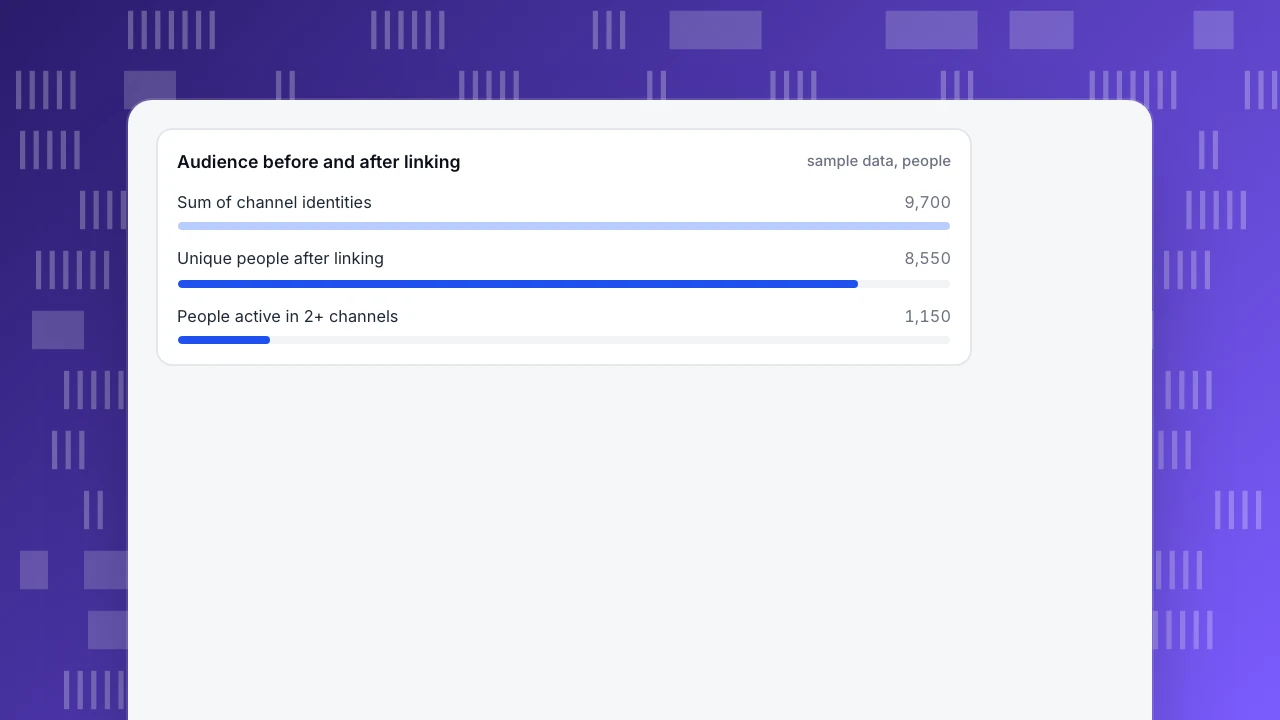
Before linking, each channel counts its own identities: 6,200 website visitors, 2,600 app devices and 900 chat contacts.
- Sum of channel identities: 6,200 + 2,600 + 900 = 9,700.
After linking by login id:
- 700 people appear in both the website and the app.
- 450 of the 900 chat contacts match someone already seen on the website or the app.
- For simplicity, assume nobody is in all three channels.
- Unique people: 9,700 − 700 − 450 = 8,550.
So the sum of channel counts overstated the audience by 9,700 ÷ 8,550 − 1 = 13.5%.
Metric 1, linked-identity rate. People active in two or more channels: 700 + 450 = 1,150. That is 1,150 ÷ 8,550 = 13.5% of all people (the same figure as the overstatement, because every identity linking removed was one person seen in a second channel). On the chat side, 450 of 900 contacts were matched, so the chat match rate is 450 ÷ 900 = 50.0%: half the chats start with an agent who can see earlier activity, and half do not.
Metric 2, repeat-question rate. The team reads 200 recent chats and finds 70 where the agent had to ask for information that was available elsewhere: 70 ÷ 200 = 35.0%. Because 50% of contacts are unmatched, this is the number to bring down by improving the match rate.
Metric 3, cross-channel conversion. Among the 1,150 multi-channel people, 138 purchased: 138 ÷ 1,150 = 12.0%. Among the other 8,550 − 1,150 = 7,400 single-channel people, 444 purchased: 444 ÷ 7,400 = 6.0%. The multi-channel group converts at twice the rate (12.0% ÷ 6.0% = 2.0). That does not prove that using two channels doubles conversion. Customers with high intent are more likely to use app, site and chat in the same month. The table below shows how the three metrics read for this month.
| Metric | Sample value | Reading |
|---|---|---|
| Linked-identity rate | 13.5% of people in 2+ channels | Real overlap exists, so linking matters |
| Chat match rate | 50.0% (450 of 900) | Half of chats start without context |
| Repeat-question rate | 35.0% (70 of 200 sampled) | Roughly a third of chats re-ask |
| Conversion, multi vs single channel | 12.0% vs 6.0% | Engaged customers are in several channels; not proof of cause |
The decision from this month: raise the chat match rate (for instance by asking logged-in customers to start chats while signed in), then re-sample the repeat-question rate next month. Do not set a goal of "more channels".
Audience before and after linking
sample data, peopleHow do you connect identity across channels?
Everything above depends on being able to say "this chat contact is the same person as that app user". Four rules make the link reliable:
- Pick one stable key. A login id or customer id that never changes, not a cookie value and not an email address people swap. See identity resolution for how mapping works and identify for the call that sets it.
- Link on a deterministic signal first. A login is a deterministic link: the person proved who they are. Guessing from device fingerprints or similar names is a probabilistic link with a real chance of a wrong merge. Prefer logins, and treat guessed links as lower confidence.
- Keep a way to undo a link. Wrong merges happen when one device is shared. You need to be able to split a device off a person and see a log of what was linked and when.
- Keep the data you link minimal. Linking works with an id; it does not need a date of birth or address. The less personal data you carry between channels, the smaller the damage if a link is wrong.
The same logic applies to the cross-channel marketing view of the problem: see cross-channel marketing for coordinating campaigns, which is a different job from connecting the conversations.
Common mistakes with omnichannel engagement
- Counting channels as progress. Going from three channels to five with separate records lowers the share of customers you can recognise. Track the linked-identity rate, not channel count.
- Summing channel audiences. In the example, adding channel counts overstated the audience by 13.5%. Report unique people.
- Reading cross-channel conversion as cause. 12.0% vs 6.0% reflects who chooses several channels. Test with a before and after or a holdout.
- Merging identities without a way back. A shared family tablet will eventually link two people. Plan for splits.
- Ignoring consent. Linking identities is processing of personal data; check what your consent and privacy settings allow in each region before you connect channels.
- Measuring only volume. Message counts per channel say how busy you are, not whether the customer had to repeat themselves. Sample the repeat-question rate.
How to see connected engagement in TapCub
TapCub covers the website, app, mini program and live chat in one project. It does not send email or push messages, so the channels it connects are the ones where people browse, use the product and talk to you. Here is how the store in the example would use it.
- Identify logged-in people. Call
tapcub.login()when a person logs in. One login id is then one person across web, App and mini program, and the first login on a device attaches that device's earlier anonymous history. Visitors who never log in stay in the aggregate reports and are not profiled. - Read the timeline. In All-platform analytics › Users › People, open a person to see a day-by-day timeline that merges their bound devices. Use the platform field to see which actions happened on web, App or mini program, and filter by pageview, event, error or identity.
- Use the identity map to measure the link. All-platform analytics › Users › Identity map compares visitor, device and person counts for the selected dates, showing how many extra identities identity removed, and keeps a log of binds and splits. That is the unique-people check from the example, done by the product, and the split action is the undo that rule 3 asked for.
- Give the chat agent context. Live chat uses the same visitor ID as web analytics. In Live chat › Inbox, the side panel shows the visitor's source, their browsing trail from the last 2 days and past conversations, with one click to the analytics visitor profile. This is where the repeat-question rate falls: the agent can see what the visitor already did before asking.
- Compare chatted and not chatted. Live chat › Reports › Conversion attribution compares the goal rate of visitors who chatted with visitors who browsed without chatting, and warns when fewer than 30 visitors chatted. Treat it like metric 3: a raw gap, not proof.
- Know the boundary. TapCub does not send email or push, does not run campaigns across channels and does not compute a repeat-question rate; that one stays a manual sample. It measures and connects; you decide what to say and where.
FAQ
What is omnichannel engagement?
Omnichannel engagement is interacting with the same customer across several channels so that each interaction continues from the previous one. A customer who asked about a delivery date on the site does not have to repeat it in chat. It depends on connecting identity and context across channels, not on how many channels you have.
What is the difference between omnichannel and multichannel engagement?
Multichannel means several channels, each managed separately with its own customer record. Omnichannel means the channels share one view of each person, so context moves with them. You can have many channels and still be multichannel; the difference is data sharing, not channel count.
What is digital engagement?
Digital engagement is the interaction a person has with you through digital touchpoints such as site visits, app sessions, chat and in-product actions, and how much of it there is. It measures activity. Omnichannel engagement adds the requirement that those touchpoints are connected for each person.
How do you measure omnichannel engagement?
Use three measures: the linked-identity rate (people recognised across channels ÷ people active in two or more), the repeat-question rate (contacts where the customer re-gave information, from a sample), and cross-channel conversion, read as a pattern rather than a cause. Also compare unique people with the sum of channel counts.
What channels count as omnichannel?
Any channel where you can tie activity to the same person: website, app, live chat, email, phone, in-store. The number does not matter. Two channels sharing one customer record beat five with separate lists, because the value comes from carrying context from one to the next.
See also: Customer Support Channels: Which to Offer, With Cost and Response Targets.
See also: Customer Engagement Automation: Three Trigger Rules With Numbers.
See also: Customer Engagement Ideas: 12 Tactics With the Metric for Each.
Sources
- Peter C. Verhoef, P. K. Kannan & J. Jeffrey Inman. From Multi-Channel Retailing to Omni-Channel Retailing: Introduction to the Special Issue on Multi-Channel Retailing. Journal of Retailing 91(2), 2015 — omni-channel management as managing channels and touchpoints together. Verified 2026-11-18.
- Wikipedia. Omnichannel — definition and the relationship to multichannel retailing. Verified 2026-11-18.
- Google Analytics Help. Measure activity across platforms with User-ID — attaching your own identifiers to follow one person across sessions, devices and platforms. Verified 2026-11-18.
Was this article helpful?
We use your answers to fix and expand this page.
Couldn’t send. Please try again in a minute.
Thanks for the feedback. We’ll use it to improve this page.You’ve already sent feedback on this page. Thanks.

Product Analyst
Focuses on event analysis, conversion funnels, and retention, using clear metric definitions and structured analysis to explain product performance.