Try it on your own data
Every report in this article is in the free plan. One snippet for web and apps, up to 10 sites.
Start freeMost customers meet a brand on several channels before they convert, yet channels are usually planned and judged one by one. This guide explains cross-channel marketing, shows how 1,000 sample conversions are credited under three attribution models, and lists the rules that keep the measurement honest.
What you will learn
- Cross-channel marketing gives each channel a job in one journey with one message
- Compare at least two attribution models before moving budget; last touch undervalues discovery channels
- Consistent UTM tags, one conversion and a fixed lookback window make the comparison trustworthy
What is cross-channel marketing?
Cross-channel marketing connects your channels so that each one picks up where the last left off. Someone who reads a blog post from search sees a retargeting ad, then gets an email that continues the same story, and signs up from it. The channels share a message and a sequence instead of competing for the same person.
The point is the journey, not the channel count. Most customers touch more than one channel before converting, so planning and measuring channels in isolation misses how they work together.
Cross-channel vs multichannel vs omnichannel
The three terms are often mixed up. The table below shows the difference.
| Multichannel | Cross-channel | Omnichannel | |
|---|---|---|---|
| Idea | Be present on several channels | Channels hand off in one journey | One continuous experience everywhere, online and offline |
| Message | Often separate per channel | Shared and sequenced | Shared, personalised in real time |
| Data | Per channel | Joined per person across channels | Fully unified profile |
| Typical measurement | Last click per channel | Multi-touch attribution | Customer-level journey and lifetime value |
Cross-channel is the practical middle step most teams can run with analytics and good tagging.
Planning a cross-channel journey
- Start from the conversion you care about and work backwards: what does someone need to know or feel before signing up?
- Give each channel a job. Search and content for discovery, social for reach and reminders, email for follow-up, sales or chat for the final question.
- Hand off on purpose. A visitor who read the pricing page gets a different email from one who read a beginner guide.
- Keep one message. The same offer, terms and names across ads, pages and emails.
- Measure the whole path, not each channel's last click.
A sample: one month, three attribution models
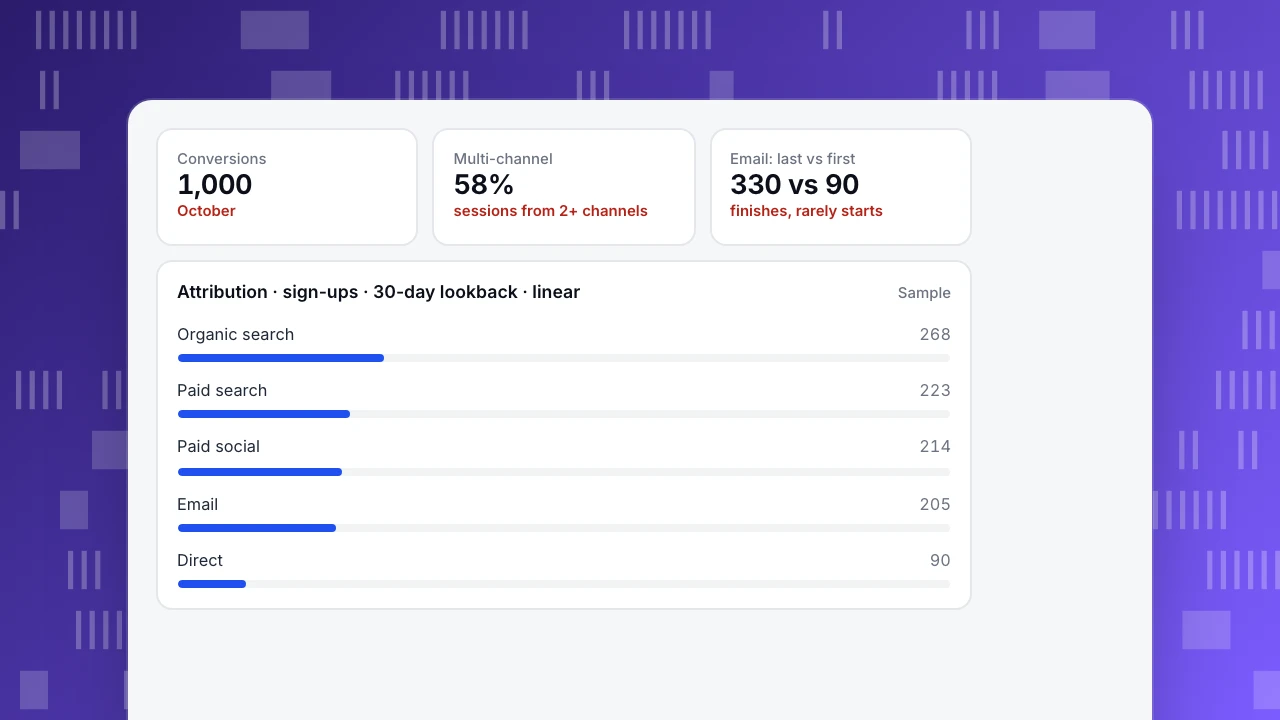
A SaaS product records 1,000 sign-ups in a month with a 30-day lookback (sample numbers). 58% of them had sessions from more than one channel. Here is how much credit each channel gets under three models:
| Channel | First touch | Last touch | Linear |
|---|---|---|---|
| Paid social | 310 | 120 | 214 |
| Organic search | 260 | 280 | 268 |
| Paid search | 240 | 210 | 223 |
| 90 | 330 | 205 | |
| Direct | 100 | 60 | 90 |
Under last touch, email looks like the star and paid social looks weak. Under first touch, it is the reverse: social starts many journeys that email finishes. Cutting social because of its last-touch number would starve email of people to follow up with. Linear spreads the credit and is a reasonable middle view.
No model is the truth. Compare at least two before moving budget, and test the decision with a holdout when the stakes are high; see incrementality.
Conversions
1,000
October
Multi-channel
58%
sessions from 2+ channels
Email: last vs first
330 vs 90
finishes, rarely starts
Attribution · sign-ups · 30-day lookback · linear
SampleMeasurement rules
- Tag every link with consistent UTM parameters: lowercase, one naming scheme, the same campaign name in ads and emails.
- Use one conversion across channels, such as sign-up or purchase.
- Fix the lookback window and say what it is; 30 days suits most B2C and short B2B cycles.
- Connect identities when people log in, so visits on different devices join one person.
- Watch the unattributed share. Conversions with no session in the window are not "direct"; they are unknown.
Common mistakes
- Judging channels only on last click. Discovery channels always lose.
- Same message blasted everywhere. That is multichannel volume, not a journey.
- Inconsistent tagging. "Email", "e-mail" and "newsletter" split one channel into three rows.
- Ignoring time to convert. If most journeys take 20 days, a 7-day window drops much of the credit.
Running the analysis in TapCub
In All-platform analytics › Behavior › Behavior analysis, choose the attribution model. Set the conversion goal (an event or a page), then the touch: channel by default, or UTM source, UTM campaign, referrer domain or landing page. The lookback window defaults to 30 days (1 to 90). Select several models at once (first touch, last touch, linear, position or time decay) to get one credit column per model, plus the number of conversions with no touch. For the paths themselves, see conversion paths.
Was this article helpful?
We use your answers to fix and expand this page.
Couldn’t send. Please try again in a minute.
Thanks for the feedback. We’ll use it to improve this page.You’ve already sent feedback on this page. Thanks.

Product Experience Specialist
Explores usability, user journeys, and feature adoption through practical examples of onboarding and everyday product use.