Try it on your own data
Every report in this article is in the free plan. One snippet for web and apps, up to 10 sites.
Start freeMost advice on increasing website traffic is a list of tactics with no way to choose between them. A better order: measure where your visitors come from today, pick the one or two channels with the most room to grow, run strategies that fit your time and budget, and tag everything so you can tell what worked. Below are 14 strategies grouped by channel, with time to impact and cost, a worked six-month plan, and the kind of traffic you should never buy.
What you will learn
- Start from a channel baseline; grow the channel with the most headroom, not the most hype
- Refreshing and interlinking existing pages is often the fastest search win
- Tag every campaign link and judge strategies by engaged visits and conversions, not raw sessions
Start from a baseline
Before choosing tactics, check your website traffic by channel for the last three to six months: organic search, direct, referral, social, email, paid, and AI sources. Note three things for each: sessions, the trend, and how many of those visits engage or convert.
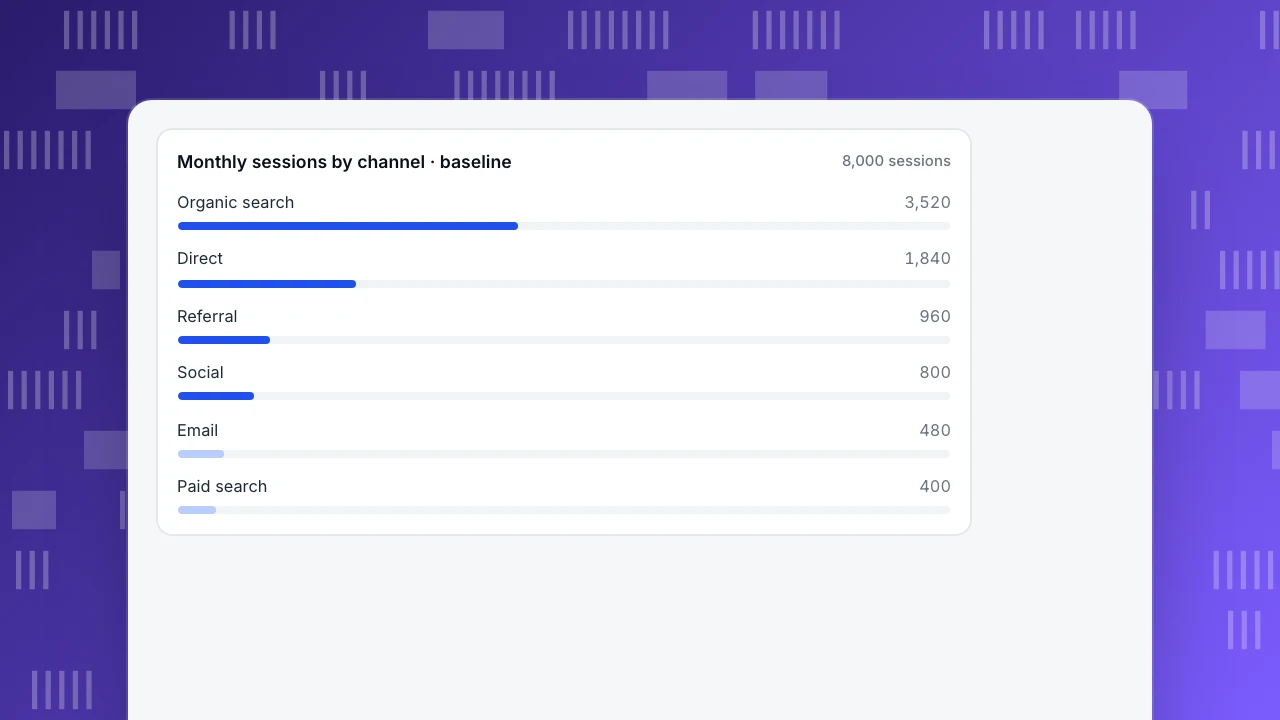
The chart shows a sample baseline for a B2B site with 8,000 sessions a month. Organic search is already the largest channel, but its trend is flat because older articles are losing clicks; email is small because nobody sends a newsletter; referral comes mostly from two partner sites. That points to the plan: refresh content, start email, add partners, rather than "post more on social".
Monthly sessions by channel · baseline
8,000 sessions14 ways to increase website traffic
Search
1. Fix technical SEO basics. Make sure important pages are indexable, load fast and are not blocked by robots.txt or noindex tags, and that each has a clear title. Google's Search Essentials list the requirements. This rarely adds traffic on its own, but nothing else works if pages cannot be found.
2. Refresh decaying content. Find pages whose search clicks are falling (content decay), update facts and examples, answer the questions searchers now ask, and improve titles. This is often the fastest search win because the page already has history and links.
3. Publish for real search demand. Use keyword data to find questions your audience searches and that your site can answer better than the current results. Google's guidance on helpful content is a good test: written for people, by someone with first-hand experience, and complete.
4. Build internal links. Link from your strongest pages to new and refreshed ones, with descriptive anchor text. Orphan pages with no internal links are rarely found by crawlers or people.
5. Improve speed and mobile experience. Core Web Vitals affect experience and conversion more than rankings, but a slow mobile page wastes the traffic you already have.
6. Show up in AI answers. AI assistants cite and link to sources. Clear, factual pages with original data are more likely to be cited; track the visits they send as their own channel. See AI visibility.
Owned channels
7. Start an email newsletter. Email sends visitors you already earned back to new content. A monthly email to a few thousand subscribers can outperform a year of social posting for a B2B site.
8. Repurpose content into other formats. Turn a guide into a checklist, a talk, a short video or a thread, each linking back to the full version.
Community and social
9. Take part in communities. Answer questions where your audience asks them (forums, Reddit, Slack and Discord groups, industry communities), linking only when the link genuinely helps.
10. Post on social with a reason to click. Native posts get reach; links get clicks only when the post promises something the platform cannot show, such as a template, data or a tool.
Referrals and partnerships
11. Earn links and mentions. Guest articles, podcast appearances, original research that journalists cite, listings in reputable directories. Measure each as referral traffic by domain.
12. Partner with complementary products. Integrations, co-written guides and joint webinars send qualified visitors both ways.
Product-led and paid
13. Offer free tools and templates. Calculators, generators and templates attract links and repeat visits. TapCub's own UTM builder is an example of a small tool that earns steady search traffic.
14. Run paid search and social ads. The fastest way to add visits, and the only one that stops the day you stop paying. Use it to test messages and landing pages before investing in slower channels.
| Strategy | Time to impact | Cost | What to measure |
|---|---|---|---|
| Fix technical SEO basics | Weeks | Low | Indexed pages, organic clicks |
| Refresh decaying content | 2–6 weeks | Low | Clicks per refreshed page |
| Publish for real search demand | 3–6 months | Medium | Organic sessions to new pages |
| Internal links | Weeks | Low | Clicks to linked pages |
| Email newsletter | Immediate | Low | Sessions and conversions by campaign |
| Community and social | Weeks | Time | Social sessions, engaged sessions |
| Partnerships, guest posts, PR | 1–3 months | Medium | Referral sessions by domain |
| Free tools and templates | Months | Medium | Tool page sessions, sign-ups |
| Paid search and social | Immediate | High | Cost per engaged visit and per conversion |
Time to impact and cost are typical ranges; your mix depends on your baseline.
A worked six-month plan
Sample data: the site above wants +30% sessions in six months (8,000 → 10,400 a month).
| Channel | Baseline | Target | Change | Main strategies |
|---|---|---|---|---|
| Organic search | 3,520 | 4,600 | +1,080 | Refresh 10 decaying posts, 6 new articles, internal links |
| Direct | 1,840 | 2,000 | +160 | Follows brand growth |
| Referral | 960 | 1,400 | +440 | Two new integration partners, one guest post a month |
| Social | 800 | 900 | +100 | Community answers, repurposed content |
| 480 | 1,000 | +520 | Monthly newsletter, new sign-up form | |
| Paid search | 400 | 500 | +100 | Small test budget for new landing pages |
| Total | 8,000 | 10,400 | +2,400 (+30%) |
After two months, the first results: the 10 refreshed posts went from 1,240 to 1,710 search clicks a month (+38%), while new articles had barely started to rank, which is normal. That is why the plan front-loads refreshes and email: they show results while slower strategies build.
How to tell which strategies worked
- Tag every link you control. Use UTM parameters on emails, social posts, partner links and ads, with a consistent naming scheme; the UTM builder helps.
- Compare like with like. Same weekdays, and the same period last year for seasonal businesses.
- Look past sessions. A strategy that doubles visits with no engagement or sign-ups has not helped. Compare engaged sessions and conversions by channel.
- Annotate launches on your charts so a spike can be traced to its cause.
- Give it time. Judge refreshes after 4–6 weeks, new content after 3–6 months, paid after a few days.
Traffic you should not buy
Some services in the same search results sell "website traffic": bots or click farms that load your pages. They inflate session counts, add zero customers, distort every rate in your reports and can get your ad accounts flagged. Fake referrers (referral spam) are the same problem from the other side. If a traffic jump has very short sessions, no conversions and odd sources, check your bot report before celebrating.
In TapCub, Web analytics › Sources groups visits into channels from UTM tags, the referring host and ad click IDs, shows AI sources (people who came from an AI product) separately from AI crawlers, and counts known bots apart from visitors, so the numbers you plan against are real people.
FAQ
How can I increase website traffic fast?
Paid ads and email to an existing list work within days. For organic growth, refreshing pages that already rank and adding internal links to them is the fastest search lever, usually showing results in weeks.
How can I increase website traffic for free?
Refresh and interlink existing content, publish answers to real search questions, take part in communities, start a newsletter, and partner with complementary sites. All cost time rather than money.
How long does SEO take to increase traffic?
Fixes and content refreshes often show within weeks. New pages on a young site typically take three to six months to rank for competitive terms.
Does posting on social media increase website traffic?
Somewhat, if posts give people a reason to click. For many B2B sites, social sends less traffic than search, email or partners; measure it with UTM tags before investing more.
Sources
- Google Search Central, Google Search Essentials.
- Google Search Central, SEO Starter Guide.
- Google Search Central, Creating helpful, reliable, people-first content.
- web.dev, Web Vitals.
Was this article helpful?
We use your answers to fix and expand this page.
Couldn’t send. Please try again in a minute.
Thanks for the feedback. We’ll use it to improve this page.You’ve already sent feedback on this page. Thanks.

Product Experience Specialist
Explores usability, user journeys, and feature adoption through practical examples of onboarding and everyday product use.