Try it on your own data
Every report in this article is in the free plan. One snippet for web and apps, up to 10 sites.
Start freeReferral traffic is visits that arrive by a link on another website. This guide explains how analytics decides a visit is a referral, which referrers to clean out first, how to judge referring sites by what their visitors do, and where good referral links come from.
What you will learn
- Referral = an external referrer that is not search, social or tagged
- Clean out self-referrals, payment pages, spam and untagged own channels first
- Rank referrers by conversions and engagement, not by visits
What referral traffic is
Referral traffic is visits that arrive by clicking a link on another website: a news article, a forum thread, a partner's blog, a directory listing, a review site. In analytics it is one of the main traffic channels, next to organic search, paid, social, email and direct.
It matters for two reasons. Referral visitors often arrive with a recommendation attached, so they can convert well. And referral links are part of how search engines judge a site, so a growing list of good referrers usually comes with better organic visibility too.
How analytics decides a visit is a referral
When someone clicks a link, the browser usually sends the address of the page they came from in the Referer header (the misspelling is in the standard). The analytics script reads it on the first pageview and the tool applies channel rules in roughly this order:
- A UTM tag or ad click ID on the landing URL wins: the visit goes to the campaign's channel.
- A known search engine as referrer means organic search; a known social network means social.
- Any other external domain means referral.
- No referrer at all means direct.
So referral is partly a leftover category: an external site that is not a search engine, a social network or tagged. Two consequences follow. Links that should be tagged, such as your own newsletter, can land in referral or direct if you skip the UTM. And sites that strip the referrer (some apps, some privacy settings, links opened from documents) send visitors who show up as direct. In TapCub, clicks between pages of your own site are internal hops and never count as referrals.
Referrers that are not real referrals
Before you judge the channel, clean it. The table lists the four kinds of referrer that inflate it without bringing new visitors.
| Fake referral | How to spot it | What to do |
|---|---|---|
| Self-referral | Your own domain or subdomain as referrer | Install the tag on every domain you own; register them as site domains |
| Payment or login redirect | Payment provider or SSO domain, visits with conversions but no browsing | Check the tool keeps the original source; TapCub does not split a session on a payment or sign-in return |
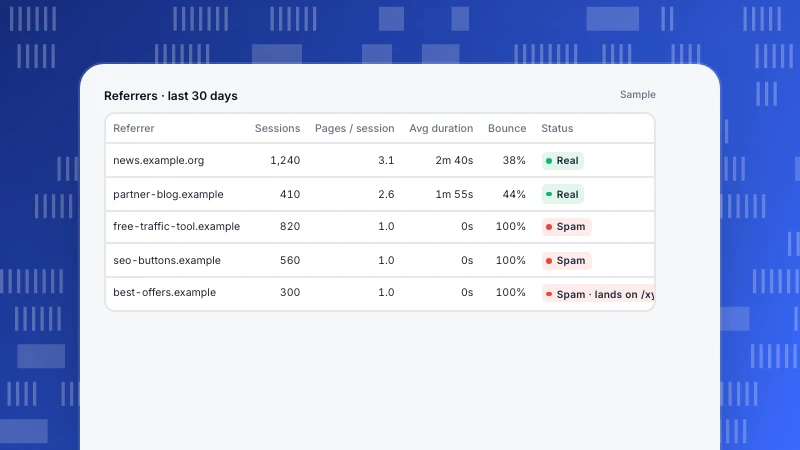
| Referral spam | Odd domains, ~100% bounce, zero duration, no conversions | Filter bots and spam; see referral spam guide |
| Untagged own channels | Webmail, newsletter or your app as referrer | Add UTM tags to every link you send |
Clean these out before comparing referral with other channels.
How to evaluate referring sites
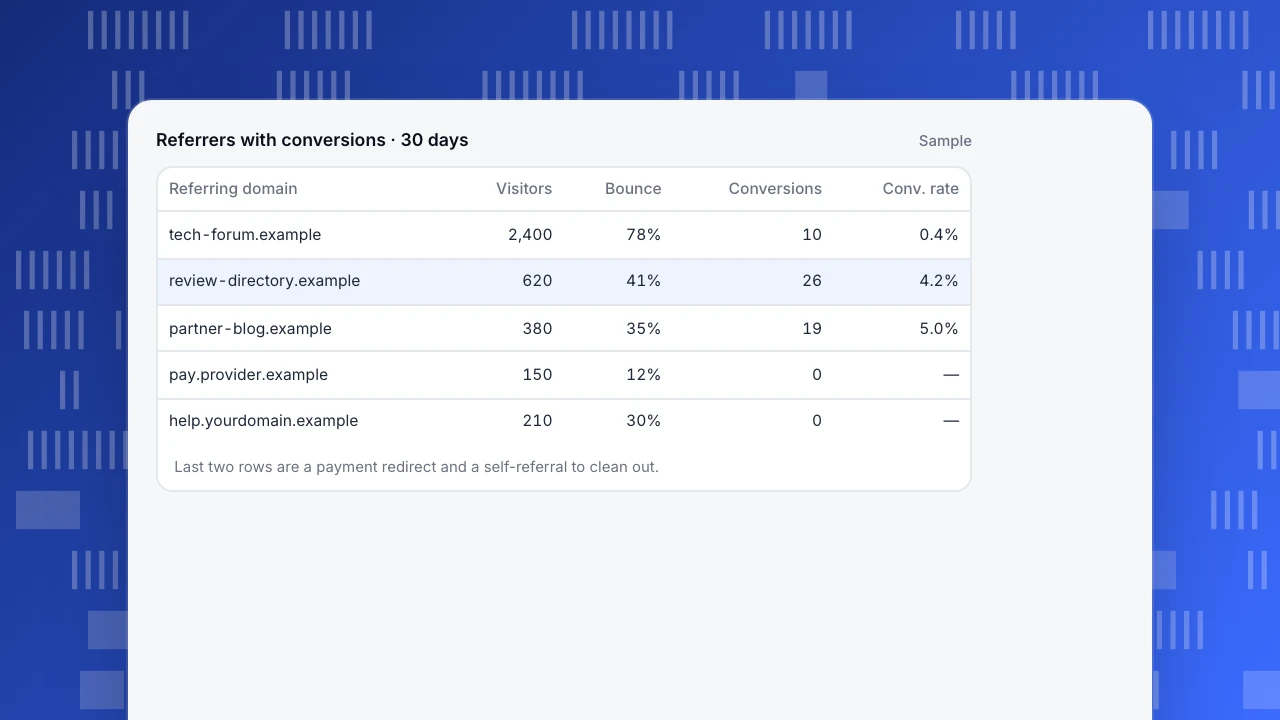
Rank referrers by what their visitors do, not by visits. In the sample, a tech forum thread sent 2,400 visitors, four times more than a review directory, but most bounced and only 10 converted (0.4%). The directory sent 620 visitors, 26 of whom converted (4.2%), and a partner's blog post sent 380 with 19 conversions (5.0%).
The forum spike is worth a thank-you and maybe a follow-up post; the directory and the partner are worth an ongoing relationship: an up-to-date listing, a second article, a co-hosted webinar. Without the conversion column, the team would have chased more forum threads.
In TapCub, the Referrers tab lists each referring domain with visitors, sessions, bounce and duration, and the Channels tab adds conversions. By default each session is credited to the source it arrived from; an "every arrival" view also counts arrivals from an external site in the middle of a session.
Referrers with conversions · 30 days
Sample| Referring domain | Visitors | Bounce | Conversions | Conv. rate |
|---|---|---|---|---|
| tech-forum.example | 2,400 | 78% | 10 | 0.4% |
| review-directory.example | 620 | 41% | 26 | 4.2% |
| partner-blog.example | 380 | 35% | 19 | 5.0% |
| pay.provider.example | 150 | 12% | 0 | — |
| help.yourdomain.example | 210 | 30% | 0 | — |
Last two rows are a payment redirect and a self-referral to clean out.
Where good referral traffic comes from
- Listings people already use to choose: review sites, marketplaces and integration directories for the tools your customers use.
- Partners: agencies, consultants and complementary products that link to you in guides and documentation.
- Content others want to cite: original data, calculators, templates and clear explanations. A useful tool page attracts links for years.
- Communities: answering questions well in forums and newsletters your audience reads, with a link only where it helps.
- Coverage: podcasts, interviews and news when you have something new.
Avoid paid link schemes and mass directory submissions; they bring little traffic and can harm search visibility.
FAQ
What is the difference between referral and direct traffic?
Referral traffic has an external referrer that is not a search engine or social network. Direct traffic has no referrer at all: typed URLs, bookmarks, and links whose referrer was stripped.
Why is my own domain showing as a referral?
Usually because the tag is missing on part of the site (a subdomain, a checkout or a help centre), so visits that come back from it look like new arrivals. Install the same tag on every domain you own and register them as the site's domains.
Why do payment providers show up as referrers?
After paying, customers are redirected back to your thank-you page from the payment page, which becomes the referrer. Check that your tool does not start a new session on that return. In TapCub, returns from payment or third-party sign-in never split a session, so the purchase stays with the original source.
Is referral traffic good for SEO?
The links behind it can help, if they come from relevant sites people actually read. The traffic itself is a good sign that the link is real and noticed.
Was this article helpful?
We use your answers to fix and expand this page.
Couldn’t send. Please try again in a minute.
Thanks for the feedback. We’ll use it to improve this page.You’ve already sent feedback on this page. Thanks.

Product Experience Specialist
Explores usability, user journeys, and feature adoption through practical examples of onboarding and everyday product use.