Try it on your own data
Every report in this article is in the free plan. One snippet for web and apps, up to 10 sites.
Start freeWhen an AI answer appears, fewer people click through, but your content may still be read and quoted. AI visibility separates three things: whether AI crawlers read your pages, whether answers cite you, and whether anyone comes back. This guide shows how to measure each, with a worked month of data from one site.
What you will learn
- AI visibility has three layers: retrieval, citation and return
- Pew found clicks fell from 15% to 8% when an AI summary appeared
- Track coverage, citation rate, AI-referred visits and crawl-to-visit
- Client-rendered pages are often invisible to AI crawlers
- Give AI traffic its own channel so it does not hide in referral
What is AI visibility?
AI visibility is how often, and how prominently, your brand, pages and products appear in answers generated by AI systems: Google AI Overviews and AI Mode, ChatGPT search, Perplexity, Microsoft Copilot, Claude and Gemini. It has three layers:
- Retrieval: AI crawlers and answer engines can fetch and read your pages.
- Citation: the answer mentions your brand or links your page as a source.
- Return: people click that citation and arrive on your site.
Classic SEO measures rank and clicks on a results page. AI visibility adds the steps before and after: was the page read at all, was it used in an answer, and did the answer send anyone back.
Why it matters now
AI answers change how many people reach a website after a search. In a Pew Research Center study of 900 US adults' real browsing in March 2025, users who saw a Google AI summary clicked a traditional search result in 8% of visits, against 15% when no summary appeared, and clicked a link inside the summary itself in only 1% of visits.
So two things are true at once: fewer clicks per search, and a new surface (the answer) where your brand is either named or absent. A page can lose traffic while its ideas are being used more than ever. Measuring AI visibility is how you tell those apart.
How to measure AI visibility
No single tool sees all three layers. Combine them:
| Layer | Question | Data source |
|---|---|---|
| Retrieval | Do AI crawlers fetch my pages, and do they get 200s? | Server logs or bot analytics (GPTBot, OAI-SearchBot, ClaudeBot, PerplexityBot, Google-Extended rules) |
| Citation | Am I named or linked for my key prompts? | Prompt tracking: a fixed prompt set run weekly across assistants, recording mention and link |
| Return | Do people arrive from AI answers? | Web analytics: sessions whose referrer is an AI product (chatgpt.com, perplexity.ai, copilot.microsoft.com, gemini.google.com, claude.ai) |
| Outcome | Do those visitors convert? | Conversions and revenue by AI source |
Four metrics cover most of it:
- AI crawl coverage: share of the URLs in your sitemap that at least one AI crawler fetched in the last 30 days.
- Citation rate: share of tracked prompts where your brand is mentioned or linked.
- AI-referred visits: human sessions from AI products; track trend and landing pages.
- Crawl-to-visit ratio: AI-referred visits divided by AI crawls. It shows which operators read a lot and send almost nobody.
| Metric | Definition |
|---|---|
| AI crawl coverage | Sitemap URLs fetched by an AI crawler |
| Citation rate | Tracked prompts that mention or link you |
| AI-referred visits | Human sessions from AI products |
| Crawl-to-visit | AI visits ÷ AI crawls |
Track monthly by operator and landing page.
Worked example: one month of AI traffic for a B2B site
A B2B software site with 1,200 indexed URLs looked at 30 days of data (sample figures):
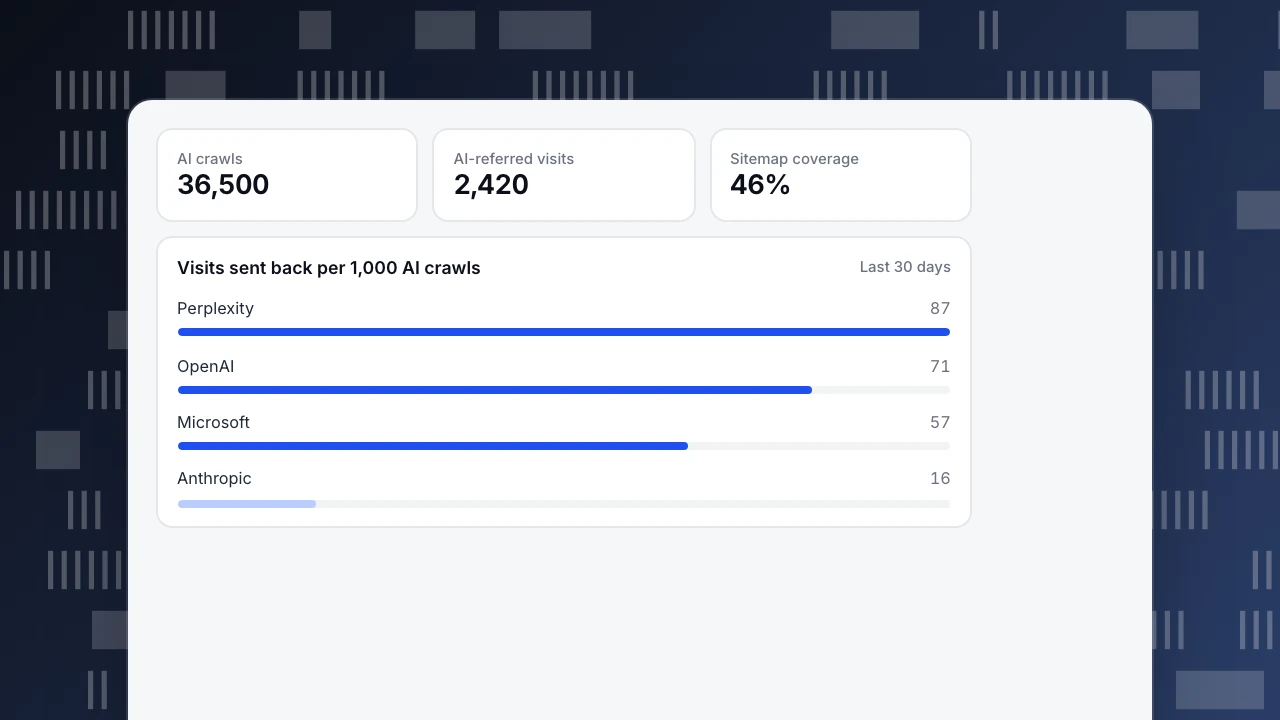
| AI operator | Crawls | Visits sent back | Visits per 1,000 crawls |
|---|---|---|---|
| OpenAI (GPTBot + OAI-SearchBot + ChatGPT-User) | 18,400 | 1,310 | 71 |
| Perplexity | 6,200 | 540 | 87 |
| Anthropic (ClaudeBot + Claude-User) | 9,800 | 160 | 16 |
| Microsoft (Copilot) | 2,100 | 120 | 57 |
| Google (Gemini, AI Mode referrals) | — | 290 | — |
| Total | 36,500 | 2,420 | 66 |
What the team learned:
- Coverage was the first problem. AI crawlers had fetched only 46% of sitemap URLs. The pricing page and the integration docs, the pages most often worth citing, were among the unfetched ones because they were rendered client-side and returned an empty shell.
- Citations concentrated on four pages. Of 2,420 AI-referred visits, 61% landed on four comparison and glossary pages. Those pages had direct definitions in the first paragraph and a table.
- AI visitors converted better. AI-referred sessions converted to a trial at 3.1%, against 1.9% for organic search. Small volume (2.4% of all sessions) but higher intent.
- Prompt tracking matched the logs. In a weekly set of 40 prompts, the brand was cited in 9 (22.5%), and all 9 citations pointed to pages that also appeared in the "visits sent back" landing list.
After server-rendering the pricing and docs pages and adding a short answer at the top of eight key pages, coverage rose to 78% and AI-referred visits rose 38% in the following 30 days (sample figures).
AI crawls
36,500
AI-referred visits
2,420
Sitemap coverage
46%
Visits sent back per 1,000 AI crawls
Last 30 daysHow to improve AI visibility
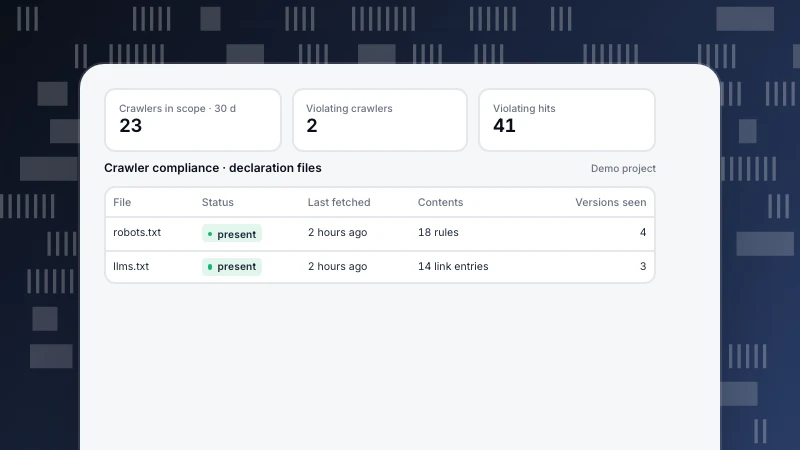
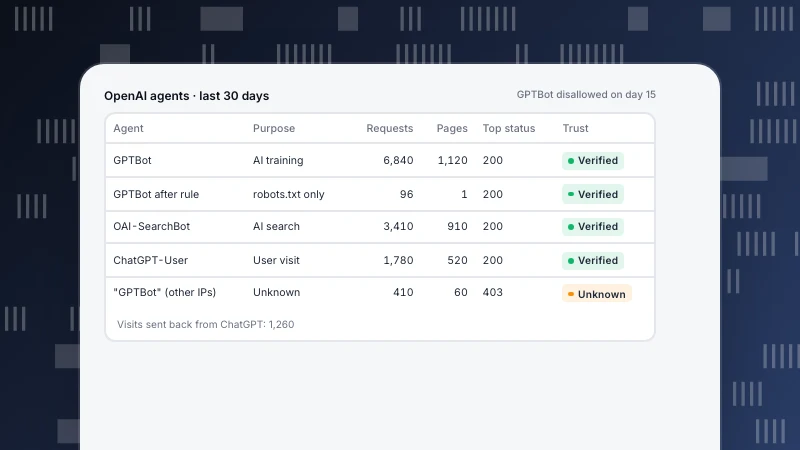
- Let the right crawlers in. Decide per crawler in robots.txt: search and answer bots (OAI-SearchBot, PerplexityBot, ChatGPT-User) bring citations; training bots (GPTBot, Google-Extended, CCBot) do not send visitors directly. Blocking a search bot removes you from that assistant's answers.
- Serve real HTML. Many AI crawlers do not run JavaScript. If the main content only exists after hydration, it does not exist for them. Server-render or pre-render key pages.
- Answer first. Put a direct, quotable definition or answer in the first 40–60 words, then the detail. Assistants lift sentences that stand on their own.
- Add structure. Tables, numbered steps, clear headings and consistent terminology are easier to extract than long prose.
- Publish original data. Benchmarks, worked examples and first-party numbers give an assistant a reason to cite you instead of a summary of everyone else.
- Be consistent across the web. Assistants cross-check. Product names, pricing and claims should match on your site, docs, marketplaces and review sites.
- Measure monthly. Coverage, citation rate, AI-referred visits and their conversion, by operator and by landing page.
Common mistakes
- Counting crawls as visibility. A million fetches with no citations and no visits is cost, not exposure.
- Blocking every AI bot by default. It protects content from training but also removes you from AI search answers.
- Treating AI referrals as "referral" or "direct". Without a dedicated channel, AI traffic hides in referral or, when the referrer is stripped, in direct.
- Tracking one prompt. Answers vary by wording and by run. Use a fixed set of 30–50 prompts and look at rates, not single answers.
- Chasing a "rank" in AI answers. There is no stable position. Measure share of prompts and returned visits instead.
Measuring AI visibility in TapCub
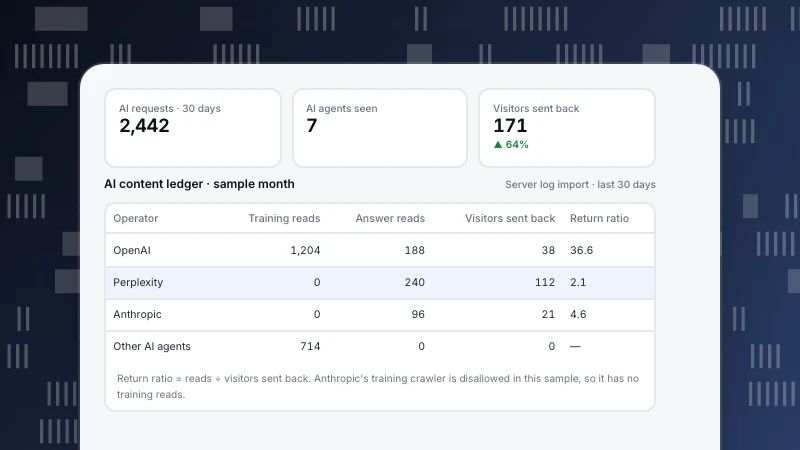
In Web analytics › Bots, the AI visibility tab shows AI crawls, AI-referred visits, the crawl-to-visit ratio and sitemap coverage (once a sitemap is set), with a By AI brand table and a list of Cited pages, the landing pages that received AI-referred visits. The AI content ledger on the AI & agents tab shows reads and visitors sent back per operator. In Web analytics › Sources, the AI sources tab counts human sessions from AI products, using the same definition.
With only the page script, crawlers that do not run JavaScript are not seen. To get complete crawl counts, add server collection or import server logs. See Read the AI crawler ledger and Bots and AI crawlers.
See also: Web crawler, Zero-click searches.
Sources
- Pew Research Center, Google users are less likely to click on links when an AI summary appears in the results (2025).
- Google Search Central, AI features and your website.
- OpenAI, Overview of OpenAI crawlers.
Was this article helpful?
We use your answers to fix and expand this page.
Couldn’t send. Please try again in a minute.
Thanks for the feedback. We’ll use it to improve this page.You’ve already sent feedback on this page. Thanks.

Customer Experience Consultant
Writes about live chat, visitor conversations, and self-service, sharing practical ways to make customer communication clearer and more effective.