Try it on your own data
Every report in this article is in the free plan. One snippet for web and apps, up to 10 sites.
Start freeAI conversion rate optimization uses machine learning and language models to speed up analysis, idea generation, testing and personalization. This guide maps where AI helps in each CRO step and what still needs a human, lists the limits, and shows an attribution example where AI-assisted analysis plus session replay found a broken pricing toggle in an hour.
What you will learn
- AI speeds up CRO; it does not replace the process
- Fix tracking before adding AI
- Use automatic attribution to explain metric changes
- Fact-check AI-written copy before it ships
- Judge tests on revenue and guardrails, not only clicks
What is AI conversion rate optimization?
AI conversion rate optimization (AI CRO) is the use of machine learning and language models to speed up the parts of conversion rate optimization that are slow when done by hand: finding where and why visitors drop off, generating test ideas and copy variants, allocating traffic between variants, and personalizing content for different visitors. The goal is the same as traditional CRO (a higher share of visitors who sign up, buy or book) but with faster analysis and more experiments per month.
AI does not replace the CRO process. It still needs clean conversion tracking, a clear goal, enough traffic and a human who decides what is worth testing and checks that results make sense.
How AI is used across the CRO process
| CRO step | Without AI | With AI | What still needs a human |
|---|---|---|---|
| Find problems | Analyst explores reports and funnels | Anomaly detection, automatic attribution of changes to channels, pages or devices | Deciding which finding matters for the business |
| Understand why | Watch replays, read surveys | Summaries of session patterns, chat and review themes | Checking summaries against real sessions |
| Generate ideas | Workshops, best practices | Draft hypotheses, headline and copy variants | Choosing ideas that fit the brand and are true |
| Run experiments | Fixed 50/50 A/B tests | Multi-armed bandits that shift traffic to winners | Guarding against stopping too early, checking long-term metrics |
| Personalize | Rules by segment | Models that pick content per visitor | Privacy, consent and fairness |
| Report | Manual slides | Natural-language answers and summaries | Verifying numbers and definitions |
| Use AI for | Keep a human on |
|---|---|
| Scanning thousands of segments for drops | Deciding which drop matters |
| Drafting hypotheses and copy | Truth, brand and legal review |
| Allocating traffic in tests | Stopping rules and long-term metrics |
| Summarizing chats and replays | Checking summaries against sessions |
The learning log of tests and decisions is the asset that compounds.
Where AI CRO helps most
- Analysis at scale. A model can scan thousands of page, channel and device combinations for unusual drops in minutes. Humans then look at the few that matter.
- Explaining changes. "Conversion fell 12% this week" becomes "mobile Safari visitors from paid social on the pricing page account for 70% of the drop."
- Copy and creative variants. Language models produce many headline and description options quickly. Fact-check every claim before it ships.
- Traffic allocation. Bandit algorithms send more traffic to better-performing variants during a test, which reduces the cost of testing weak ideas.
Limits and risks
- Garbage in, garbage out. If goals fire twice, bots are counted or tracking breaks after a release, AI finds patterns in the noise.
- Statistical traps. Automatic winners on small samples, many simultaneous comparisons and novelty effects still apply.
- Generic ideas. Models suggest the same best practices everyone has read. Your own data and customer conversations are the differentiator.
- Invented facts. Generated copy can promise features, guarantees or numbers you do not have. Treat it as a draft.
- Privacy. Personalization and session-level analysis must respect consent and data protection rules.
How to start with AI CRO in five steps
1. Fix measurement first
Check that each goal fires once per conversion, bots and internal traffic are excluded, and revenue matches your backend. AI amplifies whatever data you give it.
2. Use AI to find and explain drops
Run automatic attribution on your main conversion metric every week: which channels, pages, countries or devices moved it. Investigate the top two contributors.
3. Turn findings into hypotheses
Ask a model to draft hypotheses from the finding plus evidence (replays, chat transcripts), then rewrite them in your own words with an expected effect and metric.
4. Test with guardrails
Use A/B tests or bandits, fix the sample size or decision rule in advance, and watch guardrail metrics such as refund rate and average order value.
5. Keep a learning log
Record each test, result and decision. Over time this log, not the AI tool, becomes your most valuable CRO asset.
Worked example: explaining a drop
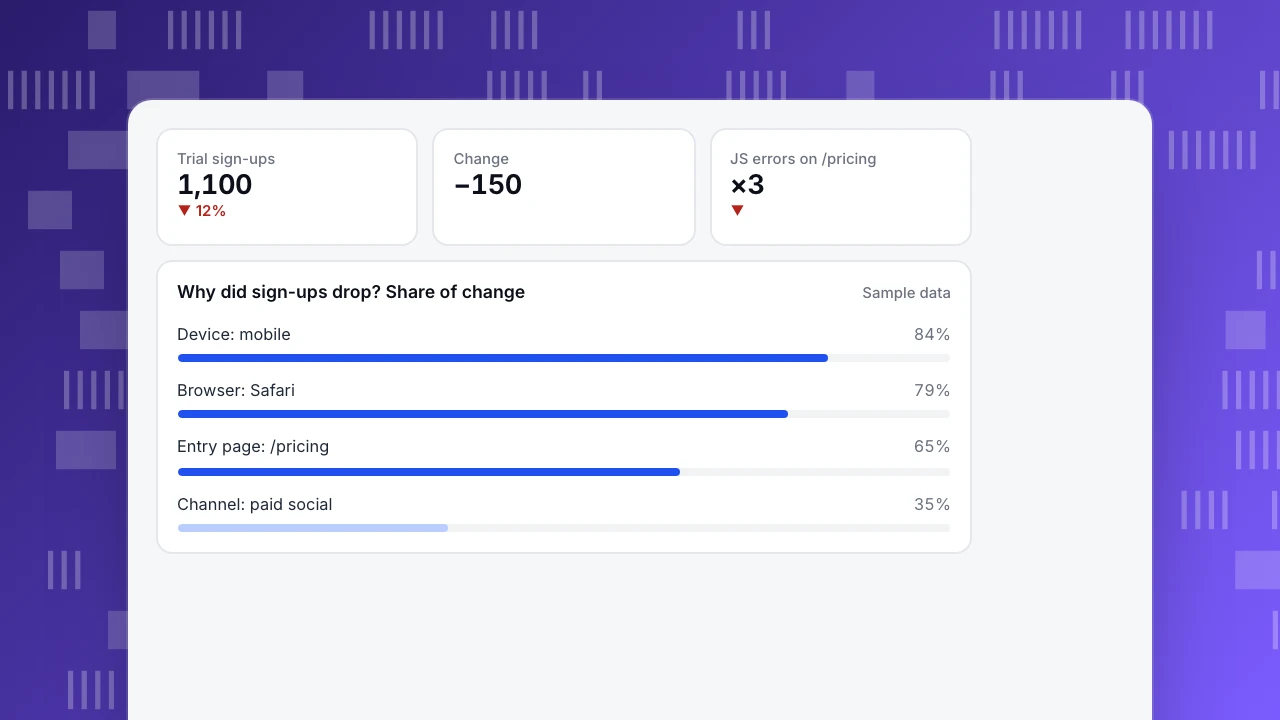
A SaaS site's trial sign-ups (sample data) fell from 1,250 to 1,100 week over week: −150. Automatic attribution by dimension showed:
| Dimension value | Change in sign-ups | Share of the total change |
|---|---|---|
| Device: mobile | −126 | 84% |
| Browser: Safari (all devices) | −118 | 79% |
| Entry page: /pricing | −97 | 65% |
| Channel: paid social | −52 | 35% |
Mobile Safari on the pricing page explained most of the drop. Session replays showed the plan toggle not responding after a CSS change; JavaScript errors on that page had tripled. The fix took an hour. An AI-generated list of "ten ways to improve pricing pages" would have been irrelevant; attribution plus replay found the actual cause.
Trial sign-ups
1,100
▼ 12%
Change
−150
JS errors on /pricing
×3
▼
Why did sign-ups drop? Share of change
Sample dataCommon mistakes
- Buying an AI tool before fixing tracking.
- Shipping AI-written copy without fact-checking.
- Letting automated tests stop on tiny samples.
- Optimizing only for clicks or sign-ups, not revenue, retention or refunds.
- Ignoring qualitative data. Chats and replays explain what models can only point at.
AI CRO with TapCub
- Ask: All-platform analytics › Operations › AI Assistant turns a sentence such as "visitor trend for the last 7 days versus the previous period" into a repeatable query and shows the query it ran. Numbers come from your project's data, not from a model's memory.
- Why did it change: splits a metric's change by channel, referrer, country, device, entry page or platform (one or two levels) and shows each value's share of the total change, as in the example above.
- MCP for agents: connect AI agents to your analytics with read-only tools such as run_insight, ask and attribute_change. See connect AI agents with MCP.
- Evidence: funnels, heatmaps, rage clicks, errors and session replay to confirm what the numbers suggest.
TapCub does not run A/B tests or bandits. See also ask the AI assistant and conversion rate optimization.
FAQ
Can AI do conversion rate optimization on its own? No. It speeds up analysis, idea generation and testing, but people still need to set goals, judge which findings matter, check facts and decide what ships.
Is AI CRO only for large websites? Analysis and explanation help sites of any size. Automated testing and personalization need enough traffic and conversions to learn from.
What is a multi-armed bandit in CRO? A testing method that shifts traffic toward better-performing variants during the test instead of keeping a fixed split, which reduces the cost of showing weak variants.
Does AI personalization need consent? Personalization that relies on personal data or tracking across sessions is subject to privacy laws such as the GDPR. Check your consent setup before enabling it.
Sources
- Kohavi, R., Tang, D. and Xu, Y. (2020). Trustworthy Online Controlled Experiments. Cambridge University Press. Book site.
- Google Search Central. Guidance about AI-generated content.
- Optimizely. What is a multi-armed bandit?
Was this article helpful?
We use your answers to fix and expand this page.
Couldn’t send. Please try again in a minute.
Thanks for the feedback. We’ll use it to improve this page.You’ve already sent feedback on this page. Thanks.

Growth Strategist
Explores acquisition channels, activation, and conversion experiments, turning data insights into actionable growth hypotheses and evaluation methods.