Try it on your own data
Every report in this article is in the free plan. One snippet for web and apps, up to 10 sites.
Start freeHyper-personalization means tailoring what each person sees using their own recent behavior, often within the same visit, instead of one message per broad group. It works best when it starts small: two or three behavioral signals such as what someone did and how recently, one different experience, and a holdout group that shows whether the change really added conversions.
What you will learn
- "Hyper" means a specific, recent signal about one person, not a large pile of data
- Every signal you stack shrinks the audience; add one only if the rest can still reach the sample size a test needs
- Prove the lift against a holdout group, and use only data inside the consent the person gave
What is hyper-personalization, and how does it differ from personalization?
Hyper-personalization changes what a person sees using that person's own recent behavior, often within the same visit, instead of sending one message to a broad group. Ordinary personalization says "customers in Germany get the German page". Hyper-personalization says "this person looked at the pricing page twice this week and has not upgraded, so show them the pricing FAQ instead of the generic homepage".
The word "hyper" describes how narrow and how current the signal is, not how much data you hold. A rule built on two behaviors (what someone did, and how recently) is already hyper-personalization if it is specific to the individual's last few days. A model with fifty inputs is not better by default; it is harder to explain, harder to test and easier to get wrong.
You will often see statistics such as "faster-growing companies drive 40 percent more of their revenue from personalization" (McKinsey). That is a correlation between two company traits. It does not show that adding more data to a campaign raises its results, and it cannot tell you whether your next change worked. Only a comparison with a group that did not receive the change can, which is what the worked example below does.
What are the three levels of personalization?
Most teams skip straight to the third level. The first two cover most of the practical value and can be tested with the traffic a normal site has.
| Level | What decides what is shown | Example | Signals needed | What you must maintain |
|---|---|---|---|---|
| Rule-based | One fixed rule you write | Show the pricing FAQ to anyone who viewed pricing twice | 1–2 behaviors | The rule |
| Segment-based | A group defined by rules, refreshed on a schedule | A different homepage hero for lapsed buyers and for new users | 2–3 behaviors plus a time window | The segment definitions and one message per group |
| Predictive, per person | A model scores each person | Product ranking tuned to each person's history | Many signals and a long history per person | The model, its training data and its monitoring |
The rule for moving up a level is simple: move up only when the lower level has a measured lift and you can name what the next level would add. If you cannot name it, you are paying for complexity.
For definitions and ready-made groups, see what a segment is, behavioral segmentation and user segmentation examples.
Which behavioral signals should you use first?
Start with signals that are cheap to collect, easy to explain to a customer and available in a short window. The table below lists seven, and each row is a rule you can write today.
A useful discipline: write each signal as an event, a window and a count. "Interested in enterprise" is not a signal; "viewed the enterprise page in the last 14 days" is. The same four-part rule format (action, did or did not, window, count) is explained in behavioral segmentation.
| Signal | Example rule | What it tells you | Privacy note |
|---|---|---|---|
| Did or did not | Viewed pricing, did not upgrade | Interest without a decision | First-party behavior on your own site |
| Recency | Last active within 7 days | Whether the interest is still warm | Same |
| Frequency | Opened the report builder on 3+ days in 30 | Habit, not curiosity | Same |
| Entry source | Arrived from a "compare" article | Which question they came with | Campaign tags you set yourself |
| Lifecycle stage | First seen in the last 7 days | Needs onboarding, not offers | Derived from the same events |
| Value | RFM bucket "about to sleep" | Worth a win-back effort | Needs purchase events |
| Platform | Uses the iOS app, not the website | Which surface to adapt (mobile personalization) | Device type, not identity |
Write every signal as an action, did or did not, a window and a count, so two people compute the same audience.
How much data is enough before you stack another signal?
Every signal you add shrinks the audience, and a smaller audience cannot prove anything. This is the quiet limit on hyper-personalization, and it is arithmetic you can do before you build anything.
Sample data: a product has 20,000 monthly active signed-in users, and each added signal narrows the group.
| Step | Rule added | People left | Share of the previous step |
|---|---|---|---|
| 1 | Monthly active, signed in | 20,000 | 100% |
| 2 | Viewed the pricing page in 30 days | 3,200 | 16.0% |
| 3 | Has not upgraded | 2,880 | 90.0% |
| 4 | Came back in the last 7 days | 1,440 | 50.0% |
Now the testing requirement. Suppose the usual upgrade rate for this group is 3.0% and you hope the tailored page lifts it to 4.5%. A standard two-proportion sample-size calculation (5% significance, 80% power) needs about 2,514 people in each group, so roughly 5,028 in total. Run the test on step 3 (2,880 people a month) and you reach that in about 1.7 months. Run it on step 4 (1,440 people a month) and it takes about 3.5 months. By then the product, the season and the traffic have all changed.
The judgment rule: add a signal only if the audience you are left with can reach the required sample within one or two months. If it cannot, keep the broader audience and make the experience more specific in another way, or accept a larger, longer test.
Worked example: a tailored page for people who viewed pricing but did not upgrade
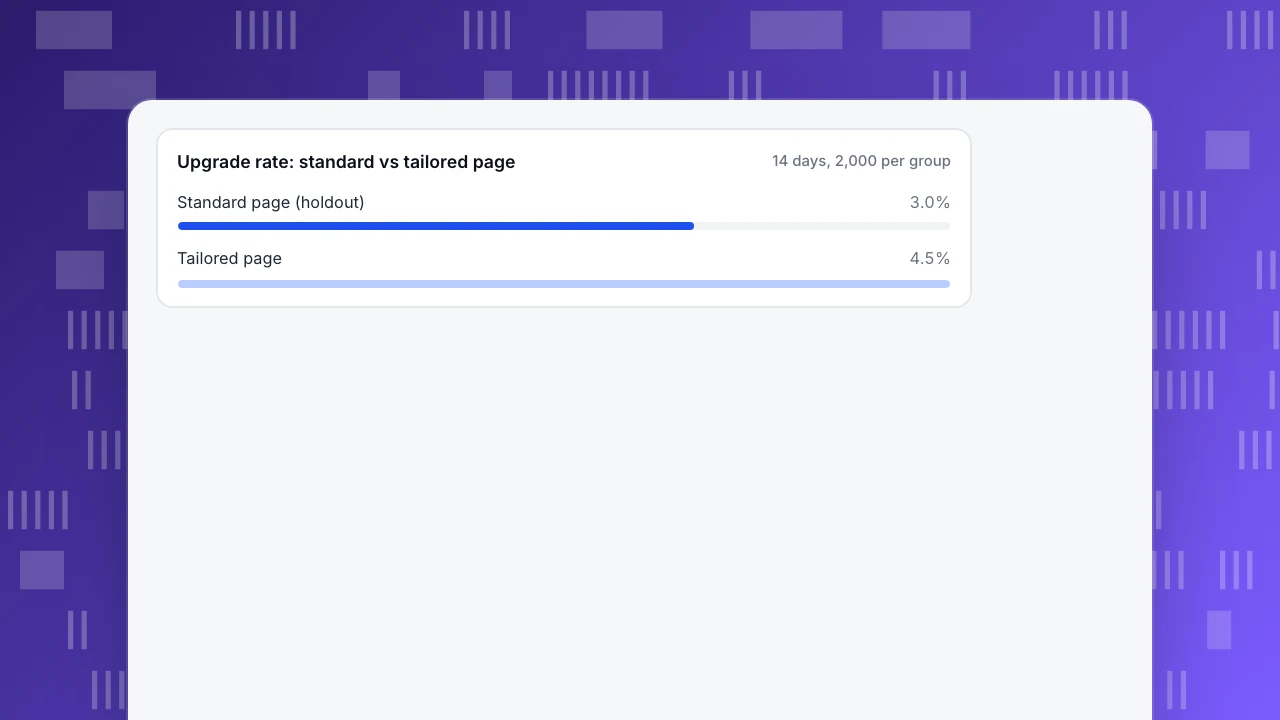
Sample data: about 1.4 months of the step-3 audience above, 4,000 signed-in people who viewed pricing and have not upgraded, are split at random. Half see the standard page. Half see a page that leads with the pricing FAQ and the comparison of plans. Both groups are followed for 14 days.
| Group | People | Upgraded | Upgrade rate |
|---|---|---|---|
| Standard page (holdout) | 2,000 | 60 | 3.0% |
| Tailored page | 2,000 | 90 | 4.5% |
| Difference | 30 | +1.5 points (+50% relative) |
How to recompute: 60 ÷ 2,000 = 3.0%, 90 ÷ 2,000 = 4.5%, 4.5% − 3.0% = 1.5 points, and 1.5 ÷ 3.0 = 50%. The extra upgrades are 30 for a group of 2,000. For significance, the pooled rate is 150 ÷ 4,000 = 3.75%, the standard error is √(0.0375 × 0.9625 × (1/2,000 + 1/2,000)) ≈ 0.0060, and z = 0.015 ÷ 0.0060 ≈ 2.50 (p ≈ 0.013). The lift is unlikely to be noise, though at 2,000 per group the test is a little under the 2,514 per group calculated earlier, so treat it as borderline.
Compare that with what happens if the same rates are seen with only 500 people per group: 15 versus about 22.5 upgrades, z ≈ 1.25 and p ≈ 0.21. The gap is identical and the conclusion is "we can't tell". That is why the holdout and the audience size matter more than the sophistication of the targeting.
Upgrade rate: standard vs tailored page
14 days, 2,000 per groupHow does personalization work for ecommerce and mobile apps?
The same rule format covers the two cases readers search for most. Each example below is one signal pair and one change.
- Ecommerce, cart and browse. Signal: added to cart in the last 3 days, did not check out. Change: show the cart contents and delivery estimate at the top of the next visit. Measure: checkout completion for the tailored group against a holdout. For cart abandonment itself, see checkout abandonment.
- Ecommerce, repeat buyers. Signal: purchased twice in 90 days. Change: skip the first-purchase discount banner for them. Measure: orders per visitor and discount cost, because a discount shown to people who would buy anyway is a cost, not a lift.
- Ecommerce, value tiers. Signal: RFM bucket. Change: a win-back message for "about to sleep" and a loyalty message for "champions". See RFM.
- Mobile app, onboarding. Signal: installed in the last 7 days and has not completed the first key action. Change: an in-app checklist on the next open. Measure: share completing the action within 14 days.
- Mobile app, platform and version. Signal: platform and app version. Change: show a feature only where it exists, so nobody sees a prompt for something they cannot use.
In each case the change is one thing, small and reversible. Hyper-personalization fails when ten things change at once and nobody can say which one mattered.
What privacy limits apply to hyper-personalization?
Two principles in the GDPR set the boundary, and they are useful even where the GDPR does not apply. Personal data must be collected for specified, explicit and legitimate purposes and not used in ways incompatible with them (Article 5(1)(b)), and it must be adequate, relevant and limited to what is necessary (Article 5(1)(c)). Separately, a person can object at any time to their data being used for direct marketing, including profiling linked to it, and the organization must then stop (Article 21(2) and (3)).
Practical rules that follow:
- Use only the signal the person gave you or generated on your own site. "Viewed pricing" is first-party behavior. Buying a profile from elsewhere to guess income is a different matter and a different legal question.
- Prefer what people tell you. A preference they stated, such as the product category they chose at sign-up, is the safest and most accurate input. See zero-party data.
- Respect consent state. If consent for analytics or marketing is missing, the personalization that depends on it must not run.
- Give a way out. A visible control to reset or turn off tailoring costs little and answers Article 21 in practice.
- Do not infer sensitive traits. A rule such as "viewed health pages" used to target an offer reveals more than the person chose to share.
This section is general information, not legal advice; the legal basis for your own use depends on your country and your consent setup.
Common mistakes in hyper-personalization
- Starting with the model. Without a rule-based baseline you cannot tell whether the model adds anything.
- Stacking signals past the testable size. In the example, step 4 needed 3.5 months of traffic to test.
- No holdout. Without a group that did not get the change, seasonal traffic and a good week look like a lift.
- Counting the people who would have acted anyway. Showing a discount to people about to buy anyway raises revenue on paper and lowers margin.
- Personalizing on a stale list. A static list exported last month still contains people who have since upgraded.
- Changing many things at once. If copy, layout and offer all change, a win teaches nothing you can repeat.
How to build and measure hyper-personalization in TapCub
Here is how the pricing-page example would run with TapCub as the measurement layer. TapCub does not send emails or push messages and does not serve different pages; it defines the group and measures the result. Your site, CMS or messaging tool delivers the change.
- Define the group as a rule. In All-platform analytics › Users › Segments & tags, create a rule segment: did the pricing page view in the last 30 days and did not do your upgrade event. Preview the member count before saving. The segment refreshes daily (or on demand) and keeps a 30-day size trend, so you can see the audience shrink as you add rules.
- Identify the people. Segments only contain identified people; anonymous visitors have no profile and never join one. Call
tapcub.login()when a user signs in (see identify users). Whether a login is bound to a profile depends on the identification setting in the Privacy center. - Send the assignment as a property. When your site decides who sees the tailored page, record that choice as an event property, for example
variant=standardortailored. - Compare the two groups. In All-platform analytics › Behavior › Behavior analysis, build a funnel from the pricing page view to your upgrade event and break it down by the variant property, or use Analyze on the segment to apply it as a cohort. Read the two conversion rates and check the group sizes against the sample you calculated.
- Use RFM for ecommerce. An RFM segment takes a purchase event and an amount property and sorts people into 10 buckets (champions, loyal, potential loyalists, new, promising, needing attention, about to sleep, at risk, cannot lose, hibernating), and records moves between buckets.
If a webhook is configured, TapCub emits a membership change when the segment refreshes, which your own tools can use to start a message. TapCub does not randomize traffic itself.
FAQ
What is hyper-personalization in simple terms?
It is showing each person something based on what they themselves did recently, rather than what a whole group usually does. A visitor who viewed the pricing page twice and has not upgraded sees a page that answers pricing questions. It depends on recent first-party behavior, a rule you can write down and a comparison group to prove it worked.
What is the difference between personalization and hyper-personalization?
Personalization usually groups people by broad traits such as country, plan or industry and sends one experience per group. Hyper-personalization narrows to the individual's own recent behavior and updates as it changes. In practice the line is a matter of degree: more specific signals, shorter windows and faster updates.
Do I need AI or a lot of data for hyper-personalization?
No. Two behavioral signals and a time window are enough to start, and they can be tested with a few thousand people. A model becomes worth considering only after a rule-based version has shown a measured lift and you can name what the model would add. More data also means more privacy duty and more to maintain.
How do I personalize for ecommerce customers?
Pick one signal pair and one change: for example, added to cart in the last 3 days and did not check out, then show the cart and delivery estimate on the next visit. Measure against a holdout group. RFM buckets give a second easy axis for repeat buyers and lapsing customers.
How do I personalize for mobile app users?
Use the same rule format on app events: installed in the last 7 days and has not completed the first key action, then show an in-app checklist. Platform and app version are simple signals that stop you showing features a person cannot use. Measure completion of the action within a fixed window.
See also: Personalized Shopping Experience: Layers, Data and How to Measure It.
See also: Web Personalization Steps: From Segment to Measured Lift.
Sources
- McKinsey & Company. The value of getting personalization right—or wrong—is multiplying. Source of the statement that faster-growing companies derive more revenue from personalization, treated here as a correlation.
- Regulation (EU) 2016/679 (GDPR). Article 5: Principles relating to processing of personal data, paragraphs 1(b) and 1(c).
- Regulation (EU) 2016/679 (GDPR). Article 21: Right to object, paragraphs 2 and 3.
- NIST/SEMATECH e-Handbook of Statistical Methods. 7.3.3 How can we determine whether two processes produce the same proportion of defectives? Two-proportion z-test used in the example.
Was this article helpful?
We use your answers to fix and expand this page.
Couldn’t send. Please try again in a minute.
Thanks for the feedback. We’ll use it to improve this page.You’ve already sent feedback on this page. Thanks.

Product Analyst
Focuses on event analysis, conversion funnels, and retention, using clear metric definitions and structured analysis to explain product performance.