Try it on your own data
Every report in this article is in the free plan. One snippet for web and apps, up to 10 sites.
Start freeA return policy template is fill-in-the-blanks text covering the return window, item condition, exclusions, who pays shipping and how refunds work. This guide gives copy-paste return and shipping policy templates for apparel, electronics, final-sale and digital stores, the clauses each needs, where to show them before checkout, and a 12-point checklist.
What you will learn
- Every return policy needs seven clauses: window, condition, exclusions, how to start, who pays shipping, refund method and timing, and the damaged-item path.
- Free or paid returns both work; hiding which one you use does not. State the cost beside the buy button and in the cart.
- Show the policy where doubt happens: product page, cart summary and checkout, not only the footer. This is a drafting aid, not legal advice.
What is a return policy template, and what must it contain?
A return policy template is a fill-in-the-blanks text that tells shoppers how long they have to send an item back, what condition it must be in, who pays shipping, how they get their money back, and what cannot be returned. Below you will find copy-paste return policy and shipping policy templates for four common store types, the clauses each one needs, and where to show them so shoppers actually see them before they pay. Anything in [square brackets] is a placeholder for your own numbers.
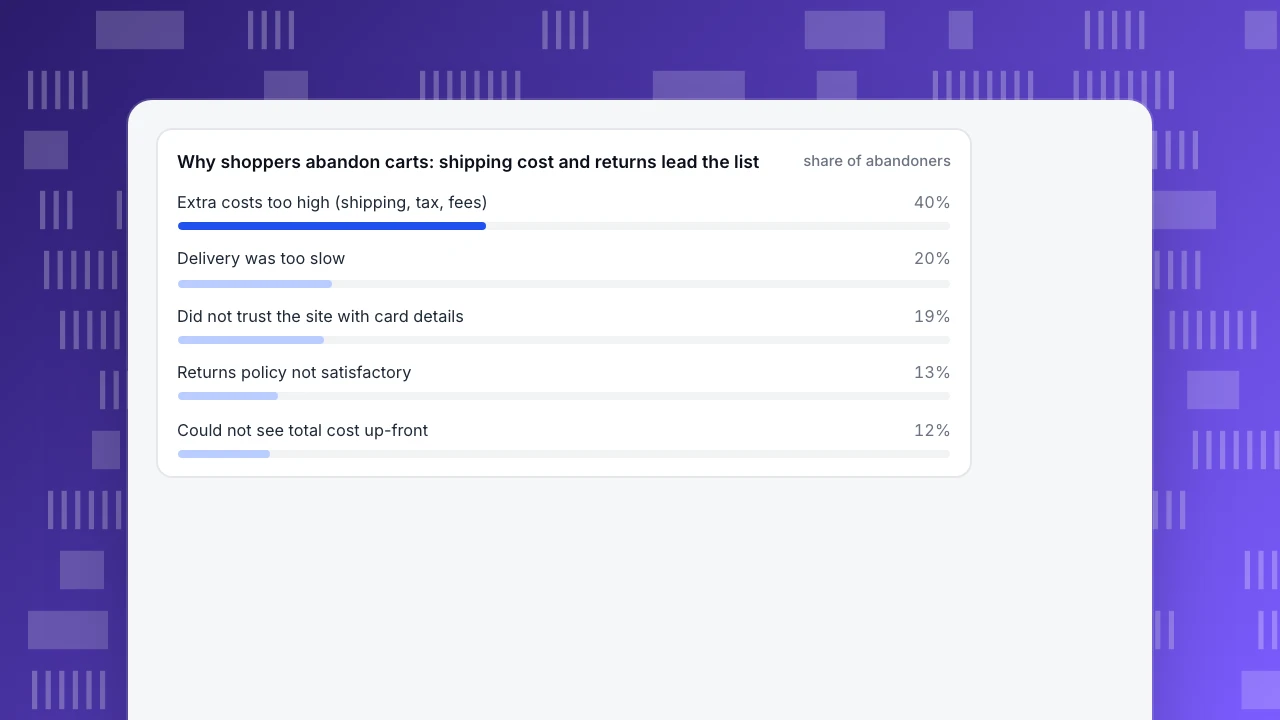
A policy only helps if it matches what you really do and is easy to find. Baymard Institute's cart abandonment statistics list "returns policy wasn't satisfactory" as a reason for 13% of abandoned carts (after removing "just browsing"), and "extra costs too high (shipping, tax, fees)" as the biggest at 40%. A clear policy does not fix a bad one, but an unclear one makes a good one invisible.
This is a drafting aid, not legal advice. Consumer law differs by country and state, so have the final text checked against the rules where you sell.
Every return policy needs these seven clauses:
- Window — how many days, and counted from delivery or from order.
- Condition — unused, tags attached, original packaging, or "any condition".
- Exclusions — final-sale items, hygiene products, custom or made-to-order goods, digital downloads.
- How to start a return — one email address, a form or a portal link, and what to include (order number).
- Who pays return shipping — you, the customer, or it depends on the reason.
- Refund method and timing — original payment method or store credit, and "within [X] business days after we receive the item".
- Damaged or wrong item — what you do, and that return shipping is on you.
Why shoppers abandon carts: shipping cost and returns lead the list
share of abandonersWhat should an apparel return policy say about fit and exchanges?
Apparel returns are mostly about size, so the template leads with exchanges and condition. Copy and adapt:
Returns and exchanges. Not the right fit? You can return or exchange unworn items within [30] days of delivery. Items must be unwashed, with tags attached and in the original packaging. To start, email [returns@yourstore.com] with your order number, or use our returns page [link]. We will send a prepaid label for exchanges. For refunds, return shipping costs [$X] and is deducted from your refund [or: is free]. Once we receive your item we refund the original payment method within [5–7] business days. Final sale: swimwear, underwear, face masks and items marked "final sale" cannot be returned. Damaged or incorrect item? Email us within [14] days with a photo and we will replace it or refund you in full, including shipping.
Clause notes: say "unworn" rather than "unused" so nobody has to guess. Put the size guide link near the policy, because the best return is the one that never happens.
What should an electronics return policy say about opened items and warranty?
Electronics add three risks: opened or activated devices, missing accessories and defects. Copy and adapt:
Returns. You may return unopened electronics within [30] days of delivery for a full refund. Opened items can be returned within [15] days; a [15]% restocking fee may apply if the item is not in resellable condition or accessories are missing. Include all original accessories, manuals and packaging. Please remove accounts and passwords and reset the device first. Defective on arrival? Contact us within [30] days and we will replace it or refund you; we cover return shipping. After this window, the manufacturer's warranty of [12 months] applies. Non-returnable: gift cards, software with a used licence key, and items damaged by misuse. Refunds are issued to the original payment method within [7] business days after inspection.
Clause notes: a restocking fee is legal in many places but must be disclosed before purchase, so show it on the product page, not only in the policy. Keep the warranty and the return window as separate paragraphs; shoppers confuse them.
How do I write a final-sale or digital-product refund policy?
Final-sale and digital policies are the shortest, so the risk is vagueness. Copy and adapt:
Final sale and digital products. Items marked "final sale" at checkout, custom or personalised items, and downloadable products cannot be returned or refunded once [the item ships / the download link is delivered], except where the law says otherwise or the item arrives damaged or not as described. If a digital file does not open or is not what we described, contact [support@yourstore.com] within [14] days and we will fix it or refund you. We confirm "final sale" on the product page and again in the cart before you pay.
Clause notes: the exclusion has to be visible before payment, not discovered afterwards. In the EU, the Commission's Your Europe guidance says the 14-day withdrawal right does not apply to made-to-order or clearly personalised goods, and that digital content is excluded only if the buyer expressly agreed to lose the right by starting the download or streaming. A pre-ticked box is not agreement, so do not rely on one.
Free returns or paid returns: which template wording fits?
Both models work; what hurts is hiding which one you use. Swap this paragraph into any of the templates above.
| Model | Wording to copy | Watch out for |
|---|---|---|
| Free returns | "Returns are free within [30] days. We email a prepaid label; refunds are issued within [5] business days of arrival." | State any exceptions (final sale, international) in the same sentence |
| Paid returns | "Return shipping is the customer's responsibility. A flat [$X] label fee is deducted from your refund; exchanges ship free." | Show the cost on the product page and in the cart, not only in the policy |
| Hybrid | "Free returns for exchanges and defective items; refunds to the original method have a [$X] return fee." | Make the exchange path the easy one if you want fewer refunds |
The EU page above notes that for a withdrawal within 14 days the buyer normally pays postage and packaging, unless the seller offers to pay or fails to tell them about the costs before purchase. Whatever you choose, say it plainly before the buy button.
| Store type | Clause to get right | Common mistake |
|---|---|---|
| Apparel | Condition (unworn, tags) and exchanges | Free returns promised, size exchange not explained |
| Electronics | Opened items, restocking fee, warranty | Fee only in the policy, not on the product page |
| Final sale / digital | Exclusion visible before payment | Discovered only after purchase |
| Any store | Who pays return and shipping costs | Cost hidden until checkout |
Quick comparison of what each template must get right.
What should a shipping policy template include?
A shipping policy answers four questions: where you ship, how much it costs, how long it takes and what happens if something goes wrong. Copy and adapt:
Shipping. We ship to [United States and Canada]. Orders placed before [2 pm ET] on a business day are dispatched the same day; otherwise the next business day. Delivery times: Standard [3–5] business days, Express [1–2] business days, counted from dispatch. Cost: Standard [$X, free over $Y]; Express [$X]. Duties and taxes for international orders are [included / paid by the buyer on delivery]. You will receive a tracking link by email when your order ships. Delays: if your order will be late we will email you with a new date and the option to cancel for a full refund. Lost or damaged in transit: contact us within [14] days and we will replace or refund. We cannot deliver to PO boxes or [excluded regions].
Clause notes: give a concrete date or range at the product page, not just "fast shipping". Name the carrier cut-off time. For US sellers, the Federal Trade Commission's business guide to its Mail, Internet, or Telephone Order Merchandise Rule says that if you make no shipment statement you must have a reasonable basis to believe you can ship within 30 days, and if you cannot ship on time you must seek the customer's consent to the delay or offer cancellation with a prompt refund. Your shipping policy should describe that delay path in plain words, then match it in practice.
Where should shoppers see the policy before they buy?
Most stores write the policy and hide it in the footer. Welo Badge, a business-verification vendor, reviewed the public shopping path of 200+ US and Canada ecommerce brands and reports that 39% show no returns information or link on the product page, 38% give no concrete delivery date and 32% show no costs or cost calculator on the product page. This is a vendor-run study; the brand list and dataset are not published, so treat it as an indicative sample, not an industry benchmark. It does match the shopper-side data above: returns and delivery are real doubts and they are often unanswered where the shopper is looking.
Put each clause at the moment the shopper asks the question:
| Where | What to show | Why there |
|---|---|---|
| Product page, beside price and buy button | One line: "Free returns within [30] days" or the return cost, plus a delivery date range and a "Shipping and returns" link | The shopper decides to add to cart here |
| Size, fit or spec block | Fit guidance, exchange note, restocking fee if any | Fit and compatibility cause the returns |
| Cart summary | Shipping cost or estimator and the total, final-sale flag on the affected line | Surprise costs are the top abandonment reason in Baymard's list |
| Checkout, near the pay button | Returns line, delivery estimate, link that opens the full policy without leaving checkout | Card details and final cost collide here |
| Order confirmation and email | The policy, return instructions and tracking link | Reduces "where is my order" and return-email volume |
| Footer and a dedicated page | The full policy text with a table of contents | For people who want to read everything and for search engines |
For the wider picture of placing evidence where doubt happens, see ecommerce trust signals for the checkout stage, checkout abandonment, and to watch the effect over time, ecommerce conversion rate.
What is the policy checklist you can copy?
Use this before you publish or edit a policy. Each item is a yes or no.
| Check | Done |
|---|---|
| Return window is a number of days and states the start date | ☐ |
| Condition requirements are stated in plain words | ☐ |
| Exclusions (final sale, custom, digital) are listed and flagged on the product page | ☐ |
| Who pays return shipping is stated before purchase | ☐ |
| Refund method and timing are stated | ☐ |
| Damaged or wrong item path is separate and says you pay | ☐ |
| Shipping cost or estimator shows on the product page or cart | ☐ |
| A concrete delivery date or range shows on the product page | ☐ |
| Delay and lost-parcel steps are written down and match your practice | ☐ |
| Returns line sits beside the buy button and beside the pay button | ☐ |
| The policy page is linked from the footer, cart and order email | ☐ |
| Text checked against local consumer law, and dated "Last updated" | ☐ |
If you would rather start from a generated draft than a blank page, the Refund Policy Generator builds one from your answers; edit it against the clauses above.
How do you check in TapCub that shoppers see the policy?
Writing the policy is half the work; the other half is whether shoppers reach it. Analytics and live chat in TapCub run on one script and one visitor ID, so you can check three things:
- Does the cart to checkout step leak? Build a product, cart, checkout, payment, purchase funnel in All-platform analytics › Behavior › Behavior analysis. A large drop at cart to checkout is where shipping cost surprises show up. Bots and AI crawlers are counted separately, so the denominator is real people.
- Do people look for the policy and fail? In All-platform analytics › Behavior › Heatmaps, read click, rage and scroll maps on the product page and cart. Repeated rage clicks on a "Shipping and returns" link, or low scroll reach to the policy line, show a link that is hard to find or that does not answer the question.
- Can someone answer on the spot? Add a rule in Live chat › Chat settings › Proactive invites: path contains your returns or shipping page, a dwell time you choose (anything from 3 to 600 seconds), and a line such as "Questions about returns or delivery? Ask here." The rule list records impressions, open rate and reply rate. Chats then arrive in Live chat › Inbox, with the visitor's current page and recent browsing in the side panel.
TapCub does no A/B testing or traffic splitting, so a change you make is an observational before and after, not a controlled experiment. It does not write or host your policy text either; it shows you whether people find and use it.
FAQ
What should a return policy include?
A return policy should include the return window and its start date, item condition, exclusions such as final-sale or custom goods, how to start a return, who pays return shipping, the refund method and timing, and what happens with damaged or wrong items. State it in plain language and show it before purchase.
How long should my return window be?
There is no single right number. Many stores use 30 days from delivery; some use 14 or 60. In the EU, buyers have at least 14 days to withdraw from most online purchases. Choose a window you can honour, state when it starts, and check your local rules.
Do I have to offer free returns?
Not generally, but you must be clear about the cost before purchase. Under EU guidance the buyer pays return postage in a withdrawal unless the seller offers to pay or did not disclose the cost beforehand. Check the rules where you sell, and show return costs on the product page and in the cart.
What should a shipping policy include?
Regions you ship to, costs and free-shipping thresholds, dispatch and delivery times, cut-off time, tracking, what happens if an order is late, and how lost or damaged parcels are handled. US sellers should also check the FTC's rule on shipping times and delayed orders.
Where should I put my return policy on the site?
Beside the price and buy button on the product page, in the cart summary, near the pay button at checkout, in the order confirmation and in the footer. The full text lives on one dedicated page that all of these link to.
Is a policy template legal advice?
No. A template is a starting point. Consumer law varies by country and state, so have the final text checked against local rules before publishing.
See also: Funnel Analysis: How to Build, Read and Fix a Funnel; Live Chat Analytics: Metrics That Matter and What Chat Reports Miss
Sources
- Baymard Institute. Cart Abandonment Rate: 50 Statistics — 70.22% average abandonment; among reasons (excluding just browsing) extra costs 40%, delivery too slow 20%, card distrust 19%, returns policy 13%, total cost not visible up-front 12%. Verified 2026-11-21.
- Welo Badge. 2026 Trust Gap Report — vendor-run review of 200+ US and Canada brands; 39% no returns information or link on the product page, 38% no concrete delivery date, 32% no costs or cost calculator on the product page. Method is the vendor's own, brand list and dataset not published; Welo sells verification services. Verified 2026-11-21.
- Federal Trade Commission. Business Guide to the Mail, Internet, or Telephone Order Merchandise Rule — reasonable basis to ship within 30 days if no shipment statement; consent or cancellation with prompt refund for delays. Verified 2026-11-21.
- European Union, Your Europe. Returning a product — 14 days to cancel distance purchases without justification; buyer pays return postage unless the seller offers or fails to disclose; exceptions for personalised goods and started digital content. Verified 2026-11-21.
Was this article helpful?
We use your answers to fix and expand this page.
Couldn’t send. Please try again in a minute.
Thanks for the feedback. We’ll use it to improve this page.You’ve already sent feedback on this page. Thanks.

Data Engineer
Writes about event design, data quality, and collection workflows, with verifiable implementation methods for reliable analytics.