Try it on your own data
Every report in this article is in the free plan. One snippet for web and apps, up to 10 sites.
Start freePersonas often end up as posters with stock photos that nobody uses. This guide shows how to build them from interviews and usage data, what to include, how they differ from segments, and how a sample of three personas looks once real numbers are behind them.
What you will learn
- A persona summarises evidence: goals, context, frustrations and measurable behaviour
- Give each persona a signal you can measure, and check its size and behaviour in your data
- Two to four personas, reviewed each quarter, are more useful than ten that nobody remembers
What is a user persona?
A user persona is a short, specific description of one type of user: what they are trying to do, what gets in the way, and how they behave with your product. It is built from research, interviews and usage data, so that a team can make design and marketing decisions with a concrete person in mind instead of "the user".
A persona is a summary of evidence. Without the evidence, it is just a guess with a stock photo.
Persona vs segment
A segment is a group defined by rules in data: "accounts on the Pro plan created in the last 90 days". A persona explains a group: goals, context, frustrations. Good personas map to segments you can measure, so you can check that they exist and how big they are. See user segmentation examples.
What to include
The table below lists the fields worth including, and the ones to skip.
| Include | Why | Skip |
|---|---|---|
| Goal: the job they are trying to get done | Drives what to build and say | Hobbies, favourite brands |
| Context: team size, role, tools used before | Explains constraints and workarounds | Made-up life stories |
| Frustrations and triggers | Shows what makes them search for a product | Generic pain points that fit everyone |
| Behaviour in your product, with numbers | Lets you check the persona exists and how big it is | Demographics with no link to behaviour |
| One or two real quotes | Keeps the persona grounded | Invented quotes |
If a field would not change a decision, leave it out.
How to build personas from real data
- Start with interviews. 10–15 conversations with recent sign-ups and long-time customers. Ask about the last time they did the job your product helps with.
- Look for patterns in goals and context, not demographics: team size, who else is involved, what they used before.
- Draft two to four personas. More than that and nobody remembers them.
- Find a measurable signal for each, such as company size, plan, number of sites, or the first thing they did after sign-up.
- Check them against usage data. How many accounts match each persona, and do they behave differently?
- Write them on one page each, and put the numbers on the page.
A sample: three personas, checked against data
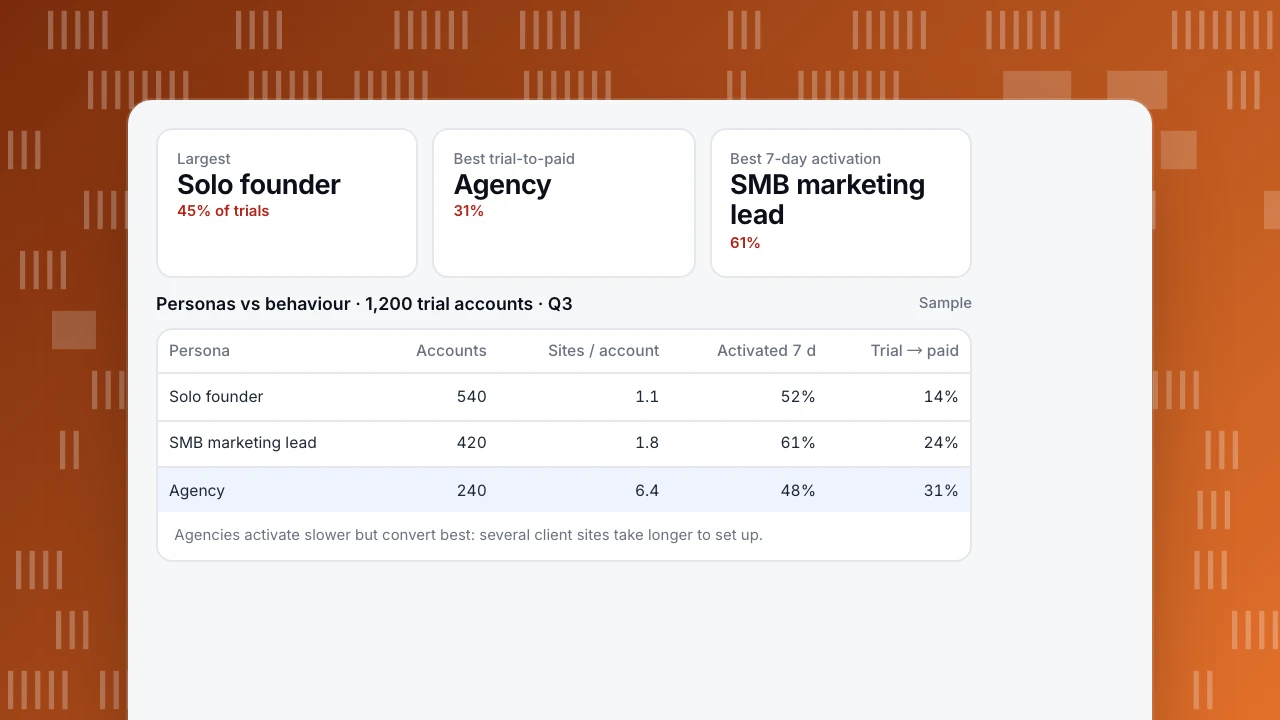
A web analytics product drafts three personas from 14 interviews, then tags 1,200 trial accounts from one quarter by the signals in each (sample numbers):
| Persona | Accounts | Sites per account | Activated in 7 days | Trial to paid |
|---|---|---|---|---|
| Solo founder | 540 (45%) | 1.1 | 52% | 14% |
| SMB marketing lead | 420 (35%) | 1.8 | 61% | 24% |
| Agency | 240 (20%) | 6.4 | 48% | 31% |
The data changes the story. Solo founders are the largest group but pay least often. Agencies are the smallest but convert best, despite activating less in the first week, because setting up several client sites takes longer. That suggests a different onboarding path for agencies, not a faster one.
Largest
Solo founder
45% of trials
Best trial-to-paid
Agency
31%
Best 7-day activation
SMB marketing lead
61%
Personas vs behaviour · 1,200 trial accounts · Q3
Sample| Persona | Accounts | Sites / account | Activated 7 d | Trial → paid |
|---|---|---|---|---|
| Solo founder | 540 | 1.1 | 52% | 14% |
| SMB marketing lead | 420 | 1.8 | 61% | 24% |
| Agency | 240 | 6.4 | 48% | 31% |
Agencies activate slower but convert best: several client sites take longer to set up.
Common mistakes
- Inventing details. Hobbies and favourite brands rarely change a product decision.
- Personas based on demographics alone. Age and job title predict less than goal and context.
- Too many personas. Two to four is enough for most products.
- Never updating them. Check the numbers each quarter; groups grow and shrink.
- Personas nobody uses. Name the persona in briefs and roadmap items, or retire it.
Keeping personas live in TapCub
Turn each persona's signal into a segment in All-platform analytics › Users › Segments & tags, for example "sites per account ≥ 3" or a plan property set from your server. Segments recompute daily, so you can watch each persona's size and compare its funnels and retention side by side. For B2B products, All-platform analytics › Users › Accounts shows behaviour per company rather than per person. See also product discovery for how personas feed research.
See also
Was this article helpful?
We use your answers to fix and expand this page.
Couldn’t send. Please try again in a minute.
Thanks for the feedback. We’ll use it to improve this page.You’ve already sent feedback on this page. Thanks.

Product Adoption Consultant
Explores customer onboarding, live conversations, and self-service, turning common usage questions into practical guidance and improvements.