Try it on your own data
Every report in this article is in the free plan. One snippet for web and apps, up to 10 sites.
Start freeThird-party data is information about people collected by companies that have no relationship with them, then sold. It can still help with enrichment and research, but accuracy, consent and browser changes all limit it. This guide explains the four data types, the uses and risks, and how to test a vendor before relying on it.
What you will learn
- Third-party data comes from companies with no direct relationship to the people described
- Test any vendor on your own known records, per field, before buying
- First-party data from your own site and product is becoming the base; third-party data fills gaps
Definitions
Data about customers is usually grouped by who collected it and what relationship they have with the person:
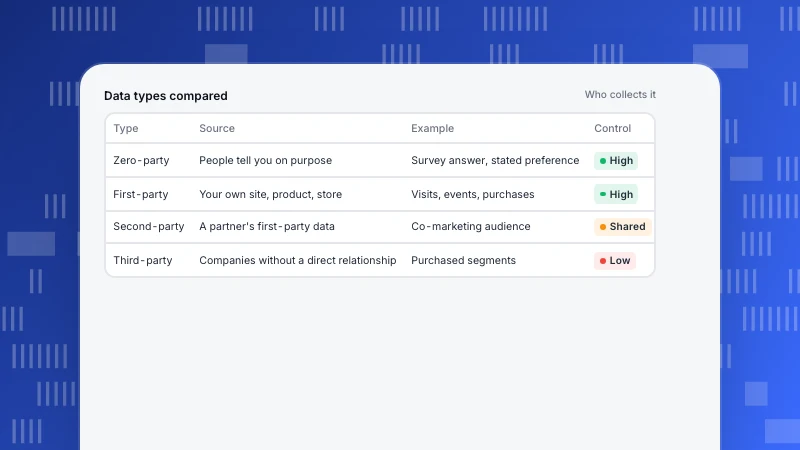
- Zero-party data: what people tell you on purpose: preferences, survey answers, profile settings.
- First-party data: what you collect from your own customers and visitors: site and product behavior, purchases, support history.
- Second-party data: another company's first-party data, shared with you directly under an agreement, such as a co-marketing partner.
- Third-party data: collected by a company that has no direct relationship with the people it describes, combined from many sources, and sold or licensed. Examples: demographic segments, B2B firmographics (company size, industry), intent data, purchased audience lists.
The four types compared
The table below compares the four types on source, accuracy and control.
| Type | Who collects it | Example | Accuracy | Your control |
|---|---|---|---|---|
| Zero-party | You, from what people say | Preferences, survey answers | High (self-reported) | Full |
| First-party | You, from your own channels | Site behavior, purchases | High | Full |
| Second-party | A partner, shared directly | Co-marketing partner list | Medium to high | By agreement |
| Third-party | Aggregators with no relationship to the person | Firmographics, audience segments | Variable | Low |
Consent rules apply to all personal data, whoever collected it.
Where third-party data still helps
- Enrichment: adding company size and industry to B2B sign-ups, so sales can prioritise.
- Market sizing and research: how many companies of a type exist in a region.
- Reaching new audiences when you have no first-party data yet, typically through ad platforms.
- Filling gaps in forms: shorter sign-up forms, with fields filled in afterwards.
The risks
- Accuracy. Data is aggregated, inferred and often out of date. Job changes, company moves and shared devices all add errors.
- Consent. Under laws such as GDPR, you need a lawful basis to use personal data, including data you bought. Ask how the vendor obtained it.
- Signal loss. Browsers block third-party cookies by default (Safari, Firefox), and mobile platforms limit tracking, so cookie-based third-party audiences shrink.
- No differentiation. Competitors can buy the same lists.
A worked example: testing an enrichment vendor
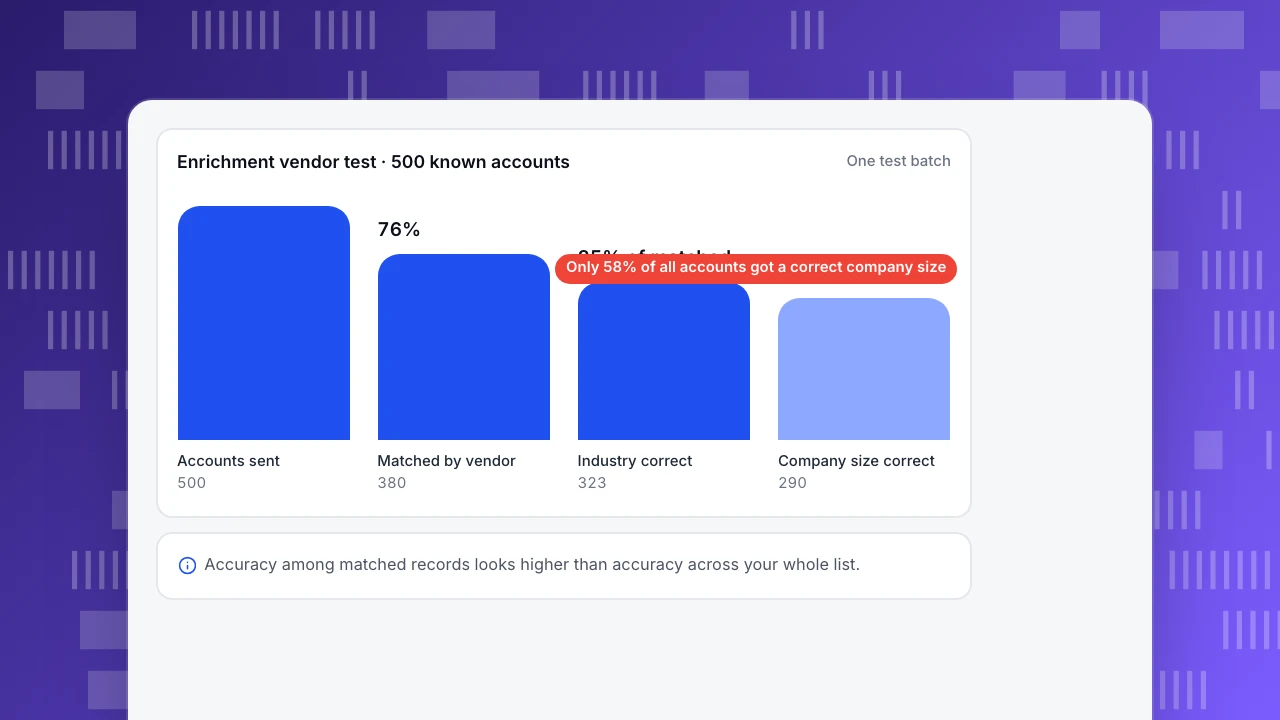
Before signing a contract, a B2B company sends the vendor 500 accounts whose details it already knows (sample numbers):
- Matched: 380 of 500 (76%)
- Company size correct: 290 of the 380 matched, so 58% of all 500
- Industry correct: 323 of the 380 matched, so 65% of all 500
The vendor's sales deck quoted "over 90% accuracy", which turned out to be accuracy among matched records for industry only (323 ÷ 380 = 85%). For routing leads by company size, the useful number is 58%: four in ten leads would need checking anyway. The company decides to use the vendor for industry only, and to ask for company size on the sign-up form.
Enrichment vendor test · 500 known accounts
One test batchAccounts sent
500
Matched by vendor
380
Industry correct
323
Company size correct
290
Vendor checklist
- How was the data collected, and on what legal basis?
- How often is it refreshed?
- Match rate and accuracy on your own sample, per field.
- Can people opt out, and how are deletions passed on?
- Where is the data stored and processed?
First-party analytics as the base
As third-party signals fade, first-party data becomes the base for understanding customers. TapCub collects first-party data on your own domains and apps, and its website script writes no cookie by default. Accounts in All-platform analytics › Users › Accounts let you attach the company properties you do know (plan, size from your CRM), and analyse behavior by account. See first-party data strategy, first-party cookie, third-party cookie and GDPR-compliant analytics.
This article is general information, not legal advice.
See also: Zero-party data.
Was this article helpful?
We use your answers to fix and expand this page.
Couldn’t send. Please try again in a minute.
Thanks for the feedback. We’ll use it to improve this page.You’ve already sent feedback on this page. Thanks.

Solutions Engineer
Covers SDKs, API integrations, and data implementation, with an emphasis on validation, system interoperability, and troubleshooting.