Try it on your own data
Every report in this article is in the free plan. One snippet for web and apps, up to 10 sites.
Start freeEmpathy statements are short sentences that show a customer you understand their problem from their side, such as "Six days without a tracking update is frustrating." In support chat they only work when the next sentence is a specific action; "I understand how you feel" with nothing after it reads as a script. Below: the three-part structure, 26 examples by situation, chat versus phone, phrases to avoid, and how to measure the effect.
What you will learn
- Follow every empathy line with a specific action and a time; empathy alone reads as a script
- Name the customer's actual problem in their words: acknowledge, specify, act, in two sentences
- In chat, use one short empathy sentence in the first reply, then measure repeat contacts, not just ratings
What is an empathy statement?
An empathy statement is a sentence that shows the customer you understand their situation from their side, not yours. The APA Dictionary of Psychology defines empathy as understanding a person "from their frame of reference rather than one's own", and that is the test for a support reply: does it describe the problem the way the customer experiences it?
Three things often get mixed up, and the difference matters in a reply:
- Sympathy says you feel sorry: "That's a shame." It keeps you on the outside of the problem.
- Empathy says you see what the problem means to them: "You planned the gift for Saturday, and now it won't arrive in time."
- An apology takes responsibility for something you did: "We shipped it late." When the fault is yours, you usually need both. Writing the apology itself is covered in sorry for the inconvenience, so this article stays with the empathy part.
An empathy statement on its own does not solve anything. Customers contact support to get a problem fixed, and a sentence about feelings with nothing after it reads as a script. That is the rule this whole guide is built on: an empathy statement earns its place only when the next sentence is a specific action.
The three-part structure: acknowledge, specify, act
Every strong empathy statement in a support chat has three parts, usually in two sentences:
- Acknowledge — show you heard the emotion or the stakes. "That's frustrating."
- Specify — name the actual problem in the customer's terms, so it could not be pasted into any other chat. "…especially when the tracking page has said 'in transit' for six days."
- Act — say what you are doing now, and when they will hear back. "I've opened a trace with the carrier and I'll message you by 3 pm with what they find."
The middle part is what separates empathy from a template. "I understand your frustration" fits every conversation, which is exactly why it convinces nobody. "Six days on 'in transit' is too long" proves you read the message.
Clinicians use a similar checklist when they respond to emotion. VitalTalk's NURSE framework, written for doctors talking to seriously ill patients, lists naming the emotion, understanding, respecting, supporting and exploring. The support version is shorter, but the idea carries over: name what the person feels, show you understood why, then commit to help. "Supporting" in NURSE is a commitment, not a feeling, which is the same move as the action step here.
Two writing rules keep the structure tight in chat:
- One sentence of empathy, at most. In a chat window, three sentences of sympathy push the answer below the fold.
- Use "I" and an active verb for the action. "I've refunded the shipping fee" beats "A refund has been processed", because it tells the customer a person did something.
The table below shows the three parts with weak and strong versions of each.
| Part | What it does | Weak | Strong |
|---|---|---|---|
| Acknowledge | Shows you heard the feeling or the stakes | "I understand your frustration." | "That's frustrating…" |
| Specify | Names the problem in the customer's terms | "…with your order." | "…when tracking has said 'in transit' for six days." |
| Act | Says what you are doing and when they hear back | "Let me look into this." | "I've opened a trace and I'll update you by 3 pm." |
Usually two sentences in chat: acknowledgement plus specifics, then the action.
Empathy statements by situation
These examples follow the three-part structure. Replace the details in {curly braces} with the customer's specifics; if you cannot fill in a specific detail, the statement is not ready to send.
When an order or a reply is delayed
- "Waiting {six days} with no tracking update is frustrating. I've asked the carrier to trace parcel {number} and I'll update you by {time}."
- "You were promised delivery by {date}, and that matters when it's a gift. I've upgraded the replacement to express shipping at no cost."
- "Sorry you waited {40 minutes} for this reply; that's longer than it should be. Here's the answer: {answer}."
- "I can see why you're worried; the order still shows 'processing' after {three days}. I've checked with the warehouse: it ships today, and you'll get the tracking email tonight."
When something went wrong on our side
- "Being charged twice is alarming, and that's on us. I've reversed the second charge; your bank should show it within {3–5 business days}."
- "You received the wrong size after waiting a week. I've sent the right one today and emailed you a prepaid return label for the other."
- "Losing your saved settings after an update is a real setback. I've restored them from yesterday's backup; can you reload and check?"
- "A broken link in the welcome email is our mistake. Here's the working one, and I've reported it so it's fixed for others."
When the customer wants a refund
- "Paying for a plan you didn't use isn't fair. I've refunded the {amount} for this month; you'll see it within {5 business days}."
- "That sounds like the product didn't do what you needed. I've started the return; the label is in your inbox, and the refund goes out when the parcel is scanned."
- "I know a refund isn't what you wanted after waiting this long. It's processed now, and I've added a note so the team can see what went wrong."
- "Refund policies can be confusing when they differ by item. Yours qualifies: I've issued {amount} back to the original card."
When the customer has had to repeat themselves
- "You shouldn't have to explain this a third time. I've read the earlier chats, so you don't need to start over: the issue is {summary}, and I'm handling it from here."
- "Being passed between people is tiring. I'm keeping this conversation until it's solved, and I'll message you here when it is."
- "You've already sent the screenshot twice. I have it now and I've forwarded it to our engineers with your account details."
- "I'm sorry nobody followed up last time. I've set myself a reminder to update you by {day}, even if the answer isn't final yet."
When the answer is no
- "I understand this isn't the answer you hoped for. I can't extend the return window, but I can offer an exchange or store credit; which works better?"
- "That's a reasonable request, and I wish I could say yes. The discount ended on {date}; what I can do is {alternative}."
- "I can see why that feature would save you time. It isn't available yet; I've added your use case to the request so the product team hears it."
When the customer is angry
- "You have every reason to be annoyed after {what happened}. Let's fix it now: {first step}."
- "I hear you, and I'd feel the same after {two missed deliveries}. I've booked a fixed delivery slot for {date}; does that time work?"
- "I can tell this has cost you real time. I'm going to stay on this chat until it's solved. First, {question or action}."
Empathy in chat versus on the phone
Empathy statements written for call centres often fail in a live chat window. On the phone, tone of voice does half the work; in text, the words carry all of it, and the customer can reread them. NN/g's research on tone of voice describes four dimensions (formal vs casual, serious vs funny, respectful vs irreverent, matter-of-fact vs enthusiastic). In support chat, aim for respectful and matter-of-fact, and move toward serious as the stakes rise.
| Chat | Phone | |
|---|---|---|
| Length | One short sentence of empathy, then the action | A few words of acknowledgement, said warmly |
| Timing | In the first reply, not repeated every message | Early, and again after bad news |
| What carries tone | Word choice, punctuation, specificity | Voice, pace, pauses |
| Signals of listening | Quoting a detail from their message | "Mm-hm", repeating back |
| Exclamation marks | Avoid in bad-news replies | Not applicable |
| Silence | A gap of several minutes reads as being ignored; say what you're checking | A pause while checking is normal if you say so |
Two chat-specific habits help. If you need time, say so: "Give me two minutes to check the order." And avoid stacking one empathy line per message. One clear acknowledgement in the first reply, followed by progress updates, reads as attention; the same sympathy line three times reads as a macro.
Phrases to avoid and what to say instead
Some common phrases do more harm than silence because they sound like empathy but point away from the problem.
| Phrase | Why it lands badly | Say instead |
|---|---|---|
| "I understand how you feel." | Claims too much, and fits every chat | "Six days without an update is frustrating." |
| "I'm sorry you feel that way." | Apologises for their feelings, not the problem | "I'm sorry the parcel is late." |
| "Calm down." | Tells them their reaction is wrong | "Let's get this fixed. First, …" |
| "As I said before…" | Blames them for not reading | "To recap: …" |
| "I know exactly what you mean." | Rarely true, and sounds rehearsed | Name the detail you understood |
| "Unfortunately, that's our policy." | Ends the conversation without help | "I can't do X, but I can do Y." |
Stock apologies have the same problem; alternatives for "sorry for the inconvenience" are collected in sorry for the inconvenience. For a quick bank of reply lines beyond empathy, see the customer service phrases tool.
Before and after: one chat rewritten
Here is a late-order chat, first with a generic empathy line and then with the three-part structure.
Before
Customer: My order was supposed to arrive Tuesday. It's Friday and tracking hasn't moved since Monday. I needed it for a birthday tomorrow. Agent: I completely understand your frustration and I'm sorry for any inconvenience. Let me look into this for you. (four minutes of silence) Agent: Your order is in transit. Please allow a few more days.
After
Customer: My order was supposed to arrive Tuesday. It's Friday and tracking hasn't moved since Monday. I needed it for a birthday tomorrow. Agent: Four days with no movement, with a birthday tomorrow, is stressful. I'm checking with the carrier now; give me two minutes. Agent: The parcel is stuck at the regional depot. I can't get it to you by tomorrow, so I've sent a replacement by overnight courier; it arrives by noon. You'll get the tracking link by email in the next hour, and when the original turns up you can keep it or refuse it.
What changed: the "after" agent names the two details that matter (no movement since Monday, birthday tomorrow), says what they are doing during the wait, and ends with an action and a time. The "before" version uses two stock phrases and ends with no action at all.
How to roll empathy statements out across a team
Individual agents improve quickly with feedback; a team improves when the good versions are the fast ones to use. Four steps:
- Write one saved reply per situation, with placeholders for the specifics and the action built in. Store them as canned responses, so the empathy-plus-action version is quicker to insert than typing a generic line.
- Ban the generic lines in the same library. If "I understand your frustration" exists as a saved reply, it will be used everywhere.
- Review ten conversations a week against the three parts: acknowledged, specified, acted. A missing action is the most common gap.
- Practise the hard cases. Role-play the "no" and "angry" situations during onboarding; a structure for that is in customer service training.
How to measure whether empathy statements help
Satisfaction scores alone are a weak signal, because few customers rate a chat and the score mixes many causes. Pair the score with repeat contact: did the same customer come back about the same problem within seven days? An empathy line without an action tends to produce a second contact, because nothing happened.
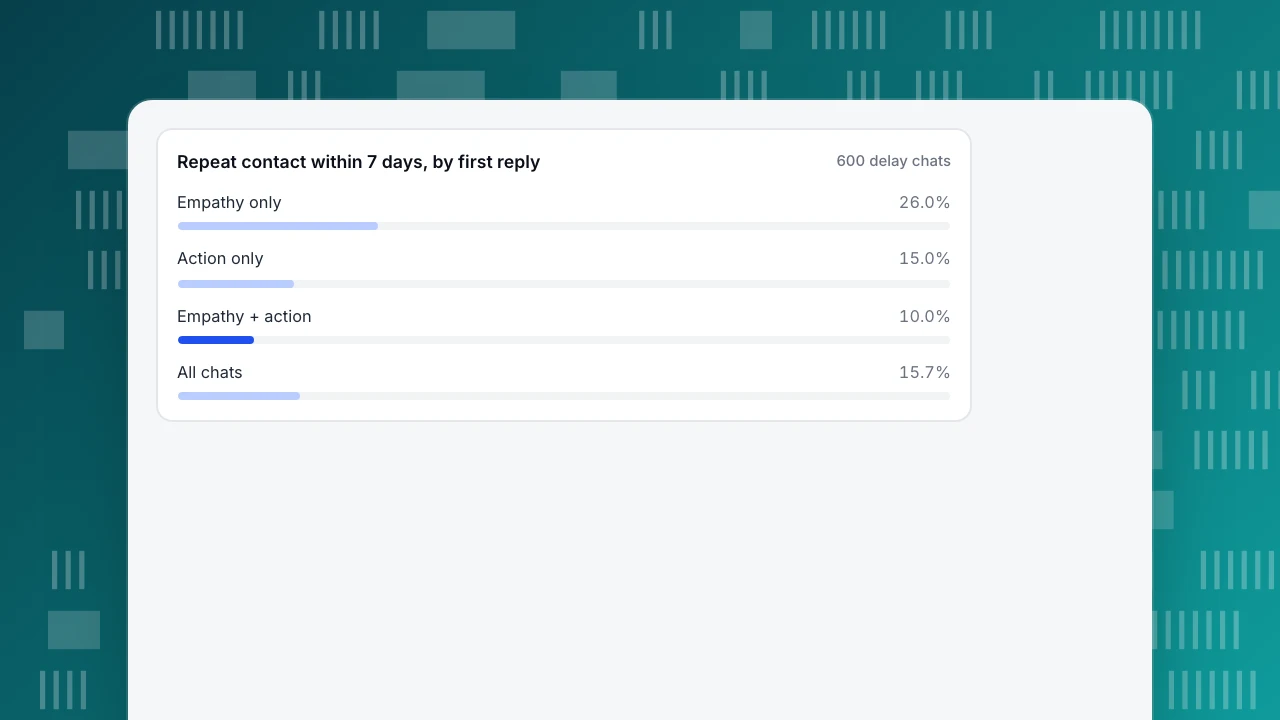
Sample data: a store tagged 600 delay-related chats in one month by the pattern of the agent's first reply.
- Empathy only ("I understand, sorry for the wait"): 150 chats, 39 came back within seven days: 39 ÷ 150 = 26.0%. 60 were rated, average 3.3 out of 5.
- Action only (straight to the fix): 200 chats, 30 came back: 30 ÷ 200 = 15.0%. 80 rated, average 3.9.
- Empathy + action: 250 chats, 25 came back: 25 ÷ 250 = 10.0%. 100 rated, average 4.3.
- All 600: 39 + 30 + 25 = 94 repeat contacts, 94 ÷ 600 = 15.7%. Average rating (60 × 3.3 + 80 × 3.9 + 100 × 4.3) ÷ 240 = 940 ÷ 240 = 3.9.
Read it carefully: this is an observational comparison, not an experiment. Agents choose their replies, and harder cases may attract different wording. Still, the pattern is the one to look for: the empathy-only replies sit at the bottom on both measures, and adding the action matters more than adding the empathy. For broader score work, see how to improve CSAT; for reading the emotion in messages at scale, see customer sentiment.
Repeat contact within 7 days, by first reply
600 delay chatsHow to write empathy statements in TapCub
The late-order chat above is the scenario. Here is how a team runs it in TapCub live chat.
- Save the three-part versions as canned replies. In Live chat › Canned replies, create one row per situation, for example
/late-tracewith "{days} without a tracking update is frustrating. I've asked the carrier to trace your parcel and I'll update you by {time}." In the inbox, typing/inserts it, and nothing is sent until the agent has filled in the details and pressed send. Each row shows a use count, so you can see whether agents actually reach for the new versions and delete the generic ones nobody should use. - Get the specific detail from the side panel, not by asking. In Live chat › Inbox, the visitor drawer shows the current page, landing page, referrer, the analytics trail from the last two days and earlier conversations with the same visitor. If the customer has been on the order-tracking page for ten minutes, the agent knows the problem before the first message. Use the context to understand; don't recite the browsing trail back to the customer.
- Spot repeat contacts as they happen. When a visitor writes again after the reopen window, TapCub creates a new conversation tagged as returning and shows the earlier conversation above it, so the agent can open with "You shouldn't have to explain this again" and mean it. TapCub does not calculate a repeat-contact rate for you; tally it from your weekly review sample.
- Keep empathy plain when translation is on. With two-way translation in Live chat › Chat settings › Greeting & translation, the visitor sees only the translated reply and the agent sees both versions. Idioms translate badly, so write empathy lines literally: "Four days without movement is too long" survives translation better than a figure of speech.
- Watch satisfaction per agent. Live chat › Reports shows satisfaction, a 1–5 score the visitor can give within 24 hours after the chat is resolved, averaged to one decimal, plus per-agent workload and satisfaction. The report does not split scores by which canned reply was used, so pair it with the reply use counts and your review sample.
FAQ
What is an example of an empathy statement?
"Six days with no tracking update is frustrating. I've asked the carrier to trace your parcel and I'll update you by 3 pm." It acknowledges the feeling, names the specific problem in the customer's terms, and ends with a concrete action and a time. Without the second sentence, the first one reads as a template, however warmly it is worded.
What is the difference between empathy and sympathy in customer service?
Sympathy says you feel sorry for the customer: "That's a shame." Empathy shows you understand what the problem means from their side: "You needed it for a birthday tomorrow." Sympathy keeps distance; empathy names the stakes. In support, follow either one with an action, because the customer contacted you to get something fixed, not to be consoled.
Is "I understand your frustration" a good empathy statement?
On its own, no. It fits every conversation, so customers recognise it as a script. Make it specific ("Waiting a week for a refund is frustrating") and follow it immediately with what you are doing about it. If you cannot name the specific problem yet, ask a clarifying question instead of using a generic empathy line.
How many empathy statements should I use in a chat?
Usually one, in your first reply, followed by progress and actions. Repeating a sympathy line in every message reads as a macro and delays the answer. Add a second acknowledgement only when the situation changes, for example when you have to deliver bad news or tell the customer that the fix will take longer than promised.
How do you measure empathy in customer service?
Combine two signals: satisfaction scores and repeat contacts on the same issue within about seven days. Review a sample of conversations each week against three checks: did the agent acknowledge, name the specific problem, and take an action? A reply that misses the action step tends to bring the customer back, because nothing actually happened.
See also: Apology Email to Customers: Structure and 6 Annotated Examples.
Sources
- American Psychological Association. Empathy. APA Dictionary of Psychology — definition of empathy as understanding from the other person's frame of reference. Verified 2026-11-15.
- VitalTalk. Responding to emotion: respecting — the NURSE framework (naming, understanding, respecting, supporting, exploring). Verified 2026-11-15.
- Kate Moran, Nielsen Norman Group. The Four Dimensions of Tone of Voice — formal vs casual, serious vs funny, respectful vs irreverent, matter-of-fact vs enthusiastic. Verified 2026-11-15.
Was this article helpful?
We use your answers to fix and expand this page.
Couldn’t send. Please try again in a minute.
Thanks for the feedback. We’ll use it to improve this page.You’ve already sent feedback on this page. Thanks.

Growth Strategist
Explores acquisition channels, activation, and conversion experiments, turning data insights into actionable growth hypotheses and evaluation methods.