Try it on your own data
Every report in this article is in the free plan. One snippet for web and apps, up to 10 sites.
Start free"Sorry for the inconvenience" is the most-used apology in customer support and one of the least convincing. It is polite, safe and fast to type, which is exactly why customers read it as a template. A better apology names what went wrong, owns it and says what happens next. Below: why the stock phrase falls flat, what research says an apology needs, 36 alternatives grouped by situation, and how to make good apologies the team default.
What you will learn
- Name the specific problem and own it; 'inconvenience' minimises what happened
- Research finds acknowledging responsibility and offering repair matter most
- Store situation-specific apologies as canned replies, then check satisfaction on those chats
Why "sorry for the inconvenience" falls flat
The phrase has three problems.
- It is generic. It could be pasted under any complaint, and customers know it. A reply that does not mention their problem tells them nobody read it carefully.
- It shrinks the problem. A double charge, a lost order or a day of downtime is not an "inconvenience" to the person it happened to. The word quietly argues with them about how bad it was.
- It skips the parts that matter. It does not say what went wrong, who is responsible or what happens next, which are exactly what the customer wants to know.
Variants make it worse: "sorry for any inconvenience this may have caused" doubts that there was a problem at all.
| Phrase to avoid | Why it lands badly | Say instead |
|---|---|---|
| Sorry for the inconvenience | Generic; shrinks the problem to an 'inconvenience' | I'm sorry your order arrived two days late |
| Sorry for any inconvenience this may have caused | 'Any' and 'may have' doubt that there was a problem | I'm sorry we charged you twice |
| We apologize if you were upset | Apologises for the customer's feelings, not your action | We got this wrong, and I'm sorry |
| Unfortunately, that's our policy | Ends the conversation without help | I can't do X, but here's what I can do |
| Your call is important to us | Says it while making them wait | Thanks for waiting; here's where things stand |
Phrases and rewrites are written for chat and email support.
What a good apology contains
Lewicki, Polin and Lount (2016) tested six components of an apology: expressing regret, explaining what went wrong, acknowledging responsibility, declaring repentance, offering repair and requesting forgiveness. Acknowledging responsibility was the most effective single component, followed by offering repair; requesting forgiveness added least. Research on complaint handling (Tax, Brown and Chandrashekaran, 1998) points the same way: customers judge a recovery by the outcome, the process and how they were treated, not by the politeness of the words.
For support replies, that gives a five-part pattern:
- Name the problem in their terms: "your order arrived two days late".
- Own it: "we got the delivery date wrong".
- Say what you are doing: "I've refunded the shipping fee".
- Say what happens next, and when: "the refund shows in 3–5 business days".
- Prevent or reassure: "we've changed how we estimate dates for your region".
Not every reply needs all five, but a reply with none of them is not an apology.
36 alternatives, by situation
When you made a mistake
- "That's our mistake, and I'm sorry."
- "You're right, we got this wrong."
- "I'm sorry we sent the wrong size. A replacement is on its way today."
- "Thank you for flagging this. It was an error on our side, and I've fixed it."
- "I'm sorry for the mix-up with your account. Here's what happened and what I've changed."
- "We should have caught this before it reached you. I'm sorry."
When the customer had to wait
- "Thank you for waiting. I'm sorry it took this long."
- "I'm sorry we kept you waiting longer than we said we would."
- "You shouldn't have had to chase us for this. I'm sorry."
- "Sorry for the slow reply. I've got your answer now."
- "Thanks for your patience over the last two days. Here's where things stand."
- "I'm sorry this has dragged on. I'll stay on it until it's resolved."
When there is an outage or a bug
- "We're sorry: our service was down between 14:05 and 14:50 UTC. Everything is working again."
- "You've found a bug, and I'm sorry it got in your way. Our team is fixing it, and I'll update you by Friday."
- "I'm sorry this broke your workflow. Here's a workaround until the fix ships."
- "We know this disrupted your day, and we're sorry. The full explanation is on our status page."
- "Thanks for reporting this so quickly. It helped us fix it faster."
- "Sorry for the disruption. We've added monitoring so we hear about this before you do next time."
When an order is late or wrong
- "I'm sorry your order is late. The new delivery date is Thursday."
- "I'm sorry the item arrived damaged. A replacement ships today, no need to return the old one."
- "That's not the experience we want you to have. I've refunded the shipping."
- "I'm sorry your parcel is stuck. I've opened a trace with the carrier and will update you tomorrow."
When there is a billing problem
- "I'm sorry we charged you twice. I've refunded the duplicate payment; it will show in 3–5 business days."
- "You're right, that charge shouldn't have happened. It's been reversed."
- "I'm sorry for the confusion on your invoice. Here's a corrected copy."
- "Thanks for catching this. I've credited your account for this month."
When you can't give them what they asked for
- "I can't do that, but here's what I can do."
- "I understand why you'd want that. It isn't possible because… What I can offer is…"
- "That's a fair request. We don't support it yet; I've passed it to the product team with your use case."
- "I'm sorry this isn't the answer you hoped for. Here are two options that might help."
When it isn't your fault (but it is your problem)
- "I'm sorry this happened. Let's get it sorted."
- "That sounds frustrating. Here's how we can fix it."
- "I can see why that's confusing. Let me walk you through it."
When thanks works better than sorry
- "Thank you for your patience." (instead of "sorry for the wait", when the wait was short)
- "Thanks for bearing with us while we looked into this."
- "Thanks for telling us. This helps us improve."
Before and after
Late delivery. Before: "Sorry for the inconvenience. Your order is in transit." After: "I'm sorry your order is two days late. It's with the courier now and due Thursday. I've refunded your shipping fee because we gave you the wrong date."
Double charge. Before: "We apologize for any inconvenience this may have caused." After: "I'm sorry we charged you twice. That was a payment error on our side. The duplicate is refunded and will show in 3–5 business days."
Outage. Before: "We apologize for the inconvenience and appreciate your patience." After: "We're sorry: dashboards didn't load for about 45 minutes this afternoon. Data collection wasn't affected, so nothing is missing. The cause and fix are on our status page."
In each rewrite, the customer learns what happened, who owns it and what changes for them. The word "inconvenience" is no longer needed.
When "sorry for the inconvenience" is fine
The phrase is not banned. It is acceptable when the issue really is minor and impersonal: a planned maintenance notice, a short page that is temporarily unavailable, a form that needs to be submitted again. Even then, "sorry for the short interruption" is more precise. The problem is using it for serious, personal problems, and using it instead of a fix.
Make good apologies the team default
Agents reach for the stock phrase because it is fast. The fix is to make the better version just as fast.
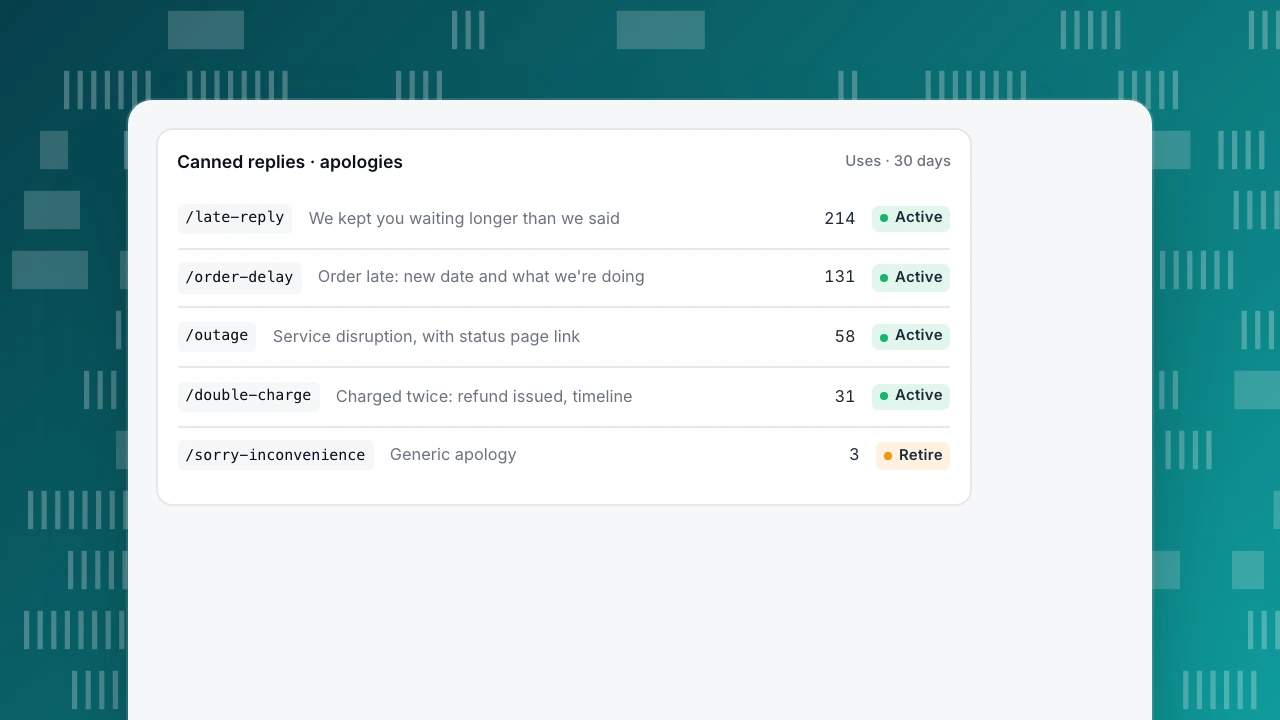
- Write situation-specific canned replies for your five or six most common problems, each following the five-part pattern, with placeholders for dates and amounts. See canned responses.
- Retire the generic one. If agents still use it, the use count will show it.
- Train on rewrites, not rules. Show real before/after pairs in onboarding; see customer service training.
- Measure. Compare satisfaction scores on conversations about the same problem before and after the change.
Sample data: a store rewrote three canned replies for late orders. Over the next month, average satisfaction on "late order" conversations rose from 3.6 to 4.2 (on a 1–5 scale), while satisfaction on other topics stayed at 4.4. The specific apology did not fix late deliveries, but it changed how customers rated the conversation about them.
In TapCub, canned replies live in Live chat › Canned replies: each has a shortcut, title and content, can be site-wide or personal, and shows a use count; agents type / in the composer to insert one and can still edit it before sending. Satisfaction in Live chat › Reports is a 1–5 score given after a chat is resolved. See use canned replies.
Canned replies · apologies
Uses · 30 days/late-replyWe kept you waiting longer than we said214Active/order-delayOrder late: new date and what we're doing131Active/outageService disruption, with status page link58Active/double-chargeCharged twice: refund issued, timeline31Active/sorry-inconvenienceGeneric apology3Retire
FAQ
Is it rude to say "sorry for the inconvenience"?
It is not rude, but it often sounds automatic. For anything beyond a minor issue, name the specific problem and say what you are doing about it.
What can I say instead of "sorry for the inconvenience"?
Name the problem and own it: "I'm sorry your order is late", "That's our mistake", "Thank you for waiting". Then say what happens next.
Should I say "apologize" or "sorry"?
"Sorry" sounds more personal in chat; "we apologize" suits formal email or public notices. The word matters less than naming the problem and the fix.
Is "thank you for your patience" better than "sorry for the wait"?
When the wait was short or expected, yes: thanking is warmer. When the wait was long or broke a promise, apologise first, then thank.
Sources
- Lewicki, R. J., Polin, B. and Lount, R. B. (2016). An Exploration of the Structure of Effective Apologies. Negotiation and Conflict Management Research, 9(2), 177–196.
- Tax, S. S., Brown, S. W. and Chandrashekaran, M. (1998). Customer Evaluations of Service Complaint Experiences: Implications for Relationship Marketing. Journal of Marketing, 62(2), 60–76.
Was this article helpful?
We use your answers to fix and expand this page.
Couldn’t send. Please try again in a minute.
Thanks for the feedback. We’ll use it to improve this page.You’ve already sent feedback on this page. Thanks.

Growth Strategist
Explores acquisition channels, activation, and conversion experiments, turning data insights into actionable growth hypotheses and evaluation methods.