Try it on your own data
Every report in this article is in the free plan. One snippet for web and apps, up to 10 sites.
Start freeAn apology email to customers has five parts in order: a subject naming the problem, one apology with ownership in the first sentence, specific facts, a remedy already started and a next step with a time. Below are six annotated emails (delayed order, double charge, outage, data incident, missed reply, wrong email), the rule behind each and a break-even check for credits.
What you will learn
- Put the fact before the feeling: subject names the problem, first sentence apologises and owns it, then who and how long
- Some timings are set by rules: delayed-order notice before the original ship date (FTC) and breach notice to authorities within 72 hours (GDPR)
- Size a credit by break-even: $4 to 1,200 customers costs $4,800 and pays back if 10 of them stay
What does a good apology email to customers contain?
A good apology email does five jobs in a fixed order, and a reader should be able to find each one in under ten seconds. Use this as a checklist before you send anything.
| Part | What it does | Test question |
|---|---|---|
| 1. Subject line | Names the problem so the email is opened and not mistaken for marketing | Could the customer tell from the subject alone what went wrong? |
| 2. Apology and ownership | Says sorry once, in the first sentence, and says the company caused it | Does the first sentence contain "we" and a plain verb, with no "if" or "any inconvenience"? |
| 3. Specifics | States what happened, who was affected and for how long | Could the customer check the facts against their own experience? |
| 4. Remedy | Says what you have already done and what the customer can do now | Is there at least one action completed, not only promised? |
| 5. Next step | Gives a time for the next update and a person or channel to reach | Is there a date or hour, and a reply-to that a human reads? |
The common failure is to merge parts 2 and 3 into a general statement of regret. "We apologise for any inconvenience this may have caused" is covered in sorry for the inconvenience; the point here is that every example below states the fact first and the feeling second. For the wording of the feeling itself see empathy statements.
Placeholders in square brackets are things you must fill with real facts. Never leave a promise in an email you cannot keep: a date you have invented is worse than no date.
What do six apology emails look like by incident type?
Each example is a complete short email followed by what each part is doing. They are templates, not recommendations of exact wording; replace every bracket with your own facts.
1. A delayed order
Subject: Your order #[number] will ship on [new date], not [old date] Hi [Name], We are sorry: your order #[number] will not ship on [old date] as we promised. A supplier delay left us without [item] in stock, and that is our responsibility. The new ship date is [new date]. If you would rather not wait, you can cancel for a full refund, including shipping, at [free cancellation link]; we will refund within seven working days of your cancellation. If you do nothing, we will ship on [new date]. Questions go to [name] at [address], and we will write again on [date] even if nothing has changed.
Annotations. The subject names both dates. The apology is in the first clause and ownership in the second. In the United States the FTC's Mail, Internet or Telephone Order Merchandise Rule requires a delay notice, sent no later than the original ship date, to give a definite revised date or say none can be given, state the right to cancel for a full prompt refund and provide a free way to cancel. If the new date is within 30 days of the original, the notice must also say that silence counts as consent to the delay. A refund generally has to follow within seven working days. This email covers each of those points; check your own situation with a lawyer.
2. A double charge
Subject: We charged you twice on [date] and have refunded the extra [amount] Hi [Name], We made a mistake: your card was charged [amount] twice for order #[number] on [date]. A payment error on our side caused it. We refunded the second charge of [amount] today. It should appear on your statement within [days] depending on your bank, and the reference is [refund ID]. Nothing else on your account has changed. If it has not appeared by [date], reply to this email and [name] will trace it with you.
Annotations. The subject carries the amount and the fix, so the customer can stop worrying at the subject line. "We made a mistake" is shorter and more convincing than a paragraph of regret. The remedy is already done ("refunded today"), and the only unknown, bank timing, is stated honestly with a reference number and a date to check. No offer of a credit appears because the harm was a temporary cash-flow gap, not a lost service.
3. A service outage
Subject: [Product] was down from [start] to [end] on [date] Hi [Name], Our service was unavailable for [duration], from [start] to [end] [timezone], and we are sorry. You could not [specific action] during that window. The cause was [one plain sentence, for example a failed database update on our side]. It is fixed, and we have [specific change, for example added a check before every release]. Your account was affected for [duration]. We have credited [amount or days] to your next invoice; you do not need to ask. Our status page at [link] shows any further issues. Questions to [address].
Annotations. Times and duration are stated exactly, so the customer can match them to what they saw. The cause is one sentence, without jargon and without blaming a vendor by name. The credit is automatic ("you do not need to ask"), which matters because most customers never claim one. The email contains no promotion; keeping it free of marketing also keeps it clearly a service message (see the sending section).
4. A data incident
Subject: Important: a security incident affecting your [Product] account Hi [Name], We are writing to tell you about a security incident that involved your data, and we are sorry. What happened: on [date] [plain description of the incident]. What was involved: [data categories, for example names and email addresses]; payment card details and passwords [were / were not] involved. What it could mean for you: [likely consequences in plain terms, for example more phishing emails using your name]. What we have done: [measures taken]. What we suggest you do: [specific steps for the customer]. You can contact [named contact point] at [address and phone].
Annotations. This email needs lawyer review before it is sent. Under the GDPR, a controller must notify the supervisory authority within 72 hours of becoming aware of a breach where feasible (Article 33), and must tell affected people without undue delay when the breach is likely to result in a high risk to them (Article 34). The notice to individuals must be in clear and plain language and describe the nature of the breach, the likely consequences, the measures taken or proposed, and a contact point, which is exactly the five bold labels above. Article 34 lists exemptions, for example where the data was encrypted, so do not assume every incident requires an individual notice.
5. A slow or missed support reply
Subject: We missed our reply time on your request #[number] Hi [Name], You asked us about [topic] on [date] and we promised to answer by [promised time]. We did not, and that is on us: your request waited in the wrong queue. The answer is below: [direct answer in the email itself] If it does not solve the problem, reply and [name] will take it from here today. I have also moved your request to the front of the queue.
Annotations. The email repeats the promise the company broke, which shows the customer that someone checked. The reason is short and operational. The answer is in the email, not behind a link, because a late apology followed by a second wait compounds the harm. If your reply targets are in doubt, chatbot vs live chat covers when speed matters most.
6. A wrong email sent by mistake
Subject: Please ignore our email from this morning Hi [Name], We sent you an email this morning with the subject "[subject]" by mistake. Please ignore it; [one sentence on what was wrong, for example the link in it did not work]. We are sorry for the confusion. The correct information is [fact or link], and nothing about your account has changed.
Annotations. Keep it short: three sentences and one fact. A long apology for a small error draws more attention than the error did. Do not use this email to resend the original promotion, because that changes its purpose. For a large mistaken send, watch complaints closely (see the next sections): a correction email can itself generate spam reports.
When should I send each kind of apology and what must it include?
| Incident | Send | Must include | Offer a remedy? |
|---|---|---|---|
| Delayed order | Before the original ship date (FTC rule) | Revised date, cancel-for-refund option, free way to cancel | Cancellation and refund are required; extras are optional |
| Double charge | Same day you refund | Amount, refund reference, bank timing | The refund itself |
| Outage | After service is restored; a status update earlier | Start, end, cause, change made | A credit if the customer lost paid time |
| Data incident | Authority within 72 hours where feasible (GDPR Art. 33); individuals without undue delay when high risk (Art. 34) | Nature, consequences, measures, contact point, plain language | Protective steps; legal advice on more |
| Missed reply | As soon as you notice | The promised time, the answer | Usually none; the answer is the remedy |
| Wrong email | Within hours | What to ignore, the right fact | None |
Only the delayed order and data incident rows have published deadlines in the sources below. The others are judgement: the customer should hear from you before they complain, and later than a few hours begins to look like silence.
| Incident | Send | Must include |
|---|---|---|
| Delayed order | Before the original ship date (FTC rule) | Revised date, cancel-for-refund option, free way to cancel |
| Double charge | Same day as the refund | Amount, refund reference, bank timing |
| Outage | After restore; status update earlier | Start, end, cause, change made |
| Data incident | Authority within 72 hours where feasible; individuals without undue delay at high risk | Nature, consequences, measures, contact point |
| Missed reply | As soon as noticed | Promised time, the answer |
| Wrong email | Within hours | What to ignore, the right fact |
Only the delayed order and data incident rows have published deadlines; the rest is judgement. General information, not legal advice.
Does an apology with a credit pay back?
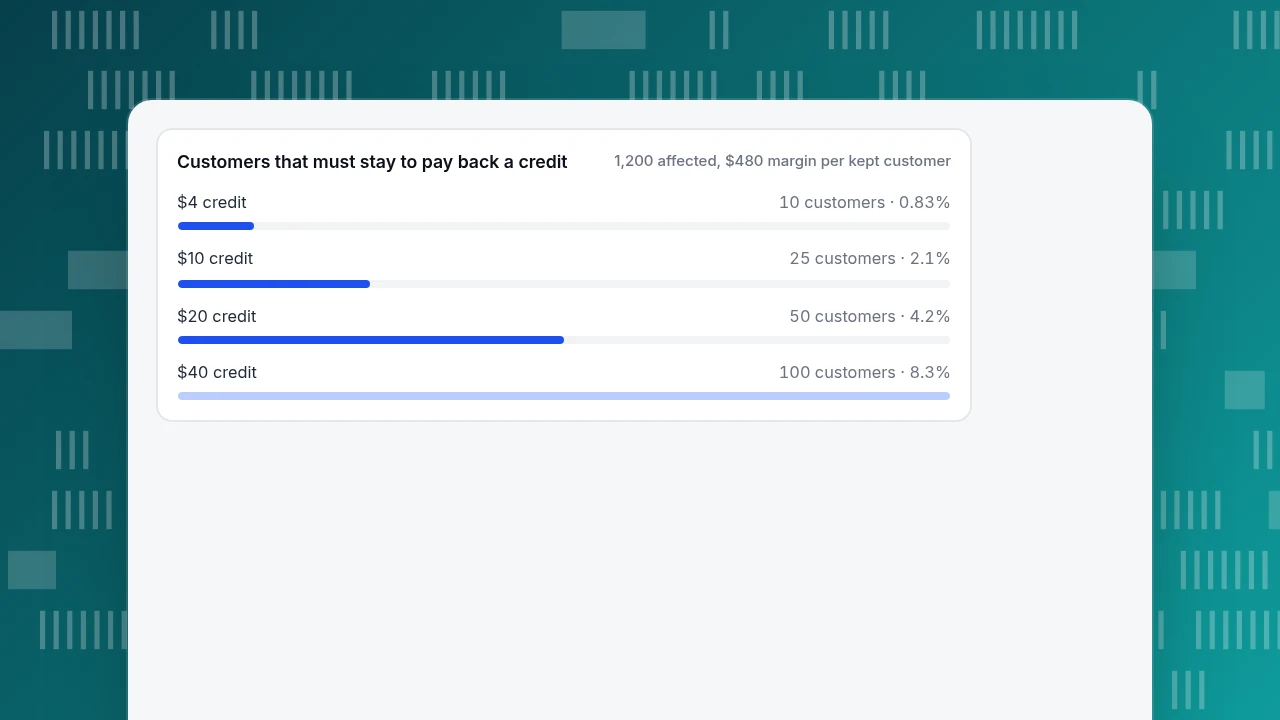
Decide the size of a credit from the number of customers it needs to keep, not from instinct. Sample data: an outage affects 1,200 customers and you credit each $4, a cost of 1,200 × $4 = $4,800. A retained customer is worth $50 a month at an 80% gross margin for 12 months, so $50 × 0.80 × 12 = $480 of margin.
- Break-even retention = 4,800 ÷ 480 = 10 customers, or 10 ÷ 1,200 = 0.83% of those affected.
- If the apology and credit stop 2% of the 1,200 from cancelling, that is 24 customers kept: 24 × $480 = $11,520 of margin against $4,800 of credit, a net gain of $6,720 and a return of 140%.
You cannot know the 2% in advance, but you can set the credit so that only a small effect is needed to pay for it: here under one customer in a hundred. If the credit were $40 instead, break-even would be 1,200 × $40 ÷ $480 = 100 customers, or 8.3% of those affected, which is more than an apology can plausibly keep. A credit also tells the customer you took the incident seriously, which an email alone does not.
Customers that must stay to pay back a credit
1,200 affected, $480 margin per kept customerHow do I send a mass apology without creating a second problem?
Three rules from the sources below apply to mass sends.
- Keep it a service message. Under the FTC's CAN-SPAM guidance, a message that facilitates or updates an agreed transaction or ongoing relationship is transactional and is exempt from most requirements, but it may not contain false or misleading routing information. If the subject line reads as commercial, or the transactional content is not mainly at the start, the message is treated as commercial. Penalties run up to $53,088 per email. Do not slide a discount code into the apology.
- Watch spam complaints. Google's sender guidelines say to keep the reported spam rate below 0.10% and never reach 0.30%; senders above 5,000 messages a day to Gmail accounts have additional requirements. An apology to a large list that people did not expect can generate reports, so send it from a recognisable address with a clear subject.
- Use a real reply-to. A noreply address makes an apology feel like a notice. Route replies to a monitored inbox and plan for volume: the apology will produce questions.
How do I support an apology in TapCub?
TapCub does not send email, so the apology itself goes out from your email tool. It helps before and after the send.
- Size the incident. In Monitoring › Errors, the error cards show the error count, error rate (errors ÷ pageviews), affected visitors and affected sessions, and each error group shows how often it occurred and when it last appeared. That gives you the "who was affected and for how long" facts for part 3 of the email. For a sustained outage, a monitor in All-platform analytics › Operations › Monitors on the
error_rateorerrorsmetric checks hourly and notifies you; it only sends the notification and does not take any action. - Prepare the reply text for chat. Customers will also write in. In Live chat › Canned replies, save a site-level apology reply; agents insert it by typing
/and can edit it before sending, so each reply still names the customer's own situation. See canned responses. - Tag the links in the email. Put UTM parameters on any link in the apology, for example
utm_campaign=outage-apology. Web analytics › Sources shows how many visitors came back through it, and which pages they landed on. - Watch the chat load. In Live chat › Reports, check conversation counts and the heatmap of chat starts by weekday and hour before and after the send. If starts spike in the hour after the email, schedule more agents next time you send.
TapCub does not write the email or decide the credit, and it cannot tell you whether the apology kept a customer. Whether those customers renewed is a billing question; see how to calculate churn rate.
FAQ
How do you write an apology email to a customer?
Use five parts in order: a subject that names the problem, an apology with ownership in the first sentence, specific facts, a remedy you have already started and a next step with a time. Keep it short and put the fact before the feeling.
How soon should you send an apology email?
As soon as you know the facts and the fix. Some timings are set by rules: a delayed order notice must reach the customer no later than the original ship date under the FTC rule, and a data breach notice to authorities is due within 72 hours where feasible under the GDPR.
Should an apology email include compensation?
If the customer lost something paid for, yes, and automatically. Size it by break-even: in the example, a $4 credit to 1,200 customers costs $4,800 and pays back if just 10 customers stay. Where the harm was a short delay, a clear fix and a refund are often enough.
What should you never say in an apology email?
Avoid "if" and "any inconvenience", which hedge the apology, and avoid vague causes. Do not add a promotion, which can change the message from service to commercial. Do not promise a date you cannot keep.
Sources
- Federal Trade Commission. Business guide to the Mail, Internet or Telephone Order Merchandise Rule — shipping deadlines, delay notice contents and refund timing. Checked 2026-11-20.
- GDPR. Article 33: notification of a personal data breach to the supervisory authority and Article 34: communication of a personal data breach to the data subject — the 72-hour rule, required content and the plain-language requirement. Checked 2026-11-20.
- Federal Trade Commission. CAN-SPAM Act: a compliance guide for business — transactional or relationship messages and penalties. Checked 2026-11-20.
- Google. Email sender guidelines — spam rate thresholds and the 5,000-message-a-day tier. Checked 2026-11-20.
Was this article helpful?
We use your answers to fix and expand this page.
Couldn’t send. Please try again in a minute.
Thanks for the feedback. We’ll use it to improve this page.You’ve already sent feedback on this page. Thanks.

Product Analyst
Focuses on event analysis, conversion funnels, and retention, using clear metric definitions and structured analysis to explain product performance.