Try it on your own data
Every report in this article is in the free plan. One snippet for web and apps, up to 10 sites.
Start free"I apologize for any inconvenience this may have caused" hedges (any), shrinks (inconvenience), doubts (may have caused) and promises nothing. Use it only for planned, minor events and after the facts. For a real problem, name it, own it, say what you did and when they will hear next. Eight rewrites below score 36 of 40 on a five-question checklist; the stock replies scored 9.
What you will learn
- Each word of the stock phrase hedges, shrinks or hides something: any, inconvenience, may have caused, and no fix or time
- Replace it with four parts: name the problem, own it, say what you did, give a time for the next update
- Scored on five yes-or-no questions, eight stock replies got 9 of 40 and their rewrites 36 of 40
What does "I apologize for any inconvenience this may have caused" actually say?
Read the sentence word by word and it says less than it seems to. Each part of it hedges, shrinks or hides something.
| Part of the phrase | What it signals to the customer | What to write instead |
|---|---|---|
| "I apologize" | A formal act, in the voice of a form letter | "Sorry" or "We got this wrong" |
| "for any" | Maybe nothing went wrong | Name what went wrong: "your order is two days late" |
| "inconvenience" | The harm is minor and only about convenience | Say the real cost: money, time, data |
| "this may have caused" | We are not sure we caused it | Own it: "that was our error" |
| (no fix, no time) | Nothing will change | Say what you did and when the customer will hear from you next |
The customer who receives it learns four things: you are not sure anything went wrong, you are not sure it was you, you consider it minor, and you will not tell them what happens next. That is why the phrase tends to make an upset person more upset. The rest of this guide shows how to write the replacement, with eight rewrites you can adapt and a simple score that shows how much they improve.
| Part of the phrase | What it signals | Write instead |
|---|---|---|
| "I apologize" | A formal act, form-letter voice | "Sorry" or "We got this wrong" |
| "for any" | Maybe nothing went wrong | Name the problem |
| "inconvenience" | The harm is minor | Say the real cost: money, time, data |
| "this may have caused" | We are not sure it was us | "That was our error" |
| (nothing after it) | Nothing will change | What you did and when they will hear next |
A planned maintenance notice is the one case where the phrase is acceptable, placed after the facts.
Why does it land badly in support replies?
Support readers are looking for evidence that someone understood their specific problem and will do something about it. The stock phrase gives them neither, and the research on writing for users points the other way.
Nielsen Norman Group's guidelines for error messages say to be specific: a generic message such as "An error occurred" gives users no context, and the message should describe the exact problem. They also say to offer a constructive next step, to avoid shifting blame onto the user, and to use apologies sparingly rather than on every ordinary error (NN/g). A support reply is the human version of an error message, and the same rules apply: the apology works when it is attached to a named problem and a way forward, and it is empty when it stands alone.
Tone also changes how a message is perceived, though by less than people assume. In a study of 50 American respondents rating near-identical pages that differed only in tone, differences in perceived friendliness and formality were statistically significant but small, about 0.5 to 1 point on a 5-point scale (NN/g). The practical reading: do not expect a warmer adjective to rescue a reply that contains no information. Change what the reply says first, then how it sounds.
When is the stock phrase acceptable?
It is not banned. Use it, or something close to it, only when all of these hold:
- The inconvenience is genuinely minor and impersonal. A planned maintenance window is the standard case: nobody did anything wrong; people are simply affected.
- Nothing has gone wrong for this person yet. The phrase is forward-looking ("may cause"), not a response to a harm that has already happened ("may have caused").
- The reply also carries the facts. Even for planned maintenance, give the date, the window and what will and will not be affected.
Do not use it when:
- Money, data or a deadline was affected. A double charge or a missing file is not an inconvenience, and calling it one reads as dismissive.
- Your team caused it. Say so. "That was our error" costs nothing and signals competence.
- The customer is writing in chat. The formal register feels cold in a live conversation; a short, direct sorry reads better.
- You are saying no. A refusal needs the reason and an alternative, not a ritual sentence before it.
A note on legal worry, which is the usual reason teams keep the vague wording. Rules differ by country and state, and this is not legal advice. In the UK, section 2 of the Compensation Act 2006 says that an apology, an offer of treatment or other redress "shall not of itself amount to an admission of negligence" or breach of statutory duty (legislation.gov.uk). Many other places have their own apology rules, and some are narrower. If your business handles claims, ask your counsel which wording is safe, then write the specific version inside that limit.
If you want alternative short phrases for different situations, see 36 ways to say sorry for the inconvenience. This guide is about the structure of the whole reply.
What structure replaces the stock phrase?
Use four parts, in this order, in one to four sentences:
- Name the problem in the customer's terms. "Your order {order_id} is two days late."
- Own it, if it is yours. "That was our error." Skip this part when the cause was outside your control, and say what you know instead.
- Say what you have done or will do. "I have refunded the shipping fee." Use the past tense for what is already done.
- Say when they will hear next. "I will message you here by 11:00 UTC either way." A time turns a promise into something checkable.
Add a short "sorry" at the start or the end if it fits; it does not need to carry the reply. Keep the whole reply under about 45 words in chat. Where compensation is warranted (a refund, a credit), say the amount in the reply, not "we will make it right".
Two cautions. Do not promise a time you cannot meet; "within 5 to 10 business days" for a refund is a statement about the payment network, and should be said only if it is true for your payment method. And do not blame a vendor or a colleague by name; the customer's relationship is with you.
What do eight before-and-after rewrites look like?
Placeholders are in {braces}. Each "before" ends with the stock phrase or builds on it; each "after" follows the four-part structure. Times and amounts are examples.
1. Late delivery (email)
- Before: "I apologize for any inconvenience this may have caused. Your order will arrive soon."
- After: "Your order {order_id} is two days late, and that is our fault: the carrier missed the pickup on {date}. It left the depot today and is due {new_date}. I have refunded the {shipping_fee} shipping fee."
2. Outage (chat)
- Before: "I apologize for any inconvenience this may have caused. We are experiencing technical difficulties."
- After: "Sorry, reports have failed to load since 09:10 UTC. Our engineers found the cause and are fixing it. I will message you here by 11:00 UTC either way."
3. Double charge (email)
- Before: "I apologize for any inconvenience this may have caused. Please allow time for the issue to be resolved."
- After: "We charged you twice for invoice {invoice_id}: $49 on {date_1} and again on {date_2}. That was our error. The duplicate $49 is refunded and should appear on your statement within 5 to 10 business days."
4. Wrong item (email)
- Before: "I apologize for any inconvenience this may have caused. A replacement will be sent."
- After: "We sent you the blue {product} instead of the black one you ordered. I have shipped the right one today with a prepaid return label for the blue one. Tracking: {tracking_link}. You will have it by {date}."
5. Long wait (chat)
- Before: "I apologize for any inconvenience this may have caused. How can I help you?"
- After: "Sorry for the wait, {wait} minutes is too long. I am here now and have read your message about the failed export. Can you tell me which file type you chose?"
6. Bug in the product (email)
- Before: "I apologize for any inconvenience this may have caused. Our team is looking into it."
- After: "The export button failed for accounts created before March. That was a bug in our release of {date}. We shipped the fix at 14:20 UTC; please try again, and reply if it still fails."
7. A request you cannot grant (chat)
- Before: "I apologize for any inconvenience this may have caused. Unfortunately we cannot offer a refund."
- After: "I cannot refund this charge because the 30-day window ended on {date}. What I can do today is switch you to the monthly plan from the next cycle. Do you want me to do that?"
8. Planned maintenance (notice), where the stock phrase is fine
- Before: "We apologize for any inconvenience this may cause."
- After: "We will take the dashboard offline for maintenance on Sunday 22 November from 02:00 to 03:00 UTC. Data keeps collecting during this time. We apologize for any inconvenience this may cause."
Notice that rewrite 8 keeps the phrase, and puts it after the facts. The fix is not "never say it"; it is "never let it be the whole reply".
How much better are the rewrites? A simple score
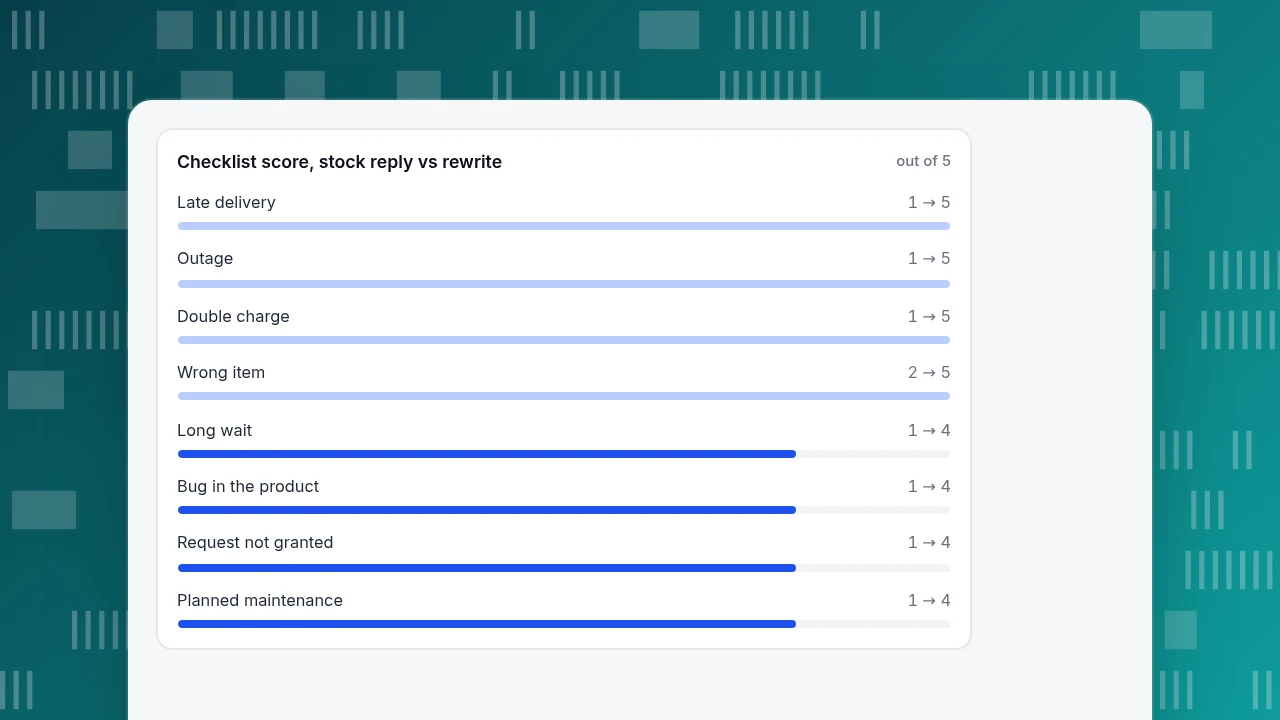
You can check a reply against five yes-or-no questions: does it name the specific problem, own it, state what has been done or will be done, give a time for the next update or outcome, and stay under 45 words? Score one point for each yes. Scoring the sixteen replies above (sample data, word counts and totals recomputed in Python):
| Situation | Words before | Words after | Score before (of 5) | Score after (of 5) |
|---|---|---|---|---|
| Late delivery | 14 | 35 | 1 | 5 |
| Outage | 14 | 28 | 1 | 5 |
| Double charge | 18 | 35 | 1 | 5 |
| Wrong item | 14 | 37 | 2 | 5 |
| Long wait | 14 | 31 | 1 | 4 |
| Bug in the product | 15 | 34 | 1 | 4 |
| Request not granted | 15 | 35 | 1 | 4 |
| Planned maintenance | 8 | 31 | 1 | 4 |
| Total (of 40) | 9 | 36 |
The stock replies scored 9 of 40 points, an average of 1.1 of 5, and most of that was for being short. The rewrites scored 36 of 40, an average of 4.5. They are also longer, by 14 to 23 words each, and that is the point: the extra words are the information the customer was missing. The score is a writing checklist, not a measure of customer satisfaction, so confirm the effect on your own conversations.
Checklist score, stock reply vs rewrite
out of 5How do you measure whether better apologies help?
Measure outcomes you already have, over several weeks, before and after you change the wording, and read the change as you would any before-and-after comparison.
- Re-contact rate. Of the customers you apologised to, how many wrote back about the same issue within 7 days? A reply that names the fix and the time should reduce chasers.
- Satisfaction score. Compare the average rating on conversations that involved a problem, before and after.
- Time to resolve. A better first reply sometimes shortens the thread because the agent does not need to ask what happened.
- A sample read. Read 20 apologies a month against the five-question score. A checklist you actually use beats a policy nobody reads.
Do not expect a large or fast change in the satisfaction score from wording alone. If the underlying problem keeps happening, the reply cannot offset it.
How do you turn this into a team habit in TapCub?
For repeated situations, the four-part structure belongs in a saved reply with placeholders. Using the examples above:
- Write one saved reply per situation. In Live chat › Canned replies, create replies such as
/late-delivery,/double-chargeand/long-wait, with placeholders for the details an agent fills in. A shortcut can be up to 40 characters, the title 80, and the content 4,000. - Choose personal or site level. Site-level replies are available to every agent who handles chats; turn on Personal (only visible to me) for your own. Owners, admins and analysts can edit site-level replies.
- Insert and edit. In the inbox, type
/and keep typing the shortcut or title; the reply fills the composer and you edit the placeholders before sending. Step-by-step: use canned replies. - Retire the stock phrase. A use count shows which replies are actually sent. If an old reply built on the stock phrase still has the highest count, rewrite it first.
- Read the outcomes. Live chat › Reports shows resolution rate, first response (human replies only), satisfaction on a 1 to 5 scale and agent workload, so you can compare the weeks before and after the new replies.
TapCub's canned replies are for live chat. TapCub does not send email, so the apology emails in this guide go out from your own email tool, and the same text can live in whichever template system that tool provides. For more on what to say in common support exchanges, see customer service questions and canned responses.
FAQ
Is "I apologize for any inconvenience this may have caused" a good apology?
Not on its own. It does not name the problem, does not say who caused it, and gives no fix or time. It can work in a planned-maintenance notice if it follows the facts.
What can I say instead of "I apologize for any inconvenience"?
Name the problem, own it if it is yours, say what you have done, and give a time. For example: "We charged you twice for invoice {invoice_id}. That was our error. The duplicate is refunded."
Is it formal to say "I apologize for any inconvenience this may have caused"?
Yes, it is a formal, form-letter register. That is the reason it feels cold in live chat. In a formal letter or notice it is acceptable when the specific facts come first.
Does apologising admit liability?
Rules vary. In the UK, section 2 of the Compensation Act 2006 says an apology does not of itself amount to an admission of negligence or breach of statutory duty. Other places differ, so ask legal counsel about your situation.
How long should a customer apology be?
In chat, about 45 words or fewer. In the examples above, the replies run 28 to 37 words, short enough to read at a glance and long enough to hold the problem, the fix and a time.
Sources
- Nielsen Norman Group. Error-Message Guidelines. Read 2026-11-20.
- Moran, K. The Four Dimensions of Tone of Voice. Nielsen Norman Group. Read 2026-11-20.
- UK Parliament. Compensation Act 2006, section 2: Apologies, treatment or other redress. Read 2026-11-20.
Was this article helpful?
We use your answers to fix and expand this page.
Couldn’t send. Please try again in a minute.
Thanks for the feedback. We’ll use it to improve this page.You’ve already sent feedback on this page. Thanks.

Product Experience Specialist
Writes about product experience, practical workflows, and growth, turning complex processes into clear steps for everyday decisions.