Try it on your own data
Every report in this article is in the free plan. One snippet for web and apps, up to 10 sites.
Start freeARR means annual recurring revenue: the yearly value of the subscription revenue you expect to repeat, taken from contracts that are active today. Multiply monthly recurring revenue by 12, or divide each contract's total value by its years. The skill is in the edge cases: use the discounted price, leave out one-time and usage fees, and treat multi-year value per year. In our seven-customer example, five wrong choices together almost double the number.
What you will learn
- Calculate ARR from the net price customers pay now: MRR × 12, or contract value ÷ years
- Setup fees, overage and multi-year totals are the usual inflators; together they nearly doubled the sample ARR (1.96×)
- Write a six-line ARR policy and apply it every month, because definitions vary even between public companies
What does ARR mean?
ARR stands for annual recurring revenue: the yearly value of subscription revenue that is expected to repeat, taken from the contracts that are active today. Shopify's definition is "revenue derived from subscription agreements or other contractual payment agreements of one year or more", and the same article notes that a six-month subscription for $600 is recorded as $100 of monthly recurring revenue and none of it counts toward ARR (Shopify).
Three properties follow from that definition:
- Recurring. It renews by default. One-time setup fees, consulting and hardware are left out; the finance guides we checked agree on that.
- Annualized. Whatever the billing rhythm, the number is expressed per year, so a $250-a-month customer is $3,000 of ARR (Hibob).
- A snapshot, not a flow. ARR is the run-rate you hold on a given day. Revenue recognised in the year is a different number, and it lags ARR when you grow.
There are two conventions in use. The strict one counts only contracts of a year or longer. The common SaaS one also annualizes monthly plans (MRR × 12). Neither is wrong, but you must pick one and apply it every month, because the example below shows how far the totals can drift.
Three ways to calculate ARR
| Method | Formula | Use it when | Check against a published example |
|---|---|---|---|
| From MRR | ARR = MRR × 12 | Monthly or mixed billing | 50 customers × $100 a month = $5,000 MRR, so $60,000 ARR (CFI) |
| From contracts | ARR = total contract value ÷ years, summed over customers | Annual and multi-year contracts | A three-year deal worth $90,000 is $30,000 ARR (Hibob) |
| Roll-forward | Ending ARR = starting ARR + new + expansion − contraction − churn | Monthly or quarterly reporting | $400,000 + $100,000 + $50,000 − $20,000 − $30,000 = $500,000, growth of 25% (CFI) |
The first two build ARR from the bottom up, one customer at a time. The third explains how ARR changed since the last period. A trustworthy ARR report has both, and they should reconcile.
Worked example: seven customers, one ARR number
Sample data: seven customers and the rule applied to each. The convention here is annualized, net of discounts, excluding one-time and usage fees.
| Customer | What they pay | Rule applied | ARR |
|---|---|---|---|
| A | $99 a month | $99 × 12 | $1,188.00 |
| B | $99 a month list, 20% off for as long as they stay | Use the price actually paid: $99 × 0.80 × 12 | $950.40 |
| C | $1,000 a year prepaid; list price $100 a month with two months free | The annual price, not $1,200 | $1,000.00 |
| D | Three-year contract, $27,000, plus a $1,500 setup fee | $27,000 ÷ 3; the setup fee is one-time | $9,000.00 |
| E | $12,000 a year plus $2,300 of overage this year | Overage is variable, so left out | $12,000.00 |
| F | Six-month subscription, $600 | Shorter than a year, so tracked as MRR ($100) only | $0.00 |
| G | Free trial | Nothing contracted | $0.00 |
| Total | $24,138.40 |
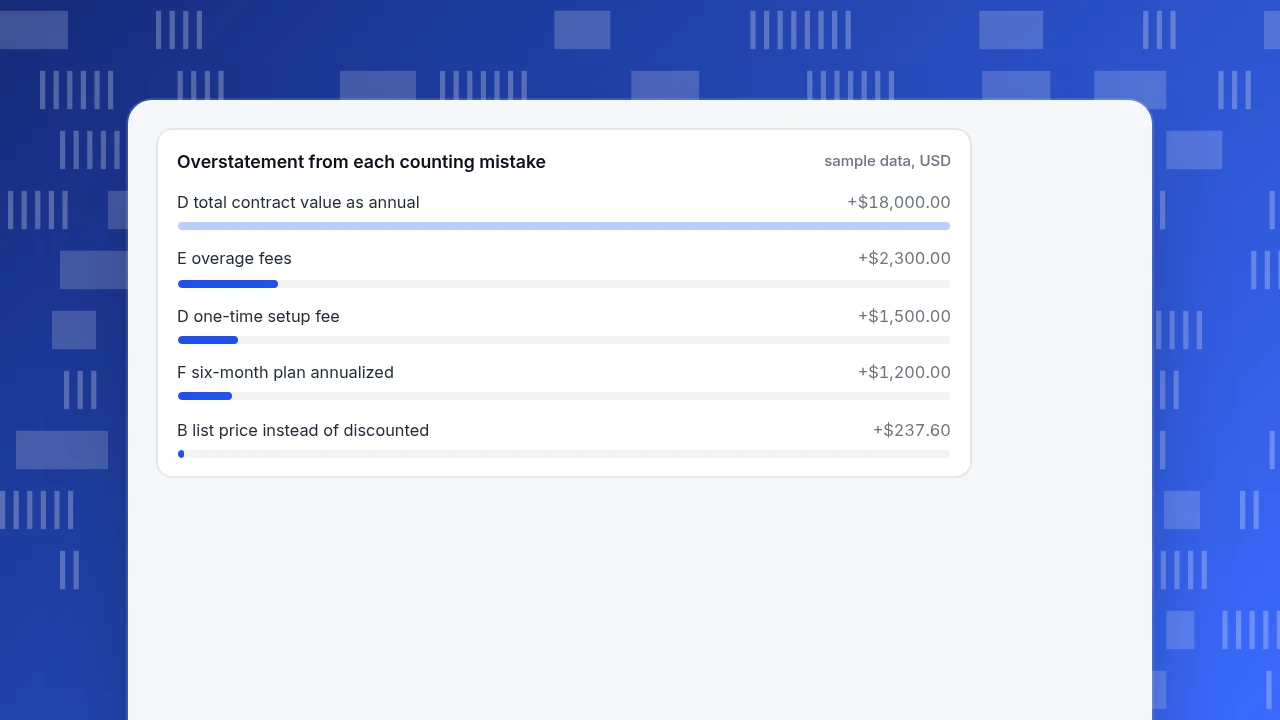
Now count what happens when each judgement call goes the other way:
| Mistake | Added to ARR | Share of the correct total |
|---|---|---|
| Counting list price for B instead of the discounted price | $237.60 | 1.0% |
| Counting D's one-time setup fee | $1,500.00 | 6.2% |
| Counting E's overage | $2,300.00 | 9.5% |
| Annualizing F's six-month plan (× 2) | $1,200.00 | 5.0% |
| Counting D's total contract value instead of one year | $18,000.00 | 74.6% |
All five mistakes together give $47,376.00, which is 1.96 times the right answer. The largest error, multi-year value counted as annual, is also the most common in spreadsheets that sum a "contract value" column.
Discounts need one more rule. If a $99 plan runs at 50% off for the first three months, the customer pays $49.50 a month during the promotion, which annualizes to $594. Decide in advance whether ARR uses the current price (so it steps up to $1,188 when the promotion ends) or the contracted future price, and write the choice down.
Overstatement from each counting mistake
sample data, USDMonthly plans versus annual plans
A monthly customer and an annual customer can show the same ARR on day one and behave very differently afterwards. The table follows 100 customers on each plan for one year, using the sample prices above and two assumptions: 3% of monthly customers cancel each month, and 85% of annual customers renew.
| 100 monthly customers at $99 | 100 annual customers at $1,000 | |
|---|---|---|
| ARR today | $118,800 | $100,000 |
| Chance a customer can leave in the next month | 3% | 0% until renewal |
| Share still customers after 12 months | 0.97^12 = 69.4% | 85% |
| ARR after 12 months, no new sales | $82,428 | $85,000 |
The trap is the arithmetic: 3% a month is 30.6% lost over a year, not 3% × 12 = 36%, because each month's churn applies to a smaller base. Monthly ARR starts higher but is less certain, which is why teams with mostly monthly plans watch MRR and churn closely and report ARR as the annualized total.
How churn, upgrades and downgrades change ARR
Sample data for one quarter, using the roll-forward:
| Movement | Amount | How it is counted |
|---|---|---|
| Starting ARR | $600,000 | Last period's ending number |
| New | + $90,000 | 18 new customers × $5,000 |
| Expansion | + $42,000 | Existing customers who added seats or add-ons |
| Contraction | − $12,000 | Existing customers who downgraded |
| Churn | − $48,000 | Customers who cancelled |
| Ending ARR | $672,000 | Net new ARR $72,000, growth 12.0% |
The same table gives two retention figures that investors ask for. Gross revenue retention is (600,000 − 12,000 − 48,000) ÷ 600,000 = 90.0%, and net revenue retention is (600,000 + 42,000 − 12,000 − 48,000) ÷ 600,000 = 97.0%. The difference between them is the expansion that hides churn; the full comparison is in NRR vs GRR, and the churn arithmetic in how to calculate churn rate.
Timing needs a rule too. Remove churned ARR on the date the contract actually ends, or on the date the customer cancels? Either is defensible; mixing them moves ARR between months and makes growth look noisy.
ARR, MRR, run rate, revenue and bookings
| Term | What it measures | Differs from ARR because |
|---|---|---|
| MRR | Recurring revenue per month | ARR is MRR × 12 under the annualized convention; MRR is the better monthly signal |
| Annual run rate | Any recent revenue × 12 | May include one-time and variable revenue that is not contracted |
| Recognised revenue | Revenue earned in a period under accounting rules | Backward-looking and affected by timing of service delivery |
| Bookings | Value of contracts signed | Counts the full contract value, not the yearly slice |
ARR has no single legal definition. Ordway's review of 12 public companies shows the variation: one excludes professional services from its monthly recurring revenue, another averages variable overages over the trailing three months, and two reset exchange rates at the start of the fiscal year (Ordway). When you compare your ARR with someone else's, compare the definitions first.
Write the definition down
A policy that fits in six lines prevents most disputes. Copy this and fill in your own choices:
- Included: active subscription contracts, annualized at the current net price.
- Excluded: setup, consulting, hardware and one-time fees.
- Usage and overages: excluded (or averaged over a stated window, if you include them).
- Multi-year contracts: total contract value ÷ years.
- Timing: new ARR on the start date; churn on the end date.
- Currency: one exchange rate per fiscal year, set on the first day.
Review it whenever you launch a new plan type, because that is when exceptions appear.
| Item | Counts toward ARR? | Sample rule |
|---|---|---|
| Subscription at net price | Yes | $99 × 0.80 × 12 = $950.40 |
| One-time setup fee | No | $1,500 left out |
| Usage or overage fees | Policy choice, usually no | $2,300 left out |
| Contract shorter than a year | No under the strict convention | Six months, $600: MRR only |
| Multi-year contract | Yes, per year | $27,000 ÷ 3 = $9,000 |
| Free trial | No | $0 |
Sample data. The policy choice is yours, but it has to be the same every month.
How to see what feeds ARR in TapCub
Take the seven-customer table above. TapCub does not read your billing system, so it does not calculate ARR; it measures what happens before the first invoice, which tells you where the next customers will come from.
- Count paid sign-ups as a goal. In Web analytics › Goals, create a goal on the event that fires when someone starts a paid plan. Sending the amount with the event, as in
tapcub.track('purchase', { revenue: 99, currency: 'USD' }), keeps revenue attached to each conversion. - See which channels produce them. Web analytics › Sources has a conversions column per channel, split by referrer and UTM.
- Add what you spent. In All-platform analytics › Business › Channel ROI, import spend by day, channel, source or campaign. The page shows cost per click, cost per acquisition (spend ÷ purchases in orders) and return on ad spend, grouped by channel, source or campaign.
- Compare with first-year ARR. Divide the cost per acquisition by the first-year ARR per customer from your billing system. That is your payback period.
- For B2B accounts, call
tapcub.group('company', 'acme', { ... })after login. All-platform analytics › Users › Accounts shows active accounts and a 0–100 health score; a falling score is a prompt to talk to the customer before renewal, not proof they will leave.
TapCub does not do billing, invoicing or dunning. Use your billing tool for the ARR itself, and TapCub for acquisition and engagement. More on the growth side is in SaaS metrics and how to calculate CAC.
FAQ
What does ARR mean in business?
ARR means annual recurring revenue: the yearly value of subscription revenue from active contracts that is expected to repeat. It excludes one-time fees and is a point-in-time figure. Most SaaS companies quote it to show scale and growth, but the exact inclusion rules differ by company, so check the definition.
How do you calculate ARR from monthly revenue?
Multiply monthly recurring revenue by 12. If 50 customers each pay $100 a month, MRR is $5,000 and ARR is $60,000. Use the net price customers actually pay, and leave out one-time charges and variable usage fees unless your written policy says otherwise.
Is ARR the same as revenue?
No. Revenue is what you earned and recognised in a period, while ARR is the yearly value of recurring contracts you hold today. A fast-growing company usually has ARR above trailing twelve months of revenue, because new customers have only paid for part of the year.
Should discounts be subtracted from ARR?
Yes under the usual convention: use the price the customer pays now. A $99 plan at 20% off is $950.40 of ARR, not $1,188. If a promotion expires on a known date, decide whether ARR steps up on that date and apply the rule consistently.
Does ARR include one-time fees and usage?
One-time fees such as setup or consulting are excluded by every guide we checked. Usage and overage fees vary: some companies leave them out, others average them over a trailing window. Choose one treatment, write it down, and do not change it without restating past periods.
Sources
- Shopify, What is ARR? (definition; $600 six-month example). Checked 2026-11-20.
- Corporate Finance Institute, Annual Recurring Revenue (ARR) (MRR × 12 and roll-forward examples). Checked 2026-11-20.
- Hibob, Annual recurring revenue (ARR) (contract-value method; monthly and annual examples). Checked 2026-11-20.
- Ordway, How SaaS companies define ARR (12 public-company definitions, published 2023-06-24). Checked 2026-11-20.
Was this article helpful?
We use your answers to fix and expand this page.
Couldn’t send. Please try again in a minute.
Thanks for the feedback. We’ll use it to improve this page.You’ve already sent feedback on this page. Thanks.

Data Analyst
Explores traffic sources, conversion funnels, and retention, using clear metric definitions and concrete examples to explain what the numbers mean.