Try it on your own data
Every report in this article is in the free plan. One snippet for web and apps, up to 10 sites.
Start freeThe CAC formula is total acquisition cost ÷ new customers acquired in the same period: $100,000 and 200 new customers gives $500. The answer is only as good as its definitions: count every cost of winning customers, and only genuinely new customers. One quarter can honestly report $150, $250 or $500.
What you will learn
- CAC = all acquisition cost ÷ new customers in the same period; state which version you used
- The same quarter gives $150 (media only), $250 (paid) or $500 (fully loaded), so LTV:CAC runs from 10.0 to 3.0
- Count first-time customers only, match cost to the sales cycle, and compare fully loaded CAC with gross-margin LTV
What is the CAC formula?
Customer acquisition cost (CAC) is what it costs, on average, to win one new customer:
CAC = total acquisition cost ÷ number of new customers acquired
Both numbers come from the same period. If you spent $100,000 in a quarter on everything it took to win customers and 200 new customers arrived, CAC is 100,000 ÷ 200 = $500. The formula is simple; the arguments are about what goes in the top and who counts in the bottom.
This guide's point is that CAC is only as useful as its two definitions are complete and consistent: count every cost that goes into winning customers, and count only genuinely new customers, the same way every period. The same business can honestly report $150, $250 or $500, depending on what goes in the numerator, and the choice changes whether the unit economics look healthy. This page covers how to calculate it; the term itself has a glossary entry on CAC, the ratio with lifetime value is in LTV to CAC ratio, and how long it takes to earn the money back is in CAC payback period.
Three versions of CAC
| Version | Numerator | Denominator | Use it for |
|---|---|---|---|
| Paid CAC | Ad spend on that channel | New customers from that channel | Comparing paid channels |
| Blended CAC (media only) | All ad spend | All new customers | A quick trend line |
| Fully loaded CAC | Ad spend + agency + creative + marketing and sales salaries + tools + overhead you allocate | All new customers | Financial planning, payback, investor-style reporting |
Each answers a different question. Paid CAC tells you which channel is cheaper to win customers from. Blended CAC shows whether things are drifting. Fully loaded CAC tells you whether the whole business of winning customers pays for itself, and it is the one to use when you compare CAC with LTV. David Skok, a venture investor, puts the principle bluntly: CAC must account for all costs, because leaving items out, such as headcount, flatters the numbers.
Never mix versions. A fully loaded numerator over a paid-only denominator, or the reverse, produces a number that means nothing.
What counts as acquisition cost
| Cost | Include? | Note |
|---|---|---|
| Ad spend (search, social, display) | Yes | Net of platform credits |
| Agency or freelancer fees for acquisition | Yes | Retainers and performance fees |
| Creative and content production | Yes | Video, landing pages, content built for acquisition |
| Marketing team salaries and benefits | Yes | Prorate if the team also does retention |
| Sales salaries and commissions | Yes | The part spent on closing new customers |
| Marketing and sales software | Yes | Prorate shared tools |
| Events and sponsorships | Yes | Booth, travel, sponsorship fees |
| Customer success and support | No | That is retention, not acquisition |
| Product development | No | Unless a feature exists only to convert |
| Discounts given to win a customer | Decide | Include first-order discounts consistently or subtract them from revenue instead |
The two rules that matter: allocate shared costs by a stated share (for example, 70% of a marketing designer's time on acquisition), and keep the same list every period. Changing the list changes CAC without changing anything about your customers.
A worked example: 150, 250 or 500 from one quarter
Sample data: a quarter's costs and customers.
| Cost line | Amount |
|---|---|
| Ad spend | $30,000 |
| Agency fees | $5,000 |
| Creative and content | $6,000 |
| Marketing salaries | $24,000 |
| Sales salaries | $30,000 |
| Software | $5,000 |
| Fully loaded total | $100,000 |
New customers in the quarter: 200, of which 120 came from paid channels and 80 from other channels such as organic and referrals.
| Version | Calculation | CAC |
|---|---|---|
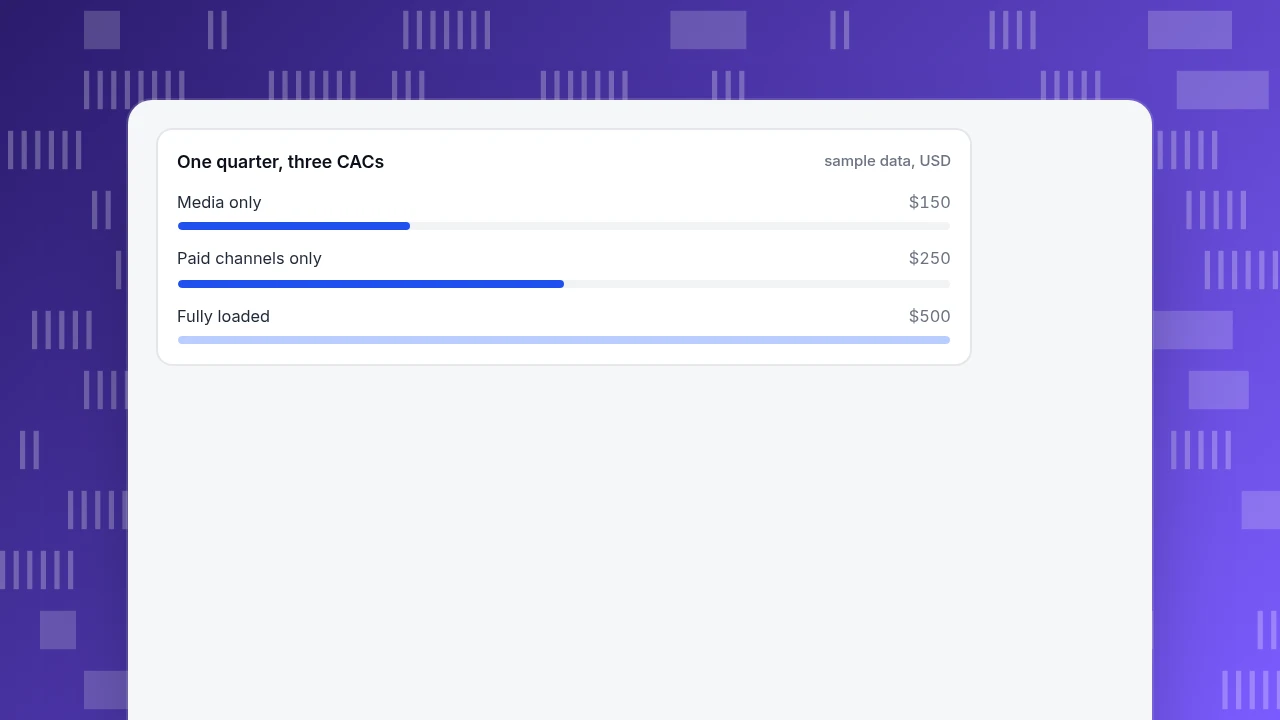
| Blended, media only | 30,000 ÷ 200 | $150 |
| Paid CAC | 30,000 ÷ 120 | $250 |
| Fully loaded | 100,000 ÷ 200 | $500 |
Same quarter, same customers, a more than 3x range. If average customer lifetime value (gross-margin basis) is $1,500, the LTV to CAC ratio is 1,500 ÷ 150 = 10.0 on the media-only figure, 1,500 ÷ 250 = 6.0 on paid CAC and 1,500 ÷ 500 = 3.0 fully loaded. The first looks like room to spend far more; the third sits right at the commonly cited guideline of 3. Skok's rule of thumb is that good businesses have an LTV to CAC ratio above 3, with a caveat that these are guidelines only.
Note the paid CAC uses only ad spend over paid-channel customers; if you also want salaries in a channel view, allocate them to channels by a stated rule rather than dropping them in with the paid figure.
One quarter, three CACs
sample data, USDWho counts as a new customer
The denominator is the other half of the argument. Define "new customer" once, in writing:
- First paid purchase or contract, not signups, trials or leads. A free trial is a lead until it pays.
- Not returning customers. A repeat purchase is not acquisition. Count a customer once, in the period of their first purchase.
- Refunded or cancelled in the first days? Decide whether to net them out and apply the rule every time.
- Same period as the costs, with a lag when cycles are long. If deals take two months to close, most customers who close in April were won by spend in February and March, so April's customers should be matched to earlier spend, not to April's. Shift the spend window back by the length of the cycle, or use a period long enough that the lag washes out.
Definitions of CAC differ across companies, and the denominator is where. In an SEC letter, Warby Parker explained that it defines CAC as total marketing expenses divided by Active Customers, new and returning together, because customers return every couple of years, and noted that new-customer CAC can be calculated from the disclosed inputs: $41, $44 and $70 for 2018 to 2020. The lesson is not which is right; it is that the two give different numbers, so state the definition beside the figure.
CAC with LTV and payback
CAC alone does not say whether acquiring customers is a good deal. Pair it with two checks.
LTV to CAC ratio. Compare gross-margin lifetime value with CAC. In the example: 1,500 ÷ 500 = 3.0 fully loaded. See LTV to CAC ratio for how to compute LTV.
Payback. How many months of gross profit repay CAC? If a customer gives $60 a month in gross profit, fully loaded payback is 500 ÷ 60 = 8.3 months; paid-only is 250 ÷ 60 = 4.2 months. Skok writes that many of the best SaaS businesses recover CAC in 5 to 7 months and that payback longer than 12 months is a weakness; read those as guidelines. More in CAC payback period.
A short payback with a ratio near 3 is a healthy, scalable pattern; a long payback with a high ratio means a good business that needs cash to grow.
| Version | CAC | LTV:CAC (LTV $1,500) | Payback ($60 a month) |
|---|---|---|---|
| Media only, all new customers | $150 | 10.0 | 2.5 months |
| Paid channels only | $250 | 6.0 | 4.2 months |
| Fully loaded | $500 | 3.0 | 8.3 months |
Use fully loaded CAC against gross-margin LTV for planning; the others are channel views.
CAC, CPA and cost per lead
These sound alike and are not:
- CPA (cost per acquisition or action): spend ÷ conversions, where a conversion can be a purchase, a lead or an app install. It is a channel efficiency measure.
- Cost per lead: spend ÷ leads. It is upstream of customers.
- CAC: all acquisition cost ÷ new paying customers. It is the business-level number.
A channel can have an excellent CPA on leads and a poor CAC if few leads close. When a tool reports "cost per acquisition", read its definition of "acquisition" before you call it CAC. Marketing return as a whole is in marketing ROI, and you can try numbers in the CAC calculator.
Common mistakes
- Counting only ad spend. It leaves out the people and tools that win customers, and it flatters the number.
- Counting all customers, not new ones. Repeat buyers shrink CAC without any acquisition.
- Mixing versions of numerator and denominator.
- Ignoring the sales cycle. With a 60-day cycle, this month's spend mostly wins customers two months from now.
- Comparing against LTV measured on revenue. Use gross-margin LTV against fully loaded CAC.
- Quoting one blended number for every channel. Organic and referral customers pull blended CAC down and hide an expensive paid channel.
- Changing the cost list between periods without restating the past.
How TapCub helps you measure CAC
TapCub does not hold your salaries, commissions or CRM records, so it cannot produce a fully loaded CAC. It can give you the channel half, which is where paid CAC comes from:
- Open All-platform analytics › Business › Channel ROI, go to the Costs tab and import ad spend by day, channel, source and campaign (CSV columns
day,channel,source,campaign,cost,currency,clicks,impressions;dayandcostrequired), or add rows one at a time. Costs need an owner or admin. - On the ROI tab, group by channel, source or campaign. TapCub shows cost per click (spend ÷ sessions) and cost per acquisition (spend ÷ purchases on the order ledger), plus return on ad spend.
- Read the cost per acquisition for what it is: it divides by purchases, so repeat orders lower it, and it is not a new-customer count. For paid CAC, replace the denominator with the number of new customers from that channel from your own records, then add the salary, agency and tool lines for the fully loaded version, as in the table above.
- Use Web analytics › Goals and the sources reports to see which channels' visitors convert, so the allocation of customers to channels matches what happened on your site.
TapCub measures cost and conversion by channel; it does not run ads, score leads or hold your cost ledger beyond the spend you import.
FAQ
What is the CAC formula?
CAC = total acquisition cost ÷ new customers acquired in the same period. With $100,000 of cost and 200 new customers, CAC is $500. State whether the cost is media only, paid-channel or fully loaded.
How do you calculate CAC for a quarter?
Add every acquisition cost for the quarter (ads, agency, creative, marketing and sales salaries, tools), divide by the number of new customers who made a first purchase in that quarter. Adjust for lag if your sales cycle is long.
What is included in customer acquisition cost?
Ad spend, agency and creative costs, marketing and sales salaries, marketing and sales software and events. Support and product development are normally excluded. Allocate shared costs by a stated share and keep the list stable.
What is a good CAC?
It depends on what a customer is worth. Compare fully loaded CAC with gross-margin LTV and payback. A common guideline is LTV above 3 times CAC and payback within about 12 months, but treat these as rules of thumb.
What is the difference between CAC and CPA?
CPA is spend per conversion of any kind, such as a lead or purchase. CAC is all acquisition cost per new paying customer. A channel can have a low CPA and a high CAC if few conversions become customers.
See also: How to Lower Customer Acquisition Cost: Three Levers With the Math.
Sources
Was this article helpful?
We use your answers to fix and expand this page.
Couldn’t send. Please try again in a minute.
Thanks for the feedback. We’ll use it to improve this page.You’ve already sent feedback on this page. Thanks.

Product Adoption Consultant
Explores customer onboarding, live conversations, and self-service, turning common usage questions into practical guidance and improvements.