Try it on your own data
Every report in this article is in the free plan. One snippet for web and apps, up to 10 sites.
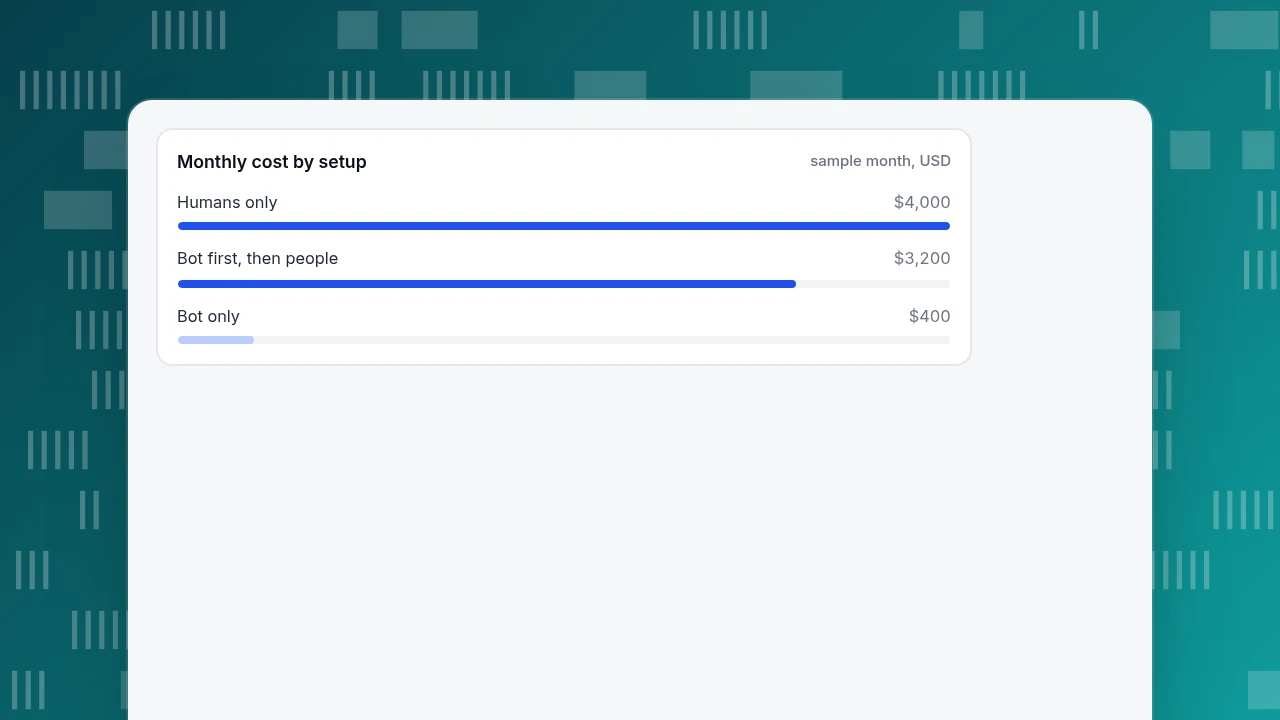
Start freeChatbot vs live chat comes down to who writes the reply: a bot answers from stored material, a person answers in real time. They are a relay, not a choice. Let the bot take repeated, fixed-answer questions at any hour, and send complaints, exceptions and buying intent to people. In a sample month of 1,000 conversations that relay cost $3,200 against $4,000 for humans only.
What you will learn
- Route by question type: one stable answer goes to the bot; judgement, money and emotion go to a person
- Give the bot five handoff triggers, starting with 'visitor asks for a person'
- Count only conversations the bot fully resolved; bot-only looks cheapest but left 65% unanswered in the sample
What is the difference between a chatbot and live chat?
The difference is who writes the reply. In live chat a person answers in real time. A chatbot answers from rules, stored answers or a language model, with no person involved unless it hands the conversation over. Everything else (cost, speed, tone, risk) follows from that one fact.
| Chatbot | Live chat (human agent) | |
|---|---|---|
| Who answers | Rules, stored answers or an AI model | A person |
| Availability | Every hour, including nights and holidays | Office hours, plus whoever is on shift |
| First response | Seconds | Seconds to minutes, depending on queue |
| Cost shape | Mostly fixed monthly fee plus set-up and upkeep | Grows with every conversation (agent time) |
| Strong at | Repeated, factual questions with one right answer | Judgement, exceptions, upset customers, selling |
| Weak at | Anything not in its material; recognising a dispute; knowing when it is wrong | Volume spikes; after-hours coverage; answering the same question 200 times |
| Typical failure | Confident wrong answer, or a loop with no way out | Slow queue, inconsistent answers between agents |
Which kind of bot you are comparing (rule-based, AI-driven or a mix) is explained in types of chatbots; the human side is covered in live chat customer service. This article is about the choice between them, and the short answer is that it is rarely a choice.
Why "chatbot or live chat" is usually the wrong question
The two do different jobs, so a better framing is a relay: the bot takes the high-frequency, fixed-answer questions, and people take the complex and high-value ones. The bot is the first runner, and it must be able to pass the baton at any moment.
Two outside sources show why the baton matters.
- The US Consumer Financial Protection Bureau reviewed chatbots in consumer finance in 2023 and described a "doom loop": a customer stuck in repetitive replies without an off-ramp to a human. It also noted that rigid bots may only register a dispute when specific words are used, and that chatbots become less effective as issues grow more complex.
- On the human side, a field study of 5,179 customer-support agents found that giving them an AI assistant raised issues resolved per hour by 14% on average and by 34% for novices. People plus AI worked better than either alone.
That does not make human-only the safe default. A team that answers "what are your opening hours?" for the hundredth time this week is spending its judgement on the wrong work. The rest of this article shows how to split the work and what the split is worth.
Which questions should go to the bot, and which to a person?
Sort every question you receive by two things: is there one stable correct answer, and what happens if the answer is wrong or the customer is upset? Then apply the table.
| Question type | Example line | Who should answer | Why |
|---|---|---|---|
| Fixed fact | "Do you ship to Canada?" | Bot | One answer, easy to keep current, no judgement needed |
| Status or location | "Where is my order?" | Bot if it can read the status; otherwise a person | A bot that cannot see the order can only point to a tracking page |
| How-to | "How do I reset my password?" | Bot | Steps rarely change; a link with the steps is enough |
| Product fit | "Will this fit a 2019 model?" | Bot first, person if the material has no match | Needs catalogue detail; wrong answers cost returns |
| Exception | "My order arrived damaged and I need it Friday" | Person | Needs a decision on refund or replacement |
| Complaint or dispute | "You charged me twice" | Person, immediately | Emotion and money; a loop here is the worst outcome |
| Buying intent | "Can you do a discount for 20 seats?" | Person | High value, needs negotiation |
Turn the table into rules a bot can follow. Five handoff triggers cover most cases:
- Visitor asks for a person. Always honour it on the first request, not the third.
- Two replies in a row did not help. If the visitor repeats the question or says it did not solve it, stop answering.
- No match in the material. If nothing in the stored answers fits, hand off instead of guessing.
- Topic on an always-human list. Refunds, cancellations, complaints, legal and security reports, anything involving an account being locked.
- High-value page plus buying words. A conversation that starts on a pricing or checkout page and mentions quantity, discount or contract should reach a person within the first message.
If a question fits none of these, let the bot answer. If it fits any of them, assume a person should.
| Question type | Who answers | Why |
|---|---|---|
| Fixed fact, how-to | Bot | One stable answer, easy to keep current |
| Product fit | Bot first, person if no match | Needs catalogue detail; wrong answers cost returns |
| Exception or complaint | Person, immediately | Emotion and money; a loop here is the worst outcome |
| Buying intent | Person | High value, needs negotiation |
If a question fits any handoff trigger (asked for a person, two unhelpful replies, no match, always-human topic, high-value page), assume a person should answer.
What does the relay save? A worked month
Sample data: a store receives 1,000 chat conversations a month. A human-handled conversation takes an agent 8 minutes at a fully loaded $30 an hour: 8 ÷ 60 × $30 = $4.00. The bot costs $400 a month all in (subscription, usage and upkeep time).
The questions break down like this, and the bot is allowed to try the first two groups:
| Group | Conversations | Bot resolves | Resolved by bot | Goes to a person |
|---|---|---|---|---|
| Fixed fact, status, how-to | 400 | 70% | 280 | 120 (after bot tried) |
| Product questions | 350 | 20% | 70 | 280 (after bot tried) |
| Exceptions, complaints | 150 | 0% | 0 | 150 (direct) |
| Buying intent | 100 | 0% | 0 | 100 (direct) |
| Total | 1,000 | 35% | 350 | 650 |
Now compare three setups.
- Humans only: 1,000 × $4.00 = $4,000.
- Relay (bot first on the first two groups): people handle 650 conversations: 650 × $4.00 = $2,600. The 400 conversations that the bot tried and then handed over cost an extra minute each, because the agent has to read what was already said: 400 × (1 ÷ 60 × $30 = $0.50) = $200. Add the bot's $400. Total $3,200, a saving of $800, or 20%.
- Bot only: $400 in cost, but only 350 conversations are resolved. The other 650, or 65%, have no one to answer them. Those include every dispute and every large order.
Two things are worth noticing. First, the saving is real but modest: 20% of cost, not 90%. It comes from the bot resolving 35% of conversations, not from replacing the team. Second, the cheapest line on the page, bot only, is the one that leaves two-thirds of customers without an answer, and the 150 complaints and 100 high-value conversations are exactly where a missing person costs most.
If your own mix has more fixed questions, the bot's share rises and the saving grows. The calculation to run for your site is: share of conversations in each group × the bot's resolution rate for that group. For a fuller cost and return model, see chatbot ROI.
Monthly cost by setup
sample month, USDHow do you hand over so the customer does not repeat themselves?
A handoff fails when the person starts with "How can I help you today?" after the customer has already explained twice. Four things make it work:
- Carry the whole transcript. The agent should see every line the bot and the visitor exchanged, labelled by who said it.
- Say what is happening. Tell the visitor a person is joining, and when. A handover message that sets no expectation reads as being ignored.
- Show the reason. The agent should know whether the visitor asked for a person, the bot found no match or the turn limit was reached, because each calls for a different first sentence.
- Cover the empty-room case. If no agent is online, offer a way to leave an email and question, and say when they will hear back. A handoff into an empty queue is the doom loop with extra steps.
Set a limit on how many bot turns a conversation can take before it hands off: low enough that no one is trapped, high enough that the bot can finish a simple answer. Start with a handful of turns and adjust from the handoff reasons you see.
What do teams get wrong when they compare the two?
- Counting "bot-handled" as "bot-resolved". A conversation the bot touched and then passed on saved nothing, and it may have cost the agent more. Count only conversations that ended with no person involved, and subtract the ones that returned about the same issue.
- Hiding the human option. Burying the "talk to a person" path to keep the bot's numbers high makes the resolution rate look good and the customer experience worse.
- Judging the bot on its easiest questions. A bot looks excellent on opening hours and shipping rules. Measure it on the groups where you expect it to fail too, and route them away.
- Letting the bot run on stale material. Prices, delivery times and policy change. An outdated stored answer is wrong at the speed of a bot. Assign an owner and review answers monthly.
- Assuming the bot can act. A bot that only produces replies cannot refund, cancel or change an order. If a question needs an action, it needs a person or a connected system, and the bot should say so.
- Ignoring who is responsible. In Moffatt v. Air Canada (2024), a tribunal held that a company is responsible for the information on its website, including what its chatbot said. A wrong answer is your answer.
How to run the relay in TapCub
Here is how the store in the example would set up the relay in TapCub live chat. TapCub gives you the bot's answers, the handoff and the numbers. The cost per conversation and the choice of question groups are yours.
- Write the stored answers for the fixed group. In Live chat › Knowledge base, add Q&A entries for the 400-conversation group: shipping, returns, opening hours, password reset. A Q&A match is sent as written and does not use an AI call. Add documents (for example a help page) for product questions, which the model drafts from.
- Choose when the bot answers. In Live chat › Chat settings › AI assistant, pick one of three modes: off, only when all agents are offline, or AI answers first. For the relay above, choose AI answers first; if you want people to answer whenever someone is online, choose the offline-only mode. Set Max AI turns per conversation (1 to 20, default 6) so no one is trapped.
- Leave a way out. Write the Handoff message and set Live chat › Chat settings › Office hours and Live chat › Chat settings › Offline messages. If the knowledge base cannot answer or a visitor asks for a person, the chat goes to an agent; when nobody is online the window becomes a message form.
- Read the reason on every handoff. In Live chat › Inbox, each handoff is labelled: no knowledge match, the model cannot answer, the visitor asked, the turn limit or an agent took over. Count these for the 280 product handoffs in the example, then use Fix & save on a wrong answer so the next identical question is answered correctly.
- Measure the split. Live chat › Reports shows conversations, resolution rate, first response time (human replies only) and the knowledge base hit rate. TapCub does not run the bot's cost calculation for you; the resolved conversations and handoff reasons are the inputs for the table above.
TapCub's AI only drafts replies from your knowledge base. It does not refund orders, edit accounts or call other systems, so anything that needs an action stays with a person.
FAQ
Is a chatbot better than live chat?
Neither wins outright. A chatbot is better for repeated, factual questions at any hour; live chat is better for judgement, exceptions and complaints. In the sample month, bot-first routing saved 20% of cost while a bot alone left 65% of conversations unresolved. Use both and decide by question type.
Can a chatbot replace live chat agents?
For most businesses, no. In the sample month the bot resolved 35% of conversations by itself, and the other 65% still needed a person. A bot reduces the volume agents handle and covers off-hours; it does not remove the need for people who can decide, apologise and sell.
When should a chatbot hand over to a human?
When the visitor asks for a person, when two replies in a row did not help, when nothing in the stored material matches, when the topic is on an always-human list (refunds, complaints, security), or when a high-value visitor shows buying intent. Make handoff available from the first message, not after a loop.
Is live chat or a chatbot cheaper?
A chatbot has a mostly fixed monthly cost; live chat costs agent time per conversation. At $4.00 per human conversation and $400 a month for a bot, the sample store paid $4,000 with humans only and $3,200 with a relay. Cheaper only counts if the customer's question gets answered.
Do customers prefer chatbots or humans?
It depends on the question, and the evidence here is thin. A simple request may need only a quick answer, while a complex or emotional one needs a person. The CFPB's 2023 report cites a survey in which 80% of consumers who used a chatbot felt more frustrated afterwards and 78% then needed a human, so provide an easy path to one.
See also: Asynchronous Messaging for Support: How It Works and When Live Chat Wins.
Sources
- Consumer Financial Protection Bureau. Chatbots in consumer finance (June 6, 2023): doom loops, dispute recognition, limits with complex issues, survey of consumers. Verified 2026-11-19.
- Erik Brynjolfsson, Danielle Li & Lindsey R. Raymond. Generative AI at Work. NBER Working Paper 31161, 2023: 14% average and 34% novice gains in issues resolved per hour. Verified 2026-11-19.
- Civil Resolution Tribunal of British Columbia. Moffatt v. Air Canada, 2024 BCCRT 149: paragraphs 27–28 on responsibility for chatbot information. Verified 2026-11-19.
Was this article helpful?
We use your answers to fix and expand this page.
Couldn’t send. Please try again in a minute.
Thanks for the feedback. We’ll use it to improve this page.You’ve already sent feedback on this page. Thanks.

Product Analyst
Focuses on event analysis, conversion funnels, and retention, using clear metric definitions and structured analysis to explain product performance.