Try it on your own data
Every report in this article is in the free plan. One snippet for web and apps, up to 10 sites.
Start freeA backlink example is a journalist writing 'according to a survey of 1,200 shop owners' with those words linked to your research page. In HTML it is an <a href> on their page pointing to yours, with the linked words as anchor text and sometimes a rel value. This guide shows eight types as real code, what Google says about rel nofollow, sponsored and ugc, what counts as link spam, and a four-question way to judge any link.
What you will learn
- Every backlink is judged on three things: the linking page, the anchor text and the rel value
- Paid links must carry rel sponsored or nofollow; user-generated links should carry ugc or nofollow
- Ask whether the link would exist without search engines, then check that the linking page is indexed
What does a backlink look like in code?
A backlink is a link on someone else's page that points to a page on your site. In HTML it is an <a> element with an href, anchor text between the tags and, sometimes, a rel attribute that tells search engines how to treat it:
<a href="https://yoursite.example/guides/pricing-models" rel="sponsored">pricing models guide</a>Google follows <a> elements that have a real href. Its documentation lists <a href="https://example.com"> as crawlable and <span href="…">, <a onclick="goto('…')"> and href="javascript:…" as not recommended; an empty anchor has no text, and for an image link Google uses the image's alt text (Google Search Central). So three parts decide what a link is worth to you: where it sits (the linking page), what it says (anchor text) and how it is marked (rel). The examples below show each part. For the definition, see the backlink glossary entry; for ways to earn them, how to get backlinks.
Eight backlink examples side by side
The addresses are placeholders. The point is the pattern.
| Type | Where it appears | Typical anchor text | Typical rel | What to ask about it |
|---|---|---|---|---|
| Editorial citation | A journalist or blogger cites your research in a story | "a 2026 survey of 1,200 shop owners" | none | Was it a free editorial choice? |
| Resource page | A "useful links" page on a university or association site | "pricing templates" | none | Is the page relevant and maintained? |
| Business directory | A listing in a local or trade directory | Business name | often nofollow | Does the directory vet entries? |
| Forum or Q&A answer | A signature or an answer on a community thread | "this checklist" | ugc | Does the link answer the question? |
| Guest post author bio | A byline link at the end of an article you wrote | Brand name | none or nofollow | Did the editor choose the topic? |
| Sponsored or advertorial | A paid article or ad placement | Brand or product | sponsored | Is it labelled and qualified? |
| Partner or customer page | A supplier names you as a partner or customer | Company name | none | Is the relationship real and current? |
| Image link | A logo or screenshot that links to you | Alt text | none | Does the alt text describe the target? |
Four of them as code, so you can recognise each when you see it in the page source:
<!-- Editorial citation: no rel, descriptive anchor -->
<p>Prices rose in 2026 according to <a href="https://yoursite.example/research/pricing-survey">a survey of 1,200 shop owners</a>.</p>

<!-- Forum answer: user-generated, qualified -->
<a href="https://yoursite.example/checklist" rel="ugc nofollow">this checklist</a>

<!-- Paid placement: qualified as sponsored -->
<a href="https://yoursite.example/" rel="sponsored">YourBrand</a>

<!-- Image link: Google reads the alt text as the anchor -->
<a href="https://yoursite.example/"><img src="/logo.png" alt="YourBrand home"></a>
What rel nofollow, sponsored and ugc mean
Google documents three link attributes for qualifying outbound links (Google Search Central):
rel value | Use it for | Google's guidance |
|---|---|---|
sponsored | Advertisements and paid placements | Preferred over nofollow for paid links, though nofollow is still acceptable |
ugc | User-generated content such as comments and forum posts | Can be removed for members who have contributed good content over time |
nofollow | Everything else you do not want to vouch for | Use when the other values do not apply |
Links carrying these values will generally not be followed. Other attributes on the same tag have nothing to do with search: rel="noopener" and rel="noreferrer" control what a new tab can do to the page that opened it, and noreferrer also withholds the referrer, so a visit through such a link may show up as direct traffic in your analytics (MDN).
Which backlinks count as link spam?
Google defines link spam as creating links to or from a site primarily to manipulate search rankings. Its examples include buying or selling links for ranking, excessive link exchanges ("link to me and I'll link to you"), advertorials or native advertising where payment passes ranking credit, and links created with automated programs (spam policies). Buying and selling links for advertising or sponsorship is fine when the links are qualified with rel="nofollow" or rel="sponsored".
A simple test follows from this: would this link exist if search engines did not? A journalist citing a survey passes. A footer of 40 unrelated "partner" links, or a paid article whose anchor text says "best pricing software" with no rel, does not. If you are unsure, qualify the link.
A healthy anchor text mix, worked from a sample
Anchor text is what a link says. Google advises making it descriptive, reasonably concise and relevant to both pages, and avoiding "click here" and "read more" (Google Search Central). Search Console's Links report shows your most common linking text, and treats links with no text as "(empty)" (Search Console Help).
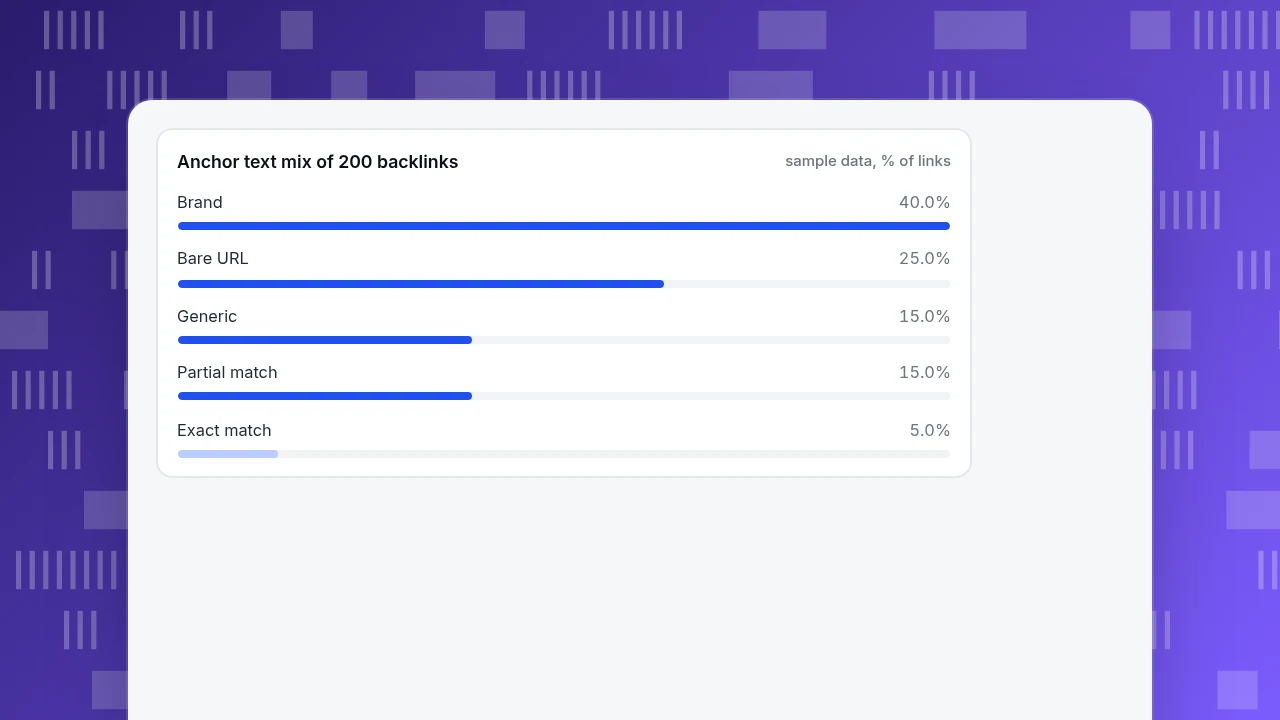
Sample data: 200 backlinks to one site, classified by anchor type.
| Anchor type | Example | Links | Share |
|---|---|---|---|
| Brand | "YourBrand" | 80 | 40.0% |
| Bare URL | "yoursite.example/guides" | 50 | 25.0% |
| Generic | "click here", "this site" | 30 | 15.0% |
| Partial match | "guide to pricing models" | 30 | 15.0% |
| Exact match | "pricing software" | 10 | 5.0% |
| Total | 200 | 100.0% |
There is no official percentage for a "good" mix, so treat these as a pattern to monitor rather than a target. Natural profiles are dominated by brand and URL anchors, and a sharp change is the signal: if exact-match anchors rose from 5% to 30% in a single month right after a paid campaign, look at where those links came from. This threshold is our rule of thumb, not a Google rule.
Anchor text mix of 200 backlinks
sample data, % of linksHow much do backlinks matter? Two numbers
The largest published look at backlinks and traffic comes from an index of about 14 billion pages. It found that 96.55% of pages get no traffic from Google. It reports a clear correlation between the number of linking websites and a page's traffic, and states that correlation does not prove backlinks cause higher rankings. About 20 million pages in the index have no referring domains, and only 2,997 of them get more than 1,000 search visits a month, roughly 1 in 6,700 (Ahrefs study, 1 December 2023). Pages with traffic and no links do exist, but almost all of them target low-competition topics.
Two readings follow. Backlinks are common among pages that rank, and the evidence for cause is weaker than the correlation; the difference matters, and causation explains why. Do not buy links expecting a guaranteed result, and do not skip the content that earns them.
Which links are worth chasing? A scoring example
Sample data: score each candidate link from 0 to 2 on four questions (relevance, editorial choice, page is indexed, plausible visitors). Maximum 8.
| Candidate link | Relevance | Editorial | Indexed | Visitors | Total |
|---|---|---|---|---|---|
| Citation in an industry news story | 2 | 2 | 2 | 2 | 8 |
| Resource page at a trade association | 2 | 1 | 2 | 1 | 6 |
| Answer on a Q&A site | 1 | 1 | 2 | 1 | 5 |
| Local business directory | 1 | 0 | 2 | 0 | 3 |
Paid article, no rel | 1 | 0 | 2 | 1 | 4, and a spam risk |
Page with noindex | 2 | 2 | 0 | 0 | 4 |
The last row is a trap: a perfect editorial link on a page that Google does not index is unlikely to help, because the page never enters the index. Check that the linking page is indexed before you spend a week pitching it. The scale is ours, so adjust it; what carries over is asking four questions about every candidate.
| Candidate link | Relevance | Editorial | Indexed | Visitors | Total (max 8) |
|---|---|---|---|---|---|
| Citation in an industry news story | 2 | 2 | 2 | 2 | 8 |
| Resource page at a trade association | 2 | 1 | 2 | 1 | 6 |
| Answer on a Q&A site | 1 | 1 | 2 | 1 | 5 |
| Local business directory | 1 | 0 | 2 | 0 | 3 |
| Paid article, no rel | 1 | 0 | 2 | 1 | 4, spam risk |
| Page with noindex | 2 | 2 | 0 | 0 | 4 |
Sample data. Score each 0–2; the scale is ours, the four questions carry over.
How to find your own backlink examples
Search Console's Links report lists your top linked pages, top linking sites (grouped by root domain) and top linking text. Tables hold up to 1,000 rows, exports up to 100,000, and the data is a sample rather than every link (Search Console Help). Export the latest links, open ten of the linking pages, and classify each using the table above. More methods are in how to find backlinks to your website.
Seeing which backlinks send visitors in TapCub
A backlink index tells you a link exists. It does not tell you whether anyone clicks it. TapCub covers the second part; it is not a backlink index and will not list links that send no visits.
- Open the referrers. Web analytics › Sources has a Referrers tab with visitors, sessions, pageviews, bounce and duration for each linking site. The default counts each session's first source; Every arrival also counts external arrivals in the middle of a session.
- Tag the links you control. On a partner page, an author bio or a directory profile, add UTM parameters, for example
?utm_source=partner-site&utm_medium=referral&utm_campaign=bio-link, so each placement shows up in the UTM tab. Name UTM parameters has the naming rules. - Check what visitors from each link did. The channel table has a conversions column when you have goals set up in Web analytics › Goals. A link that sends 30 visits and 3 sign-ups is worth more than one that sends 300 and none.
- Keep crawlers out of the count. SEO tools and search crawlers that follow your links are listed under Web analytics › Bots, not in your visitor numbers.
- Match with search. If you have connected Google Search Console in Monitoring › Search performance, compare clicks and impressions for the linked pages before and after a link appears.
Direct traffic is also a reminder: links with noreferrer can arrive without a referrer, so some real clicks appear as direct. See referral traffic and referral source.
FAQ
What is an example of a backlink?
A journalist writing "according to a survey of 1,200 shop owners" with those words linked to your research page is a backlink. In HTML it is an <a href> on their page pointing to yours, with the linked words as anchor text. Directory listings and partner pages are other examples.
How can I tell whether a backlink is nofollow, sponsored or ugc?
Open the linking page's source and find the <a> element that points to you. If it has rel="nofollow", rel="sponsored" or rel="ugc", that is the qualification. No rel means the link is a plain link. Search Console does not tell you which; check the source or a crawler.
Do nofollow backlinks help?
Google says links qualified with these attributes will generally not be followed, and its spam policy says qualified paid links are not meant to pass ranking credit. They can still send visitors and build awareness, so judge them by clicks and conversions. A forum link that sends 30 visits is still valuable.
Are directory backlinks good?
They can be, but most carry little weight. Listings in vetted local or trade directories are cheap and help people find you; mass submissions made by automated tools fall under the automated-links example in Google's spam policy. Use the "would this exist without search engines" test, and prefer a few relevant listings to many generic ones.
How many backlinks do I need?
There is no fixed number. In a study of about 14 billion pages, the number of linking sites correlated with traffic, yet pages with traffic and no links existed on low-competition topics. Look at the pages that already rank for your target phrase and compare their linking sites with yours.
See also: UGC Examples: 8 Types and the Metric Each One Tracks.
Sources
- Google Search Central, Qualify your outbound links to Google (nofollow, sponsored, ugc). Checked 2026-11-20.
- Google Search Central, Spam policies for Google web search (link spam examples; qualifying paid links). Checked 2026-11-20.
- Google Search Central, SEO link best practices (crawlable links, anchor text). Checked 2026-11-20.
- Google Search Console Help, Links report (top linking sites and text, row limits). Checked 2026-11-20.
- Ahrefs, Search traffic study (14 billion pages, 96.55% with no traffic; published 2023-12-01). Checked 2026-11-20.
- MDN Web Docs, rel attribute (nofollow, noopener, noreferrer). Checked 2026-11-20.
Was this article helpful?
We use your answers to fix and expand this page.
Couldn’t send. Please try again in a minute.
Thanks for the feedback. We’ll use it to improve this page.You’ve already sent feedback on this page. Thanks.

Product Adoption Consultant
Explores customer onboarding, live conversations, and self-service, turning common usage questions into practical guidance and improvements.