Try it on your own data
Every report in this article is in the free plan. One snippet for web and apps, up to 10 sites.
Start freeTo get backlinks, give people a reason to link: original data, a free tool or a clear reference worth citing, then tell the sites that cover the topic. Buying or swapping links for ranking counts as link spam. Below: which links count, eight methods ranked by effort and risk, and a cost-per-link example.
What you will learn
- Earn links with something worth citing; asking without a reason is the most expensive way to get one
- Paid or exchanged links for ranking count as link spam; marked sponsored links are advertising
- Judge a link by the visitors it sends and the clicks the linked page gains, not by the count
Which links count as backlinks worth getting?
A backlink is a link from another website to a page on yours. Not every one is worth the effort, and the useful distinction is how the link came to exist:
| Link type | How it appears | Worth chasing? |
|---|---|---|
| Editorial | A writer or site owner chose to link because your page helps their reader | Yes: this is the goal |
| Partnership | A partner, supplier or integration page lists you | Yes, if the page is real and visited |
| Profile or directory | You created it yourself on a listing site | Occasionally, for discovery rather than ranking |
| Sponsored | Someone was paid or given a product for the link | Allowed only if marked |
| User-generated | Comments, forum posts, signatures | Little value; often marked |
| Exchanged or bought | "Link to me and I'll link to you", or paid placement for ranking | No: this is what search engines classify as link spam |
Search engines document this line clearly. Google's spam policies list buying or selling links for ranking purposes, excessive link exchanges and automated link creation as link spam, and say paid links are fine when they carry rel="nofollow" or rel="sponsored". Its guidance on qualifying outbound links describes sponsored for ads and paid placements, ugc for user-submitted material and nofollow for anything else you do not want to vouch for.
So the practical definition is: get backlinks from people who chose to link. Everything below is about making that choice easy and likely.
Why would anyone link to your page?
Nobody links to be nice. A person links because it saves them work or makes their own page more credible. Google's guidance on people-first content asks the same question of any page: why does it exist? Before you contact anyone, check whether your page offers at least one of these:
- A number they can cite. Original data from your own product, survey or experiment, with the method stated. Writers need a source for a claim and prefer the original.
- A tool they can send readers to. A calculator, checker or template that does a job a paragraph of text cannot.
- A reference they would otherwise write themselves. A clear definition, a glossary entry, a step-by-step setup guide.
- A fix. A broken page someone links to, a moved resource, a corrected statistic.
- A genuine contribution. A quote, an interview answer or a case from first-hand experience that the other writer does not have.
If your page offers none of them, an outreach email is asking for a favour. That is why the same email gets replies from some pages and silence from others.
Which ways of getting backlinks are worth the effort?
The table ranks common methods by effort, how repeatable they are and the risk. "Reply rate" is deliberately not given: published figures vary by niche and nobody can promise one for you.
| Method | What you do | Effort | Risk |
|---|---|---|---|
| Link-worthy asset | Publish original data, a free tool or a definitive guide, then tell people who wrote about the topic | High once, low after | None |
| Unlinked mentions | Find pages that mention your brand or product without linking, ask for the link | Low | None |
| Broken links | Find dead outbound links on relevant pages, offer your matching page as replacement | Medium | None |
| Expert contributions | Answer journalist or podcast requests with a quote, interview or data | Medium, ongoing | None |
| Partner and integration pages | Ask partners, suppliers and customers who already work with you to list you | Low | None |
| Resource pages | Pitch inclusion on curated "useful links" pages in your field | Medium | Low |
| Guest articles | Write something useful for a relevant site for readers first | High | Medium: it becomes link spam when payment or optimised anchor text is the point |
| Paid or exchanged links | Pay for placement or swap links | Low | High |
Start at the top. The first three need nothing but your own pages and time, and the asset in the first row makes every other row work better.
| Method | Effort | Risk |
|---|---|---|
| Link-worthy asset (data, tool, guide) | High once, low after | None |
| Unlinked mentions | Low | None |
| Broken links | Medium | None |
| Expert contributions | Medium, ongoing | None |
| Guest articles | High | Medium |
| Paid or exchanged links | Low | High |
Start at the top: the first rows need only your own pages and time.
How many links does an outreach campaign really produce?
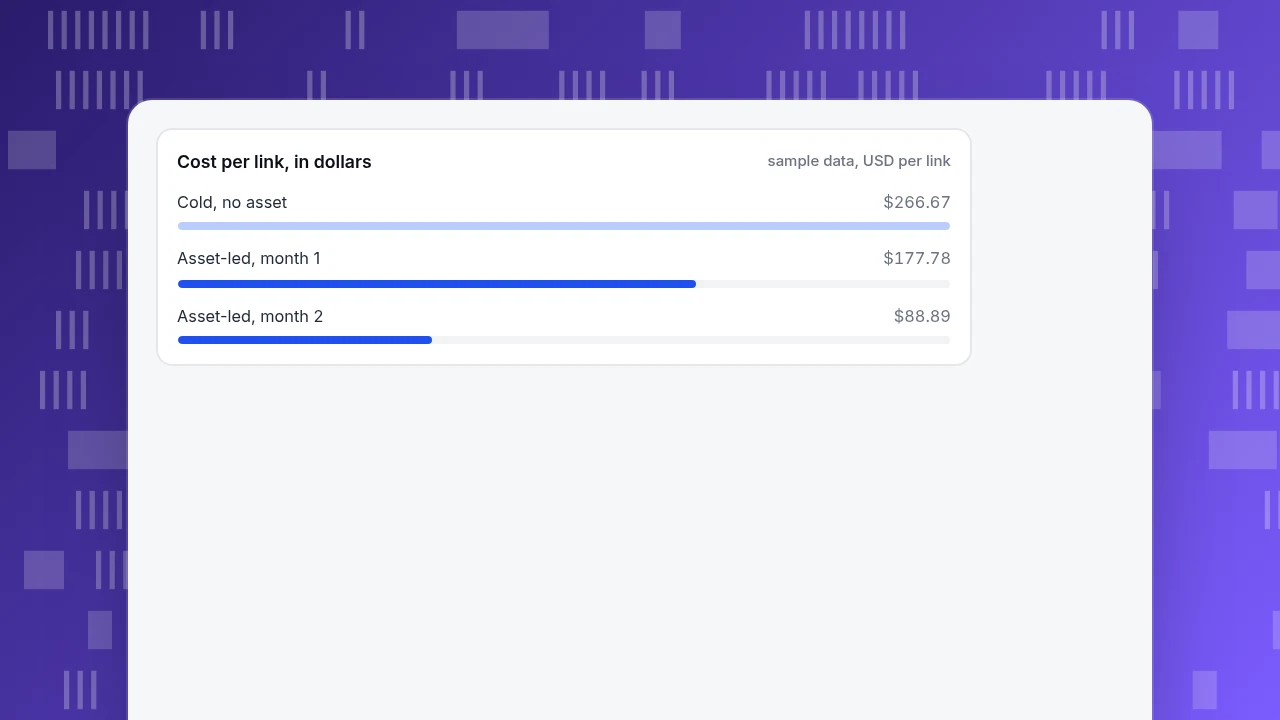
Sample data: a small software company wants links to a guide on its analytics topic. Compare two months of outreach, both sending 120 emails at 10 minutes each (20 hours), with the writer costing $40 an hour.
| Cold, no asset | Asset-led, month 1 | Asset-led, month 2 | |
|---|---|---|---|
| Hours building the asset | 0 | 20 | 0 (reused) |
| Hours on outreach | 20 | 20 | 20 |
| Total cost at $40 an hour | $800 | $1,600 | $800 |
| Links earned | 3 | 9 | 9 |
| Link rate (links ÷ 120 emails) | 2.5% | 7.5% | 7.5% |
| Cost per link | $266.67 | $177.78 | $88.89 |
The arithmetic: 3 ÷ 120 = 2.5% and 9 ÷ 120 = 7.5%; $800 ÷ 3 = $266.67, $1,600 ÷ 9 = $177.78, $800 ÷ 9 = $88.89. Across the two months the asset-led approach earned 18 links for $2,400 ($133.33 each) against 6 links for $1,600 ($266.67 each) for cold outreach. The asset-led figures are assumptions chosen to show the shape of the economics, not a benchmark: what you should take from the table is that the building cost is paid once, and that a cold email without a reason to link is the most expensive way to get a link, not the cheapest.
Cost per link, in dollars
sample data, USD per linkWhich links should you chase first?
You will have more possible links than time. Rank them with three questions, in this order:
- Would the link send real visitors? Imagine search engines did not exist. A link from a page your audience reads is worth having anyway; a link from a page nobody visits is not.
- Is the page about the same subject? A link from a page on your topic tells readers and crawlers what yours is about; an unrelated page tells them nothing.
- Is the link in the body of the page? A link in running text, with surrounding words that describe your page, beats one in a footer list of fifty.
If a link scores "no" on the first question, treat it as optional whatever the other two say. Do not chase a count: ten links from relevant pages that people read will do more than a hundred from pages that exist to hold links.
What should you avoid when getting backlinks?
- Buying links to pass ranking credit. If you pay for a mention, it should be marked
sponsoredornofollow, which also means it will not behave like an editorial link. - Reciprocal swaps at scale. A single genuine "we reference each other because we work together" is normal; a spreadsheet of swaps is not.
- Automated link creation. Tools that post your URL to hundreds of sites are on the policy list above.
- Optimised anchor text in paid or syndicated articles. Google lists links with optimised anchor text in guest posts or press releases distributed on other sites as link spam when payment is involved.
- Asking before you have a reason. A request without an asset, a fix or a contribution is just a favour request.
- Counting links instead of results. Ten links that never send a visitor and never help a page rank are not a success.
How do you tell whether a new backlink worked?
Give it a few weeks, then check three things:
- Referral visits. Did people arrive from that page? A link that never sends anyone is a weak one.
- Landing-page behaviour. Do those visitors view more than one page or reach a goal, or do they leave immediately?
- Search clicks to the linked page. Compare the page's clicks and rank in your search report before and after, remembering that other changes move the same numbers.
Do not credit a ranking change to a single link; too many things change at once. Judge the programme by whether the pages you linked to grew in referral visits and search clicks over a quarter.
How do you track backlinks in TapCub?
Suppose the company in the example has published its guide and earned nine links. TapCub does not crawl the web or list who links to you, so a backlink index lives in a separate tool. What TapCub shows is what those links did to your own traffic:
- In Web analytics › Sources, open the Referrers tab. Each row is an external site that sent visitors, with visitors, sessions, pageviews, bounce and duration. A newly earned link appears here once someone clicks it.
- Check the counting mode: First source of session credits only the source a session arrived from, while Every arrival also counts external hops in the middle of a session.
- Open the linked page in Web analytics › Pages and look at what referral visitors do next; a goal under Web analytics › Goals tells you whether they converted.
- Connect a search account and use Monitoring › Search performance to see clicks, impressions and average position for that page, by query and country, with data usually one to three days behind.
- Add a note in Configuration › Annotations on the date a link was published so the chart shows what changed afterwards.
TapCub is a measurement tool here. It does not find prospects, send outreach or verify that a link exists.
FAQ
How do I get a backlink?
Give someone a reason to link, then make it easy: publish a page with data, a tool or a clear reference, find sites that cover the topic, and send a short note saying what the page offers and where it would fit their article. Linking is their decision; your job is to remove the effort.
How long does it take to get backlinks?
Expect weeks for the first links from outreach and longer for effects on search clicks. Links earned from replies and mentions arrive in bursts rather than steadily. Judge a programme over a quarter, using referral visits and clicks to the linked pages, not the day-by-day count.
Is buying backlinks allowed?
Search engines treat buying or selling links for ranking purposes as link spam. Paid placements are acceptable when marked with rel="sponsored" or rel="nofollow", but then they are advertising rather than editorial links. If a seller promises ranking from links, treat it as a warning sign.
How many backlinks do I need?
There is no number. What matters is whether pages you want to rank have links from relevant pages that people read, and whether competing pages have more. A page on a narrow topic may need a handful; a competitive one needs a stronger asset, not more emails.
Do links from comments and forums help?
Very little. They are user-generated, usually marked ugc or nofollow, and are easy for anyone to create. Take part in communities to be useful and to be known; if links follow because people found you helpful, good, but do not make them the plan.
See also: How to Find Backlinks to Your Website: 5 Free Methods.
See also: Backlink Examples: 8 Types With Real Link Code, Anchor Text and rel Values.
See also: Link Building Report: Metrics to Include and a Template With Sample Numbers.
Sources
- Google Search Central. Spam policies for Google web search: link spam, including buying or selling links, excessive exchanges and automated link creation. Verified 2026-11-19.
- Google Search Central. Qualify your outbound links to Google:
sponsored,ugcandnofollow. Verified 2026-11-19. - Google Search Central. Creating helpful, reliable, people-first content: the question to ask of any page, why it exists. Verified 2026-11-19.
Was this article helpful?
We use your answers to fix and expand this page.
Couldn’t send. Please try again in a minute.
Thanks for the feedback. We’ll use it to improve this page.You’ve already sent feedback on this page. Thanks.

Product Experience Specialist
Explores usability, user journeys, and feature adoption through practical examples of onboarding and everyday product use.