Try it on your own data
Every report in this article is in the free plan. One snippet for web and apps, up to 10 sites.
Start freeAI referral traffic is human visits that start from a link inside a ChatGPT, Perplexity, Gemini, Copilot or Claude answer, which is different from AI crawlers fetching your pages. This guide shows how it appears in analytics, why it is undercounted, how to measure it, and how TapCub reports it.
What you will learn
- AI referral traffic is people clicking links in AI answers; AI crawlers and user-triggered fetchers are bot requests with no visitor.
- Referrer hosts and UTM tags identify it, but visits with neither land in direct, so the measured number is a floor.
- Read AI-referred visits next to crawler reads, by brand and by cited page, and judge the channel by outcomes rather than share.
What is AI referral traffic?
AI referral traffic is the set of human visits that start when someone clicks a link inside an AI assistant's answer, such as ChatGPT, Perplexity, Gemini, Copilot or Claude, and lands on your site. You measure it in your analytics as a traffic source, by the referring host (chatgpt.com, perplexity.ai) or a tag like utm_source=chatgpt.com. It is not the same as AI crawler traffic, where a bot fetches your pages and no person arrives.
That difference decides everything else in this guide. A crawler hit proves an AI system read your page. A referral visit proves a person chose to leave the answer and come to you. Only the second one can become a signup, a purchase or a chat. The two are related (you usually need to be read before you can be cited), but they live in different reports, and mixing them gives you numbers nobody can act on.
If you searched for "chatgpt referral traffic" or "how to track chatgpt traffic", the short version is: filter your sources for the AI hosts, add a channel rule for them, and accept that the result is a floor, not the full count. The rest of this article shows why, and what to do about it.
How is AI referral traffic different from AI crawler traffic?
There are three kinds of AI-related requests, and they behave differently in your logs and in your analytics. OpenAI's overview of its crawlers separates them clearly, and Perplexity's crawler documentation follows the same split:
- Training and index crawlers such as GPTBot and PerplexityBot fetch pages on their own schedule. OpenAI describes GPTBot as crawling content that may be used to train its models, and PerplexityBot as the agent that surfaces and links sites in Perplexity search results.
- Search crawlers such as OAI-SearchBot decide whether your site can show up in ChatGPT's search answers. OpenAI says blocked sites will not be shown in ChatGPT search answers, though they can still appear as navigational links.
- User-triggered fetchers such as ChatGPT-User and Perplexity-User visit a page because a person asked a question that needs it. OpenAI says ChatGPT-User is not used for automatic crawling and that, because users start these actions, robots.txt rules may not apply. Perplexity says its Perplexity-User agent generally disregards robots.txt for the same reason.
None of these three is a human visit. The visit you are after is the fourth thing: the person who reads the answer, sees your link and clicks. The table after this section puts the four side by side.
The user-triggered fetchers are the confusing one. A ChatGPT-User request means a real person asked about your page, so it is a strong signal of interest, but the request itself comes from OpenAI's servers. It is bot traffic in your logs and it does not carry a visitor. If the person then clicks through, that second request is the referral visit.
| Kind | Examples | What it is | Shows up as |
|---|---|---|---|
| Training / index crawler | GPTBot, PerplexityBot | Fetches pages on its own schedule | Bot request; no visitor |
| Search crawler | OAI-SearchBot | Decides whether pages appear in ChatGPT search answers | Bot request; no visitor |
| User-triggered fetcher | ChatGPT-User, Perplexity-User | Fetches a page because a person asked about it | Bot request from the provider; no visitor |
| AI referral visit | chatgpt.com, perplexity.ai, utm_source=chatgpt.com | A person clicks your link in an answer | Human session with a referrer or tag, or direct if both are missing |
Based on OpenAI and Perplexity crawler documentation read 2026-11-21. Analytics treat only the last row as a human visit.
How does AI referral traffic show up in analytics?
A click from an AI answer usually arrives in one of three shapes:
- A referrer host. The browser sends
chatgpt.com,perplexity.ai,gemini.google.comorclaude.aias the referring site. Seer Interactive's guide to tracking AI traffic (updated June 2026) says that with the referrer intact and no UTM tags, GA4 shows these sessions as Referral with that host as the source. - A UTM tag. Links in ChatGPT answers can carry
utm_source=chatgpt.com. The same Seer guide says that when the tag is present, it fills the session source. If you build your own links for AI use, this is the one you control. - Nothing. No referrer and no tag. Your analytics files the visit under direct, and there is no way to tell it came from an AI answer.
The third shape is not hypothetical. In October 2026, Search Engine Roundtable reported that ChatGPT links had stopped carrying utm_source=chatgpt.com around the GPT-6 release. It cites analyst Cedric Huesler's review of about 500 pages: ChatGPT-attributed visits fell by about 31,000 a day while direct rose by about 26,000 a day on the same pages. His explanation was that the links opened with no tag and no referrer, so "your analytics files the visit under direct". On October 15 he updated his post to say it was a bug and the tags were returning. The point for you is not the specific bug. It is that the identifying signal is controlled by someone else and can disappear without notice.
Why is AI referral traffic undercounted?
Three effects push the number down, and all three are visible in published sources:
- Missing referrers. Seer's guide lists links with neither UTMs nor referrer data landing in direct, privacy-sensitive paths stripping referrer information, and traffic from in-app browsers or copy-pasted links ending up in direct too. It tells readers to treat the native AI channel as "a floor on your AI traffic, not a ceiling."
- Direct is a catch-all. Ahrefs' 2025 study of about 35,000 websites (published March 26, 2025) says AI traffic is underreported because it often appears as direct in analytics tools. Ahrefs is an SEO software vendor and the study is from 2025, so read the figures as a dated snapshot.
- Influence without a click. The same article notes that people do more research without clicking, so attributable traffic understates what AI answers do for a brand. You cannot measure the answer someone read and then typed your name into a search box.
On scale, Ahrefs found AI sent just 0.1% of total referral traffic across that sample, with search at 43.8% and direct at 42.3%. Within AI, ChatGPT had roughly 50%, Perplexity 30.7% and Gemini 17.6%. Smaller sites saw a larger share: sites with under 10,000 visits got 0.3% of traffic from LLMs, against 0.1% for sites over a million. Treat those as 2025 numbers; the channel has been growing, and your own site's mix is the only figure that matters for your decisions.
Two practical consequences. First, a small percentage is normal, so do not judge the channel by its share of all traffic; judge it by what those visitors do. Second, never present the measured number as the total. Say "at least N visits".
How do you measure AI referral traffic?
Use the same five steps in any analytics tool:
- Group the hosts. Create one channel (or one saved segment) for the referring hosts:
chatgpt.com,chat.openai.com,perplexity.ai,gemini.google.com,copilot.microsoft.com,claude.ai. Addutm_sourcevalues that match. - Keep crawlers out of the count. Your human-visit reports should exclude bots, otherwise a crawler spike looks like a traffic win.
- Split by brand. One total hides that ChatGPT and Perplexity behave differently on your site.
- Look at landing pages. The pages that receive AI visits are the pages being cited. That list is more useful than the total.
- Compare with reads. Count how often AI crawlers fetched the same pages. A page read often and clicked rarely is a different problem from a page that is not being read at all.
The worked example below uses sample data to show the arithmetic. It is not a benchmark.
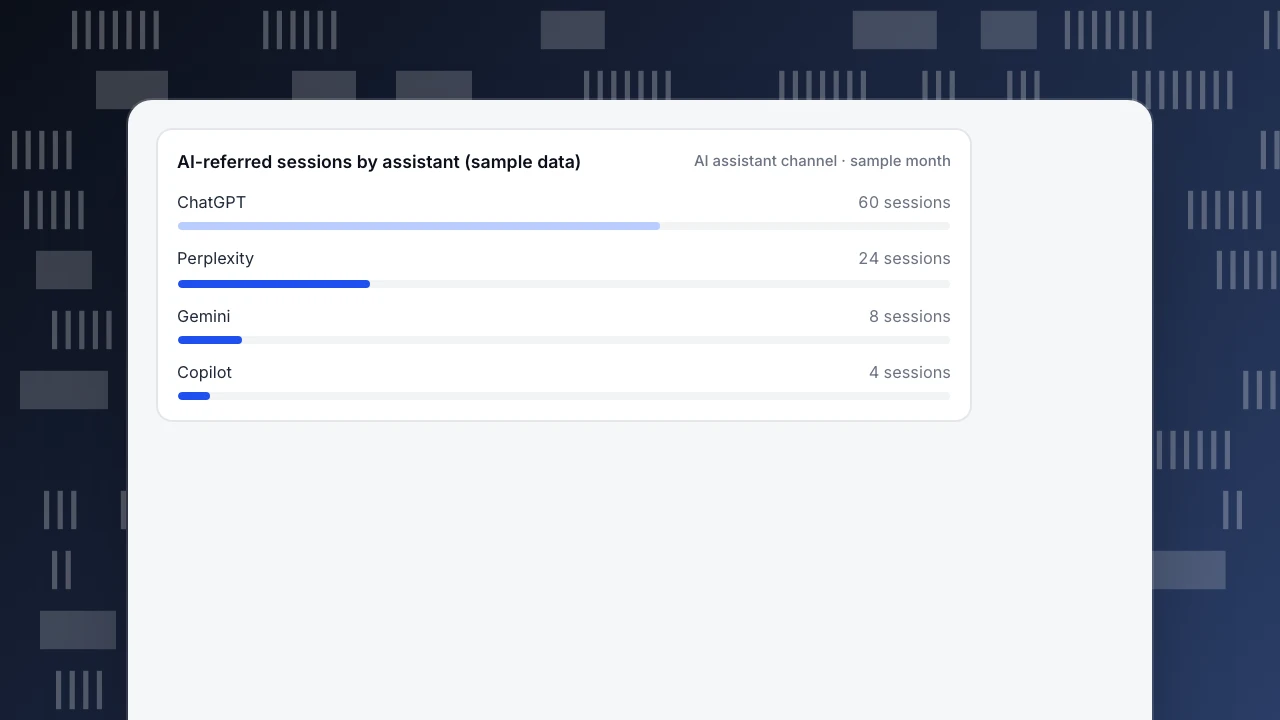
Sample month (illustrative, not real data): a site has 12,000 human sessions. The AI assistant channel shows 96 sessions: ChatGPT 60, Perplexity 24, Gemini 8 and Copilot 4. Those sum to 96, and 96 ÷ 12,000 = 0.80% of human sessions. ChatGPT's share of the AI channel is 60 ÷ 96 = 62.5%.
AI crawlers fetched the site's pages 4,800 times in the same month. Visits per crawl is 96 ÷ 4,800 = 2.0%; flipped around, that is 4,800 ÷ 96 = 50 reads per visitor sent back. Neither number is a click-through rate, because the denominator is crawl requests, not impressions.
Now the undercount. If 10% of true AI visits lost their referrer, the real count would be 96 ÷ 0.90 ≈ 107. If 40% did, it would be 96 ÷ 0.60 = 160. These are scenarios, not measurements: the point is that the gap between the measured floor and the truth could be anywhere from a handful to well over half again, and you cannot see which from inside the report.
How do you track AI referral traffic in TapCub?
TapCub treats AI assistants as their own acquisition channel and keeps AI crawlers in a separate report, so the two are never added together:
- See the channel. In Web analytics › Sources, open the AI sources tab. These are human sessions that arrived from an AI product, not crawler reads. By default, a referring host that is an AI product, or a UTM source that matches one, is classed as an AI assistant. A visit with no source at all is direct, the same limit described above.
- Adjust the rules. If a source is classed wrongly, add a channel rule under Configuration › Web settings. Rules you add for your site win over the defaults, and you can recompute history.
- Read the crawler side separately. In Web analytics › Bots, the AI & agents tab shows AI requests, agents and crawlers, with an AI content ledger per operator: reads, human visitors sent back and a return ratio (reads divided by visitors). Recognised bots are excluded from the human reports by default.
- Put them together. The AI visibility tab on the same page shows AI crawls, AI-referred visits, crawl→visit (visits divided by crawls), a by-brand table and the Cited pages list, which are the landing pages that received AI-referred visits. Find brands with many crawls and few visits, then open the cited pages for the article being cited.
- Check your rules files against reality. Monitoring › Crawler compliance fetches your robots.txt and compares it with the fetches it recorded, flagging crawlers that fetched while blocked, fetched a disallowed path, or ignored a declared delay. The file itself cannot stop a fetch; this page is the evidence.
Limits worth knowing. With only the page script, TapCub sees the bots that run JavaScript, so crawl counts are incomplete until you add server collection or a log import. With no sitemap set, coverage is empty rather than zero. And the AI sources channel only counts what identifies itself: a visit with no referrer and no tag stays in direct, as it does in every tool.
If you only want to check which AI bots your robots.txt allows, two free tools do not need an account: the AI bots directory and the AI crawler checker. For how to read the crawler side in depth, see the AI crawler ledger, and for the GPTBot, ClaudeBot and PerplexityBot profiles, the individual guides. The help article on bots and AI crawlers covers the report settings.
What can you do to get more AI referral traffic?
Measurement comes first, but it is worth separating what you can and cannot influence.
- Allow the search agents you want to be cited by. OpenAI recommends allowing OAI-SearchBot if you want to appear in ChatGPT search, and Perplexity recommends allowing PerplexityBot for the same reason. Both say changes can take about 24 hours to apply. Blocking GPTBot is a separate decision about training, and OpenAI states that disallowing it signals content should not be used in training.
- Do not expect a file to change your referral count. robots.txt and llms.txt tell crawlers what they may read; neither one sends visitors, and neither measures them. Use your analytics to see whether reading turned into visits, and use your rules files to set policy.
- Write the page worth citing. The cited-pages list tells you which of your pages AI answers link to. Look at what those pages have in common (a clear definition, a number someone can quote, a comparison table) and write more of that.
- Tag the links you control. If you place links in answers, profiles or posts that feed AI tools, add a
utm_sourceso the visit stays identifiable even when the referrer is lost. - Judge by outcomes, not by share. Compare AI-referred sessions with other channels on conversions, not on volume.
FAQ
What is AI referral traffic?
Visits from people who clicked a link inside an AI assistant's answer (ChatGPT, Perplexity, Gemini, Copilot, Claude) and arrived on your site. It shows up as a referring host or a UTM tag. It is different from AI crawler traffic, where a bot fetches your pages and no person visits.
How do I track ChatGPT traffic?
Filter your sources for the referring host chatgpt.com and for utm_source=chatgpt.com, then group them into an AI channel. Expect an undercount: links with no referrer and no tag land in direct. In October 2026 a reported bug briefly removed the tag from many links, so check direct for sudden rises.
Is ChatGPT-User the same as a ChatGPT referral?
No. ChatGPT-User is OpenAI's fetcher that visits a page when a person asks ChatGPT something that needs it. It is a bot request from OpenAI's servers. A referral is a different event: a person clicks your link in the answer and their browser loads your page.
Does blocking GPTBot stop AI referral traffic?
Not by itself. OpenAI describes GPTBot as related to training. Appearing in ChatGPT search is governed by OAI-SearchBot, and OpenAI says sites blocked for it will not be shown in search answers, though they can still appear as navigational links.
Why is my AI referral traffic so low?
For most sites it is small. Ahrefs' 2025 sample of about 35,000 websites found AI sent 0.1% of total referral traffic, and some of it is hidden in direct. Look at who the visitors are and what they do, and compare your own trend over time rather than the share.
Do robots.txt and llms.txt affect how many visitors AI sends?
They set what crawlers may read. They do not send visitors and do not measure them. To check whether crawlers follow your rules, compare the file with the fetches you actually received, then check whether those pages receive AI-referred visits.
See also: Bot Traffic: How to Detect, Filter and Report It; Content Analytics: What to Measure and How to Review It
Sources
- OpenAI. Overview of OpenAI Crawlers — GPTBot, OAI-SearchBot and ChatGPT-User purposes and robots.txt behaviour; the page does not mention referrals or UTM tags. Read 2026-11-21.
- Perplexity. PerplexityBot and Perplexity-User — PerplexityBot surfaces sites in search results and is not used for foundation-model training; Perplexity-User fetches on a person's request and generally disregards robots.txt. Read 2026-11-21.
- Ahrefs (2025, March 26). AI Traffic Research — about 35,000 websites; AI 0.1% of total referral traffic; ChatGPT about 50%, Perplexity 30.7%, Gemini 17.6% of AI traffic; underreporting via direct. Vendor-run study (Ahrefs sells SEO software). Read 2026-11-21.
- Seer Interactive (originally 2024-12-02, updated 2026-06-22). Your AI Traffic Is Hiding — how AI referrals appear in GA4, why they land in direct, native AI channel as a floor. Agency guide. Read 2026-11-21.
- Search Engine Roundtable (2026, October). OpenAI Drops UTM Parameters From ChatGPT Results — missing
utm_source=chatgpt.comand referrer around the GPT-6 release, direct up about 26,000 a day on about 500 pages, later described as a bug. Third-party reporting of an analyst's data. Read 2026-11-21.
Was this article helpful?
We use your answers to fix and expand this page.
Couldn’t send. Please try again in a minute.
Thanks for the feedback. We’ll use it to improve this page.You’ve already sent feedback on this page. Thanks.

Product Experience Specialist
Explores usability, user journeys, and feature adoption through practical examples of onboarding and everyday product use.