Try it on your own data
Every report in this article is in the free plan. One snippet for web and apps, up to 10 sites.
Start freeA SaaS content marketing strategy works when you write about the problems your product solves, publish the highest-scoring topics first, give each piece a next step toward a trial, and judge content by the sign-ups it influenced rather than by traffic. The examples below score topics by product fit and intent and show how three attribution models credit the same 100 sign-ups very differently.
What you will learn
- Score topics by product fit and buyer intent before search volume
- Give every piece a next step that reaches a trial, template or demo
- Read first touch, last touch and linear credit together; last-touch alone makes content look useless
What is a SaaS content marketing strategy?
A SaaS content marketing strategy is a plan to publish content that attracts people who have a problem your software solves, and to measure it by the sign-ups and customers it leads to. It differs from general content marketing in two ways. The sales cycle is usually longer and involves more steps (visit, trial, activation, purchase), so one article rarely closes a sale on its own. And the product itself is the answer to most of your readers' questions, so the best topics sit right next to what the product does.
That gives the guide its rule: write about the problems your product can solve, and judge content by sign-ups it influenced, not by traffic alone. Traffic is an input. A post with 30,000 visits and no sign-ups taught people something that was not about you.
The measurement side is covered in content marketing analytics and content performance metrics; the broader marketing context is in SaaS marketing. This guide covers the strategy underneath: what to write, in what order, and how to credit it.
How do you choose topics: by volume or by product fit?
Search volume tells you how many people ask. It does not tell you whether your product answers them. Score each candidate topic on three things, each 0 to 3:
- Product fit: does the product solve this problem? (3 = it is exactly what the product does.)
- Buyer intent: would the reader be looking for a tool soon? (3 = they are comparing or fixing it now.)
- Ease: how likely are you to produce a better answer than what ranks? (3 = you have data or expertise others lack.)
Score = 2 × fit + 2 × intent + ease, a maximum of 15. Sample data for an invoicing product:
| Topic | Fit | Intent | Ease | Score |
|---|---|---|---|---|
| Fix duplicate invoices | 3 | 3 | 2 | 14 |
| Migrate from spreadsheets to invoicing software | 3 | 3 | 1 | 13 |
| Invoice reminder email templates | 3 | 2 | 2 | 12 |
| Reconcile bank feeds with invoices | 3 | 2 | 2 | 12 |
| Accounting basics glossary | 1 | 1 | 3 | 7 |
| Late payment laws by state | 2 | 1 | 1 | 7 |
| What is SaaS? | 1 | 0 | 3 | 5 |
| Industry trends for 2027 | 1 | 0 | 1 | 3 |
The top four are problems the product solves for people actively trying to fix them. "What is SaaS?" may well draw more searches than any of them, and it still scores 5, because almost nobody who searches it needs invoicing software this week. Publish the 12-and-up topics first.
| Stage | Content | Metric |
|---|---|---|
| Problem-aware | Diagnostic guides, checklists | Engaged visits |
| Solution-aware | How-to, comparisons of methods | Click to product page |
| Product-aware | Use cases, setup guides | Sign-ups |
| Customer | Tutorials, release notes | Activation, retention |
Many teams write only the first stage; sign-ups come from the second and third.
How do you map content to the buyer's stage?
Readers arrive at different stages, and each stage needs a different next step. A simple map:
| Stage | The reader's thought | Content | Call to action | Metric |
|---|---|---|---|---|
| Problem-aware | "Something is wrong" | Diagnostic guides, checklists | Related guide | Engaged visits |
| Solution-aware | "How do people fix this?" | How-to, comparisons of methods | Template or demo | Click to product page |
| Product-aware | "Would this tool work for me?" | Use cases, setup guides | Start a trial | Sign-ups |
| Customer | "How do I get more from it?" | Tutorials, release notes | Use a feature | Activation, retention |
Many SaaS teams write only the first stage. The sign-ups come from the second and third, so check that every topic you publish has a way to reach one of those. A guide with no link to the product, a template or a trial is an expensive way to give traffic to search engines.
What makes SaaS content good enough to rank and convert?
Google's guidance on helpful, reliable, people-first content gives a self-assessment that fits SaaS well. It asks whether the content demonstrates first-hand experience and depth of knowledge, whether a reader would feel they learned enough to achieve their goal, and whether the content was created to help people rather than only to attract search visits. Turn that into three checks before you publish:
- Who is this written by, and what do they know? A guide on reconciling bank feeds written by someone who has done it, with screenshots from the real product, beats a generic summary.
- Does it finish the job? A reader who follows the steps should be able to solve the problem without opening another tab.
- Is the product shown honestly? Where the product is the answer, say so, and say where it is not (for example, a manual step the reader still has to do).
Refresh matters as much as publishing. A guide whose screenshots, prices or steps are out of date loses trust and rankings. Keep a refresh date on each piece and review the top ten by sign-ups every quarter.
How do you credit content for sign-ups? A worked example
Content rarely gets the last click. A reader finds a guide, leaves, comes back later from an email and signs up through a direct visit. If you credit only the last click, content looks useless. Sample data: 100 sign-ups with these paths (each touch is a session in the lookback window):
| Path | Sign-ups |
|---|---|
| Blog, Direct | 30 |
| Blog, Email, Direct | 12 |
| Search, Blog, Search | 18 |
| Paid, Paid | 20 |
| Direct | 20 |
Credit under three models:
| Channel | First touch | Last touch | Linear (equal split) |
|---|---|---|---|
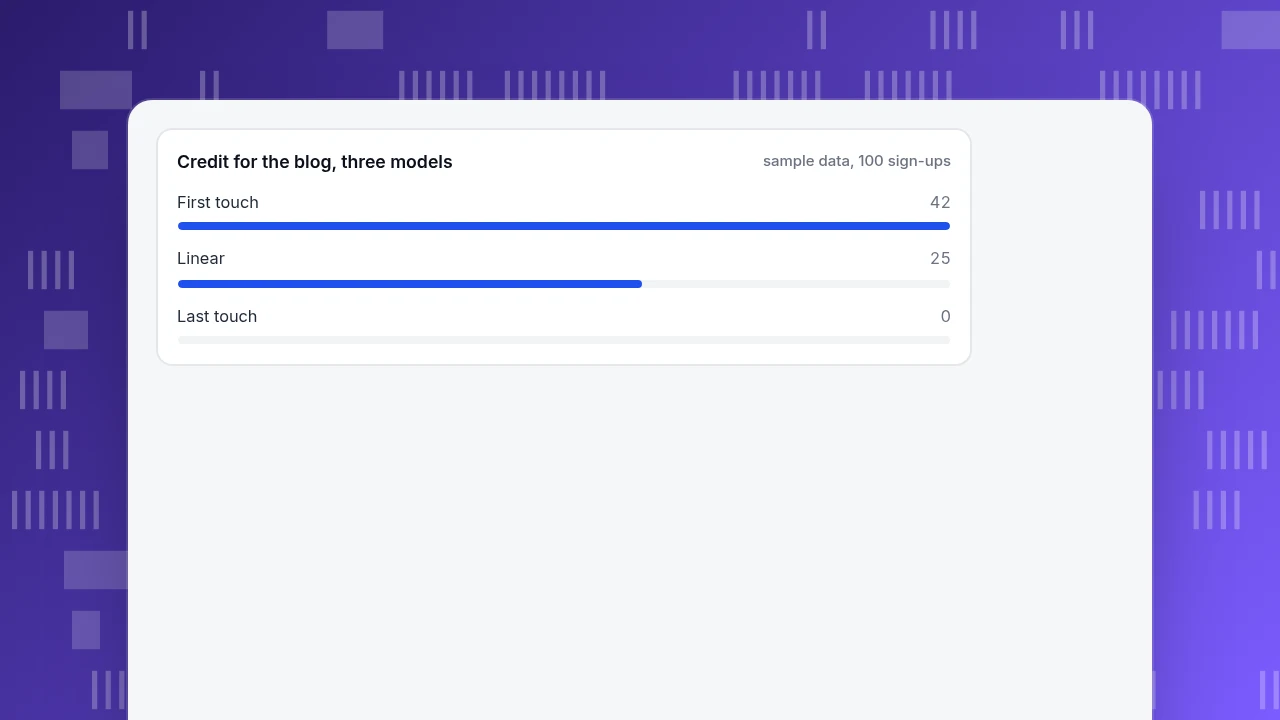
| Blog | 42 | 0 | 25.0 |
| Search | 18 | 18 | 12.0 |
| Paid | 20 | 20 | 20.0 |
| 0 | 0 | 4.0 | |
| Direct | 20 | 62 | 39.0 |
The blog gets 42 sign-ups under first touch, none under last touch and 25 under linear credit, and 60 of the 100 sign-ups (30 + 12 + 18) had a blog visit somewhere on the path. Last-touch credits direct with 62 sign-ups, which mostly reflects people returning after content or email already did the persuading. None of the three is correct; each answers a different question. First touch asks "what introduced them?", last touch asks "what closed?" and linear spreads the credit. The decision is not to pick one, but to read the gap: a channel that is large under first or linear and small under last is doing assist work and should not be cut because of last-touch numbers.
Credit for the blog, three models
sample data, 100 sign-upsWhat does a first 90-day plan look like?
A plan this small can start next week. Sample schedule for the invoicing product:
| Weeks | Work | Check at the end |
|---|---|---|
| 1 to 2 | Score 20 candidate topics; add the sign-up goal and UTM convention | A ranked list; goal rate visible per source |
| 3 to 8 | Publish the four topics scoring 12 or more, each with a template or trial link | Entry-page visits and click to product page |
| 9 to 10 | Refresh the two oldest existing guides | Change in clicks and position for those pages |
| 11 to 12 | Read three attribution models for all content | Sign-ups influenced per article; assist versus last-touch gap |
Write the stop rule before you start: for example, "any topic cluster with fewer than 5 influenced sign-ups after 90 days gets one rewrite, then is dropped." The numbers are yours to choose; the point is that content has an end condition, like any other channel.
What are the most common SaaS content mistakes?
- Choosing topics by volume. "What is SaaS?" attracts readers who will never buy.
- No path to the product. Content with no trial, template or demo link cannot produce sign-ups.
- Judging by last click. It makes the channels that persuade look worthless.
- Writing only for prospects. Customer tutorials drive activation and retention, which drive recurring revenue.
- Publishing and forgetting. Out-of-date screenshots and prices lose trust.
- Copying the top results. If you only repeat what ranks, you have no reason to outrank it.
- Reporting traffic as success. Report sign-ups influenced, and activation of those sign-ups.
How to measure SaaS content marketing in TapCub
Use the invoicing product above. TapCub measures visits, sources, sign-ups and what happens after them; it does not write, publish or schedule content, so the editorial work stays in your own tools. The steps:
- Define the outcome. In Web analytics › Goals, create a goal for the sign-up event or confirmation page. The goal rate is conversions divided by unique visitors.
- Compare attribution models side by side. In All-platform analytics › Behavior › Behavior analysis, select first touch, last touch, linear, position and time-decay together; each model gets a column, so a blog that only assists is visible. Choose the landing page as the touchpoint dimension to see credit per article; the default is channel. The lookback window is 30 days by default (1 to 90) and includes the session where the conversion happened. The touchpoint conversion rate is paths divided by touchpoint sessions.
- See which pages start the path. In Web analytics › Pages, the entry-pages tab shows which articles bring people in, with downstream pageviews showing which pages send people onward.
- Check search demand and clicks. With Google Search Console or Bing Webmaster connected, Monitoring › Search performance shows clicks, impressions, CTR and average position by page and query. It also flags pages ranking in the top 10 with a click-through rate below the median, where a better title and description is the cheapest fix. Data arrives one to three days late.
- Follow what happens after sign-up. Build a funnel from sign-up to your activation event (see user onboarding), so the credit you give to content is tied to people who stay.
- Know the boundary. TapCub does not write or publish content. Attribution uses sessions before the conversion, not install postbacks, and counts at most 50,000 conversions.
FAQ
What is a SaaS content marketing strategy?
A plan to publish content that attracts people with a problem your software solves, guide them toward a trial or demo, and measure results by the sign-ups and customers it influences, not only by traffic.
How do you choose SaaS content topics?
Score each topic on product fit, buyer intent and ease of beating the current results, then publish the highest scores first. Search volume alone favours broad topics whose readers will never buy.
How do you measure the ROI of SaaS content?
Credit content with sign-ups it influenced, using more than one attribution model, then follow those sign-ups through activation and retention. Compare content cost with the customers it helped bring in, remembering that last-touch credit understates it.
How often should a SaaS company publish content?
Often enough to keep topics fresh without sacrificing depth. A fixed number is less useful than a rule: publish only pieces that finish the reader's task, and review the top performers each quarter.
What types of content work best for SaaS?
Those that match the stage: diagnostic guides for problem-aware readers, how-tos and templates for solution-aware readers, use cases and setup guides for product-aware readers, and tutorials for customers. Measure each type by its own stage metric.
Sources
- Google Search Central. Creating helpful, reliable, people-first content. Self-assessment questions on experience, completeness and purpose.
- Google Search Console Help. Performance report (Search). Clicks, impressions, CTR and position by query and page.
Was this article helpful?
We use your answers to fix and expand this page.
Couldn’t send. Please try again in a minute.
Thanks for the feedback. We’ll use it to improve this page.You’ve already sent feedback on this page. Thanks.

Product Adoption Consultant
Explores customer onboarding, live conversations, and self-service, turning common usage questions into practical guidance and improvements.