Try it on your own data
Every report in this article is in the free plan. One snippet for web and apps, up to 10 sites.
Start freeReferral marketing is a structured way to get existing customers to bring in new ones, and it is measured by participation, conversion and the retention of the people they bring. Judge it on cost per incremental customer and on how long referred customers stay, not on sign-ups. Below: the five-step loop, a metric for each step, a recomputed worked quarter, reward rules and the mistakes that flatter results.
What you will learn
- Measure each step of the loop: sharing, sign-up, paid conversion, then retention of referred customers
- Report cost per incremental customer, not raw sign-ups; in the sample, 480 sign-ups became 120 payers and $40 became $57
- Pay the reward on the first paid order and disclose it clearly when referrers post links publicly
What is referral marketing, and what is it not?
Referral marketing is a structured way to get existing customers to bring in new ones: you give people a reason, a link or a code, and a way to be recognised, and you track what happens to the people they send. The structure is what separates it from plain word of mouth, which happens whether or not you do anything about it.
Three neighbours get confused with it:
| Term | Who sends the new customer | How they are paid | What you measure |
|---|---|---|---|
| Word of mouth | Anyone who likes you | Not paid | Hard to measure; mostly surveys |
| Referral marketing | A current customer | Usually a reward for the sender, often for the friend too | Invites, sign-ups, paid conversions, retention |
| Affiliate marketing | A publisher or creator whose business is promotion | Commission, often a percentage of the sale | Clicks, sales, commission cost |
A customer who tells a friend is making a recommendation; an affiliate is running a channel. The difference matters for measurement and for disclosure rules (more on that below). One more distinction is about words, not tactics: in web analytics, "referral" also names a traffic channel for visits that arrive from other websites. That is a different thing, covered in referral traffic. This guide is about the program.
How does a referral program work, step by step?
Every referral program, whatever the reward, is the same five-step loop. Each step is a place where people drop out, so each one gets its own number later.
- Trigger. A customer reaches a moment where asking makes sense: first successful order, a support issue solved, a milestone in the product. Asking at signup, before the person has had a good experience, produces few shares.
- Share. The customer gets a personal link or code and a one-tap way to send it by message, email or social post.
- Land. The friend opens the link and sees a page that names the offer. The link should carry a campaign tag so the visit can be told apart from other traffic.
- Convert. The friend signs up or buys. Decide now which event counts: a sign-up is cheap to fake, a first paid order is not.
- Reward. The reward is released after the qualifying event, usually after the refund window closes, to the sender and sometimes to the friend.
Two details decide whether the loop produces anything. First, reward at the paid event rather than at sign-up, otherwise you pay for accounts that never become customers. Second, make the link carry its origin; a program you cannot see in your data cannot be improved, and you cannot find out later which referrers were worth their reward.
Which metrics measure a referral program?
Use one metric per step of the loop, plus two that judge the whole program. Together they answer the question that the headline "number of referrals" never does: did the program bring in customers who stayed, at a cost below other ways of getting them?
| Metric | Formula | What it tells you |
|---|---|---|
| Participation rate | Customers who shared ÷ eligible customers | Whether the ask and the trigger moment work |
| Invites per participant | Invites sent ÷ customers who shared | How hard people push the offer |
| Invite-to-sign-up rate | Sign-ups ÷ invites | Whether the landing page and the offer are clear |
| Sign-up-to-paid rate | Paying customers ÷ sign-ups | Whether referred sign-ups are real buyers |
| Cost per referred customer | Rewards paid ÷ paying customers | Direct cost, before adjusting for people who would have come anyway |
| Cost per incremental customer | Rewards paid ÷ (paying customers × share that would not have come anyway) | The honest cost |
| Retention of referred customers | Referred customers still active at day N ÷ referred customers | Whether they stay, compared with other channels |
| Viral coefficient | Invites per customer × invite-to-paid rate | Whether the program feeds itself; see viral coefficient |
Two things to keep in mind. The viral coefficient of a typical referral program is far below 1; the program supplements other channels, it does not replace them. And the retention row is where referral programs most often earn their keep, which is why the comparison with other channels matters more than the headline sign-up count. For benchmarks on keeping customers, see customer retention examples and what is a good retention rate.
Worked example: what a referral program costs per customer
Sample data: a subscription product with 10,000 active customers runs a double-sided program for one quarter. The referrer and the friend each get a $20 account credit, released when the friend pays for the first time. Every figure below is invented for the illustration.
| Step | Calculation | Result |
|---|---|---|
| Customers who shared | 10,000 × 8% | 800 |
| Invites sent | 800 × 5 invites each | 4,000 |
| Friends who signed up | 4,000 × 12% | 480 |
| Friends who paid | 480 × 25% | 120 |
| Rewards paid | 120 × ($20 + $20) | $4,800 |
| Cost per referred customer | $4,800 ÷ 120 | $40.00 |
That $40 is flattering, because some of those 120 would have signed up anyway, for example after hearing about the product from the same friend in a conversation. Suppose you judge that 30% would have come regardless (an assumption you should replace with a holdout or a comparison of similar periods):
- Incremental customers: 120 × (1 − 0.30) = 84
- Cost per incremental customer: $4,800 ÷ 84 = $57.14
Now compare it with another channel, again with sample numbers. Suppose paid ads bring customers at $85 each, and 60% of those customers are still active at day 90, against 75% of referred customers:
- Customers still active at day 90, referral: 84 × 75% = 63, so $4,800 ÷ 63 = $76.19 per retained customer
- Customers still active at day 90, paid ads: $85 ÷ 60% = $141.67 per retained customer
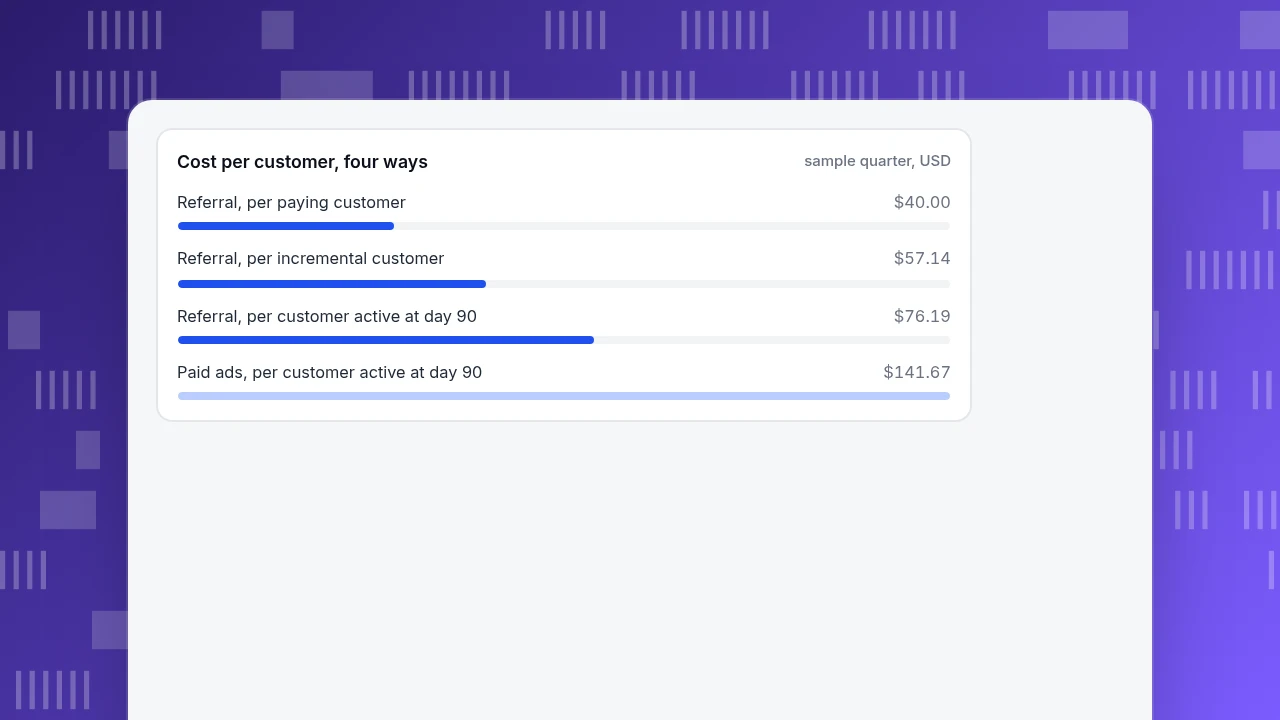
Read the example in three layers. The raw cost looks like $40; adjusted for people who would have come anyway it is $57; and per customer who stays it is $76. The ranking against the paid channel survives all three adjustments here, which is the property you want before you trust a program. If it had flipped at the third line, the headline number would have misled you.
The viral coefficient for the same program, using the definition in the table above:
- Invites per customer: 4,000 ÷ 10,000 = 0.4
- Invite-to-paid rate: 120 ÷ 4,000 = 3%
- Coefficient: 0.4 × 3% = 0.012; counting only those who shared, 5 × 3% = 0.15
Both are far below 1. The program brings in 120 customers a quarter; it will not grow on its own, and nobody should expect it to.
Cost per customer, four ways
sample quarter, USDHow do you design a reward that pays for itself?
Set the reward from the numbers above, not from what other programs offer. A workable rule: the cost per incremental customer should be below what you would pay for the same customer elsewhere, and below a fraction of the gross profit you expect from that customer in the first year.
Use these decision rules:
- If the gap between sign-ups and paid is wide (as in the example, 480 to 120), move the reward to the paid event, or to the end of the refund window.
- If participation is under about 2%, the problem is the ask, not the reward. Change the trigger moment before raising the reward.
- If the invite-to-sign-up rate is low but invites per participant is high, people are sharing but the offer is not landing; rewrite the landing page and make the friend's benefit explicit.
- If cost per incremental customer is above your other channels, shrink the reward or cap it per referrer, and look at retention before cutting: a more expensive customer who stays may still be the cheaper one.
- If a few referrers account for most sign-ups, check for self-referral and coupon-site abuse before celebrating.
The reward is also a legal question. In the United States, the FTC's Endorsement Guides treat a payment or other benefit to someone who recommends your product as a material connection that has to be clearly disclosed when it is not obvious to the audience. A referrer who posts a link publicly and earns credit for it should say so; build the disclosure into the share text. This is general information, not legal advice; check the rules in each market you run the program in.
| What you see | Likely cause | First change |
|---|---|---|
| Participation under about 2% | The ask or the moment is wrong | Move the trigger to after a good experience |
| Many invites, few sign-ups | The offer is unclear on the landing page | Name the friend's benefit above the fold |
| Many sign-ups, few payers | Reward paid too early | Pay at the first paid order |
| Cost above other channels | Reward too large or baseline ignored | Cap the reward, then compare retained cost |
| A few referrers drive most sign-ups | Self-referral or coupon sites | Sample referred accounts every month |
Change one thing at a time and compare against a quarter of baseline.
What do referral marketing examples look like in practice?
Rather than naming companies, it is more useful to group programs by shape, because the shape decides the metrics you watch. Only one published example is specific enough to quote: a study of a German bank's referral program, published in the Journal of Marketing, found that customers acquired through referrals were worth at least 16% more than similar customers acquired otherwise (Schmitt, Skiera and Van den Bulte, 2011). It is one company, in one country, and the authors recommend a selective approach, not a blanket one.
| Program shape | Typical reward | Fits when | Watch out for |
|---|---|---|---|
| Double-sided credit | Account credit for both people | Subscription and software products | Credit given for sign-ups that never pay |
| Tiered rewards | Higher reward after the 3rd or 5th referral | Ecommerce with repeat purchases | Top referrers gaming the tiers |
| Non-cash perks | Early access, extra storage, a free month | Products with marginal cost near zero | Perks that cost support time |
| Partner referral | Fixed fee per qualified customer | B2B services sold by consultation | Slow payback, long sales cycle |
| Community ambassador | Recognition plus a small fee | Products with an active user community | Disclosure and consistency of message |
If you are choosing among these, pick the one whose reward event matches the moment of value in your product: the first paid order, the first completed project, the second month. Reward the moment the customer proves it was a good referral.
Which mistakes make a referral program look better than it is?
- Counting sign-ups as customers. In the example, 480 sign-ups became 120 payers. Reporting the first number overstates the program fourfold.
- Ignoring the people who would have come anyway. Without an adjustment for baseline, every customer who mentioned a friend is credited to the program.
- Comparing average cost, not retained cost. The $85 channel in the example looks cheaper than the $57 referral channel only if you stop before day 90.
- Mixing the loop with the channel. Referral link visits are one source among several; if the campaign tag is missing, they fall into direct or into the generic referral bucket.
- Reporting the viral coefficient as growth. At 0.012 the loop is a rounding error on total growth. Report it as a cost and retention story.
- Skipping fraud checks. Self-referral, throwaway accounts and coupon sites inflate sign-ups quickly; sample the referred accounts every month.
How do you measure a referral program in TapCub?
TapCub does not run referral programs: it has no referral codes, reward tracking or payouts, and no tool for sending invites. Use a referral tool or your own back end for that. What TapCub does is measure what the program brings in, using the same steps as the example above.
- Tag the links. Give every referral link a campaign tag, for example
utm_source=referralwith a campaign name, following the naming rules in name UTM parameters. Do not put a person's name or email in the link. In Web analytics › Sources, the UTM view then shows visitors, sessions and conversions for the campaign separately from the generic referral channel. - Mark the qualifying events. Send a sign-up event with
tapcub.track('signup', { referred: true })from the page or your server, and the paid event as a goal, so Web analytics › Goals shows the conversion rate of the referral campaign beside your other sources. A visitor who signs up and logs in withtapcub.loginshows up in All-platform analytics › Users › People, with the timeline of what they did. - Compare retention by group. In All-platform analytics › Behavior › Behavior analysis, build the retention view and compare customers who did
signupwithreferredset against those who did not. This is the 75% versus 60% comparison from the example; the retention report guide is build a retention report. - Check the bots. TapCub counts recognised bots separately, so a spike in referral link visits that comes from crawlers does not lift your visitor count or conversion rate.
- Know the boundary. TapCub does not attribute sales back to a referrer's reward, does not hold back a random group to test the effect of the program, and does not pay rewards. The incremental-share adjustment and the reward cost live in your own spreadsheet.
FAQ
What is referral marketing?
It is a program in which existing customers recommend your product to people they know, with a tracked link or code and usually a reward. It differs from word of mouth because it is structured and measured, and from affiliate marketing because the senders are customers, not publishers whose job is promotion.
What is the difference between a referral program and affiliate marketing?
In a referral program the sender is a customer who uses the product; the reward is usually credit or a perk, and volumes are small per person. In affiliate marketing the sender is a publisher or creator who promotes for a living, paid a commission on sales. The measurement is similar; the disclosure and fraud risks are different.
How do you measure the success of a referral program?
Follow the loop: participation rate, invites per participant, invite-to-sign-up rate and sign-up-to-paid rate. Then judge the program with two numbers: cost per incremental customer, and retention of referred customers against other channels. A program is working when both beat the alternatives you already run.
What is a good referral rate?
There is no reliable universal figure. In the sample example 8% of customers shared and 3% of invites became paying customers, but those numbers are invented. Measure your own baseline for a quarter, change one thing (trigger moment, reward, landing page) and compare against it.
Do referral rewards need to be disclosed?
In the United States, the FTC treats payment or benefits to someone who recommends a product as a material connection that must be clearly disclosed when the audience would not expect it. Put the disclosure in the share text itself. Rules differ by country, and this is not legal advice.
Sources
- Christian Schmitt, Bernd Skiera & Christophe Van den Bulte. Referral Programs and Customer Value. Journal of Marketing 75(1), 2011 — referred customers' value at least 16% higher than comparable non-referred customers. Verified 2026-11-19.
- Federal Trade Commission. Guides Concerning the Use of Endorsements and Testimonials in Advertising (16 CFR Part 255, 2023 revision) — disclosure of material connections, section 255.5. Verified 2026-11-19.
Was this article helpful?
We use your answers to fix and expand this page.
Couldn’t send. Please try again in a minute.
Thanks for the feedback. We’ll use it to improve this page.You’ve already sent feedback on this page. Thanks.

Product Experience Specialist
Explores usability, user journeys, and feature adoption through practical examples of onboarding and everyday product use.