Try it on your own data
Every report in this article is in the free plan. One snippet for web and apps, up to 10 sites.
Start freeA retail chatbot should take orders, shipping and returns first: in the sample month they were 62% of chats, their answers are stable, and mistakes have a bounded cost. A policy-only bot can close about a third of all chats; order-specific questions stay with people. Below: which questions need the order system, the worked numbers, answer wording and handoff rules.
What you will learn
- Start with orders, shipping and returns: 62% of chats in the sample, with stable answers
- A bot without order access answers policy, not 'where is my order'; hand those to a person
- Never let the bot invent a delivery date; you are responsible for what it says
What does a retail chatbot actually do?
A retail chatbot is software that answers shoppers' questions in a store's chat window, in plain language, and passes the conversation to a person when it cannot. It does not need to sell anything. In most stores its useful work is answering the same few questions that arrive every day.
Those questions fall into a small number of families:
| Question family | Typical examples | Does the answer change per customer? |
|---|---|---|
| Orders | Where is my order? Can I change the address? Can I cancel? | Yes, it depends on the order |
| Shipping | How much, how long, which countries, what happens if I am not home? | No, it is policy |
| Returns and exchanges | How do I return this? How long do I have? When do I get my refund? | Mostly no, it is policy plus a few cases |
| Sizing and product details | Does this run small? Is it machine washable? | No, it comes from the product page |
| Payment and discounts | Why was my card declined? Does this code stack? | Partly |
The thesis of this article is simple: a retail bot should take orders, shipping and returns first. They are the highest-volume families, their answers are stable, and getting one wrong has a clear, bounded cost. For the wider list of what a store bot can do, see AI chatbot for ecommerce and chatbot use cases; this guide is about ordering the work and drawing the line where the bot stops.
Which questions should the bot take first?
Rank each question family on four tests, and start with the families that pass them all:
- Volume. How many chats does it account for? Count a month of real chats, do not guess.
- Repeatability. Is the answer the same every time, or does it depend on the shopper's order?
- Stability. Does the answer stay true for months, or change with every sale?
- Cost of an error. If the bot is wrong, is it a mild annoyance or a refund and an angry customer?
Sample data: a store tags 1,000 chats in a month.
| Question family | Chats | Share |
|---|---|---|
| Orders (status, change, cancel) | 250 | 25% |
| Returns and exchanges | 200 | 20% |
| Shipping (cost, time, countries) | 170 | 17% |
| Sizing and fit | 120 | 12% |
| Product details | 110 | 11% |
| Payment | 60 | 6% |
| Discount codes | 50 | 5% |
| Other | 40 | 4% |
Orders, returns and shipping total 250 + 200 + 170 = 620 chats, or 62%. That is the case for starting there: the first three families cover almost two-thirds of the volume with answers that rarely change. The next section shows how much of it the bot can really close without a person.
What can the bot answer alone, and what needs the order system?
This is the line most retail bot projects get wrong. A bot answers from the text you give it. It does not know where a given parcel is unless it is connected to the order and carrier systems, and a bot that has not been connected must not pretend it is.
| Question | Needs this shopper's order data? | What a bot without order access can do |
|---|---|---|
| How long does standard shipping take? | No | Answer from the policy |
| Do you ship to Canada, and what does it cost? | No | Answer from the policy table |
| How do I start a return? | No | Give the steps and the window |
| Where is my order #48210? | Yes | Explain how to find the tracking link; hand off if it is late |
| Can I change my address? | Yes | Explain the cut-off; hand off to a person to do it |
| My parcel arrived damaged | Yes | Apologise and hand off |
Two legal anchors make this more than good manners. In the United States the Federal Trade Commission's Mail, Internet, or Telephone Order Merchandise Rule says that if you state no shipping time, you must ship within 30 days of receiving the order, and if you cannot ship on time you must offer the buyer, clearly and without being asked, the choice to accept the delay or cancel for a prompt refund. So a bot should never invent a delivery date: it should quote your stated times and hand off when a delay needs that offer. And a tribunal has held a company responsible for what its chatbot told a customer: see Moffatt v. Air Canada, 2024 BCCRT 149. Whatever the bot says, you said.
| Question | Needs this shopper's order data? | What a policy-only bot does |
|---|---|---|
| How long does shipping take? | No | Answers from the policy |
| How do I start a return? | No | Gives the steps and the window |
| Where is my order? | Yes | Explains how to find tracking; hands off if late |
| Can I change my address? | Yes | Explains the cut-off; hands off |
| Damaged item | Yes | Apologises and hands off |
The line is data access: policy answers can be automated, order-specific ones need a person or an order integration.
How much of the volume can the bot close?
Using the sample month above, suppose the team sets the share of each family a policy-only bot can fully answer, based on reading real transcripts:
| Question family | Chats | Fully answerable by the bot | Closed by the bot |
|---|---|---|---|
| Shipping | 170 | 80% | 136 |
| Returns and exchanges | 200 | 70% | 140 |
| Orders | 250 | 20% | 50 |
| First three families | 620 | 326 |
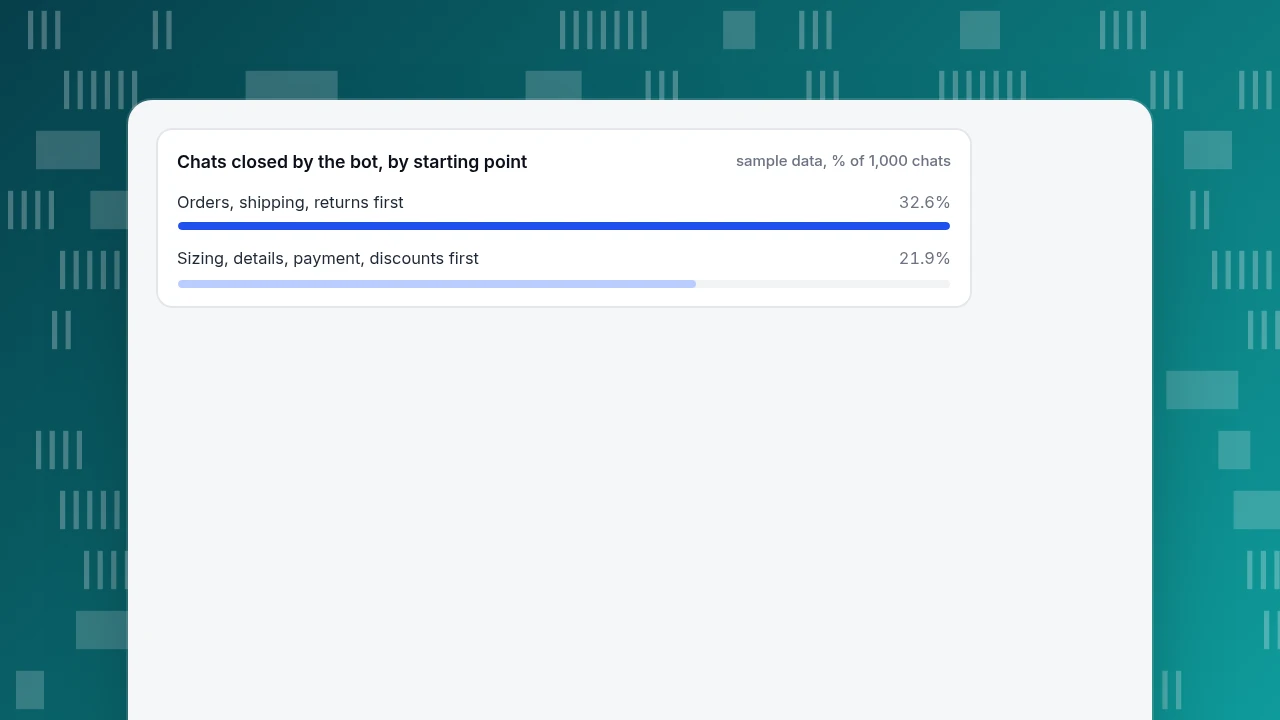
326 ÷ 1,000 = 32.6% of all chats closed without a person. The other 674 chats still reach an agent, 294 of them (620 − 326) in the three families themselves: the cases that need an order lookup or a judgement call.
Now compare with a team that starts with the next four families instead:
| Question family | Chats | Fully answerable | Closed |
|---|---|---|---|
| Sizing and fit | 120 | 60% | 72 |
| Product details | 110 | 70% | 77 |
| Payment | 60 | 50% | 30 |
| Discount codes | 50 | 80% | 40 |
| Four families | 340 | 219 |
219 ÷ 1,000 = 21.9%. Even with four families to maintain instead of three, the team closes 107 fewer chats (326 − 219). At 6 agent minutes per chat that is 326 × 6 = 1,956 minutes, 32.6 hours, handled by the first three against 219 × 6 = 1,314 minutes, 21.9 hours. The answerable percentages are assumptions to show the method; replace them with your own after reading transcripts.
Chats closed by the bot, by starting point
sample data, % of 1,000 chatsHow should the answers be written?
Each answer should do three things: give the answer in the first sentence, state the condition that changes it, and say what happens next. A returns answer in that shape:
You can return unworn items within 30 days of delivery. Start at the returns page with your order number and we will email a prepaid label. Refunds go back to your original payment method within 5 business days after we receive the parcel. Sale items can be exchanged but not refunded. Want me to hand this to a person?
Things to keep in mind when writing the policy text:
- Use the numbers in your actual policy. Do not round "within 30 days of delivery" to "about a month".
- Name exceptions in the same answer. Final-sale items, customised products and international returns are where wrong answers cost money.
- Offer the person. End every answer on something the shopper can do next, including asking for a human.
- Date the policy. If shipping times change for a sale period, update the answer the same day.
When should the bot hand off?
Decide the triggers before launch rather than discovering them in complaints:
| Trigger | Why |
|---|---|
| The question needs the shopper's order data | The bot cannot see it |
| Damaged, missing or wrong item | Needs a decision and often a refund |
| Payment declined or charged twice | Money and fraud; a person decides |
| The shopper asks for a person | Always honour it |
| Two answers in a row did not resolve it | The bot is not helping |
| Strong frustration in the wording | Tone matters more than speed |
When people and AI work together the effect can be large: in a study of customer-support agents using an AI assistant, issues resolved per hour rose by 14% on average and 34% for novices (Brynjolfsson, Li and Raymond, NBER). That is an argument for giving agents the bot's draft and the conversation so far, not for removing them.
What goes wrong with retail chatbots?
- Promising a delivery date the bot cannot know. Quote the stated window; hand off for specifics.
- Starting with product recommendations. In the sample, product details were 11% of chats, and recommendations need the product data kept correct.
- No handoff. A bot that loops is worse than no bot.
- Letting the policy text go stale. A wrong refund promise at sale time is a customer-service cost.
- Judging success by chats started. Count chats closed without a person, and whether those shoppers came back with the same question.
How do you set this up in TapCub?
Take the store in the example. It wants the bot to cover shipping and returns and to hand orders to a person. In TapCub that looks like this:
- In Live chat › Knowledge base, add the shipping and returns answers as Q&A entries. A Q&A entry is sent as written when the question matches, and does not use an AI call. Add longer policy pages as documents, which are split into passages and used by the model to draft a reply.
- In Live chat › Chat settings › AI assistant, choose a mode: AI answers first, or AI only when all agents are offline. When the material is not enough, the conversation goes to a person. TapCub's AI only generates replies; it does not look up orders, change addresses, send email or call other systems, which is exactly why order-specific questions stay with people.
- Pin the most common answers, such as "How do I return an item?", so they show in the visitor's FAQ. Opening a pinned answer does not create a conversation; clicking Not solved or asking for a person does.
- In Live chat › Inbox, an agent sees the visitor's source, current page and the last two days of browsing, so someone who asks "where is my order?" while on the order-status page is easy to place.
- In Live chat › Reports, watch the knowledge base hit rate and the conversations that reached an agent, then add Q&A entries for the questions that keep falling through. Offline messages are counted separately and are not counted as resolved.
FAQ
What is a retail chatbot?
It is software that answers shoppers' questions in a store's chat window, usually about orders, shipping, returns, sizing and payment, and hands the conversation to a person when it cannot help. It works from the answers you give it, so its quality depends on the policy text and the handoff rules behind it.
What should a retail chatbot handle first?
Orders, shipping and returns. In the sample month they were 62% of chats and have stable answers. Start with policy-only answers for shipping and returns, give order-specific questions to people, and add sizing and product details only after reading real transcripts.
Can a retail chatbot track orders?
Only if it is connected to the order and carrier systems. Without that, it can explain how to find a tracking link and what the stated delivery times are, and hand over when a parcel is late. In TapCub the AI generates replies only; it does not look up orders.
Will a retail chatbot replace customer service staff?
In the sample it closed about a third of chats; the rest still needed people, often with the policy answer already given. Staff handle order-specific cases, damage and payment problems, and anything the shopper asks a person about.
Who is responsible for what a retail chatbot says?
You are. A Canadian tribunal held an airline liable for what its website chatbot told a customer. Keep policy text accurate and dated, and set rules for handing over anything the bot should not decide.
Sources
- Federal Trade Commission. Mail, Internet, or Telephone Order Merchandise Rule, 16 CFR 435.2: 30-day default shipping time and the delay-notice option. Verified 2026-11-19.
- Civil Resolution Tribunal of British Columbia. Moffatt v. Air Canada, 2024 BCCRT 149: responsibility for chatbot information. Verified 2026-11-15.
- Erik Brynjolfsson, Danielle Li and Lindsey R. Raymond. Generative AI at Work. NBER Working Paper 31161, 2023: 14% average and 34% novice-worker gains. Verified 2026-11-15.
Was this article helpful?
We use your answers to fix and expand this page.
Couldn’t send. Please try again in a minute.
Thanks for the feedback. We’ll use it to improve this page.You’ve already sent feedback on this page. Thanks.

Product Analyst
Focuses on event analysis, conversion funnels, and retention, using clear metric definitions and structured analysis to explain product performance.