Try it on your own data
Every report in this article is in the free plan. One snippet for web and apps, up to 10 sites.
Start freeNo chatbot is HIPAA compliant on its own: HIPAA puts duties on covered entities and their business associates, not on software. Before you pick a bot, ask two things: will protected health information (PHI) ever reach it, and is the vendor acting as your business associate under a signed agreement (BAA)? This guide gives the checks, a transcript audit and a decision table. It is not legal advice.
What you will learn
- Ask whether PHI will reach the bot and whether the vendor is a business associate, rather than looking for a compliance badge
- Sample 200 real transcripts to measure how much health detail visitors type; the answer is rarely zero
- Keep PHI out by design: limit topics, warn visitors, route health questions to a person on a covered channel
What does "HIPAA compliant" actually mean for a chatbot?
HIPAA is a US law that puts duties on two kinds of organisation: covered entities (health plans, clearinghouses and most health care providers) and their business associates. It does not certify products. A chatbot cannot be compliant on its own, in the way a lock cannot be "burglary proof" without a door and a key policy. Compliance is a property of how a covered entity or business associate uses the tool: what data goes in, who holds it, what contract binds the vendor, and what safeguards run around it.
Two definitions from the regulation text decide almost everything that follows. Protected health information (PHI) is individually identifiable health information, held or sent in any form. A business associate is an outside person or company that creates, receives, maintains or transmits PHI for a covered entity (45 CFR 160.103). So the first question is not "is this chatbot compliant?" but two simpler ones:
- Will PHI ever reach this chatbot? If the bot only answers "what are your opening hours?" for an anonymous visitor, there may be no PHI at all.
- If it will, is the vendor acting as our business associate? If yes, a signed business associate agreement (BAA) is required before any PHI flows.
A vendor page that says "HIPAA compliant" answers neither. Treat the phrase as a claim to be tested with the checklist below, not as evidence. This article is a practical guide, not legal advice; your privacy officer or counsel decides what applies to you.
When does a chatbot touch PHI?
Information becomes PHI when it relates to a person's health, care or payment for care, comes from or goes to a covered entity, and either names the person or could reasonably identify them. The de-identification rule lists 18 kinds of identifier, and several are exactly what a chat widget sees by default: names, email addresses, telephone numbers, account and medical record numbers, device identifiers, web URLs and IP address numbers (45 CFR 164.514(b)(2)).
Put those next to a health topic and the line is easy to cross:
| Chat message | PHI? | Why |
|---|---|---|
| "Is the clinic open on Saturday?" from an anonymous visitor | Usually no | No health information about an identifiable person |
| "I'm Maria Lopez, can I move my 3 pm appointment?" | Likely yes | Name plus a relationship with a provider and an appointment |
| "My MRN is 48213, what do my results mean?" | Yes | Record number plus health information |
| "Does your office take Plan X?" with the visitor's email in the form | Depends | Insurance question plus identifier; ask your privacy officer |
| "I have chest pain, what should I do?" with no name | Possibly | Health detail plus an IP address and device data the platform captures |
The last two rows are why "we do not ask for names" is not a design. A visitor volunteers detail, and the platform around the bot (logs, analytics, translation, AI model calls) records it. Decide the rule for the grey rows with your privacy officer before launch, not after the first transcript review.
How to audit what your chatbot actually collects
Do not guess how much health detail visitors type. Sample it. Here is a worked example with sample data.
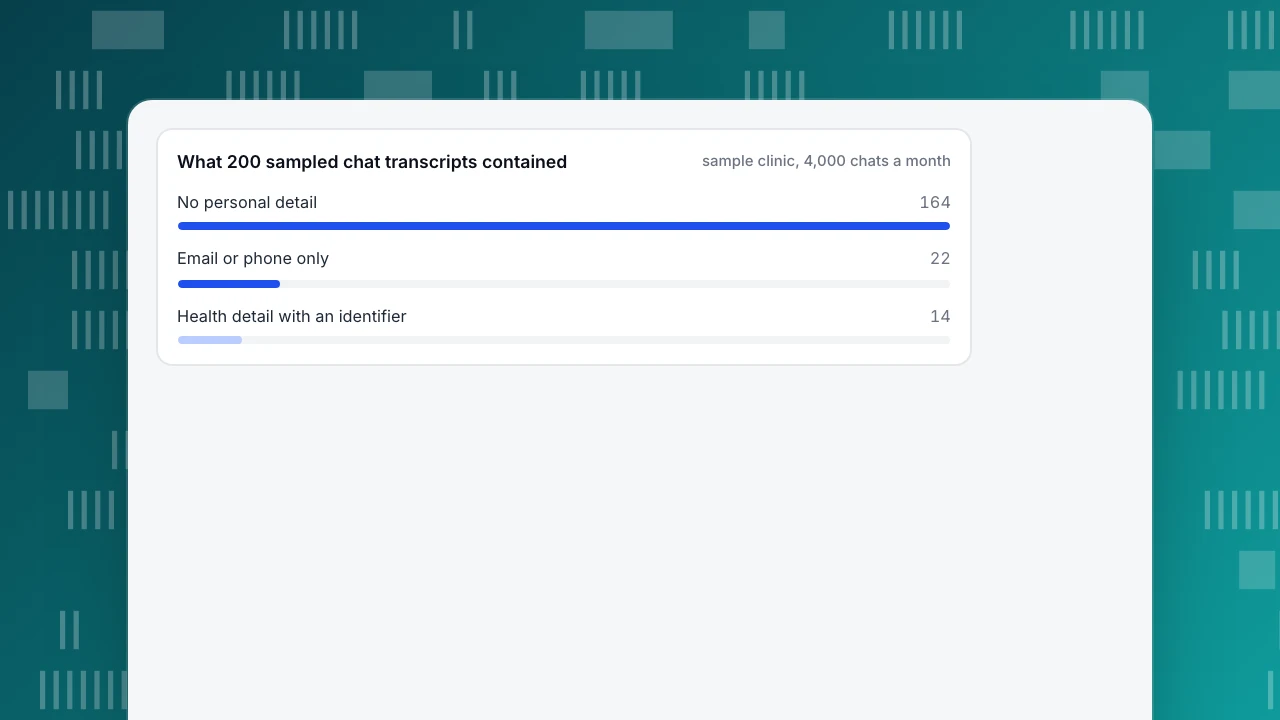
Sample data: a clinic's website bot handles 4,000 conversations a month. A reviewer reads a random 200 transcripts and tags each one.
- 14 contain health detail with an identifier (a name plus a symptom, a record number, a date of birth): 14 ÷ 200 = 7.0%.
- 22 contain only an email address or phone number (callback requests): 22 ÷ 200 = 11.0%.
- 164 contain neither: 164 ÷ 200 = 82.0%. Check: 14 + 22 + 164 = 200.
Scaled to the month, 7.0% of 4,000 is 280 conversations with health detail attached to an identifier. Because 200 is a sample, give a range: the 95% Wilson interval for 14 of 200 is 4.2% to 11.4%, which is roughly 168 to 456 conversations a month. Either way the answer is not zero, and "the bot never sees PHI" is not a position the data supports.
That number drives the decision. At 168 conversations a month, avoiding PHI by design needs a visible warning, a refusal pattern and a handoff to a secure channel. At 456 it also needs the vendor to be ready to sign a BAA, in case you decide the bot must handle those conversations rather than push them away.
What 200 sampled chat transcripts contained
sample clinic, 4,000 chats a monthWhat must a BAA and the vendor's safeguards cover?
The regulation sets the floor for a business associate contract. Under 45 CFR 164.504(e) the contract must limit how the vendor may use and disclose PHI, require appropriate safeguards and compliance with the Security Rule for electronic PHI, require reporting of unauthorised uses and breaches, bind subcontractors to the same restrictions, support individuals' access and amendment rights, make records available to HHS, and say what happens to the PHI when the contract ends: return or destroy it if feasible. The covered entity must also be able to terminate if the vendor materially breaches.
For a chatbot the contract only matters if the technical stack matches it. A chatbot is rarely one company; it is a widget, a hosting provider, often a third-party language model, plus logging, analytics and email. Use this table in a vendor review:
| Layer | Question to ask | Evidence to request |
|---|---|---|
| Chatbot vendor | Will you sign a BAA, and which services does it cover? | The signed BAA and its service schedule |
| Language model | Which model provider sees the text; is that provider bound by a BAA too? | Sub-processor list, flow-down terms |
| Hosting | Where is data stored, and who can reach it? | Hosting description, access policy |
| Logs and analytics | Do transcripts, IP addresses or device IDs reach other tools? | Data-flow diagram |
| Email and notifications | Do transcripts leave the platform by plain email? | Notification settings, transport security |
| Support access | Can the vendor's staff read your transcripts, and is it logged? | Access policy, audit log sample |
The BAA is not optional if the vendor handles PHI, and it does not make the vendor responsible for everything. You still decide what the bot is allowed to collect.
| Layer | Question to ask | Evidence to request |
|---|---|---|
| Chatbot vendor | Will you sign a BAA, and which services does it cover? | The signed BAA and its service schedule |
| Language model | Which model provider sees the text; is it bound by a BAA too? | Sub-processor list, flow-down terms |
| Hosting | Where is data stored, and who can reach it? | Hosting description, access policy |
| Logs and analytics | Do transcripts, IP addresses or device IDs reach other tools? | Data-flow diagram |
| Email and notifications | Do transcripts leave the platform by plain email? | Notification settings, transport security |
| Support access | Can vendor staff read your transcripts, and is it logged? | Access policy, audit log sample |
Ask for documents, not assurances; a badge without scope tells you little about your use case.
Which Security Rule safeguards should you check?
The Security Rule's technical safeguards in 45 CFR 164.312 give the vocabulary. Four items map directly to a chatbot review:
- Access control. Unique user identification is required; automatic logoff and encryption are "addressable", meaning you must implement them or document an equivalent measure and why. Check that every agent has their own login, and that sessions time out.
- Audit controls. The rule requires mechanisms that record and examine activity in systems holding electronic PHI. Ask whether you can see who opened which conversation.
- Integrity. Ask how the vendor detects altered or destroyed transcripts.
- Transmission security. Guard against unauthorised access to PHI in transit; encryption is addressable, so ask for the written reasoning if the vendor says it is not used.
Two more questions sit outside the technical list but decide real risk: how long transcripts are kept, and how a deletion request is carried out and confirmed. Link both to your own data retention policy; a transcript you no longer need is a transcript that cannot leak.
Ask for these as documents, not assurances. "Encrypted at rest" with no description of key handling, or "SOC 2" with no scope, tells you little about your use case.
What should a chatbot never be asked to collect?
The cheapest control is to keep PHI out of the conversation. Write down, in the bot's greeting and your policy, what the bot must not receive:
- Diagnoses, symptoms, medications and test results.
- Medical record numbers, insurance member IDs and claim numbers.
- Date of birth together with a name.
- Photos or uploaded documents that show any of the above.
- Anything a visitor would call "private" about their care.
Pair the rule with behaviour. A short opening line ("I can answer questions about hours, locations and billing. Please do not share health details here.") reduces volume. A refusal pattern when someone types a symptom ("I can't assess health issues here; please call us or use the patient portal") reduces the rest. A route to a person on an authenticated channel handles what remains.
Do not rely on automatic redaction alone. Pattern-based masking finds things with a fixed shape, such as card numbers; it cannot see a sentence like "my mother was just diagnosed with leukaemia". Treat masking as a safety net for formatted numbers, not as a way to make PHI safe to collect.
Which decision fits your situation?
| If your bot... | Then |
|---|---|
| Only answers general questions for anonymous visitors, and the greeting says not to share health details | Low PHI exposure; still review a transcript sample monthly and keep retention short |
| Books or changes appointments by asking for a name and date | PHI flows; you need a BAA with the chatbot vendor and every sub-processor that sees the text |
| Triages symptoms | Highest risk; clinical safety and liability sit alongside HIPAA; involve clinical and legal review before design |
| Is built on a general-purpose AI model | Confirm the model provider's terms for health data in writing; do not assume consumer versions are covered |
| Cannot get a BAA and you still need a chatbot | Keep the bot to non-PHI topics and route everything else to a person on a channel that is covered |
Notice what is not in the table: a vendor's compliance badge. If a decision turns on a badge, go back to the first question and ask what data the bot will see.
Common misunderstandings
- "The vendor is HIPAA compliant, so we are." HIPAA obligations stay with you as covered entity. The vendor's safeguards cover only what the vendor does.
- "A BAA makes any use fine." The BAA limits use and disclosure; it does not authorise collecting more than you need.
- "No names, so no PHI." The identifier list includes IP address numbers, device identifiers and URLs. See what counts as PII for how those overlap.
- "Encryption solves it." Encryption is addressable, not a cure. Who can decrypt, who has access and how long data stays matter equally.
- "One review at launch is enough." Prompts, knowledge-base articles and integrations change. Re-sample transcripts monthly for the first quarter.
- "Pasting PHI into a public chatbot is fine for drafting." Unless the provider has agreed to terms covering PHI, do not.
For where this sits among other bot designs, see types of chatbots, and for the wider design stance, privacy by design. If you are still choosing what a bot should handle, chatbot use cases lists the safe, low-risk starting points.
How to apply this with TapCub live chat
Take the clinic from the audit example. It wants a chat bubble that answers hours and billing questions and never becomes a place for health details. TapCub makes no HIPAA compliance claim, and this article does not treat TapCub as a HIPAA-ready vendor; the steps below are about reducing what the bot receives, not about certifying it.
- Limit what the bot can answer. In Live chat › Knowledge base, enter only general Q&A entries (hours, locations, billing contacts). An exact Q&A match is sent as written and uses no AI call. The knowledge base only produces a reply; it cannot change an order, send email or call another system.
- Choose the AI mode deliberately. In Live chat › Chat settings › AI assistant you can leave AI off or restrict it to when all agents are offline. If it is on, the visitor is told they are talking to an AI and the chat hands off when the material is not enough.
- Turn on masking, and know its limit. In Live chat › Chat settings › Privacy, "Mask sensitive data" rewrites card numbers that pass a checksum, Chinese national ID numbers, Chinese mobile numbers and numbers with an international prefix before storage. Email is left as is, because offline messages need it. It does not detect a symptom or a diagnosis typed in words.
- Write the greeting. In Live chat › Chat settings › Greeting & translation, put the "please do not share health details" line first. Offline messages ask for an email and a question, so repeat the warning there.
- Set the rest of the retention and access. Chat history cannot exceed the chat plan's retention cap, and agent permissions are set in Live chat › Agents.
TapCub does not make a platform HIPAA-compliant on your behalf, and it does not decide what counts as PHI for you; it only records what visitors type and what agents do. Take your own audit sample first, then judge whether that configuration is acceptable.
FAQ
Is there a HIPAA certification for chatbots?
No. HIPAA sets duties for covered entities and business associates; it does not certify software. A vendor can describe safeguards and sign a business associate agreement, but the compliance question is about how you use the tool with PHI.
Do I need a BAA for a website chatbot?
You need one if the vendor creates, receives, maintains or transmits PHI for a covered entity. If the bot only handles general questions from anonymous visitors and truly sees no PHI, the answer may be no, but test that with a transcript sample rather than assuming it.
Is ChatGPT HIPAA compliant?
Compliance is not a property of the tool name. Whether you may put PHI into a general-purpose AI service depends on the provider's written terms for health data, including a BAA where required. Check the specific product and plan in writing, and do not paste PHI into consumer versions.
Can a chatbot collect names and appointment details?
Yes, a covered entity can, if the vendor is bound by a BAA, safeguards match the Security Rule, access is limited and logged, and the data is kept only as long as needed. Many clinics reduce risk by sending appointment changes to an authenticated portal instead.
What is the safest way to start?
Launch a bot for non-PHI questions, tell visitors not to share health details, sample 200 transcripts after the first month, and expand only if the data and your privacy officer support it.
Sources
- Cornell Legal Information Institute, 45 CFR 160.103, Definitions — "business associate" and "protected health information". Verified 2026-11-18.
- Cornell Legal Information Institute, 45 CFR 164.514, De-identification — the 18 identifiers in paragraph (b)(2)(i). Verified 2026-11-18.
- Cornell Legal Information Institute, 45 CFR 164.504(e), Business associate contracts — required contract terms. Verified 2026-11-18.
- Cornell Legal Information Institute, 45 CFR 164.312, Technical safeguards — access control, audit controls, integrity, transmission security. Verified 2026-11-18.
Was this article helpful?
We use your answers to fix and expand this page.
Couldn’t send. Please try again in a minute.
Thanks for the feedback. We’ll use it to improve this page.You’ve already sent feedback on this page. Thanks.

Solutions Engineer
Covers SDKs, API integrations, and data implementation, with an emphasis on validation, system interoperability, and troubleshooting.