Try it on your own data
Every report in this article is in the free plan. One snippet for web and apps, up to 10 sites.
Start freeA feature is what the product does; a benefit is what the customer gets because of it. Turn one into the other by asking "so what?" until the answer is about the buyer's time, money or worry, lead with the benefit and name the feature behind it, then test the copy: in the sample, benefit-led ad copy got a 3.9% click-through rate against 2.8%.
What you will learn
- Ask "so what?" until the answer is about the buyer, then put that in the headline and the feature in the first line under it
- Plain, concrete writing wins: Nielsen Norman Group measured a version that was concise, scannable and objective as 124% better on usability than promotional copy
- Test with a sample size: about 4,200 impressions per variant detects 2.8% against 3.9%; 1,000 per variant would not
Features and benefits: the two definitions
A feature is what the product is or does: "automatic weekly backups". A benefit is what the customer gets because of it: "restore yesterday's version in two clicks after a bad edit". Features describe the product, benefits describe the customer's situation, and good copy connects them with a bridge such as "so you can" or "which means".
A third layer sometimes helps. In the feature-advantage-benefit (FAB) pattern, the advantage is why the feature beats the alternative: backups run without anyone remembering, so none are missed. You do not need all three in every line, but you do need the connection, because a feature alone makes the reader do the translation, and most will not.
The "so what" test: turn a feature into a benefit
Take each feature and ask "so what?" until the answer is something the buyer would say in their own words.
| Feature | So what? (first answer) | So what? (second answer: the benefit) |
|---|---|---|
| Real-time sync | Everyone sees edits at once | Nobody works from an old version, and nobody asks "is this the latest?" |
| Custom dashboards | You choose the charts | The three numbers you check every Monday are on one page |
| Mobile app | It runs on a phone | Approve a request from the train instead of waiting until you are at a desk |
| API access | Other tools can read your data | Orders flow into your own report without copying files by hand |
Stop when the answer is about the buyer's day, money, time or worry, not about the product. If you cannot get there, the feature may not matter to this buyer and belongs lower on the page.
| Feature | Benefit (second "so what?") |
|---|---|
| Real-time sync | Nobody works from an old version |
| Custom dashboards | The three numbers you check every Monday are on one page |
| Mobile app | Approve a request from the train |
| API access | Orders flow into your report without copying files |
Illustrative examples; stop asking "so what?" when the answer is about the buyer's day, money, time or worry.
Before-and-after copy
The examples are illustrative rewrites of a generic analytics product.
| Element | Feature-led (before) | Benefit-led (after) |
|---|---|---|
| Headline | "Advanced analytics platform with AI-powered insights" | "See why visitors leave, and fix it this week" |
| Sub-line | "Session replay, heatmaps and funnels in one dashboard" | "Watch where people get stuck, then check the fix worked" |
| Button | "Learn more" | "Show me my checkout drop-off" |
| Feature bullet | "Real-time event pipeline" | "Today's numbers by noon, not next week" |
Notice what changed. The benefit versions are shorter, name an outcome and keep one concrete detail ("checkout", "noon"). They do not become vague: "Boost your growth" would be worse than the feature version, because it promises everything and shows nothing.
When to lead with a feature instead
Benefits first is a default, not a law. Lead with the feature when:
- The reader searches for the feature by name ("session replay", "SSO"). They already know the benefit and want to confirm you have it.
- The buyer is technical and comparing. A list of capabilities answers their question faster than a story.
- The feature is the news. A launch page can open with the new capability, as long as the benefit follows in the next sentence.
A rule that works: put the benefit in the headline and the feature in the first line under it, so the page serves both the skimmer and the checker.
Write feature bullets that carry the benefit
A feature list is where most pages lose the reader, because it is a column of nouns. Give every bullet the same three-part shape: outcome, for whom, by which feature.
- Template: "[Outcome] for [who], with [feature]."
- Before: "Role-based permissions."
- After: "Give contractors access to one project, not the whole account, with role-based permissions."
- Before: "Weekly digest emails."
- After: "Start Monday knowing what changed last week, with a one-page digest in your inbox."
Check each bullet against three questions. Does the first word describe something the reader gets or does, rather than something the product has? Could the same bullet sit on a competitor's page unchanged? Is there a detail only your product has: a number, a name, a limit? If the answers are yes, no and yes, keep it. Keep bullets to one line where you can, because scanning readers stop at the first line.
Choose the mix by page
The right balance depends on where the reader is. A home page or ad should be benefit-led, because the reader has not decided yet what the product is for. A pricing page should list features by plan, since the buyer is checking what they get for the money, but each plan still needs a one-line benefit for who it suits. A product or docs page can be feature-led, with the benefit as the opening sentence of each section. An email subject line almost always wins with a benefit and a number.
If you are unsure, check what visitors do: a high exit rate on a feature-led page and long time on a pricing table suggest the reader wants detail, not a pitch.
Plain, concrete writing beats promotional writing
Nielsen Norman Group tested versions of the same web page with 51 experienced users on three tasks. The version written in promotional language, which it calls "marketese", scored lowest on virtually all usability measures. Relative to it, a concise version scored 58% better, a scannable one 47% better, an objective one 27% better, and a version that combined all three 124% better. In a separate piece, the group reported that 79% of test users always scanned new pages and only 16% read word by word.
For benefit copy, that means three things: keep it short, put the outcome where a scanning eye lands (headline, first line of a bullet) and keep claims factual. "Save two hours a week on reporting" is objective and checkable; "revolutionary reporting" is not. For more on listing features without losing the reader, see product features, and for the page around the copy, landing page conversion rate.
Test the copy with a click-through experiment
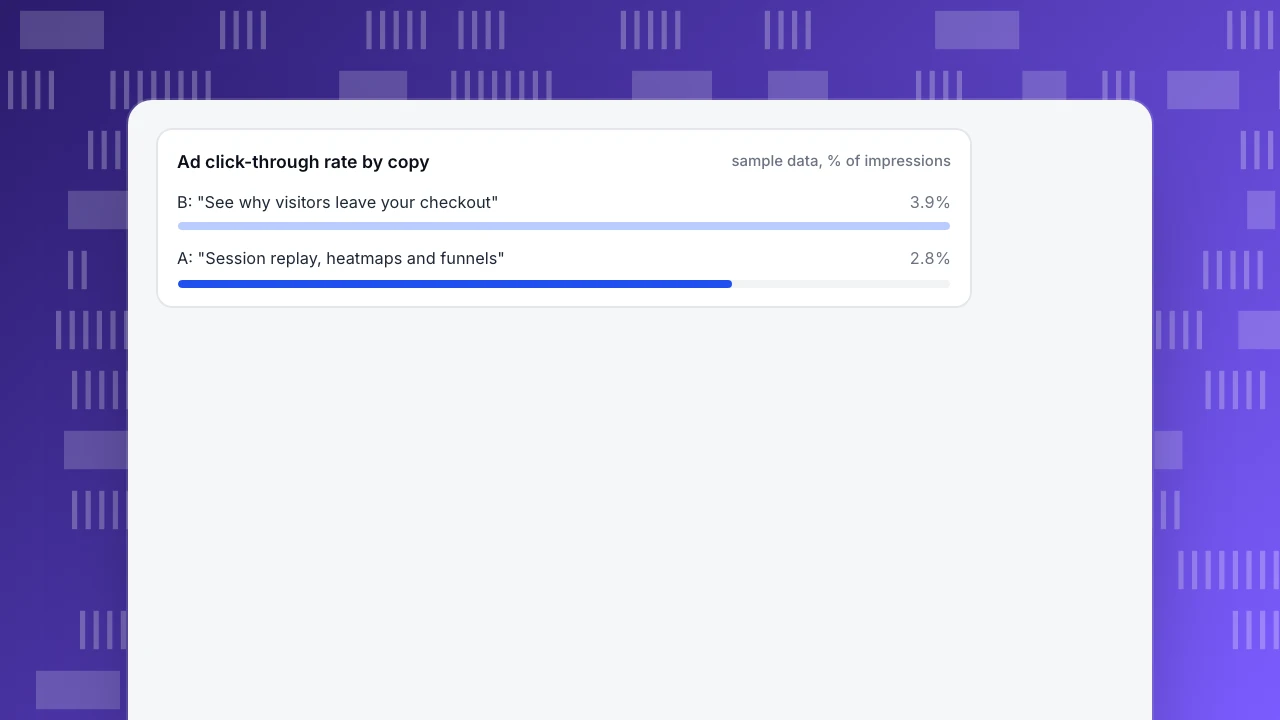
Do not assume the benefit version wins; test it. Sample data: two ad variants shown to equal audiences of 4,000 impressions.
| Variant | Copy | Impressions | Clicks | Click-through rate |
|---|---|---|---|---|
| A (feature) | "Session replay, heatmaps and funnels" | 4,000 | 112 | 2.8% |
| B (benefit) | "See why visitors leave your checkout" | 4,000 | 156 | 3.9% |
B is 3.9 ÷ 2.8 − 1 = 39% higher in relative terms. To check it is not chance, use a two-proportion z-test: pooled rate = (112 + 156) ÷ 8,000 = 3.35%; standard error = √(0.0335 × 0.9665 × (1/4,000 + 1/4,000)) = 0.00402; z = (0.039 − 0.028) ÷ 0.00402 = 2.7, p = 0.006. The 95% interval for the difference runs from +0.3 to +1.9 percentage points. The result holds: the benefit copy wins. The statistic is explained on the test statistic page, and the logic of the cut-off on statistical significance.
How big a test do you need? To detect 2.8% against 3.9% with 80% power at the 5% level, each variant needs about 4,200 impressions. With only 1,000 per variant, the same rates (28 and 39 clicks) give z = 1.4, p = 0.17: not significant, even though the relative lift is the same. Decide the sample size first, and stop when you reach it, not when the chart looks good.
Clicks are not customers. A headline that promises too much can win the click and lose the signup, so take the winner to the next step and compare signups per impression.
Ad click-through rate by copy
sample data, % of impressionsDo not let benefits drift into overclaiming
A benefit has to be true and backed by the feature. Three checks:
- Feature behind it. Name the capability that delivers the benefit in the same section.
- Number if you have one. "Two clicks" and "by noon" are stronger than "fast", but only if measured.
- Honest limits. Say who it is not for. A line like "built for teams of up to 50" sets expectations, and reduces refunds and complaints.
If a benefit line would survive on a competitor's page unchanged ("work smarter"), it is not yet a benefit of your product. Add the detail that only yours has.
Measure feature-led and benefit-led copy in TapCub
TapCub does not split traffic or run A/B tests; split in your ad platform, email tool or page editor, and use TapCub to compare what each version led to.
- Tag each version. Add a distinct
utm_content(for examplefeatureandbenefit) to the links of each version. Web analytics › Sources shows UTM source, medium, campaign, term and content, with sessions and conversions per row. - Define the outcome. In Web analytics › Goals, define the signup or demo request as a goal so each version shows a conversion rate, not only clicks.
- Compare past the click. In All-platform analytics › Behavior › Behavior analysis, run a funnel from the landing page to the goal, broken down by
utm_content, to see whether the click winner also wins at signup. Compare the counts with the z-test above. - Find the words customers use. Live chat › Inbox keeps what visitors ask, and the search-terms tab on Web analytics › Sources lists on-site search terms. Both are raw material for benefit lines in the customer's own language.
TapCub measures the outcome; the copy and the split stay with you.
FAQ
What is the difference between features and benefits?
A feature is what a product is or does; a benefit is what the customer gets from it. "Automatic weekly backups" is a feature; "restore yesterday's version in two clicks" is a benefit. Good copy states the benefit and names the feature behind it.
How do you turn a feature into a benefit?
Ask "so what?" until the answer is about the buyer's time, money, work or worry. Real-time sync becomes "nobody works from an old version". Stop when you reach something the buyer would say in their own words.
Should you lead with features or benefits?
Lead with the benefit by default and put the feature in the first line under it. Lead with the feature when the reader searches for it by name, when a technical buyer is comparing options, or when the feature is the news.
What is an example of a feature and a benefit?
Feature: "mobile app". Benefit: "approve a request from the train instead of waiting until you are at a desk". Feature: "custom dashboards". Benefit: "the three numbers you check every Monday are on one page".
How do you test benefit-led copy?
Split the audience in half, show each the same offer with different copy, and compare click-through, then signups. Decide the sample first: about 4,200 impressions per variant detects 2.8% against 3.9%. Check the gap with a two-proportion z-test.
Sources
- Nielsen Norman Group, Concise, SCANNABLE, and Objective: How to Write for the Web: 51 users; concise 58%, scannable 47%, objective 27%, combined 124% better than promotional writing. Checked 2026-11-21.
- Nielsen Norman Group, How Users Read on the Web (1997): 79% of test users always scanned, 16% read word by word. Checked 2026-11-21.
- NIST/SEMATECH e-Handbook of Statistical Methods, Comparing two proportions: pooled z-test statistic. Checked 2026-11-21.
Was this article helpful?
We use your answers to fix and expand this page.
Couldn’t send. Please try again in a minute.
Thanks for the feedback. We’ll use it to improve this page.You’ve already sent feedback on this page. Thanks.

Product Analyst
Focuses on event analysis, conversion funnels, and retention, using clear metric definitions and structured analysis to explain product performance.