Try it on your own data
Every report in this article is in the free plan. One snippet for web and apps, up to 10 sites.
Start freeA data management strategy is the written set of decisions on who owns each data set, what its fields mean, how good the data must be, who may use it and how long it is kept. It is the day-to-day layer beneath a data strategy. If you can write those five answers per data set and show evidence in five minutes, you have one; if not, more tooling will not help.
What you will learn
- Answer five questions per data set: owner, definition, quality, access and retention
- Name a person, not a team, as owner; ownership comes before any tool
- Measure it: ownership coverage, stale accounts, completeness and whether retention actually runs
What is a data management strategy?
A data management strategy is the written set of decisions about how your organisation looks after its data day to day: who owns each data set, what it means, how good it has to be, who may use it and how long it is kept. It is the operating layer. DAMA International describes its DAMA-DMBOK as the globally recognized framework for data management, offering principles, practices and functions for building and governing data programmes: a discipline, not a single tool or project.
It helps to keep three neighbouring ideas apart:
- A data strategy says what the business wants from data: the outcomes, use cases and priorities.
- Data governance is the set of decision rights: who is allowed to decide what about data.
- A data management strategy turns both into routine: owners, definitions, quality checks, access rules and retention periods that people can follow on a Tuesday afternoon.
The core claim of this guide is short: a data management strategy answers four questions for every important data set: who owns it, how long do we keep it, who can use it, and how do we know it is good. A fifth, what it means, makes the other four testable. If you can answer those five for each data set in writing, you have a strategy. If you cannot, more tools will not help.
Which five elements does a data management strategy need?
The table lists the five elements, the question each answers and what you should be able to show. Treat "evidence" as the test: if you cannot produce it in five minutes, the element exists only on paper.
Two points on how the elements relate. Ownership comes first, because every other decision needs a person who can make it. And quality and retention pull in opposite directions: quality argues for keeping more history to compare against, retention law and cost argue for keeping less. The strategy is where you settle that argument once, per data set, instead of every time someone asks.
| Element | Question it answers | Write down | Evidence you can show |
|---|---|---|---|
| Ownership | Who decides about this data? | One named owner per data set | A register with no empty owner cell |
| Definitions | What does each key term mean? | One definition and an approver per term | A glossary people actually open |
| Quality | How do we know it is good? | One check, one target, one person who looks | A check result from this month |
| Access | Who can see or change it? | Roles, what each role sees, who approves requests | A dated access review with leavers removed |
| Retention | How long do we keep it, and why? | A period and a reason per data set, plus the deletion method | A deletion that ran, not just a policy |
If you cannot produce the evidence in five minutes, the element exists only on paper.
How do you start in four weeks?
You do not need a programme office. A small team can get a first version running in four weeks if it works in this order.
| Week | Do this | Output |
|---|---|---|
| 1 | List the data sets that matter: where customer, order, product, marketing and support data lives | A one-page inventory with the system and the people who touch each set |
| 1 | Name one owner per data set; not a team, a person | Owner column filled for every row |
| 2 | Write the ten terms people argue about (customer, active user, order, revenue) with one definition each | A short glossary with a named approver |
| 2 | For each set, write one quality check you can run (required fields filled, no duplicates, matches invoices) | A check, a target and who looks |
| 3 | Review who has access; remove leavers, reduce admin rights, mask personal data from people who do not need it | A dated access review |
| 3 | Set a retention period per set, with the reason (purpose, law or contract) | Retention column filled and a deletion method |
| 4 | Agree how new data enters: who approves a new event, field or source | A short intake rule, and a place for requests |
| 4 | Put a quarterly review in the calendar | The same register, reviewed on a date |
Order matters. People often start with tools or a catalogue and skip step 1, then find nobody is responsible for what the tool shows. Owners and definitions are cheap; they are also what everything else depends on.
Worked example: a one-page data register for a 40-person company
Sample data: a 40-person online business writes its first register. The table shows part of it.
| Data set | Owner | Keep for | Quality check |
|---|---|---|---|
| Website events | Growth lead | 13 months | Required properties at least 98% complete |
| Orders | Finance lead | As tax rules require | Totals match payment records monthly |
| Support conversations | Support lead | 24 months | 20 sampled each month for wrong answers |
| Marketing email list | CRM owner | Until unsubscribed, then 12 months | Bounce rate under 2% |
| Ad spend sheet | Marketing lead | 36 months | Matches invoices each month |
| Product catalogue | Operations lead | Current plus 12 months | No duplicate SKUs |
Writing it down found three problems, and each can be measured.
Ownership coverage. Before the exercise, 3 of the 6 data sets had a named owner: 3 ÷ 6 = 50%. Afterwards, 6 ÷ 6 = 100%. The three without owners were the ad spend sheet, the product catalogue and the email list.
Stale access. The analytics project had 25 accounts with access. A comparison with the staff list found 4 belonging to people who had left: 4 ÷ 25 = 16% of accounts were stale. All four were removed in week 3.
Retention. The website events table was growing by about 2,000,000 events a month and nothing was ever deleted. Keeping 60 months would hold 2,000,000 × 60 = 120,000,000 events; keeping 13 months holds 2,000,000 × 13 = 26,000,000. That is a reduction of (120 − 26) ÷ 120 = 78.3% in stored rows, with the 13 months still covering a full year plus one month for year-on-year comparison.
None of these needed new software. They needed a list, a column of names and an afternoon.
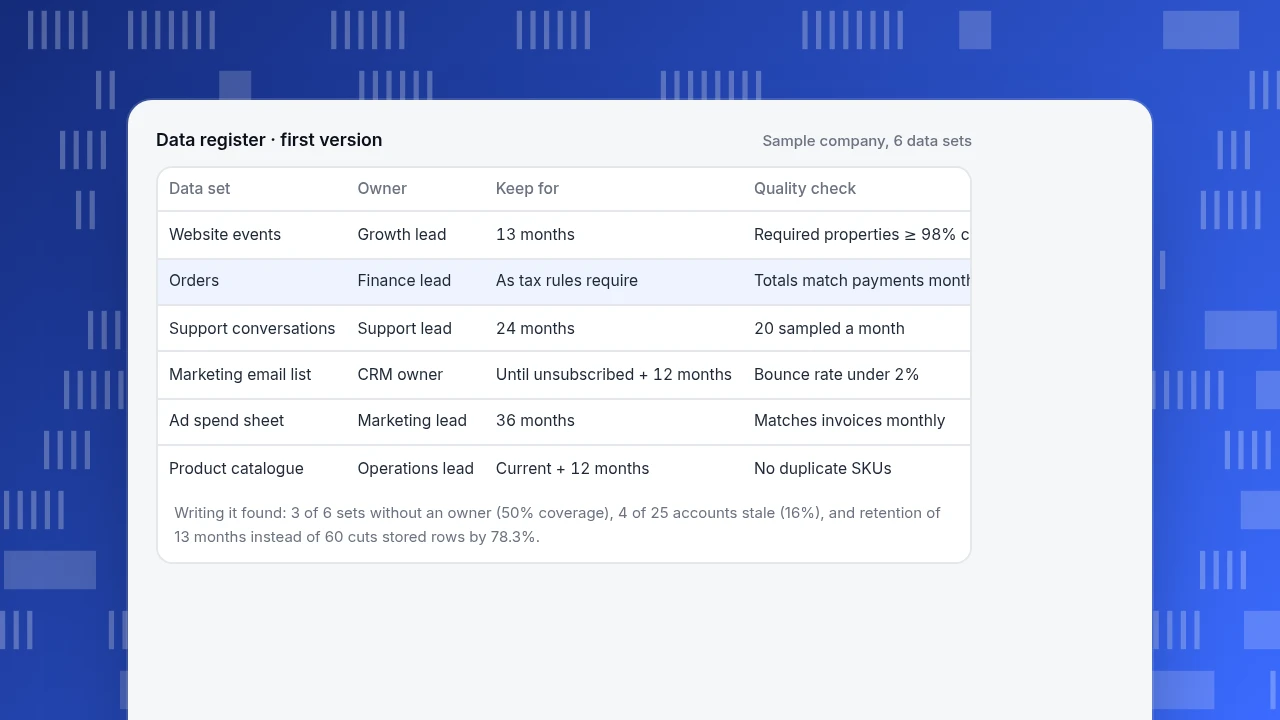
Data register · first version
Sample company, 6 data sets| Data set | Owner | Keep for | Quality check |
|---|---|---|---|
| Website events | Growth lead | 13 months | Required properties ≥ 98% complete |
| Orders | Finance lead | As tax rules require | Totals match payments monthly |
| Support conversations | Support lead | 24 months | 20 sampled a month |
| Marketing email list | CRM owner | Until unsubscribed + 12 months | Bounce rate under 2% |
| Ad spend sheet | Marketing lead | 36 months | Matches invoices monthly |
| Product catalogue | Operations lead | Current + 12 months | No duplicate SKUs |
Writing it found: 3 of 6 sets without an owner (50% coverage), 4 of 25 accounts stale (16%), and retention of 13 months instead of 60 cuts stored rows by 78.3%.
How do you choose a retention period?
Pick a period per data set, with a reason written next to it. The reason decides the period; a round number does not. Three drivers cover most cases.
| Driver | Typical question | What to write |
|---|---|---|
| Purpose | How long do we need this data to do the thing we collected it for? | The purpose and the longest time it is useful |
| Law and contracts | Is there a minimum we must keep (tax, accounting) or a maximum we must not exceed (personal data)? | The rule and where it comes from |
| Cost and risk | What does keeping it cost, and what happens if it leaks? | The storage cost and the exposure |
For personal data in the EU and UK, the storage limitation principle in Article 5(1)(e) of the GDPR says personal data must be kept in an identifiable form for no longer than necessary for its purposes. The UK regulator's guidance on the same principle expects organisations to be able to justify the periods they set and to review them. That is the reason to write the justification down at the moment you choose the period. For the schedule itself, a sample and the arithmetic, see data retention policy. None of this is legal advice; confirm requirements for your own jurisdiction.
How do you measure whether the strategy works?
A strategy that cannot be measured turns into a document. Five simple measures, each computed from the register, are enough to start.
| Measure | Formula | Example from above |
|---|---|---|
| Ownership coverage | Data sets with a named owner ÷ all data sets | 3 ÷ 6 = 50%, then 100% |
| Stale access | Accounts belonging to people who have left ÷ all accounts | 4 ÷ 25 = 16% |
| Completeness | Records with all required fields ÷ all records | Target at least 98% |
| Freshness | Share of loads that finish on schedule | Set per data set |
| Retention compliance | Data sets with a period set and a deletion that ran ÷ all data sets | Aim for all, reviewed quarterly |
Accuracy is the one quality dimension the GDPR names directly (Article 5(1)(d): personal data must be accurate and kept up to date), which is why completeness and matching-to-source checks belong on the register and not in someone's head. For quality metrics in more depth see data quality. For the people side, data democratization covers how to widen access without losing control.
What are the common data management strategy mistakes?
- Starting with a tool. Buying a catalogue before naming owners gives you a database of names nobody maintains. Owners first.
- Naming a team as owner. "Marketing" cannot approve a change. A person can.
- Defining terms in the dashboard only. Definitions that live in someone's chart break the day they leave. Write them in the glossary with an approver.
- Setting retention once and never reviewing. The register needs a date for the next review, or periods drift from the reasons behind them.
- Treating access as a one-off. People join, change roles and leave. Run the review quarterly, starting with leavers.
- Collecting first and deciding later. Adding a field is cheap; being unable to delete it is not. Ask the retention question at intake.
- Writing for auditors, not users. If the one-pager is not what people actually open, they will invent their own rules.
Data management in TapCub
Take the register above. For the data TapCub itself collects (website, app and mini-program events, users, chat), the pieces map like this:
- Ownership and definitions. In All-platform analytics › Data › Tracking plan, each planned event has a name, display name, category, platform, trigger, properties (name, type, required or not, description, example), an owner and a status (pending review, in development, in acceptance, live, deprecated). New events that nobody planned land in All-platform analytics › Data › Event inbox and join the formal definitions only once someone claims them.
- Quality. With the plan's real-time check on (last 24 hours), you see how many times each event arrived and how complete the required properties are, which is the "required properties at least 98% complete" check from the register. All-platform analytics › Data › Data quality and Property dictionary cover scanning and property rules.
- Access. Members are an owner, admin, analyst, viewer or agent-only. By default an analyst sees direct identifiers half-masked and a viewer sees them fully masked, and admins can change the policy per role. Reviewing the member list quarterly is how you catch the leavers.
- Retention. In Configuration › Privacy center, four periods are set separately: event detail, autocapture, user profiles and consent records; the starting values are 365, 90, 730 and 730 days, and the plan sets a ceiling. Daily aggregates hold no personal data and are not deleted on those schedules. Export of raw rows is an asynchronous job in All-platform analytics › Data › Data export.
TapCub manages the data it collects. It does not replace the register: your CRM, billing system, spreadsheets and warehouse each need their own owner, retention period and access review, and nothing in TapCub enforces those for you.
FAQ
What is a data management strategy?
It is the written set of decisions on who owns each data set, what its fields mean, how good it must be, who may use it and how long it is kept. It is the day-to-day operating layer under a data strategy.
What is the difference between a data strategy and a data management strategy?
A data strategy says what the business wants from data: outcomes, use cases and priorities. A data management strategy says how data is looked after to make that possible: ownership, definitions, quality checks, access and retention. See data strategy for the first.
What are the key components of a data management strategy?
Five: ownership, definitions, quality, access and retention. Each should be written per data set, with a named person and something you can show as evidence in five minutes.
How do you create a data management strategy?
Inventory your data sets, name one owner each, define the terms people dispute, set one quality check and one retention period per set, review access, and put a quarterly review in the calendar. The four-week plan above does this in order.
Who is responsible for data management?
A named owner for each data set is responsible for its decisions, and someone senior approves the definitions and the intake rule. In small companies that can be a handful of leads; the point is a person, not a team.
Sources
- DAMA-DMBOK, DAMA International: the data management body of knowledge, describing principles, practices and functions for building and governing data programmes.
- Regulation (EU) 2016/679 (GDPR), Article 5, EUR-Lex: accuracy in Article 5(1)(d) and storage limitation in Article 5(1)(e).
- Storage limitation, UK Information Commissioner's Office: guidance on justifying and reviewing retention periods.
Was this article helpful?
We use your answers to fix and expand this page.
Couldn’t send. Please try again in a minute.
Thanks for the feedback. We’ll use it to improve this page.You’ve already sent feedback on this page. Thanks.

Data Engineer
Writes about event design, data quality, and collection workflows, with verifiable implementation methods for reliable analytics.