Try it on your own data
Every report in this article is in the free plan. One snippet for web and apps, up to 10 sites.
Start freeCustomer data collection means gathering what customers tell you, what they do and what you add from outside, and each item needs a named purpose and a basis before you take it. Collect less, for less time: in the sample, cutting a nine-field form to four removes 55.6% of the data points collected each month.
What you will learn
- Match each method to a basis: contract, legal obligation or legitimate interests for the core; consent for ads, recordings and precise location
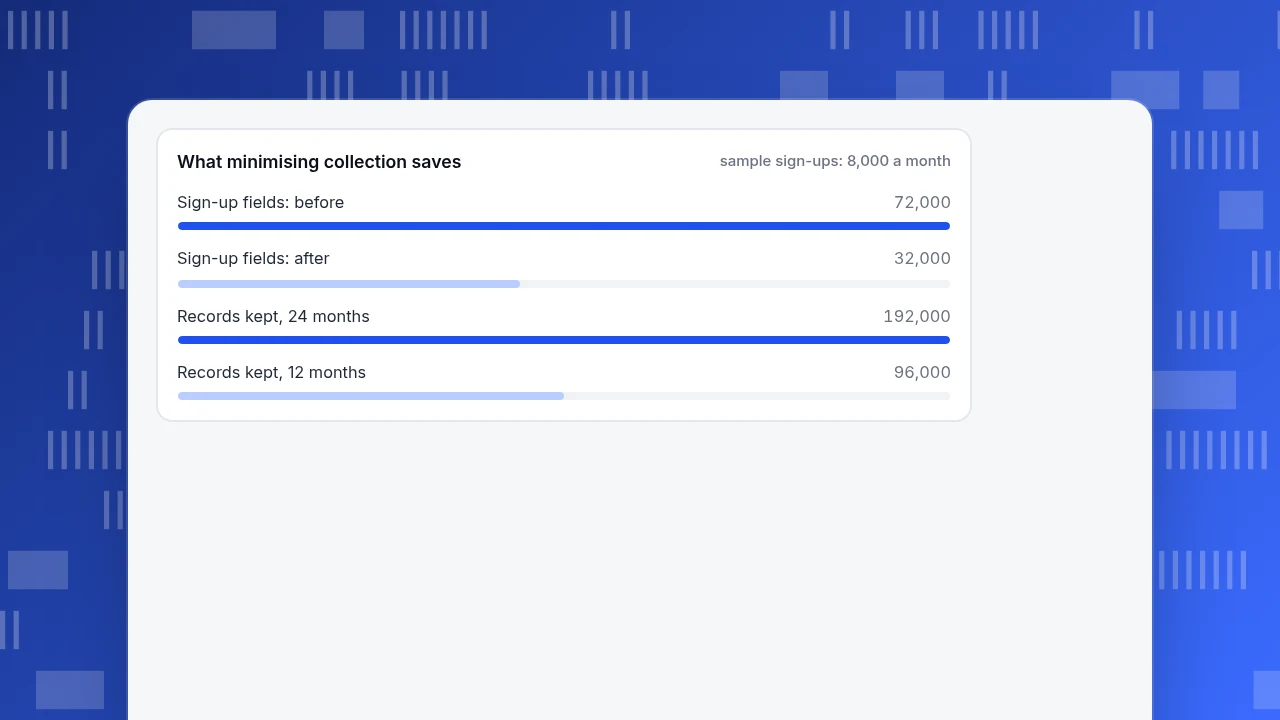
- Cut collection to what you will use in 30 days: nine fields became four, and 72,000 monthly data points became 32,000
- Shorter retention halves exposure: 12 months of 8,000 contacts a month is 96,000 records, 24 months is 192,000
What customer data collection is, and what you can skip
Customer data collection is the process of gathering information about customers and visitors so that you can serve them, sell to them and understand them. It covers what people tell you (a sign-up form, a survey), what they do (pages viewed, purchases, chats) and what you buy or infer about them (an enrichment list, a score). The useful way to think about it is not "how much can we get" but "what is each item for, and what must we do before we take it".
The rule that makes the rest easier comes from the GDPR's data protection principles, Article 5(1): personal data must be "adequate, relevant and limited to what is necessary in relation to the purposes for which they are processed" (data minimisation), and kept in identifiable form "for no longer than is necessary" (storage limitation). The same instinct appears in the California notice rules below. Collect less, for named purposes, for less time. How collected data is then used is covered in customer data analytics, and why owning it matters in the first-party data strategy. The general concept is defined in data collection.
Collection methods by data type and consent need
This table lists common methods, the data each produces, the lawful basis or notice that usually applies, and the call on whether to collect at all. It is a planning aid, not legal advice: the right answer depends on where your customers live and how you use the data.
| Data type | How it is collected | Typical basis or requirement | Call |
|---|---|---|---|
| Account details (name, email) | Sign-up form | Contract to provide the service; separate opt-in for marketing | Collect, minimal fields |
| Order and payment records | Checkout | Contract; legal obligation for tax and accounting records | Collect; keep as long as the law requires |
| Anonymous traffic (pages, sources, device type) | Analytics script, server logs | Often legitimate interests; notice | Collect; aggregate, avoid persistent IDs |
| Behaviour tied to a known person | Login-linked events | Contract or legitimate interests; consent if you add profiling | Collect only the events you will use |
| Advertising cookies and device IDs | Third-party tags | Consent; in California, a right to opt out of sale or sharing | Collect only if you run ads |
| Support conversations | Live chat, email | Contract or legitimate interests; tell people chats are stored | Collect; set retention |
| Survey answers | Surveys, interviews | Consent (voluntary participation) | Collect; anonymise where you can |
| Session recordings | Replay tools | Consent is the safe default; mask inputs | Collect sparingly, sampled |
| Precise location | Device permission | Consent | Skip unless the product needs it |
| Purchased or enriched lists | Third-party data | Hard to justify: people never dealt with you | Skip |
Read the last column first. Half of this table is "collect, but keep it small", and two rows are "skip".
| Data type | How it is collected | Typical basis or requirement | Call |
|---|---|---|---|
| Account details | Sign-up form | Contract; separate opt-in for marketing | Collect, minimal fields |
| Anonymous traffic | Analytics script, server logs | Often legitimate interests; notice | Collect; aggregate |
| Advertising cookies and device IDs | Third-party tags | Consent; opt-out of sale or sharing in California | Only if you run ads |
| Support conversations | Live chat, email | Contract or legitimate interests; tell people | Collect; set retention |
| Session recordings | Replay tools | Consent is the safe default; mask inputs | Sparingly, sampled |
| Purchased or enriched lists | Third-party data | Hard to justify | Skip |
Typical positions for planning, not legal advice. Basis depends on where your customers live and how you use the data.
Which lawful basis fits
Under the GDPR, Article 6(1) allows processing only if at least one of six bases applies: consent, contract, legal obligation, vital interests, public interest, or legitimate interests (unless the person's rights override them). For a business, the working three are contract, legal obligation and legitimate interests, with consent for the optional extras.
Consent has its own conditions in Article 7, and they affect design:
- You must be able to show that the person consented.
- A consent request inside a longer document must stand apart and use plain language.
- The person can withdraw at any time, and withdrawing must be as easy as giving it.
- Consent is not freely given if a service depends on agreeing to processing the service does not need.
The practical rule: do not bundle. A newsletter tick-box that is pre-checked, or a "agree to everything to sign up" gate, fails the last two points.
What California and similar notice laws add
California's privacy law works from notice, not from a lawful-basis list. The state Attorney General's page on the CCPA says a business must give a notice at collection at or before the point it collects personal information. The notice lists the categories collected and the purposes for each, links to the privacy policy and, if you sell or share personal information, shows a "Do Not Sell or Share" link. Consumers can ask to know, delete and opt out; a global privacy control signal can be used for the opt-out.
The law applies to for-profit businesses that do business in California and meet at least one test: over $25 million in gross annual revenue, buying, selling or sharing personal information of 100,000 or more California residents or households, or earning 50% or more of annual revenue from selling it. A small site may fall below every threshold; a site with 100,000 or more California visitors a year whose data you share with ad partners may not.
How to cut a form down: a worked example
Take a sample sign-up form with nine fields and 8,000 sign-ups a month (sample data). For each field ask one question: what will we do with it in the next 30 days?
| Field | Purpose in the next 30 days | Keep? | Alternative |
|---|---|---|---|
| Create the account and send receipts | Yes | ||
| Name | Greeting in the product | Yes | Optional |
| Company | Route to the right plan | Yes | |
| Country | Tax and region rules | Yes | Infer from billing later |
| Phone | None planned | No | Ask when a call is booked |
| Job title | None planned | No | Ask in onboarding |
| Company size | Sales follow-up that nobody does | No | Ask in onboarding |
| Address | Needed only for delivery | No | Ask at checkout |
| "How did you hear about us?" | Attribution | No | Read it from the UTM and referrer instead |
Result: 9 fields become 4. At 8,000 sign-ups a month that is 8,000 × 9 = 72,000 data points a month down to 8,000 × 4 = 32,000, a cut of 55.6%, with the same business outcome. The saving is not only storage: every field removed is one less item to protect, one less thing to answer in a deletion request and one less reason for a visitor to leave.
What minimising collection saves
sample sign-ups: 8,000 a monthRetention and requests: the clock you do not see
Keeping data costs more than it looks. Take 8,000 new contacts a month. Kept for 24 months, you hold 8,000 × 24 = 192,000 records at steady state. Kept for 12 months, 96,000, half the exposure with the same forward flow. Set retention per data type and delete on schedule.
People can also ask what you hold. Deadlines differ:
| Law | Response deadline | Extension |
|---|---|---|
| GDPR, Article 12(3) | Without undue delay and in any event within one month of the request | Two further months where necessary, with notice inside the first month |
| CCPA, right to know or delete | 45 calendar days | 45 more days (90 in total) if the person is told |
| CCPA, opt-out of sale or sharing | As soon as feasible and no later than 15 business days | None stated |
A deletion request is easy if the data lives in one place with one person ID, and painful if it is spread over six tools. Fewer fields and fewer tools are a legal safeguard as well as a tidiness win.
What to skip
- Fields you cannot name a use for. If the answer to "what do we do with it?" is "maybe later", skip it.
- Data you can read from what you already have. Source and campaign come from the UTM and referrer, not a question.
- Content people type into forms. Capture that a form was submitted, not what was in it, unless you must.
- Purchased lists and anything you cannot trace to a person who dealt with you.
- Sensitive and precise data unless the product cannot work without it.
A checklist before you turn a collection method on
- Name the purpose in one sentence. If you cannot, stop.
- Pick the basis (contract, legal obligation, legitimate interests or consent) and write it down next to the field.
- Show the notice at or before the point of collection, with categories and purposes.
- If you need consent, make it a separate, unticked choice that is as easy to withdraw as to give.
- Set a retention period and a deletion job.
- Check who else receives the data (ad tags, chat, email tools) and whether that counts as sharing.
- Test the deletion and export path with a fake account.
Applying this in TapCub
Suppose your goal is to understand visitors and sign-ups without collecting more than the form of the example.
- Start anonymous. A new project starts with anonymous analytics: it counts visitor IDs and creates no person profile, and the website script writes neither a cookie nor local storage. Your traffic, sources and funnels work without personal data.
- Choose the collection tier in the privacy center. Open Configuration › Privacy center. Tier 1 is anonymous aggregates only; the default is tier 2. In the EEA and UK the default rule is tier 2 with consent required, and without analytics consent TapCub drops to tier 1 while pageviews and custom events are still recorded. In China mode nothing is collected before consent. Read how collection tiers work and do I need a consent banner.
- Add identification only if you need it. Identified mode (people profiles through
tapcub.login) needs a plan that includes it, consent and tier 3. People who never log in stay in aggregates. - Keep form content out. The script's form events record only the form id, name and action when you turn them on; they do not record what the visitor typed. See keeping personal data out.
- Set retention. In project settings, retention can be 30, 90, 365 or 730 days. Pick the shortest that answers your questions, and use Configuration › Settings › Privacy for the privacy preset. Address truncation and retention rules are also in the privacy center.
- Answer requests. Export and deletion for a data subject are handled in the privacy tools; see handling data subject requests.
TapCub does not collect your CRM fields, run surveys or buy enrichment data; it measures behaviour on your site, app and mini program and the chats that start there. Which of the methods in the table you use remains your decision.
FAQ
What is customer data collection?
It is gathering information about customers and visitors: what they tell you in forms and surveys, what they do on your site and in chats, and what you add from outside sources. Each item should have a named purpose and a lawful basis.
What are the main methods of collecting customer data?
Forms and checkout, analytics scripts and server logs, login-linked events, support chats, surveys and recordings. The table above lists the usual basis for each and which ones to skip.
Do I need consent to collect customer data?
Not always. Under the GDPR, consent is one of six bases; contract and legitimate interests cover many needs. Consent is the safe default for advertising cookies, precise location and recordings, and it must be as easy to withdraw as to give.
How long should I keep customer data?
No longer than necessary for the purpose; Article 5(1)(e) is the rule. In the example, cutting from 24 to 12 months halves stored records from 192,000 to 96,000. Set retention per data type.
How fast must I answer a data request?
Within one month under the GDPR (extendable by two further months) and within 45 calendar days under the CCPA (extendable by 45 more days).
Sources
- GDPR Article 5: principles relating to processing, checked 2026-11-20
- GDPR Article 6: lawfulness of processing, checked 2026-11-20
- GDPR Article 7: conditions for consent, checked 2026-11-20
- GDPR Article 12: transparent information and the one-month deadline, checked 2026-11-20
- California Attorney General: California Consumer Privacy Act, checked 2026-11-20
Was this article helpful?
We use your answers to fix and expand this page.
Couldn’t send. Please try again in a minute.
Thanks for the feedback. We’ll use it to improve this page.You’ve already sent feedback on this page. Thanks.

Customer Experience Consultant
Writes about live chat, visitor conversations, and self-service, sharing practical ways to make customer communication clearer and more effective.