Try it on your own data
Every report in this article is in the free plan. One snippet for web and apps, up to 10 sites.
Start freeCustomer appreciation is recognising something a specific customer did and thanking them, without asking for a purchase. It works when specific, timely and proportionate, and you only know it worked by comparing repeat purchases with a random holdout. Below: triggers and timing, gestures and gift limits, and a worked example that looks promising but is not yet proven.
What you will learn
- Name what the customer did and send close to the event; a line that fits everyone is a newsletter
- Judge it by repeat purchases against a random holdout, not by compliments or replies
- A 5-point gap on 500 per group was not significant (p about 0.066); size the holdout before you start
What is customer appreciation, and how is it different from a promotion?
Customer appreciation is recognising something a specific customer did, such as a fifth order, a renewal, a referral or a patient wait, and saying thank you in a way that shows you noticed. A promotion asks the customer to buy something. Appreciation comes first, and it works because it is not a request.
The difference shows up in what triggers it and what you expect back:
| Appreciation | Promotion | Loyalty program | |
|---|---|---|---|
| Trigger | Something the customer did | Your calendar or stock | Points or tier reached |
| Message | "Here is what we noticed" | "Here is an offer" | "Here is your reward" |
| What you expect | Goodwill; possibly a repeat | A purchase now | Repeat purchases over time |
| How to judge it | Repeat purchase against a comparison group | Sales during the offer | Programme margin and repeat rate |
The thesis of this guide: appreciation should be specific, timely and judged by whether it changes repeat behaviour. Warm words are not a result. The wider set of retention tactics is in customer retention examples, B2B reward schemes are in B2B loyalty programs and the account-management side in customer success strategy. This article is about the thank-you itself and how to check it.
What makes appreciation feel real?
Three properties separate a thank-you people remember from one they delete:
- Specific. It names the thing: the order count, the year, the issue they were patient with. A generic message could have gone to anyone.
- Timely. It arrives close to the event, while the customer still remembers it. A thank-you for a renewal that arrives after the next invoice reads as billing.
- Proportionate. The gesture matches the relationship. A lavish gift after a first small order feels odd; silence after three years feels worse.
| Generic | Specific |
|---|---|
| "Thank you for being a valued customer." | "Your fifth order shipped today. Thank you for coming back." |
| "We appreciate your business." | "Thanks for staying with us through the migration last month; it took longer than we said." |
| "Happy anniversary!" | "Two years ago today you set up your first project. You have since added 14 teammates." |
| "You've earned a reward." | "You referred two colleagues this quarter. Here is early access to the feature you asked about." |
If a line could be sent unchanged to every customer, it is a newsletter, not appreciation.
Whom should you thank, and when?
Pick triggers that are real events in your data, so each message can be specific:
| Trigger | Window to send | Example gesture |
|---|---|---|
| Second order (the first repeat) | Within 2 days of delivery | Short note and a tip |
| Fifth order or a spending milestone | Within 2 days | Early access, small gift |
| Customer anniversary | The day or the week | Personal note from a named person |
| Referral that converts | Within 2 days | Thanks from the person who got the referral, plus a reward |
| Review or feedback given | Within a day | Reply that says what you changed |
| Long or difficult support case resolved | After resolution | Apology and a follow-up from a person |
| Renewal | Before the next invoice | Thanks with what has improved since they joined |
These windows are suggestions; there is no research-backed number. What matters is that the gesture lands while the event is fresh.
What can you give, and what should you check first?
| Gesture | Typical cost | Watch out for |
|---|---|---|
| Personal note or short call | Time | Must come from a real person who knows the account |
| Early access or a feature preview | Low | Do not promise what you cannot ship |
| Small gift | Low to medium | Business gifts have tax limits; recipient policies |
| Discount or credit | Margin | It becomes a promotion; do not name it appreciation |
| Event or dinner | High | Check recipient rules on gifts and hospitality |
| Public recognition | Low | Ask permission first |
For business gifts in the United States, the IRS limits the deduction to $25 per recipient per year; see the Gifts section of Publication 463. Many companies also have their own rules about what employees may accept, so a gift can create a problem for your customer rather than a thank-you. If the thank-you is an email that also promotes something, the CAN-SPAM requirements apply, including a working opt-out; the FTC guide notes there is no exception for business-to-business email.
| Gesture | Cost | Watch out for |
|---|---|---|
| Personal note or call | Time | Must come from someone who knows the account |
| Early access | Low | Do not promise what you cannot ship |
| Small gift | Low to medium | Tax limits; recipient policies |
| Discount or credit | Margin | It is a promotion, not appreciation |
| Event or dinner | High | Recipient rules on hospitality |
US business-gift deduction limit: $25 per recipient per year (IRS Publication 463).
Did the thank-you change repeat behaviour?
The only way to know is to compare thanked customers with similar customers who were not thanked, chosen at random. Comparing recipients with everyone else is misleading, because you probably chose the best customers to thank.
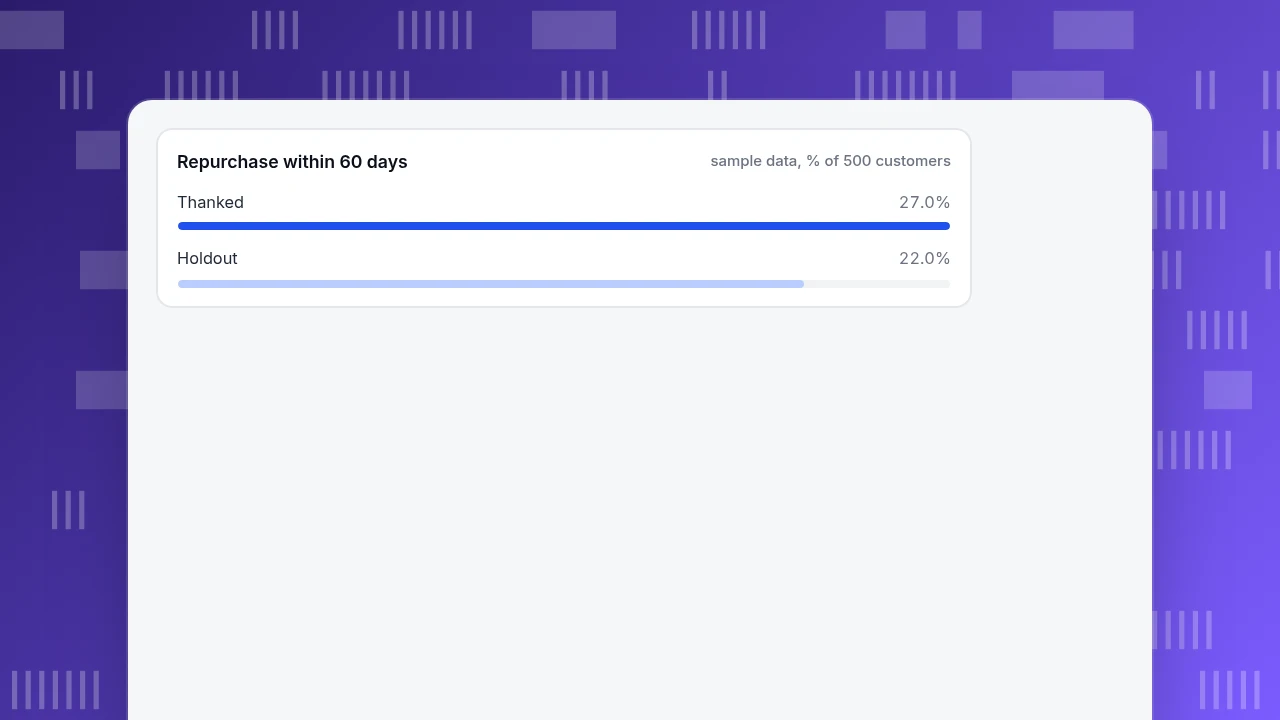
Sample data: 1,000 customers reach their third order. You assign 500 at random to receive a handwritten note and early access to a new feature, and 500 to a holdout who receive nothing special. Sixty days later:
| Group | Customers | Repurchased within 60 days | Repeat rate |
|---|---|---|---|
| Thanked | 500 | 135 | 27.0% |
| Holdout | 500 | 110 | 22.0% |
The difference is 5.0 points, a relative lift of 5.0 ÷ 22.0 = 22.7%, and 25 extra repurchases (135 − 110). If an order is worth $80 at a 40% margin, each is worth $32, so the extra margin is 25 × $32 = $800. The notes cost $1.40 each, 500 × $1.40 = $700. Net: $800 − $700 = $100, a return of 100 ÷ 700 = 14.3%.
Before declaring success, check whether the difference could be noise. The pooled repeat rate is 245 ÷ 1,000 = 24.5%; the standard error of the gap is the square root of 0.245 × 0.755 × (1 ÷ 500 + 1 ÷ 500), about 0.0272; z = 0.05 ÷ 0.0272 ≈ 1.84, which corresponds to p of about 0.066 (the large-sample test is described in the NIST handbook). A 95% interval for the gap runs from about −0.3 to +10.3 points. In plain words: this looks promising, and it is not proven. To detect a true 5-point gap reliably (80% power, 5% significance) you would need roughly 1,158 customers per group. The honest conclusion is "worth repeating with a bigger holdout", not "appreciation pays 14%".
Repurchase within 60 days
sample data, % of 500 customersWhat should you measure?
- Repeat purchase in a fixed window, thanked versus holdout.
- Time to next order. A faster return is an effect even when the rate is equal.
- Support contacts and cancellations in the following weeks.
- Referrals that follow.
- Cost per customer, including the time of the person writing.
- Opt-outs and complaints after the message. A thank-you that triggers unsubscribes is not appreciation, and you want to see that early.
- Replies that say something specific. A customer who writes back about the detail you mentioned shows the message landed, though it is a weaker signal than repeat purchase.
Decide the window and the holdout before you send anything; looking afterwards for a window that works is the same error as stopping a test early.
How does this differ for business customers?
In B2B the person you thank is not always the person who pays. Thank the user who made the product work, the buyer who signed and the champion who argued for you, each for their own contribution. Keep gestures within what their employer allows, prefer things of use (access, an introduction, a result written up with permission) over objects, and tie thanks to outcomes the account has reached, such as a milestone in their own use.
What goes wrong with customer appreciation?
- Sending the same message to everyone. It stops being appreciation.
- Thanking late. The moment has passed.
- Disguising a discount. If it asks for a purchase, call it an offer.
- Judging by replies and compliments. Compare repeat behaviour with a holdout.
- Choosing recipients by hand and comparing with the rest. You selected the best customers.
- Declaring victory on a borderline result. The example above was not significant.
- Overlooking gift rules. Tax limits and recipient policies apply.
How do you plan and check this in TapCub?
Take the third-order thank-you. TapCub does not send emails or gifts, and it does not split customers into test groups. It identifies who qualifies and measures what they do next:
- Call
tapcub.loginwhen customers sign in, so they appear in All-platform analytics › Users › People with a day-by-day timeline. Anonymous visitors have no profile and cannot be segmented. - In All-platform analytics › Users › Segments & tags, build a rule segment for people who reached their third order, or use the RFM view with 10 groups, from champions to those at risk, to see who is slipping.
- Randomly assign the list to two groups outside TapCub, then paste each group's IDs into a static segment: one for thanked, one for holdout.
- In All-platform analytics › Behavior › Behavior analysis, bring each segment into a retention or funnel analysis for the repurchase event and compare the 60-day return of the two groups.
- In Live chat › Canned replies, keep a short, specific thank-you that agents can insert with
/and edit before sending. Chat sees the visitor's history, so the message can name what they did. - Costs, margins and the thank-you messages themselves live outside TapCub.
FAQ
What is customer appreciation?
It is recognising something a specific customer did and thanking them in a way that shows you noticed, such as a repeat order, a referral, a renewal or a patient wait. It is different from a promotion because it does not ask for a purchase.
How do you show customer appreciation?
Be specific, timely and proportionate: a personal note that names what they did, early access to something they asked about, a short call from someone who knows the account. Choose triggers from real events in your data and send close to the event.
Does customer appreciation increase repeat purchases?
It can, but you only know by comparing thanked customers with a random holdout. In the sample, 27.0% versus 22.0% looked promising but gave p of about 0.066, so it was not proven; larger groups would be needed.
How much should you spend on customer appreciation?
Spend in proportion to the customer's value and the relationship, and compare the cost with the extra margin from repeat purchases. In the sample, $700 of notes returned $800 of margin. For business gifts, the US deduction limit is $25 per recipient per year.
What are good customer appreciation ideas for B2B customers?
Personal notes to the user, buyer and champion for their own contributions, early access or an introduction, a result written up with permission and recognition at milestones in their usage. Keep within what their employer permits and avoid gifts that look like inducements.
Sources
- Internal Revenue Service. Publication 463, Travel, Gift, and Car Expenses: the $25 limit under Gifts. Verified 2026-11-19.
- Federal Trade Commission. CAN-SPAM Act: A Compliance Guide for Business: requirements, including for business-to-business email. Verified 2026-11-19.
- NIST/SEMATECH. Comparing two proportions: large-sample z-test with a pooled proportion. Verified 2026-11-19.
Was this article helpful?
We use your answers to fix and expand this page.
Couldn’t send. Please try again in a minute.
Thanks for the feedback. We’ll use it to improve this page.You’ve already sent feedback on this page. Thanks.

Product Adoption Consultant
Explores customer onboarding, live conversations, and self-service, turning common usage questions into practical guidance and improvements.