Try it on your own data
Every report in this article is in the free plan. One snippet for web and apps, up to 10 sites.
Start freeAI data governance is ordinary data governance plus three questions: which data reaches the model, whether an output can be traced to its sources, and whether a person checks it. Govern the inputs first, then the outputs. This guide gives five controls (input, permission, record, review, delete), an input rule you can copy and a review example with numbers. It is not legal advice.
What you will learn
- Govern the inputs first: a written list of data that may and may not reach a model
- Measure outputs by sampling; in the example, 6 wrong in 120 reviewed gives 5.0% with a 2.3%–10.5% range
- Every AI feature needs a path to a person, a record of what happened and a deletion plan for prompts and logs
What is AI data governance, and how is it different from ordinary data governance?
AI data governance is ordinary data governance, meaning who owns data, who can use it and how it is kept, plus three questions that only appear once a model is involved: which data goes into the model (to train it, tune it or answer a request), whether an output can be traced to what produced it, and whether a person checks the output before it matters. The short rule for this guide is: govern the inputs first, then the outputs. An output you cannot trace and a model fed data it should never have seen are the two failures most teams meet.
NIST's AI Risk Management Framework frames the wider job as four functions: Govern, Map, Measure and Manage (AI RMF 1.0, published 26 January 2023, with a Generative AI Profile added on 26 July 2024). This article takes the data slice of that work and turns it into five controls you can run in a small team. It is a practical guide, not legal advice, and it does not cover how models are trained.
What does AI add to what you already govern?
| Dimension | Traditional data governance | What AI adds |
|---|---|---|
| Input | Who may collect and store a dataset | Which datasets may be sent to a model, and to whose servers |
| Purpose | Stated reason for collecting | A separate reason for using data in a model, which may differ from the original one |
| Access | Who may open a table | Who may ask the model questions that expose the data |
| Lineage | Where a table came from | Which sources an answer was drawn from |
| Quality | Is the table correct | Is the answer correct, and how often is it wrong |
| Records | Access logs | Prompts, answers and which model version produced them |
| Deletion | Delete rows on schedule | Also copies in prompts, logs, caches and any fine-tuned model |
Two rows deserve emphasis. The purpose row matters because data collected to run a service is not automatically fit to be fed into a model; GDPR's principle of data "adequate, relevant and limited to what is necessary" applies to the new use too (Article 5(1)(c)), and the idea of data minimization is the first filter. The deletion row matters because deleting a row from your database does not delete it from a vendor's log.
Which five controls cover AI data governance?
| Control | Question | Evidence it exists |
|---|---|---|
| Input | What data may reach a model? | An allow-list of data types and a block-list (personal identifiers, secrets) |
| Permission | Who can use the model, and on which data? | Roles, scoped keys, per-project limits |
| Record | Can we reconstruct what happened? | Logs of requests, outputs, model and version |
| Review | Does a person check outputs? | A sampling routine with a recorded error rate |
| Delete | Can we remove data and prove it? | Retention days for prompts and logs, a deletion procedure |
Run them in the order shown. Input comes first because no later control repairs a model that has already received data it should not have. Permission and record come next because they make misuse visible. Review measures the model's real behaviour, and delete closes the loop. For where the data came from in the first place, see data lineage, and for the wider plan these controls sit inside, data strategy.
| Control | Question | Evidence it exists |
|---|---|---|
| Input | What data may reach a model? | An allow-list and a block-list (personal identifiers, secrets) |
| Permission | Who can use the model, and on which data? | Roles, scoped keys, per-project limits |
| Record | Can we reconstruct what happened? | Logs of requests, outputs, model and version |
| Review | Does a person check outputs? | A sampling routine with a recorded error rate |
| Delete | Can we remove data and prove it? | Retention days for prompts and logs, a deletion procedure |
Run them in this order: input rules cannot be repaired after a model has already received the data.
How do you set the input rules?
Write a short, specific list. Three layers are enough:
- Never send: direct identifiers (names, emails, phone numbers, card and national ID numbers), health details, credentials and anything you have promised customers stays private. See PII examples for what belongs on that list.
- Send only when needed and masked: free-text conversation content, account names, order references. Mask before sending where you can.
- Safe to send: aggregate counts, public help-article text, product catalogue data.
Then add two checks. Provider terms: record in writing whether the provider keeps prompts, uses them to train models and where it processes data. If the answers are unclear, treat the provider as untrusted for personal data. Purpose: for each AI use case, write the one-sentence purpose and compare it with what customers were told when the data was collected.
For high-risk AI systems, the EU AI Act asks for documented practices on training, validation and test data, including design choices, how data was collected and where it came from, preparation steps such as labelling and cleaning, assumptions, suitability checks and examination of possible bias (Article 10). You do not need to be in scope to borrow the list: it is a good prompt for what to write down.
How do you review outputs with numbers?
Review turns "we trust the model" into a measured rate. A worked example with sample data: an online store runs an AI assistant for customer questions.
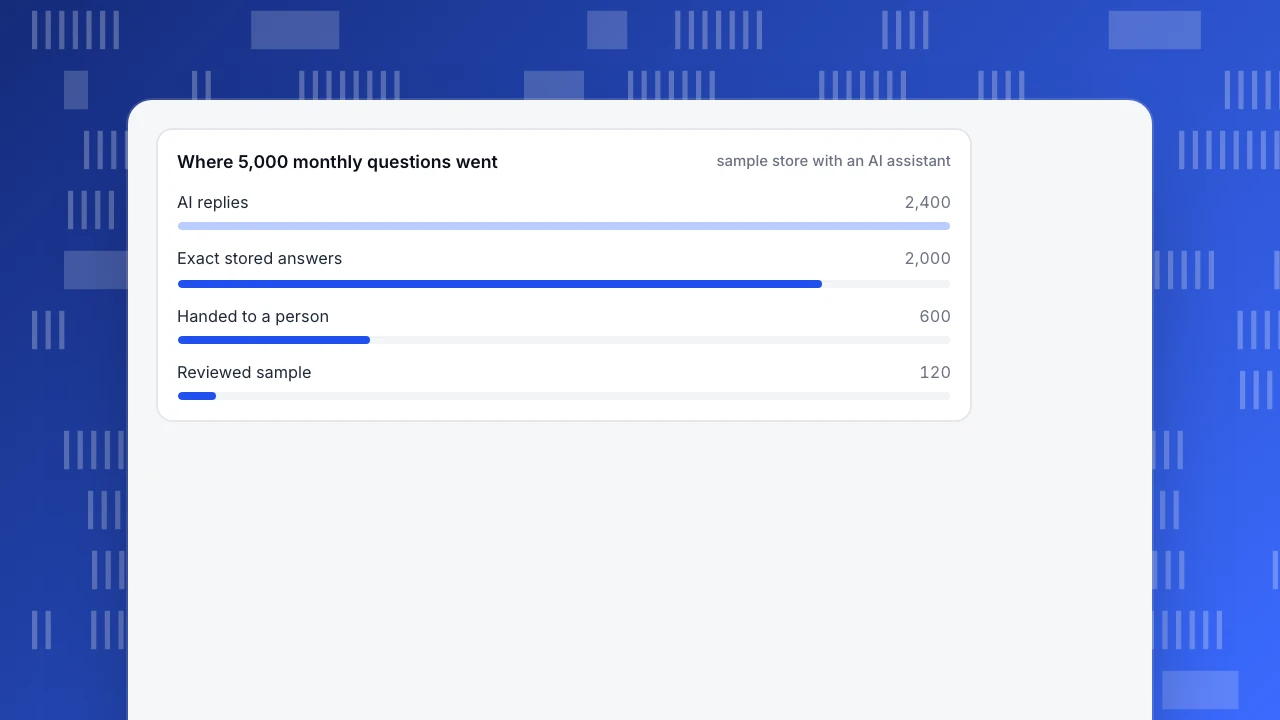
- 5,000 questions arrive in a month.
- 40% are answered by an exact stored answer, so no model is involved: 5,000 × 0.40 = 2,000.
- The remaining 3,000 go down the model path. 20% hand off to a person: 3,000 × 0.20 = 600.
- That leaves 3,000 − 600 = 2,400 AI replies.
- A reviewer reads a 5% random sample: 2,400 × 0.05 = 120 replies, and finds 6 wrong: 6 ÷ 120 = 5.0%.
Scaled up, 5.0% of 2,400 is about 120 wrong replies a month. Because 120 is a sample, state the range: the 95% Wilson interval for 6 of 120 is 2.3% to 10.5%, about 55 to 252 wrong replies a month. A decision rule follows from it: if 252 wrong replies a month is unacceptable for your riskiest question types, narrow the questions the AI may answer or hand them off. Wrong answers are not hypothetical costs: a Canadian tribunal held an airline responsible for what its website chatbot told a customer (Moffatt v. Air Canada, 2024 BCCRT 149).
Re-sample every month, and every time you change the model, the prompt or the source material.
Where 5,000 monthly questions went
sample store with an AI assistantHow should you set permissions, records and deletion?
- Permission. Give people the smallest scope that lets them work. Read-only keys for tools that only need to read; separate keys per tool so one can be revoked alone; per-project limits on model use so a runaway job cannot spend or expose everything.
- Record. Keep, for each AI-assisted answer, the time, the model, the question, the sources used and whether a person took over. Keep it only as long as a named purpose needs, because the log is itself personal data if it contains conversation text.
- Delete. List every place data lands: your database, the provider's logs, caches, exports and any fine-tuned model. Set a retention period for each and test one deletion end to end. Link the schedule to your data retention policy.
For the use of AI inside analytics work, AI marketing analytics covers where models help and where they mislead.
What mistakes do teams make?
- Governing the model, not the data. Policies about "responsible AI" with no list of allowed data protect nothing.
- Reusing data for a new purpose silently. Collection notices written for analytics may not cover model use.
- Trusting the provider's default. Defaults on logging and training vary; read the terms.
- No sampling. Without a measured error rate, "it seems fine" is the only evidence.
- Logging everything with no end date. The prompt log becomes the largest pile of personal data you hold.
- No human path. If the model cannot hand off, every error reaches the customer.
- Treating one launch review as permanent. Models, prompts and sources change monthly.
How would you apply this to AI features in TapCub?
Take the store above. It uses TapCub live chat with AI replies and wants to keep control of inputs, review and cost. The steps follow the five controls; TapCub's documentation is the source for every behaviour below.
- Limit the input by limiting the source. In Live chat › Knowledge base, the AI drafts only from knowledge-base material; with no enabled entries it does not answer. Exact Q&A matches are sent as stored, with no model call. Put only content that is safe to send into it, using the "safe to send" list above.
- Choose how much the AI does. In Live chat › Chat settings › AI assistant, the modes are off, only when all agents are offline, or AI answers first. The visitor is told they are talking to an AI before the first reply, and that notice cannot be turned off; AI messages carry an AI label. The AI only generates a reply; it cannot change an order, send email or call another system.
- Bound it. Max AI turns per conversation runs from 1 to 20, default 6; after that the chat hands off. The inbox labels every handoff with its reason (no knowledge match, model cannot answer, visitor asked, turn limit, agent took over), which gives you the review sample's denominator.
- Review and correct. In the inbox, click Fix & save on a wrong answer to store it as a Q&A entry, so the stored answer is sent next time with no model call. Drafts generated from conversations resolved in the last 30 days go to a draft inbox and nothing goes live until you approve it.
- Control analytics AI. The All-platform analytics › Operations › AI Assistant takes numbers from an analysis query run on your project; it does not search a knowledge base. Model calls have a per-site daily cap, and with no model configured it stays on rules. The MCP tab gives read-only access through a key with the Read stats scope, created in Configuration › Settings › API keys.
TapCub does not review answers for you and does not choose your allowed-data list; the monthly sampling described in the review section is yours to run.
FAQ
What is AI data governance?
It is data governance extended to cover models: which data may reach a model, whether outputs can be traced to their sources, and whether a person reviews outputs. It adds input rules, records and review to the usual ownership, access and retention rules.
How is AI data governance different from AI governance?
AI governance covers the whole model lifecycle, including risk, bias, transparency and accountability. AI data governance is the data part of it: what goes in, who can use it, what is recorded and what is deleted. The first sets the rules for the model; the second sets the rules for its data.
What are the pillars of AI data governance?
A practical set is five controls: input, permission, record, review and delete. They map onto the Govern, Map, Measure and Manage functions in NIST's AI Risk Management Framework without replacing them.
Can we put customer data into an AI tool?
Only if the provider's written terms cover how it stores, uses and deletes prompts, your own purpose allows it, and you have masked or removed direct identifiers. When terms are unclear, leave personal data out.
How often should we review AI outputs?
Sample monthly, and again after any change to the model, prompt or source material. A 5% sample of 2,400 replies is 120; read them and record the error rate with its range.
Sources
- NIST, AI Risk Management Framework — Govern, Map, Measure and Manage functions; AI RMF 1.0 released 26 January 2023, Generative AI Profile 26 July 2024. Verified 2026-11-18.
- EU Artificial Intelligence Act, Article 10, Data and data governance — practices for training, validation and test data. Verified 2026-11-18.
- GDPR, Article 5, Principles relating to processing — data minimisation. Verified 2026-11-18.
- Civil Resolution Tribunal of British Columbia, Moffatt v. Air Canada, 2024 BCCRT 149 — responsibility for information given by a website chatbot. Verified 2026-11-15.
Was this article helpful?
We use your answers to fix and expand this page.
Couldn’t send. Please try again in a minute.
Thanks for the feedback. We’ll use it to improve this page.You’ve already sent feedback on this page. Thanks.

Solutions Engineer
Covers SDKs, API integrations, and data implementation, with an emphasis on validation, system interoperability, and troubleshooting.