Try it on your own data
Every report in this article is in the free plan. One snippet for web and apps, up to 10 sites.
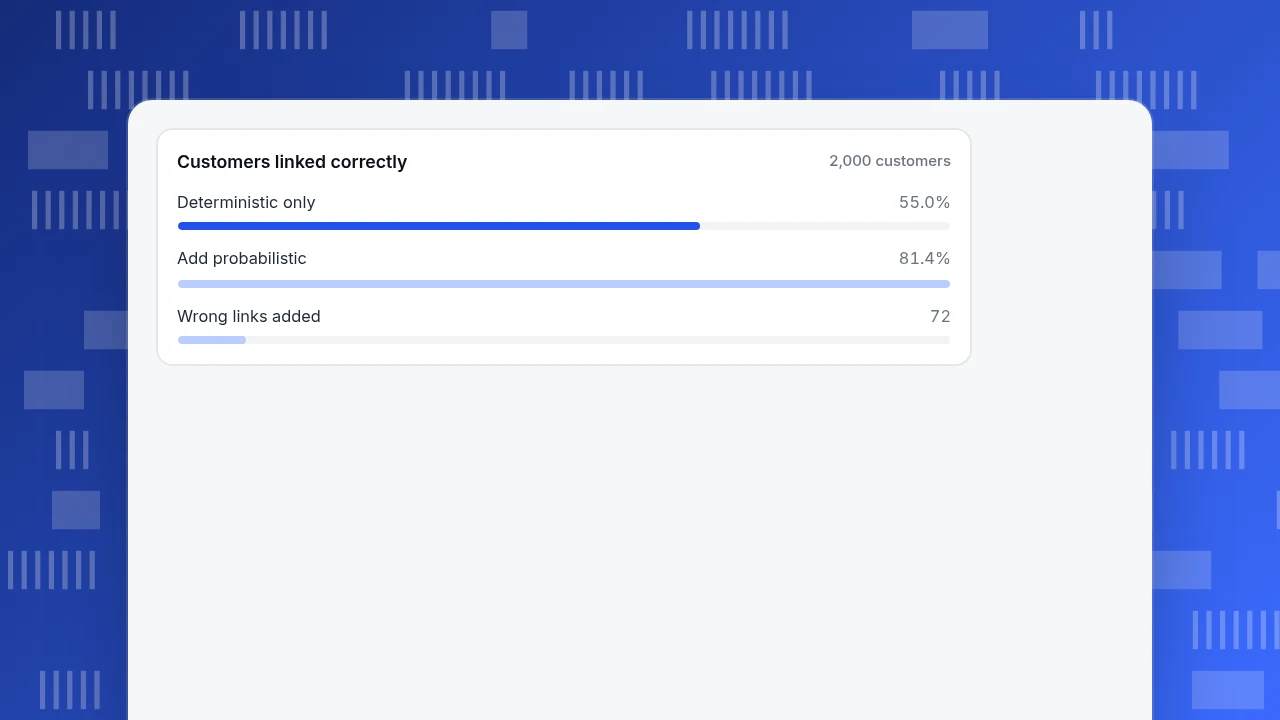
Start freeAn AI CDP is a customer data platform that adds machine-learning or language-model features: probabilistic identity matching, predictive scores, audience building and a plain-language assistant. AI does not create customer data, so each feature is capped by the identifiers underneath it. In the sample below, probabilistic matching raised linked customers from 55.0% to 81.4% but added 72 wrong merges.
What you will learn
- Each AI feature has a ceiling set by the data below it: identity needs deterministic anchors, scores need outcomes, audiences need somewhere to go
- Use probabilistic identity links for analysis, not for actions that cannot be undone: 600 added links had 72 wrong ones
- A good churn model still lost $200 on 1,000 contacts; the score is worth acting on only where precision clears break-even (16.7% here)
What is an AI CDP, and what does the AI actually add?
A customer data platform (CDP) is, in the CDP Institute's words, "software that creates and maintains a persistent, unified customer record that is accessible to other systems" (CDP Institute). Three jobs sit inside that sentence: collect data from many systems, link the records that belong to the same person, and make the result available to other tools.
An "AI CDP" is a CDP that adds machine-learning or language-model features on top of those jobs. In practice, vendors mean four things:
- Smarter identity resolution: matching records that share no ID, using probabilities.
- Predictions: scores such as churn risk or purchase likelihood.
- Audience building: segments created from a description or from a model's output.
- Assistants: asking questions of the data in plain language.
AI does not create customer data, and it cannot fix identifiers that were never collected. Every capability below has a ceiling set by the data underneath it, and this guide shows where that ceiling is with numbers you can recompute.
What does each AI capability need, and where does it break?
Use this table to turn a feature list into questions you can ask.
| Capability | What it does | What it needs | Where it breaks | Ask before you rely on it |
|---|---|---|---|---|
| Identity resolution | Links device IDs, emails and logins into one profile | At least some deterministic anchors such as a login | False merges combine two people; false splits double-count one | What is the false-merge rate on a sample you checked by hand? |
| Predictions | Scores each customer for churn, purchase or value | Enough past outcomes, clean labels, stable behaviour | Scores rank people but are wrong about most individuals | What is the precision in the top slice, and is it above break-even? |
| Audiences | Builds a segment from rules, a model or a description | Fresh data and a destination that accepts the list | Stale membership; tiny segments; overlap with other campaigns | How often does membership refresh, and what is the size and overlap? |
| Assistants | Answers questions in plain language | Access to the real data, with a record of the query | Fluent answers that are not tied to a query | Can I see the query behind each number? |
The next sections work through the first three with sample data. Assistants are covered in AI marketing analytics.
| Capability | What it needs | Where it breaks | Ask before relying on it |
|---|---|---|---|
| Identity resolution | Some deterministic anchors such as a login | False merges and false splits | False-merge rate on a hand-checked sample |
| Predictions | Past outcomes and stable behaviour | Ranks people but wrong about most individuals | Precision in the slice you will act on vs break-even |
| Audiences | Fresh data and a destination | Stale or tiny segments; overlap | Refresh interval, size, overlap |
| Assistants | Access to real data | Fluent answers with no query | Can I see the query behind each number? |
The table summarises the four capabilities; the sections below recompute the first three.
How well can AI match records to one person?
Identity resolution has two methods. Deterministic matching links records that share an exact identifier, such as the same login or hashed email. It is precise and misses everyone who never identified. Probabilistic matching scores pairs of records on weaker evidence (device type, time, location, behaviour) and links pairs above a threshold. It reaches more people and sometimes links the wrong ones. The statistical basis, going back to Fellegi and Sunter's 1969 theory of record linkage, is that you choose a threshold that trades false matches against missed matches; you cannot remove both (Fellegi and Sunter, 1969).
Why is there a gap to fill at all? Browsers limit how long anonymous identifiers last. Safari's tracking prevention deletes cookies written by JavaScript, and other script-writable storage, after 7 days without the user interacting with the site, and caps cookies at 24 hours when it detects link decoration (WebKit). A customer who visits on day 0 and returns on day 9 can look like two visitors until they log in.
A worked example (sample data, recomputed in Python). Suppose a store has 2,000 customers whose several devices could be joined into single profiles.
| Step | Links made | Correct links | Precision | Share of customers linked correctly (recall) |
|---|---|---|---|---|
| Deterministic only (shared login) | 1,100 | 1,100 | 100% | 55.0% |
| Add probabilistic matching | +600 | +528 | 88.0% on the added links | n/a |
| Both together | 1,700 | 1,628 | 95.8% | 81.4% |
Reading the table:
- Adding the probabilistic step lifts the share of customers joined from 55.0% to 81.4%, a gain of 528 correct links.
- The price is 72 wrong links (600 − 528). Each wrong link merges two different people into one profile, which means a message addressed to the wrong person or a purchase attributed to the wrong customer.
- The combined F1 score, the usual single number for matching quality, is 2 × 0.958 × 0.814 ÷ (0.958 + 0.814) = 0.88; deterministic only scores 0.71.
The decision rule: use probabilistic links for analysis, not for actions that cannot be undone. Counting audiences or measuring how many devices a typical customer uses can tolerate 4% error in the combined links. Sending a personal offer, an account notice or a refund to a probabilistically merged profile cannot. Ask any vendor for the false-merge rate measured on a hand-checked sample from your own data.
Customers linked correctly
2,000 customersCan AI predict which customers will churn, and when is the score worth acting on?
A prediction is a score per customer, and the useful way to judge it is by precision in the slice you will act on, compared with a break-even line.
Sample data: a base of 10,000 customers, 5% of whom (500) will churn this quarter. A model scores everyone and we split the base into ten equal groups from highest to lowest score:
| Score group (1,000 customers each) | Churners in the group | Precision | Lift over the 5% base rate | Cumulative share of all churners |
|---|---|---|---|---|
| 1 (highest) | 150 | 15.0% | 3.0 | 30% |
| 2 | 100 | 10.0% | 2.0 | 50% |
| 3 | 70 | 7.0% | 1.4 | 64% |
| 4 | 50 | 5.0% | 1.0 | 74% |
| 5–10 | 130 | 2.2% average | 0.4 | 100% |
This is a good model by the usual standard: the top 10% of scores catch 30% of churners, three times better than picking at random. Yet in the top group, 85% of the people flagged will not churn.
Whether that is useful depends on what acting costs and what it saves. Suppose a retention offer costs $2 per person contacted, saves 20% of the customers who would have left, and a saved customer is worth $60.
- Break-even precision = cost ÷ (save rate × value) = 2 ÷ (0.20 × 60) = 16.7%.
- Contact the top group: 1,000 × $2 = $2,000 spent; 150 churners × 20% = 30 saves × $60 = $1,800. Net −$200.
- Contact only the top half of that group (500 customers, assume 90 churners, 18.0% precision): $1,000 spent; 18 saves × $60 = $1,080. Net +$80.
The same model loses money on 1,000 customers and makes money on 500. So the rule is: set the cutoff where precision clears break-even, and measure the saves against a held-out group that got no offer. A score is not a decision. If a score alone decides something with legal or similarly significant effects on a person, such as a credit or pricing decision, the EU's GDPR gives people the right not to be subject to a decision based solely on automated processing, including profiling (Article 22(1)); get legal advice before automating that (GDPR Art. 22).
How good is an audience that AI builds for you?
An audience is a list of people who match a rule, a model score or a description. AI changes how fast you can create one; it does not change what makes one useful. Check four things on any audience before you send to it:
| Check | Why | Pass rule |
|---|---|---|
| Size | A list too small gives results you cannot read | Large enough that the expected number of conversions in each test arm is well above a few dozen |
| Freshness | Membership that updates weekly misses a visitor who left the page yesterday | Refresh interval shorter than the decision window |
| Overlap | The same person in five audiences gets five messages | Count how many people are in more than one active audience |
| Holdout | Without a control group you cannot tell effect from selection | Keep a random slice (for example 10%) out of every send |
The holdout is the one most often skipped. People who match "high purchase likelihood" were going to buy anyway, so the sales you see afterwards are mostly not caused by the message. If you want to see how much of an apparent lift is selection, the same logic appears in measuring a chatbot's return and in the A/B test guide.
What should you decide before adding AI to a CDP?
Work down this list. Stop at the first "no".
- Do you have deterministic anchors? If few of your active customers ever log in or give an email, probabilistic matching will do most of the work and its errors will dominate. Fix collection first.
- Can you write down one decision a score would change? "Who gets the retention offer" is a decision. "A churn score" is not.
- Do you have enough outcomes? A rare event with very few examples does not train a reliable model.
- Can you hold out a control group? If not, you cannot measure the benefit, so you cannot justify the cost.
- Does the audience have somewhere to go? An audience that cannot be sent to an email, ad or messaging tool is a report, not an activation.
- Can you see how each number was produced? For assistants, insist on the underlying query.
What does TapCub do here, and what does it not do?
TapCub is not a full customer data platform. It does not send audiences to email or advertising tools, it does not do CRM or email marketing, and it has no prediction scores. What it does give you is the measurement and identity layer the comparison above depends on, in one project. Using the examples:
- Create deterministic anchors. Call
tapcub.login()when someone logs in. The person then appears in All-platform analytics › Users › People with a day-by-day timeline that merges the devices bound to the same login ID. Anonymous visitors are counted but have no profile, and identified mode is a paid-plan feature at the time of writing, so check your plan in the documentation. - Group people into segments. In All-platform analytics › Users › Segments & tags, build rule segments (refreshed daily or on demand), static segments from a pasted ID list, or realtime segments. The 10-group RFM buckets and a 30-day trend of segment size are there. Anonymous visitors do not enter segments, which matches the deterministic-only row of the identity table.
- Check freshness and overlap. The segment page records who joined and who left at each refresh; if a webhook is configured, TapCub emits a membership change. Overlap between segments is yours to compare by reading the member counts.
- Treat predictions as your own work. TapCub reports counts and rates for any group; it does not score churn. If you compute scores elsewhere, bring the outcome back as an event and compare the flagged group with the holdout in All-platform analytics › Behavior › Behavior analysis.
- Ask the assistant, and read the query. All-platform analytics › Operations › AI Assistant answers from analysis queries run on your project, and your own AI agent can read the data through a read-only connection. It does not create monitors or send notifications. See identify users for the identity steps.
FAQ
What is an AI CDP?
A customer data platform with machine-learning or language-model features added: probabilistic identity matching, predictive scores, audience building and a plain-language assistant. The data collection and unification still come from the underlying platform.
What is the difference between a CDP and a data warehouse?
The CDP Institute describes a CDP as software that creates and maintains a persistent, unified customer record and makes it accessible to other systems. A warehouse stores data; a CDP takes responsibility for customer identity and for exposing the unified record.
How accurate is AI identity resolution?
It depends on your data. In the sample above, deterministic matching was 100% precise but joined 55% of customers; adding probabilistic matching joined 81.4% at 95.8% overall precision. Ask for the false-merge rate on a sample you checked yourself.
Do you need a CDP if you only run analytics?
Often not. If you need consistent identity and measurement across web and app, an analytics product with login-based identity and segments may be enough. You need a CDP when you must push unified audiences to many activation tools.
Is customer scoring covered by privacy law?
It can be. Profiling that leads to a decision based solely on automated processing with legal or similarly significant effects falls under GDPR Article 22(1). Marketing scores that only rank a mailing list are usually different, but get legal advice for your case.
Sources
- Customer Data Platform Institute. What is a CDP? Read 2026-11-20.
- Fellegi, I. P. and Sunter, A. B. (1969). A Theory for Record Linkage. Journal of the American Statistical Association 64(328).
- WebKit. Tracking Prevention in WebKit. Read 2026-11-20.
- European Union. General Data Protection Regulation, Article 22. Read 2026-11-20.
Was this article helpful?
We use your answers to fix and expand this page.
Couldn’t send. Please try again in a minute.
Thanks for the feedback. We’ll use it to improve this page.You’ve already sent feedback on this page. Thanks.

Product Experience Specialist
Writes about product experience, practical workflows, and growth, turning complex processes into clear steps for everyday decisions.