Try it on your own data
Every report in this article is in the free plan. One snippet for web and apps, up to 10 sites.
Start freePDLC and SDLC are not rivals: the product development life cycle decides what is worth building and whether it worked, while the software development life cycle decides how to build and ship it. SDLC sits inside the PDLC's build stages and continues after launch as maintenance. Below, a stage table with owners and outputs.
What you will learn
- PDLC covers discovery to learning; SDLC covers requirements to maintenance and sits inside the PDLC's build and test stages
- DORA delivery metrics measure the SDLC part; they cannot tell you whether anyone uses what shipped, so add outcome metrics
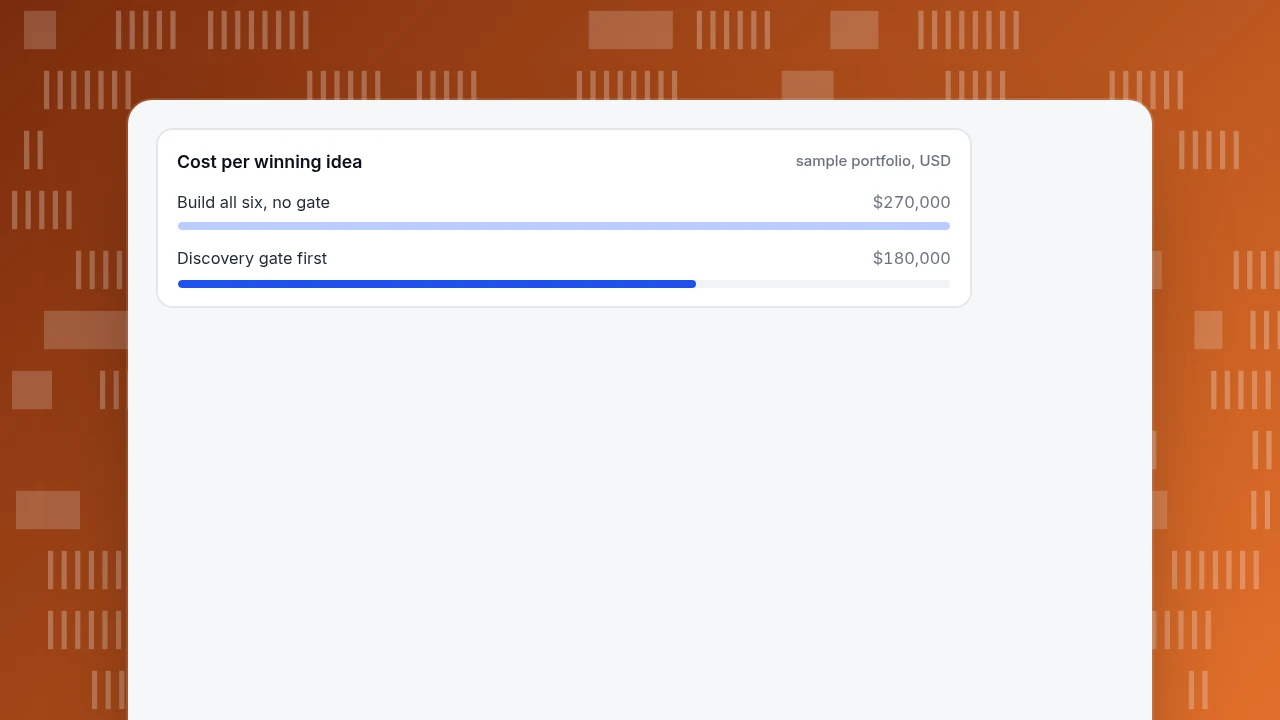
- In the sample, a three-week discovery gate cut cost per winner from $270,000 to $180,000 by stopping builds that would miss
What do PDLC and SDLC each mean?
SDLC is the software development life cycle: the sequence of work that turns a requirement into running software, usually requirements, design, build, test, release and maintenance. NIST's Secure Software Development Framework (SP 800-218, February 2022) treats it as something each organisation implements in its own way; the framework says its practices can be integrated into each SDLC implementation, whichever model that is.
PDLC is harder to pin down, and you should know why before comparing. The abbreviation is used for the product development life cycle (idea to launch to learning), but also for the "program development life cycle" in programming courses and, confusingly, as shorthand for the product life cycle (introduction, growth, maturity, decline). We found no international standard that defines it the way ISO-style standards define software life cycles, so definitions come from vendors and textbooks. In this guide PDLC means the product development life cycle: the stages a company uses to decide what to build, build it, launch it and learn whether it worked. A well-documented version is Robert Cooper's Stage-Gate model, whose term first appeared in print in 1988: Discovery and Ideation, Concept, Build the Business Case, Development, Testing and Validation, and Launch, with a go-or-kill decision at each gate.
The short version: PDLC decides what is worth building and whether it worked; SDLC decides how to build and ship it well. One contains the other, which the next section lays out stage by stage. If you plan the PDLC through a product roadmap, the SDLC is how each roadmap item is delivered.
How do the stages line up, with owners and outputs?
The table pairs each PDLC stage with the SDLC activity inside it, who usually owns the stage, and what it should produce. Owners vary by company; treat them as typical, not fixed.
| PDLC stage | SDLC activity | Typical owner | Main output | Gate question |
|---|---|---|---|---|
| Discover | none yet | Product manager, designer, researcher | Evidence of a customer problem | Is the problem real and frequent enough? |
| Define and build the case | Requirements (draft) | Product manager with engineering lead | Problem statement, outcome metric, rough cost | Is the expected value above the cost? |
| Develop | Design, build, code review | Engineering | Working increments | Does it meet the definition of done? |
| Test and validate | Test, security review, staged release | Engineering, QA, product | Release candidate and early-user evidence | Does it work for real users, and is it safe? |
| Launch | Release and deploy | Product, marketing, engineering | Live feature, announcement, success metric live | Is the metric being recorded? |
| Learn and decide | Maintain and monitor | Product manager | Outcome readout, keep, change or retire decision | Did the outcome move? |
In Cooper's Stage-Gate description, each gate has deliverables from the previous stage, criteria covering readiness and business value, and an outcome that is typically Go, Kill, Hold or Recycle, with a Go confirming the next stage's budget and timeline. The SDLC activities cluster in the Develop and Test stages, touch the stages on either side, and continue after launch as maintenance.
| Dimension | PDLC | SDLC |
|---|---|---|
| Question | What to build and did it work? | How to build and ship reliably? |
| Success measure | Customer and business outcomes | Delivery speed and stability |
| Typical owner | Product manager | Engineering lead |
| Typical failure | Wrong thing built well | Right thing built badly or late |
Owners vary by company; treat them as typical.
How are PDLC and SDLC different?
| Dimension | PDLC | SDLC |
|---|---|---|
| Question it answers | What should we build, for whom, and did it work? | How do we build, test and ship it reliably? |
| Starts with | A customer problem or opportunity | A requirement or accepted work item |
| Ends when | The product is retired or the outcome is judged | The software is retired (maintenance continues after release) |
| Decision makers | Product leaders and gatekeepers | Engineering leads and release owners |
| Success measure | Customer and business outcomes | Delivery speed and stability |
| Typical failure | Building the wrong thing well | Building the right thing badly or late |
The success-measure row has a standard vocabulary on the SDLC side. DORA, the DevOps research programme, defines delivery metrics: change lead time (commit to production), deployment frequency, failed deployment recovery time, change fail rate and deployment rework rate (DORA page updated January 5, 2026). They measure the build and ship part of the cycle. None of them tells you whether anyone uses what was shipped, which is why a high-performing delivery team can still lose on outcomes and why you need PDLC metrics as well.
How does Agile or Scrum fit in?
Agile and Scrum are delivery approaches that sit inside the Develop stage, not a third life cycle. The 2020 Scrum Guide describes sprints as fixed-length events of one month or less, an Increment as a concrete stepping stone toward the Product Goal, and a Definition of Done as the formal description of the state of an Increment that meets the required quality. It also names a Product Owner who is accountable for maximizing the value of the product. In a PDLC view that is the Develop stage run iteratively, and the Product Owner is the person who carries the gate questions into the sprints.
That also answers a common confusion: you do not choose between "PDLC or Agile." A team can run Stage-Gate-style decisions on the portfolio and Scrum inside Develop. What matters is that someone owns the gate decisions and the outcome metric, and someone else owns delivery quality.
What is a PDLC gate worth? A worked example
Sample data (assumptions labelled): a company has six ideas. A build team of six costs $15,000 a week and building any idea takes 6 weeks, so a build costs $90,000. A discovery pair costs $5,000 a week and screens an idea in 3 weeks, so a screen costs $15,000. Assume one in three ideas would work, in line with the "less than a third" Bing reported for experiments, so 2 of the 6 are winners.
| No PDLC gate: build all six | With a discovery gate | |
|---|---|---|
| Discovery cost | $0 | 6 × $15,000 = $90,000 |
| Ideas built | 6 | 3 (2 winners + 1 loser that slipped through) |
| Build cost | 6 × $90,000 = $540,000 | 3 × $90,000 = $270,000 |
| Total | $540,000 | $360,000 |
| Cost per winner (2 winners) | $270,000 | $180,000 |
The gate here screens out three of four losing ideas and keeps both winners (assumptions). It cuts total cost by $180,000, or one third. The break-even is low: the discovery spend of $90,000 is paid back as soon as the gate stops one build of $90,000. The point of the PDLC is not paperwork; it is that a cheap decision (3 weeks, 2 people) comes before the expensive one (6 weeks, 6 people). Change the assumptions to your numbers: if your screens catch fewer losers or your builds are cheaper, the gate is worth less, and the formula is simply losers stopped × build cost − screening cost.
Cost per winning idea
sample portfolio, USDHow do you keep the two from being confused in a team?
Four habits make the distinction practical:
- Name the owner of each gate. If nobody can say who decides that a project continues past discovery, the PDLC is not running, whatever the slide says.
- Write the outcome metric before the first sprint. The sprint backlog is SDLC; the metric is PDLC.
- Report two dashboards. One for delivery (DORA-style lead time and failure rate), one for outcomes (adoption, retention of the new behaviour). Do not let the first stand in for the second.
- Close the loop after launch. Add a dated "learn and decide" review (for example 30 days) to the plan. Without it the cycle stops at release and the SDLC's maintenance phase quietly becomes the whole product strategy.
For the validation stage in particular, see how to run an MVP test, which is the cheapest way to answer the Test and validate gate question.
How to close the PDLC loop in TapCub
Here is how a team would cover the stages after launch. TapCub measures what users do; it does not manage sprints, gates or feature flags, so the gates themselves stay in your planning tool.
- Record the success behaviour as an event. Have the product call
tapcub.track('feature_used', { feature: 'export' })when someone completes the behaviour the feature exists for. It appears in Web analytics › Events. Use one name for the same action across web and app. - Mark the release. Add the launch date in Configuration › Annotations so every chart shows before and after.
- Read adoption and retention. In All-platform analytics › Behavior › Behavior analysis, use the funnel to see how many reach the feature and retention to see whether people come back to it after the first use. Identify logged-in users with
tapcub.login. - Watch for regressions. Create a monitor in All-platform analytics › Operations › Monitors on error rate or sessions to be notified after the release; it only notifies, it does not roll anything back.
- Hold the review. At 30 days, compare the outcome with the number you wrote down at the gate and decide keep, change or retire.
FAQ
What is the difference between PDLC and SDLC?
PDLC is the product development life cycle, covering discovery, business case, build, validation, launch and learning. SDLC is the software development life cycle, covering how software is designed, built, tested and released. The SDLC sits inside the PDLC's build stages and continues as maintenance after launch.
Is SDLC part of PDLC?
Yes, in the usual view. The SDLC activities (requirements, design, build, test, release) happen mostly in the Develop and Test stages of the PDLC, and maintenance continues after launch. The PDLC adds the work before and after: discovering the problem, deciding whether to build, and judging the outcome.
What does PDLC stand for?
Most often product development life cycle. It can also mean program development life cycle (a programming-course term) or be used loosely for the product life cycle of introduction, growth, maturity and decline. There is no formal standard, so state which meaning you use when writing it down.
Which comes first, PDLC or SDLC?
PDLC stages come first and last: discovery and the business case before any code, and the outcome review after launch. The SDLC runs in the middle, once the company has decided to build. In an iterative team the two overlap, because discovery continues during sprints.
Do you need a PDLC if you use Agile?
Agile is a delivery approach and does not tell you what to build or whether it worked. You still need a way to decide what enters the backlog and to judge outcomes. Many teams run a lightweight PDLC around Scrum, with a named owner for the outcome metric.
Sources
- Stage-Gate International. The Stage-Gate Model: An Overview — Cooper's stages and gate structure, term first in print in 1988. Checked 2026-11-20.
- NIST. SP 800-218, Secure Software Development Framework (SSDF) Version 1.1. February 2022 — practices integrated into each SDLC implementation.
- Scrum.org and Scrum Guides. The Scrum Guide. November 2020 — sprints, Increment, Definition of Done, Product Owner.
- DORA. DORA's software delivery metrics. Updated January 5, 2026 — the five delivery metrics.
- Harry Shum, Bing Search Quality Insights. Large Scale Experimentation at Bing. August 8, 2013 — less than a third of ideas move their target metrics.
Was this article helpful?
We use your answers to fix and expand this page.
Couldn’t send. Please try again in a minute.
Thanks for the feedback. We’ll use it to improve this page.You’ve already sent feedback on this page. Thanks.

Product Experience Specialist
Writes about product experience, practical workflows, and growth, turning complex processes into clear steps for everyday decisions.